


 |
市場調查報告書
商品編碼
1936676
車內空氣濾淨器市場機會、成長要素、產業趨勢分析及2026年至2035年預測Automotive Filters Market Opportunity, Growth Drivers, Industry Trend Analysis, and Forecast 2026 - 2035 |
||||||

全球車內空氣濾淨器市場預計到 2025 年將達到 188 億美元,到 2035 年將達到 253 億美元,年複合成長率為 3%。
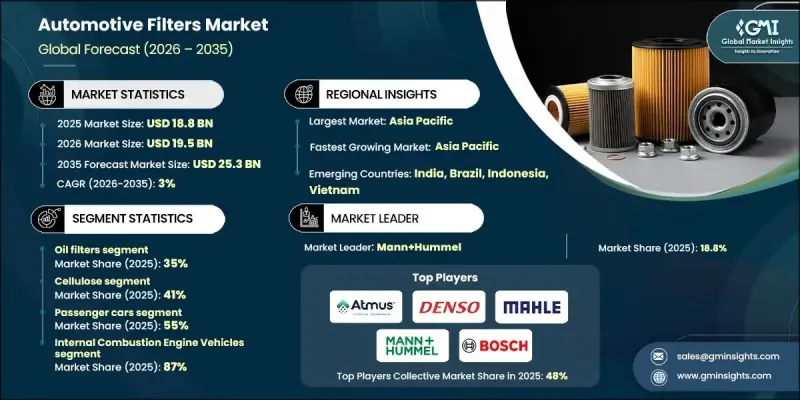
車內空氣濾淨器在維持乘用車和商用車性能方面發揮重要作用,能夠有效控制空氣、燃油和機油中的污染物,從而推動市場成長。全球汽車產量不斷成長,加上車輛平均車齡延長,正穩步推動原廠配套 (OEM) 和售後市場管道的更換需求。日益嚴格的全球排放氣體法規進一步加速了先進過濾解決方案的應用,以減少顆粒物和氮基污染物的排放。售後市場仍然是最大的收入佔有率,這主要得益於常規的更換需求和不斷擴大的獨立服務網路。行駛里程和車輛利用率的提高,推動了成熟市場和發展中市場更換量的成長。合成過濾材料的不斷改進提高了污染物捕獲能力和使用壽命,從而滿足了各類車輛的需求。
| 市場覆蓋範圍 | |
|---|---|
| 開始年份 | 2025 |
| 預測年份 | 2026-2035 |
| 起始值 | 188億美元 |
| 預測金額 | 253億美元 |
| 複合年成長率 | 3% |
預計到2025年,機油濾清器市佔率將達到35%,並在2035年之前以1.8%的複合年成長率成長。乘用車和商用車車隊持續依賴定期引擎維護,這支撐了穩定的市場需求。機油濾清器對於保護引擎零件、提高潤滑效率和延長引擎壽命至關重要,因此需要較高的更換頻率。售後市場成長尤其顯著,車輛老化和使用年限延長促使都市區和長途駕駛環境中的車主增加定期保養和重複購買機油濾清器的需求。
預計到2025年,纖維素濾芯將佔據41%的市場佔有率,並在2026年至2035年間以1.3%的複合年成長率成長。纖維素濾芯與傳統內燃機具有高度相容性,且性能經濟高效,因此成為理想之選。頻繁的更換需求,加上其在多種車型中的廣泛應用,使得纖維素濾芯的出貨量保持在高位,預計到2024年全球出貨量將超過5億個。
預計到2025年,美國車內空氣濾淨器市場將佔據88%的市場佔有率,並創造41億美元的收入。龐大且多樣化的車輛保有量、統一的維護保養制度以及乘用車和商用車領域的高保養頻率,支撐了市場的強勁成長。定期維護帶來的穩定需求,持續增強了市場的長期韌性和收入前景。
目錄
第1章調查方法
第2章執行摘要
第3章業界考察
- 生態系分析
- 供應商情況
- 利潤率分析
- 成本結構
- 每個階段的附加價值
- 影響價值鏈的因素
- 中斷
- 產業影響因素
- 促進要素
- 全球汽車擁有量不斷成長
- 嚴格的排放法規
- 售後服務成長
- 都市區空氣污染日益嚴重
- 產業潛在風險與挑戰
- 新興市場的價格敏感性
- 仿冒品品
- 市場機遇
- 電動車和混合動力汽車的成長
- 合成過濾介質的進展
- 亞洲汽車生產規模擴大
- 成長潛力分析
- 監管環境
- 北美洲
- 美國環保署(EPA)排放氣體與過濾標準
- 美國交通部車輛維修指南
- 加州 CARB 過濾器相容性
- 加拿大運輸部過濾要求
- 歐洲
- 歐盟車輛排放氣體法規
- 歐洲新車安全評鑑協會(Euro NCAP)過濾指南
- 國家合規檢查
- EN 過濾標準
- 亞太地區
- 中國車內空氣濾淨器法規
- 印度Arai過濾器監管合規性
- 日本車內空氣濾淨器指南
- 韓國過濾標準
- 東協地區的過濾指南
- 拉丁美洲
- 巴西車內空氣濾淨器標準
- 遵守阿根廷的過濾器法規
- 墨西哥濾水器法規
- 符合地區排放法規
- 中東和非洲
- 阿拉伯聯合大公國車內空氣濾淨器標準
- 沙烏地阿拉伯的過濾要求
- 南非的過濾器法規
- 區域汽車標準
- 北美洲
- 波特五力分析
- PESTEL 分析
- 科技與創新趨勢
- 當前技術趨勢
- 新興技術
- 價格趨勢
- 按地區
- 依產品
- 生產統計
- 生產基地
- 消費基礎
- 出口和進口
- 成本細分分析
- 過濾器製造和材料成本
- 安裝和整合成本
- 營運和維護成本
- 測試和認證費用
- 監理合規成本
- 培訓和服務成本
- 專利分析
- 永續性和環境方面
- 永續實踐
- 減少廢棄物策略
- 生產中的能源效率
- 環保舉措
- 碳足跡考量
- OEM 與售後市場趨勢
- 更換週期和服務間隔分析
- 電氣化對過濾器需求的影響
- 過濾器性能和效率基準
第4章 競爭情勢
- 介紹
- 公司市佔率分析
- 北美洲
- 歐洲
- 亞太地區
- 拉丁美洲
- 中東和非洲
- 主要市場公司的競爭分析
- 競爭定位矩陣
- 戰略展望矩陣
- 重大進展
- 併購
- 夥伴關係與合作
- 新產品發布
- 企業擴張計畫和資金籌措
第5章 按過濾器分類的市場估算與預測,2022-2035年
- 空氣過濾器
- 機油濾清器
- 燃油濾清器
- 車廂空氣濾清器
- 其他
第6章 按材料分類的市場估算與預測,2022-2035年
- 纖維素
- 合成
- 活性碳
- 靜電
- 其他
第7章 依車輛類型分類的市場估計與預測,2022-2035年
- 搭乘用車
- 掀背車車
- 轎車
- SUV
- 多用途汽車(MPV)
- 商用車輛
- 輕型商用車(LCV)
- 中型商用車(MCV)
- 重型商用車(HCV)
- 摩托車
- 摩托車
- Scooter
第8章 2022-2035年按推進方式分類的市場估算與預測
- 內燃機車輛
- 電動車(EV)
- 混合動力汽車(HEV/PHEV)
第9章 依銷售管道分類的市場估計與預測,2022-2035年
- OEM
- 售後市場
第10章 2022-2035年各地區市場估計與預測
- 北美洲
- 美國
- 加拿大
- 歐洲
- 德國
- 英國
- 法國
- 義大利
- 西班牙
- 俄羅斯
- 北歐國家
- 荷蘭
- 瑞典
- 亞太地區
- 中國
- 印度
- 日本
- 澳洲
- 韓國
- 新加坡
- 泰國
- 印尼
- 越南
- 拉丁美洲
- 巴西
- 墨西哥
- 阿根廷
- 中東和非洲
- 南非
- 沙烏地阿拉伯
- 阿拉伯聯合大公國
- 土耳其
第11章 公司簡介
- 世界公司
- Mann+Hummel
- Mahle
- Robert Bosch
- Denso
- Atmus Filtration Technologies
- Donaldson Company
- Freudenberg
- Parker Hannifin
- Hengst Filtration
- Purflux
- 本地製造商
- Toyota Boshoku
- First Brands
- UFI Filters
- GUD
- Elofic Industries
- ALCO Filters
- Bengbu Jinwei Automotive Parts
- 新興企業和顛覆者
- Valeo
- K&N Engineering
- AL
The Global Automotive Filters Market was valued at USD 18.8 billion in 2025 and is estimated to grow at a CAGR of 3% to reach USD 25.3 billion by 2035.
Market growth is driven by the essential role automotive filters play in maintaining vehicle performance by controlling contaminants in air, fuel, and oil across passenger and commercial vehicles. Rising global vehicle production, combined with the growing average age of vehicles on the road, is steadily increasing replacement demand through both OEM and aftermarket channels. Tightening emission norms worldwide are further accelerating the adoption of advanced filtration solutions designed to reduce particulate matter and nitrogen-based pollutants. The aftermarket continues to account for the largest revenue share due to recurring replacement requirements and the expanding presence of independent service networks. Longer driving distances and higher vehicle utilization levels are reinforcing replacement volumes across mature and developing regions. Continuous improvements in synthetic filtration media are enabling higher contaminant retention and extended service life, supporting demand across multiple vehicle categories.
| Market Scope | |
|---|---|
| Start Year | 2025 |
| Forecast Year | 2026-2035 |
| Start Value | $18.8 Billion |
| Forecast Value | $25.3 Billion |
| CAGR | 3% |
The oil filters segment held a 35% share in 2025 and is projected to grow at a CAGR of 1.8% through 2035. Ongoing reliance on routine engine maintenance across both passenger and commercial vehicle fleets continues to underpin steady demand. Oil filters remain essential for protecting engine components, improving lubrication efficiency, and extending engine life, which supports their high replacement frequency. Growth is particularly pronounced in the aftermarket, where aging vehicle populations and extended ownership cycles are driving regular service intervals and repeat purchases across urban and long-distance driving environments.
The cellulose segment accounted for a 41% market share in 2025 and is anticipated to grow at a CAGR of 1.3% from 2026 to 2035. Strong compatibility with traditional internal combustion engines and cost-effective performance characteristics continue to make cellulose filters a preferred choice. Frequent replacement needs, combined with widespread usage across multiple vehicle categories, are sustaining high shipment volumes, with global deliveries surpassing 500 million units in 2024.
U.S. Automotive Filters Market held an 88% share and generated USD 4.1 billion in 2025. Market strength is supported by a vast and diverse vehicle population, consistent maintenance practices, and high service frequency across passenger and commercial segments. Stable demand from routine servicing continues to reinforce long-term market resilience and revenue visibility.
Key players in the Global Automotive Filters Market include Robert Bosch, Donaldson Company, Mann+Hummel, Mahle, Denso, Freudenberg, Parker Hannifin, Purflux, Hengst Filtration, and Atmus Filtration Technologies. Key strategies adopted by companies in the automotive filters market focus on expanding aftermarket penetration, enhancing product durability, and investing in advanced filtration media. Leading players prioritize the development of high-efficiency filters that meet evolving emission regulations while extending service intervals. Strategic partnerships with OEMs and service networks help strengthen distribution reach and brand visibility. Companies are also investing in lightweight, eco-friendly materials and digital tools for predictive maintenance to align with sustainability trends. Capacity expansion in high-growth regions and localized manufacturing are being used to reduce costs and improve supply chain resilience. Continuous R&D efforts aimed at improving filtration performance and compatibility across vehicle platforms remain central to maintaining competitive positioning.
Table of Contents
Chapter 1 Methodology
- 1.1 Research approach
- 1.2 Quality Commitments
- 1.2.1 GMI AI policy & data integrity commitment
- 1.2.1.1 Source consistency protocol
- 1.2.1 GMI AI policy & data integrity commitment
- 1.3 Research Trail & Confidence Scoring
- 1.3.1 Research Trail Components
- 1.3.2 Scoring Components
- 1.4 Data Collection
- 1.4.1 Partial list of primary sources
- 1.5 Data mining sources
- 1.5.1 Paid sources
- 1.5.1.1 Sources, by region
- 1.5.1 Paid sources
- 1.6 Base estimates and calculations
- 1.6.1 Base year calculation for any one approach
- 1.7 Forecast model
- 1.7.1 Quantified market impact analysis
- 1.7.1.1 Mathematical impact of growth parameters on forecast
- 1.7.1 Quantified market impact analysis
- 1.8 Research transparency addendum
- 1.8.1 Source attribution framework
- 1.8.2 Quality assurance metrics
- 1.8.3 Our commitment to trust
Chapter 2 Executive Summary
- 2.1 Industry 3600 synopsis, 2022 - 2035
- 2.2 Key market trends
- 2.2.1 Regional
- 2.2.2 Filter
- 2.2.3 Material
- 2.2.4 Vehicle
- 2.2.5 Propulsion
- 2.2.6 Sales Channel
- 2.3 TAM Analysis, 2026-2035
- 2.4 CXO perspectives: Strategic imperatives
- 2.4.1 Executive decision points
- 2.4.2 Critical success factors
- 2.5 Future outlook and strategic recommendations
Chapter 3 Industry Insights
- 3.1 Industry ecosystem analysis
- 3.1.1 Supplier landscape
- 3.1.2 Profit margin analysis
- 3.1.3 Cost structure
- 3.1.4 Value addition at each stage
- 3.1.5 Factor affecting the value chain
- 3.1.6 Disruptions
- 3.2 Industry impact forces
- 3.2.1.1 Growth drivers
- 3.2.1.2 Rising global vehicle parc
- 3.2.1.3 Stringent emission regulations
- 3.2.1.4 Growth of aftermarket services
- 3.2.1.5 Increase in urban air pollution
- 3.2.2 Industry pitfalls and challenges
- 3.2.2.1 Price sensitivity in emerging markets
- 3.2.2.2 Counterfeit and low-quality products
- 3.2.3 Market opportunities
- 3.2.3.1 Growth in electric and hybrid vehicles
- 3.2.3.2 Advancements in synthetic filter media
- 3.2.3.3 Expansion of vehicle production in Asia
- 3.3 Growth potential analysis
- 3.4 Regulatory landscape
- 3.4.1 North America
- 3.4.1.1 United States EPA Emission and Filter Standards
- 3.4.1.2 DOT Vehicle Maintenance Guidelines
- 3.4.1.3 California CARB Filter Compliance
- 3.4.1.4 Canada Transport Canada Filtration Requirements
- 3.4.2 Europe
- 3.4.2.1 EU Vehicle Emission Standards
- 3.4.2.2 Euro NCAP Filtration Guidelines
- 3.4.2.3 National Compliance Inspections
- 3.4.2.4 EN Standards for Filters
- 3.4.3 Asia Pacific
- 3.4.3.1 China vehicle filtration regulations
- 3.4.3.2 India arai filter compliance
- 3.4.3.3 Japan vehicle filtration guidelines
- 3.4.3.4 South korea filter standards
- 3.4.3.5 Asean regional filtration guidelines
- 3.4.4 Latin America
- 3.4.4.1 Brazil Vehicle Filter Standards
- 3.4.4.2 Argentina Filter Compliance
- 3.4.4.3 Mexico Filter Regulations
- 3.4.4.4 Regional Emission Compliance
- 3.4.5 Middle East & Africa
- 3.4.5.1 UAE Vehicle Filter Standards
- 3.4.5.2 Saudi Arabia Filtration Requirements
- 3.4.5.3 South Africa Filter Regulations
- 3.4.5.4 Regional Automotive Standards
- 3.4.1 North America
- 3.5 Porter's analysis
- 3.6 PESTEL analysis
- 3.7 Technology and innovation landscape
- 3.7.1 Current technological trends
- 3.7.2 Emerging technologies
- 3.8 Price trends
- 3.8.1 By region
- 3.8.2 By product
- 3.9 Production statistics
- 3.9.1 Production hubs
- 3.9.2 Consumption hubs
- 3.9.3 Export and import
- 3.10 Cost breakdown analysis
- 3.10.1 Filter manufacturing and material costs
- 3.10.2 Installation and integration costs
- 3.10.3 Operational and maintenance costs
- 3.10.4 Testing and certification costs
- 3.10.5 Regulatory compliance costs
- 3.10.6 Training and service costs
- 3.11 Patent analysis
- 3.12 Sustainability and environmental aspects
- 3.12.1 Sustainable practices
- 3.12.2 Waste reduction strategies
- 3.12.3 Energy efficiency in production
- 3.12.4 Eco-friendly Initiatives
- 3.12.5 Carbon footprint considerations
- 3.13 OEM vs Aftermarket Dynamics
- 3.14 Replacement Cycle & Service Interval Analysis
- 3.15 Impact of Electrification on Filter Demand
- 3.16 Filter Performance & Efficiency Benchmarks
Chapter 4 Competitive Landscape, 2025
- 4.1 Introduction
- 4.2 Company market share analysis
- 4.2.1 North America
- 4.2.2 Europe
- 4.2.3 Asia Pacific
- 4.2.4 LATAM
- 4.2.5 MEA
- 4.3 Competitive analysis of major market players
- 4.4 Competitive positioning matrix
- 4.5 Strategic outlook matrix
- 4.6 Key developments
- 4.6.1 Mergers & acquisitions
- 4.6.2 Partnerships & collaborations
- 4.6.3 New Product Launches
- 4.6.4 Expansion Plans and funding
Chapter 5 Market Estimates & Forecast, By Filter, 2022 - 2035 (USD Mn, Units)
- 5.1 Key trends
- 5.2 Air Filters
- 5.3 Oil Filters
- 5.4 Fuel Filters
- 5.5 Cabin Air Filters
- 5.6 Others
Chapter 6 Market Estimates & Forecast, By Material, 2022 - 2035 (USD Mn, Units)
- 6.1 Key trends
- 6.2 Cellulose
- 6.3 Synthetic
- 6.4 Activated Carbon
- 6.5 Electrostatic
- 6.6 Others
Chapter 7 Market Estimates & Forecast, By Vehicle, 2022 - 2035 (USD Mn, Units)
- 7.1 Key trends
- 7.2 Passenger cars
- 7.2.1 Hatchbacks
- 7.2.2 Sedans
- 7.2.3 SUVs
- 7.2.4 MPVs
- 7.3 Commercial vehicles
- 7.3.1 Light commercial vehicles (LCVs)
- 7.3.2 Medium commercial vehicles (MCVs)
- 7.3.3 Heavy commercial vehicles (HCVs)
- 7.4 Two-Wheelers
- 7.4.1 Motorcycle
- 7.4.2 Scooter
Chapter 8 Market Estimates & Forecast, By Propulsion, 2022 - 2035 (USD Mn, Units)
- 8.1 Key trends
- 8.2 Internal Combustion Engine (ICE) Vehicles
- 8.3 Electric Vehicles (EVs)
- 8.4 Hybrid Vehicles (HEVs / PHEVs)
Chapter 9 Market Estimates & Forecast, By Sales Channel, 2022 - 2035 (USD Mn, Units)
- 9.1 Key trends
- 9.2 OEM
- 9.3 Aftermarket
Chapter 10 Market Estimates & Forecast, By Region, 2022 - 2035 (USD Mn, Units)
- 10.1 Key trends
- 10.2 North America
- 10.2.1 US
- 10.2.2 Canada
- 10.3 Europe
- 10.3.1 Germany
- 10.3.2 UK
- 10.3.3 France
- 10.3.4 Italy
- 10.3.5 Spain
- 10.3.6 Russia
- 10.3.7 Nordics
- 10.3.8 Netherlands
- 10.3.9 Sweden
- 10.4 Asia Pacific
- 10.4.1 China
- 10.4.2 India
- 10.4.3 Japan
- 10.4.4 Australia
- 10.4.5 South Korea
- 10.4.6 Singapore
- 10.4.7 Thailand
- 10.4.8 Indonesia
- 10.4.9 Vietnam
- 10.5 Latin America
- 10.5.1 Brazil
- 10.5.2 Mexico
- 10.5.3 Argentina
- 10.6 MEA
- 10.6.1 South Africa
- 10.6.2 Saudi Arabia
- 10.6.3 UAE
- 10.6.4 Turkey
Chapter 11 Company Profiles
- 11.1 Global Players
- 11.1.1 Mann+Hummel
- 11.1.2 Mahle
- 11.1.3 Robert Bosch
- 11.1.4 Denso
- 11.1.5 Atmus Filtration Technologies
- 11.1.6 Donaldson Company
- 11.1.7 Freudenberg
- 11.1.8 Parker Hannifin
- 11.1.9 Hengst Filtration
- 11.1.10 Purflux
- 11.2 Regional Players
- 11.2.1 Toyota Boshoku
- 11.2.2 First Brands
- 11.2.3 UFI Filters
- 11.2.4 GUD
- 11.2.5 Elofic Industries
- 11.2.6 ALCO Filters
- 11.2.7 Bengbu Jinwei Automotive Parts
- 11.3 Emerging Players & Disruptors
- 11.3.1 Valeo
- 11.3.2 K&N Engineering
- 11.3.3 A.L.

 2026年全球車內空氣濾淨器市場報告2026年全球重型負載過濾售後市場市場報告
 商用油霧過濾器市場:依過濾器類型、氣流速率、過濾材質、壓力等級和最終用戶產業分類,全球預測,2026-2032年
 車內空氣濾淨器市場規模、佔有率、成長率及全球產業分析:按類型、應用和地區分類,並提供2026-2034年的洞察和預測全球車內空氣濾淨器材料市場規模、佔有率、趨勢和成長分析報告:2026-2034年
 OTR車內空氣濾淨器市場 - 全球產業規模、佔有率、趨勢、機會及預測(按濾清器類型、濾材類型、需求類別、地區和競爭格局分類,2021-2031)乘用車汽車濾清器市場 - 全球產業規模、佔有率、趨勢、機會及預測(按濾清器類型、濾材類型、需求類別、地區和競爭格局分類,2021-2031)商用車汽車濾清器市場 - 全球產業規模、佔有率、趨勢、機會及預測(按濾清器類型、濾材類型、需求類別、地區和競爭格局分類,2021-2031)摩托車汽車濾清器市場 - 全球產業規模、佔有率、趨勢、機會及預測(按濾清器類型、濾材類型、需求類別、地區和競爭格局分類,2021-2031)車內空氣濾淨器市場 - 全球產業規模、佔有率、趨勢、機會及預測(按車輛類型、濾清器類型、濾材類型、需求類別、地區和競爭格局分類,2021-2031年)