


 |
市場調查報告書
商品編碼
1936675
復健設備市場機會、成長要素、產業趨勢分析及2026年至2035年預測Rehabilitation Equipment Market Opportunity, Growth Drivers, Industry Trend Analysis, and Forecast 2026 - 2035 |
||||||

全球康復設備市場預計到 2025 年將達到 230 億美元,到 2035 年將達到 472 億美元,年複合成長率為 7.5%。
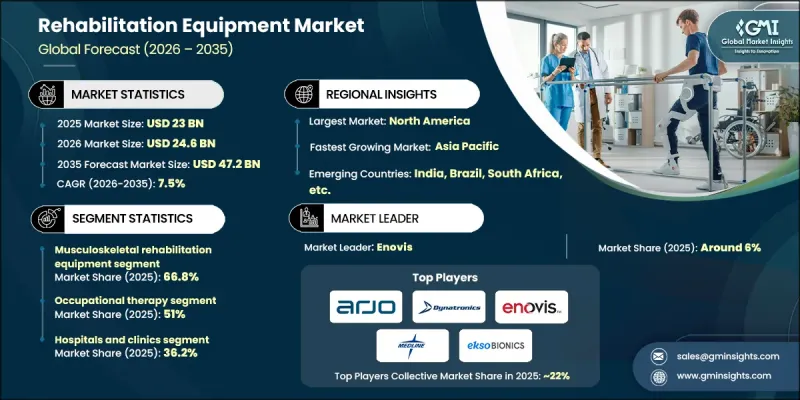
市場成長的促進因素包括:身體殘疾人數的增加、復健治療覆蓋範圍的擴大、技術的快速創新、人口老化以及慢性疾病負擔的加重。全球範圍內需要長期行動輔助和物理復健解決方案的患者群體不斷擴大,並持續刺激對復健設備的需求。隨著功能障礙在人群中日益普遍,對輔助肌肉恢復、疼痛管理和獨立行動的工具的需求也不斷成長。此外,人們對早期復健介入和結構化復健計畫重要性的認知不斷提高,也推動了市場的發展。同時,創傷相關疾病發生率的上升也促使人們對持續復健支持的需求增加,從而在醫療機構中持續推高了對先進復健產品的需求。復健產業正經歷重大變革時期,先進技術的融合提高了治療的精準性、適應性和可及性。數位化系統的應用正在推動個人化護理的普及,並擴大了中心和門診復健服務的覆蓋範圍。
| 市場覆蓋範圍 | |
|---|---|
| 開始年份 | 2025 |
| 預測年份 | 2026-2035 |
| 起始值 | 230億美元 |
| 預測金額 | 472億美元 |
| 複合年成長率 | 7.5% |
預計到2025年,肌肉骨骼復健設備市佔率將達到66.8%。該領域的成長主要得益於對行動不便和術後復健解決方案日益成長的需求。行動障礙發生率的上升持續推動著用於恢復身體機能、增強肌肉力量以及輔助醫療干預後復健的專用設備的使用。
預計到2025年,職業治療領域將佔據51%的市場佔有率,這反映了其在恢復功能獨立性方面發揮的核心作用。職能治療中使用的設備有助於恢復日常生活活動能力,並幫助患者適應功能障礙。由於功能恢復仍然是醫療保健領域的關鍵挑戰,因此對客製化復健解決方案日益成長的需求正在推動該領域的成長。
預計到2025年,北美復健設備市佔率將達到36.8%。完善的醫療基礎設施、早期復健實踐的日益普及以及對先進治療方案的強勁需求正在推動市場擴張。持續的技術進步也促進了復健設備在院內和門診環境中的廣泛應用。
目錄
第1章調查方法和範圍
第2章執行摘要
第3章業界考察
- 生態系分析
- 產業影響因素
- 促進要素
- 肌肉骨骼疾病呈上升趨勢
- 技術進步
- 人口老化和慢性病盛行率上升
- 對復健治療的需求不斷成長
- 產業潛在風險與挑戰
- 復健治療高成本
- 缺乏對復健服務的認知與獲取途徑
- 機會
- 機器人輔助復健設備的快速發展
- 透過穿戴式感測器整合實現個人化復健追蹤
- 促進要素
- 成長潛力分析
- 監管環境
- 北美洲
- 歐洲
- 亞太地區
- LAMEA
- 科技與創新趨勢
- 當前技術趨勢
- 新興技術
- 價值鏈分析
- 救贖方案
- 投資趨勢和資金籌措環境
- 對消費行為的洞察
- 政策環境
- 波特五力分析
- PESTEL 分析
- 差距分析
- 未來市場趨勢
第4章 競爭情勢
- 介紹
- 企業矩陣分析
- 公司市佔率分析
- 世界
- 北美洲
- 歐洲
- 亞太地區
- LAMEA
- 主要市場公司的競爭分析
- 競爭定位矩陣
- 重大進展
- 併購
- 夥伴關係與合作
- 新產品發布
- 擴張計劃
第5章 2022-2035年按產品分類的市場估算與預測
- 肌肉骨骼復健設備
- 雷射療法
- 超音波
- 電療
- 其他肌肉骨骼裝置
- 神經復健設備
- 神經機器人學
- 上肢矯正器具
- 下肢矯正器具
- 前臂矯正器具(手部)
- 健走訓練器
- 外骨骼
- 非侵入性刺激器
- 穿戴式裝置
- 腦機介面
- 神經復健評估設備
- 面向大眾的神經復健設備
- 神經機器人學
- 心肺復健設備
- 橢圓機
- 平衡球
- 固定自行車
- 跑步機
- 划船機
- 心率監測器
- 血壓監測儀
- 其他心肺裝置
第6章 按應用領域分類的市場估算與預測,2022-2035年
- 職業療法
- 物理治療
- 其他用途
7. 依最終用途分類的市場估計與預測,2022-2035 年
- 醫院和診所
- 復健中心
- 居家醫療環境
- 物理治療中心
第8章 2022-2035年各地區市場估算與預測
- 北美洲
- 美國
- 加拿大
- 歐洲
- 德國
- 英國
- 法國
- 西班牙
- 義大利
- 亞太地區
- 中國
- 日本
- 印度
- 澳洲
- 韓國
- 拉丁美洲
- 巴西
- 墨西哥
- 阿根廷
- 中東和非洲
- 南非
- 沙烏地阿拉伯
- 阿拉伯聯合大公國
第9章:公司簡介
- Arjo
- Bioness
- BioXtreme
- BTL
- Caremax Rehabilitation Equipment
- Dynatronics
- Enovis
- Ekso Bionics
- Medline
- MicroPort
- OMRON Healthcare
- ReWalk Robotics
- Richmar
- STORZ MEDICAL
- Tyromotion
- Zimmer MedizinSysteme
The Global Rehabilitation Equipment Market was valued at USD 23 billion in 2025 and is estimated to grow at a CAGR of 7.5% to reach USD 47.2 billion by 2035.
Market growth is driven by the rising prevalence of physical impairments, increasing utilization of rehabilitation therapies, rapid technological innovation, and the expanding aging population, alongside a growing burden of chronic conditions. A substantial global patient base requiring long-term mobility support and physical recovery solutions continues to stimulate demand for rehabilitation equipment. As functional limitations become more common across populations, the need for tools that support strength restoration, pain management, and independent mobility continues to rise. The market also benefits from increasing awareness of early rehabilitation interventions and the importance of structured recovery programs. In parallel, a higher incidence of injury-related conditions has intensified the need for continuous rehabilitation support, creating sustained demand for advanced rehabilitation products across healthcare settings. The rehabilitation industry is undergoing a significant transformation fueled by the integration of advanced technologies that enhance therapy accuracy, adaptability, and accessibility. The adoption of digitally enabled systems has improved treatment personalization and expanded access to rehabilitation services across institutional and outpatient environments.
| Market Scope | |
|---|---|
| Start Year | 2025 |
| Forecast Year | 2026-2035 |
| Start Value | $23 Billion |
| Forecast Value | $47.2 Billion |
| CAGR | 7.5% |
The musculoskeletal rehabilitation equipment segment accounted for 66.8% share in 2025. Segment growth is supported by increasing demand for recovery solutions addressing movement limitations and post-treatment rehabilitation needs. Rising occurrences of mobility-related conditions continue to drive utilization of specialized equipment designed to restore physical function, improve strength, and support recovery processes following medical interventions.
The occupational therapy segment held a 51% share in 2025, reflecting its central role in restoring functional independence. Equipment used in occupational therapy supports individuals in regaining daily activity capabilities and adapting to functional limitations. Growing demand for customized rehabilitation solutions continues to strengthen this segment as functional recovery remains a key healthcare priority.
North America Rehabilitation Equipment Market accounted for 36.8% share in 2025. Market expansion is supported by a well-established healthcare infrastructure, increasing adoption of early rehabilitation practices, and strong demand for advanced therapeutic solutions. Continuous technological progress supports broader deployment across both hospital-based and outpatient care settings.
Key companies operating in the Global Rehabilitation Equipment Market include Medline, Arjo, Zimmer MedizinSysteme, Enovis, OMRON Healthcare, Ekso Bionics, ReWalk Robotics, Dynatronics, STORZ MEDICAL, BTL, Tyromotion, Bioness, Richmar, BioXtreme, Caremax Rehabilitation Equipment, and MicroPort. These companies maintain competitive positions through diversified product portfolios and global distribution capabilities. To strengthen their foothold, rehabilitation equipment manufacturers prioritize continuous product innovation and integration of advanced technologies that enhance therapy outcomes and usability. Companies invest heavily in research and development to improve device efficiency, adaptability, and patient engagement. Strategic partnerships with healthcare providers and rehabilitation centers help expand clinical adoption and long-term demand. Geographic expansion into emerging healthcare markets supports revenue diversification, while training programs and clinician education initiatives drive product utilization.
Table of Contents
Chapter 1 Methodology and Scope
- 1.1 Market scope and definition
- 1.2 Research design
- 1.2.1 Research approach
- 1.2.2 Data collection methods
- 1.3 Data mining sources
- 1.3.1 Global
- 1.3.2 Regional/Country
- 1.4 Base estimates and calculations
- 1.4.1 Base year calculation
- 1.4.2 Key trends for market estimation
- 1.5 Primary research and validation
- 1.5.1 Primary sources
- 1.6 Forecast model
- 1.7 Research assumptions and limitations
Chapter 2 Executive Summary
- 2.1 Industry 3600 synopsis
- 2.2 Key market trends
- 2.2.1 Regional trends
- 2.2.2 Product trends
- 2.2.3 Application trends
- 2.2.4 End use trends
- 2.3 CXO perspectives: Strategic imperatives
- 2.3.1 Key decision points for industry executives
- 2.3.2 Critical success factors for market players
- 2.4 Future outlook and strategic recommendations
Chapter 3 Industry Insights
- 3.1 Industry ecosystem analysis
- 3.2 Industry impact forces
- 3.2.1 Growth drivers
- 3.2.1.1 Growing incidences of musculoskeletal disorders
- 3.2.1.2 Technological advancements
- 3.2.1.3 Increasing geriatric population along with rising prevalence of chronic diseases
- 3.2.1.4 Rising demand for rehabilitation therapies
- 3.2.2 Industry pitfalls and challenges
- 3.2.2.1 High cost of rehab therapies
- 3.2.2.2 Lack of awareness and access to rehabilitation services
- 3.2.3 Opportunities
- 3.2.3.1 Rapid expansion of robotic-assisted rehabilitation devices
- 3.2.3.2 Integration of wearable sensors for personalized rehab tracking
- 3.2.1 Growth drivers
- 3.3 Growth potential analysis
- 3.4 Regulatory landscape
- 3.4.1 North America
- 3.4.2 Europe
- 3.4.3 Asia Pacific
- 3.4.4 LAMEA
- 3.5 Technology and innovation landscape
- 3.5.1 Current technological trends
- 3.5.2 Emerging technologies
- 3.6 Value chain analysis
- 3.7 Reimbursement scenario
- 3.8 Investment trends and funding landscape
- 3.9 Consumer behavioral insights
- 3.10 Policy landscape
- 3.11 Porter's analysis
- 3.12 PESTEL analysis
- 3.13 Gap analysis
- 3.14 Future market trends
Chapter 4 Competitive Landscape, 2025
- 4.1 Introduction
- 4.2 Company matrix analysis
- 4.3 Company market share analysis
- 4.3.1 Global
- 4.3.2 North America
- 4.3.3 Europe
- 4.3.4 Asia Pacific
- 4.3.5 LAMEA
- 4.4 Competitive analysis of major market players
- 4.5 Competitive positioning matrix
- 4.6 Key developments
- 4.6.1 Mergers & acquisitions
- 4.6.2 Partnerships & collaborations
- 4.6.3 New product launches
- 4.6.4 Expansion plans
Chapter 5 Market Estimates and Forecast, By Product, 2022 - 2035 ($ Mn)
- 5.1 Key trends
- 5.2 Musculoskeletal rehabilitation equipment
- 5.2.1 Laser therapy
- 5.2.2 Ultrasound
- 5.2.3 Electrotherapy
- 5.2.4 Other musculoskeletal equipment
- 5.3 Neurological rehabilitation equipment
- 5.3.1 Neurorobotic devices
- 5.3.1.1 Upper limb devices
- 5.3.1.2 Lower limb devices
- 5.3.1.3 Lower arm devices (Hands)
- 5.3.1.4 Gait training devices
- 5.3.1.5 Exoskeleton devices
- 5.3.2 Non-invasive stimulators
- 5.3.3 Wearable devices
- 5.3.4 Brain computer interface
- 5.3.5 Neuro-rehabilitation assessment equipment
- 5.3.6 Consumer neuro-rehabilitation equipment
- 5.3.1 Neurorobotic devices
- 5.4 Cardiopulmonary rehabilitation equipment
- 5.4.1 Elliptical trainer
- 5.4.2 Stabilization ball
- 5.4.3 Stationary bicycle
- 5.4.4 Treadmill
- 5.4.5 Rower
- 5.4.6 Heart rate monitor
- 5.4.7 Blood pressure monitor
- 5.4.8 Other cardiopulmonary equipment
Chapter 6 Market Estimates and Forecast, By Application, 2022 - 2035 ($ Mn)
- 6.1 Key trends
- 6.2 Occupational therapy
- 6.3 Physiotherapy
- 6.4 Other applications
Chapter 7 Market Estimates and Forecast, By End Use, 2022 - 2035 ($ Mn)
- 7.1 Key trends
- 7.2 Hospitals and clinics
- 7.3 Rehabilitation centers
- 7.4 Homecare settings
- 7.5 Physiotherapy centers
Chapter 8 Market Estimates and Forecast, By Region, 2022 - 2035 ($ Mn)
- 8.1 Key trends
- 8.2 North America
- 8.2.1 U.S.
- 8.2.2 Canada
- 8.3 Europe
- 8.3.1 Germany
- 8.3.2 UK
- 8.3.3 France
- 8.3.4 Spain
- 8.3.5 Italy
- 8.4 Asia Pacific
- 8.4.1 China
- 8.4.2 Japan
- 8.4.3 India
- 8.4.4 Australia
- 8.4.5 South Korea
- 8.5 Latin America
- 8.5.1 Brazil
- 8.5.2 Mexico
- 8.5.3 Argentina
- 8.6 MEA
- 8.6.1 South Africa
- 8.6.2 Saudi Arabia
- 8.6.3 UAE
Chapter 9 Company Profiles
- 9.1 Arjo
- 9.2 Bioness
- 9.3 BioXtreme
- 9.4 BTL
- 9.5 Caremax Rehabilitation Equipment
- 9.6 Dynatronics
- 9.7 Enovis
- 9.8 Ekso Bionics
- 9.9 Medline
- 9.10 MicroPort
- 9.11 OMRON Healthcare
- 9.12 ReWalk Robotics
- 9.13 Richmar
- 9.14 STORZ MEDICAL
- 9.15 Tyromotion
- 9.16 Zimmer MedizinSysteme

 2026年全球運動復健器材市場報告
 復健設備市場-2026-2032年全球市場預測
 復健設備市場:按產品類型、應用程式、最終用戶和地區分類
 復健設備市場報告:按產品類型、應用、最終用途和地區分類(2026-2034 年)復健診斷設備市場按產品類型、應用和最終用戶分類,全球預測(2026-2032)2026年全球復健設備市場報告
 全球復健設備市場規模、佔有率、趨勢和成長分析報告(2026-2034)
 復健設備市場-全球產業規模、佔有率、趨勢、機會及預測(依產品類型、行動輔助設備、運動設備、應用、最終用戶、地區及競爭格局分類),2021-2031年復健和護理設備市場按產品類型、行動性別、應用、最終用戶和分銷管道分類 - 全球預測(2026-2032 年)日本復健設備市場報告(按產品類型、應用、最終用途和地區分類,2026-2034年)