

 |
市場調查報告書
商品編碼
1936665
超音波感測器市場機會、成長要素、產業趨勢分析及2026年至2035年預測Ultrasonic Sensors Market Opportunity, Growth Drivers, Industry Trend Analysis, and Forecast 2026 - 2035 |
||||||

全球超音波感測器市場預計到 2025 年將達到 72 億美元,到 2035 年將達到 169 億美元,年複合成長率為 9%。
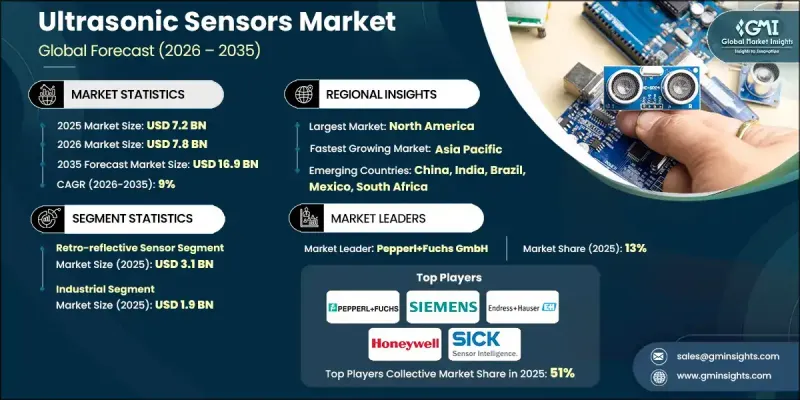
市場成長主要得益於現代車輛中電子安全功能和高級駕駛輔助技術的日益整合。超音波感測器在短距離物體偵測中發揮關鍵作用,能夠提升車輛行駛安全性並支援近距離偵測,而隨著車輛自動化程度的提高,近距離偵測的重要性也日益凸顯。除了汽車應用之外,數位化製造方法的日益普及也顯著推動了工業領域對超音波感測器的需求。超音波感測技術因其即使在惡劣的工作環境下也能保持穩定的性能而備受青睞。其在自動化生產線、智慧工廠和物料搬運系統中的日益普及進一步促進了市場成長。醫療領域對超音波感測器的需求也不斷成長,超音波感測技術能夠對體液進行非侵入性監測和精確檢測,從而提高設備的可靠性並確保患者安全。隨著各行業不斷提升精度、自動化程度和營運效率,超音波感測器正成為眾多應用領域不可或缺的組件。
| 市場覆蓋範圍 | |
|---|---|
| 開始年份 | 2025 |
| 預測年份 | 2026-2035 |
| 起始值 | 72億美元 |
| 預測金額 | 169億美元 |
| 複合年成長率 | 9% |
反射式感測器將成為主導細分市場,預計2025年市場規模將達到31億美元。由於此類感測器能夠在各種環境下提供準確可靠的遠距離探測,因此市場需求持續成長。即使在其他感測技術難以實現的情況下,其設計也能穩定地測量物體的存在和距離。
預計2025年,工業領域市場規模將達到19億美元。該領域的成長主要得益於超音波感測器在自動化系統、機器人、物料流管理和職場安全解決方案中的廣泛應用。這些感測器具有可靠的非接觸式測量能力,即使在受灰塵、潮濕和溫度波動影響的環境中也能保持測量精度。
預計到2025年,北美超音波感測器市場規模將達到30億美元。汽車製造、工業自動化、醫療系統和智慧基礎設施等領域的強勁應用持續推動該地區的成長。嚴格的安全標準、先進的生產能力以及數位化製造方法的早期應用進一步提振了市場需求。此外,對車輛安全技術的日益重視也持續推動全部區域超音波感測器的加速普及。
目錄
第1章調查方法和範圍
第2章執行摘要
第3章業界考察
- 生態系分析
- 供應商情況
- 利潤率
- 成本結構
- 每個階段的附加價值
- 影響價值鏈的因素
- 中斷
- 產業影響因素
- 促進要素
- 汽車安全與ADAS技術的日益普及
- 工業自動化和工業4.0的應用不斷擴展
- 在醫療和醫療設備領域不斷擴大應用
- 小型化和智慧感測能力的進步
- 拓展至智慧家庭和農業等新興領域
- 產業潛在風險與挑戰
- 覆蓋範圍有限且對環境敏感
- 先進感測器的高整合度和製造成本
- 市場機遇
- 與物聯網和智慧系統的整合
- 拓展至農業及環境監測等新興領域
- 促進要素
- 成長潛力分析
- 監管環境
- 波特五力分析
- PESTEL 分析
- 科技與創新趨勢
- 當前技術趨勢
- 新興技術
- 新興經營模式
- 合規要求
- 永續性措施
- 消費者心理分析
- 專利和智慧財產權分析
- 地緣政治和貿易趨勢
第4章 競爭情勢
- 介紹
- 公司市佔率分析
- 按地區
- 北美洲
- 歐洲
- 亞太地區
- 拉丁美洲
- 中東和非洲
- 市場集中度分析
- 按地區
- 主要企業的競爭標竿分析
- 財務績效比較
- 收入
- 利潤率
- 研究與開發
- 產品系列比較
- 產品線豐富
- 科技
- 創新
- 按地區分類的企業發展比較
- 全球擴張分析
- 服務網路覆蓋範圍
- 按地區分類的市場滲透率
- 競爭定位矩陣
- 領導企業
- 受讓人
- 追蹤者
- 小眾玩家
- 戰略展望矩陣
- 財務績效比較
- 2021-2024 年主要發展動態
- 併購
- 夥伴關係與合作
- 技術進步
- 擴張與投資策略
- 永續發展計劃
- 數位轉型計劃
- 新興/Start-Ups競賽的趨勢
第5章 按類型分類的市場估算與預測,2022-2035年
- 反射式感測器
- 透過光束感測器
- 其他
第6章 按運作頻率的市場估算與預測,2022-2035年
- 低頻段(17-30 kHz)
- 中頻段(30-50 kHz)
- 高頻率頻寬(50-90 kHz)
第7章 按應用領域分類的市場估算與預測,2022-2035年
- 液位測量
- 流量測量
- 距離/接近檢測
- 無損檢測 (NDT)
- 醫學診斷
- 其他
第8章 依最終用途分類的市場估算與預測,2022-2035年
- 車
- 家用電子電器
- 工業的
- 衛生保健
- 航太/國防
- 其他
第9章 2022-2035年各地區市場估算與預測
- 北美洲
- 美國
- 加拿大
- 歐洲
- 德國
- 英國
- 法國
- 義大利
- 西班牙
- 荷蘭
- 亞太地區
- 中國
- 印度
- 日本
- 澳洲
- 韓國
- 拉丁美洲
- 巴西
- 墨西哥
- 阿根廷
- 中東和非洲
- 南非
- 沙烏地阿拉伯
- 阿拉伯聯合大公國
第10章:公司簡介
- ABB Ltd.
- Baumer Holding AG
- Banner Engineering Corp.
- Continental AG
- Endress+Hauser Group Services AG
- ifm electronic GmbH
- Honeywell International Inc.
- Keyence Corporation
- Krohne Messtechnik GmbH
- MaxBotix Inc.
- Murata Manufacturing Co., Ltd.
- Omron Corporation
- Pepperl+Fuchs GmbH
- Robert Bosch GmbH
- Rockwell Automation, Inc.(Allen-Bradley)
- Senix Corporation
- SICK AG
- Siemens AG
- Texas Instruments Incorporated
- TURCK Inc.
The Global Ultrasonic Sensors Market was valued at USD 7.2 billion in 2025 and is estimated to grow at a CAGR of 9% to reach USD 16.9 billion by 2035.
Market growth is driven by the increasing integration of electronically controlled safety features and advanced driver assistance technologies in modern vehicles. Ultrasonic sensors play a critical role in short-range object detection, enabling safer vehicle maneuvering and supporting proximity-based awareness functions that are becoming increasingly essential as vehicles move toward higher levels of automation. Beyond automotive applications, the rising adoption of digital manufacturing practices is significantly boosting demand across industrial environments. Ultrasonic sensing technology is widely valued for its ability to deliver consistent performance under challenging operating conditions. Growing deployment across automated production lines, smart factories, and material handling systems is further supporting market expansion. The healthcare sector is also contributing to demand growth, as ultrasonic sensing enables non-invasive monitoring and precise fluid detection, improving both equipment reliability and patient safety. As industries continue to prioritize accuracy, automation, and operational efficiency, ultrasonic sensors are becoming an indispensable component across a wide range of applications.
| Market Scope | |
|---|---|
| Start Year | 2025 |
| Forecast Year | 2026-2035 |
| Start Value | $7.2 Billion |
| Forecast Value | $16.9 Billion |
| CAGR | 9% |
The retro-reflective sensor segment generated USD 3.1 billion in 2025, making it the leading segment in the market. Demand for these sensors continues to increase due to their ability to provide dependable long-distance detection with high accuracy across varied environments. Their design supports stable measurement of object presence and distance, even in conditions where other sensing technologies may be less effective.
The industrial segment accounted for USD 1.9 billion in 2025. Growth in this segment is supported by widespread use of ultrasonic sensors in automation systems, robotics, material flow management, and workplace safety solutions. These sensors offer reliable, non-contact measurement capabilities and maintain accuracy in environments affected by dust, moisture, or temperature variations.
North America Ultrasonic Sensors Market generated USD 3 billion in 2025. Strong adoption across automotive manufacturing, industrial automation, healthcare systems, and intelligent infrastructure continues to drive regional growth. Strict safety standards, advanced production capabilities, and early implementation of digital manufacturing practices further reinforce market demand. Rising focus on vehicle safety technologies also continues to accelerate adoption across the region.
Key companies operating in the Global Ultrasonic Sensors Market include Siemens AG, ABB Ltd., Honeywell International Inc., Robert Bosch GmbH, Continental AG, Omron Corporation, Pepperl+Fuchs GmbH, ifm electronic GmbH, Keyence Corporation, Baumer Holding AG, Banner Engineering Corp., Endress+Hauser Group Services AG, Murata Manufacturing Co., Ltd., Texas Instruments Incorporated, Rockwell Automation, Inc., SICK AG, TURCK Inc., Krohne Messtechnik GmbH, Senix Corporation, and MaxBotix Inc. Companies in the ultrasonic sensors market strengthen their market position by focusing on innovation, reliability, and application-specific customization. Many players invest in improving sensor accuracy, range, and durability to meet evolving industrial and automotive requirements. Expanding compatibility with digital communication protocols supports seamless integration into smart systems. Strategic partnerships with automation providers and OEMs help broaden market reach.
Table of Contents
Chapter 1 Methodology and Scope
- 1.1 Market scope and definition
- 1.2 Research design
- 1.2.1 Research approach
- 1.2.2 Data collection methods
- 1.3 Data mining sources
- 1.3.1 Global
- 1.3.2 Regional/Country
- 1.4 Base estimates and calculations
- 1.4.1 Base year calculation
- 1.4.2 Key trends for market estimation
- 1.5 Primary research and validation
- 1.5.1 Primary sources
- 1.6 Forecast model
- 1.7 Research assumptions and limitations
Chapter 2 Executive Summary
- 2.1 Industry 360° synopsis
- 2.2 Key market trends
- 2.2.1 Type Trends
- 2.2.2 Structure Type Trends
- 2.2.3 Sensors Trends
- 2.2.4 Operating Frequency Trends
- 2.2.5 Application Trends
- 2.2.6 End-Use Trends
- 2.2.7 Regional Trends
- 2.3 CXO perspectives: Strategic imperatives
- 2.3.1 Key decision points for industry executives
- 2.3.2 Critical success factors for market players
- 2.4 Future outlook and strategic recommendations
Chapter 3 Industry Insights
- 3.1 Industry ecosystem analysis
- 3.1.1 Supplier Landscape
- 3.1.2 Profit Margin
- 3.1.3 Cost structure
- 3.1.4 Value addition at each stage
- 3.1.5 Factor affecting the value chain
- 3.1.6 Disruptions
- 3.2 Industry impact forces
- 3.2.1 Growth drivers
- 3.2.1.1 Increasing Adoption of Automotive Safety and ADAS Technologies
- 3.2.1.2 Expansion of Industrial Automation and Industry 4.0 Applications
- 3.2.1.3 Growing Utilization in Healthcare and Medical Devices
- 3.2.1.4 Advancements in Miniaturization and Smart Sensing Capabilities
- 3.2.1.5 Penetration into Emerging Sectors such as Smart Homes and Agriculture
- 3.2.2 Industry pitfalls and challenges
- 3.2.2.1 Limited Range and Environmental Sensitivity
- 3.2.2.2 High Integration and Manufacturing Costs for Advanced Sensors
- 3.2.3 Market opportunities
- 3.2.3.1 Integration with IoT and Smart Systems
- 3.2.3.2 Expansion into Emerging Sectors such as Agriculture and Environmental Monitoring
- 3.2.1 Growth drivers
- 3.3 Growth potential analysis
- 3.4 Regulatory landscape
- 3.4.1 North America
- 3.4.2 Europe
- 3.4.3 Asia Pacific
- 3.4.4 Latin America
- 3.4.5 Middle East and Africa
- 3.5 Porter's analysis
- 3.6 PESTEL analysis
- 3.7 Technology and Innovation landscape
- 3.7.1 Current technological trends
- 3.7.2 Emerging technologies
- 3.8 Emerging Business Models
- 3.9 Compliance Requirements
- 3.10 Sustainability Measures
- 3.11 Consumer Sentiment Analysis
- 3.12 Patent and IP analysis
- 3.13 Geopolitical and trade dynamics
Chapter 4 Competitive Landscape, 2024
- 4.1 Introduction
- 4.2 Company market share analysis
- 4.2.1 By region
- 4.2.1.1 North America
- 4.2.1.2 Europe
- 4.2.1.3 Asia Pacific
- 4.2.1.4 Latin America
- 4.2.1.5 Middle East & Africa
- 4.2.2 Market Concentration Analysis
- 4.2.1 By region
- 4.3 Competitive Benchmarking of key Players
- 4.3.1 Financial Performance Comparison
- 4.3.1.1 Revenue
- 4.3.1.2 Profit Margin
- 4.3.1.3 R&D
- 4.3.2 Product Portfolio Comparison
- 4.3.2.1 Product Range Breadth
- 4.3.2.2 Technology
- 4.3.2.3 Innovation
- 4.3.3 Geographic Presence Comparison
- 4.3.3.1 Global Footprint Analysis
- 4.3.3.2 Service Network Coverage
- 4.3.3.3 Market Penetration by Region
- 4.3.4 Competitive Positioning Matrix
- 4.3.4.1 Leaders
- 4.3.4.2 Challengers
- 4.3.4.3 Followers
- 4.3.4.4 Niche Players
- 4.3.5 Strategic outlook matrix
- 4.3.1 Financial Performance Comparison
- 4.4 Key developments, 2021-2024
- 4.4.1 Mergers and Acquisitions
- 4.4.2 Partnerships and Collaborations
- 4.4.3 Technological Advancements
- 4.4.4 Expansion and Investment Strategies
- 4.4.5 Sustainability Initiatives
- 4.4.6 Digital Transformation Initiatives
- 4.5 Emerging/ Startup Competitors Landscape
Chapter 5 Market Estimates and Forecast, By Type, 2022 - 2035 ($ Bn)
- 5.1 Key trends
- 5.2 Retro-reflective sensor
- 5.3 Through-beam sensor
- 5.4 Others
Chapter 6 Market Estimates and Forecast, By Operating Frequency, 2022 - 2035 ($ Bn)
- 6.1 Key trends
- 6.2 Low Frequency (17-30 kHz)
- 6.3 Medium Frequency (30-50 kHz)
- 6.4 High Frequency (50-90 kHz)
Chapter 7 Market Estimates and Forecast, By Application, 2022 - 2035 ($ Bn)
- 7.1 Key trends
- 7.2 Level Measurement
- 7.3 Flow Measurement
- 7.4 Distance/Proximity Detection
- 7.5 Non-Destructive Testing (NDT)
- 7.6 Medical Diagnostics
- 7.7 Others
Chapter 8 Market Estimates and Forecast, By End Use, 2022 - 2035 ($ Bn)
- 8.1 Key trends
- 8.2 Automotive
- 8.3 Consumer electronics
- 8.4 Industrial
- 8.5 Healthcare
- 8.6 Aerospace & defense
- 8.7 Others
Chapter 9 Market Estimates and Forecast, By Region, 2022 - 2035 ($ Bn)
- 9.1 Key trends
- 9.2 North America
- 9.2.1 U.S.
- 9.2.2 Canada
- 9.3 Europe
- 9.3.1 Germany
- 9.3.2 UK
- 9.3.3 France
- 9.3.4 Italy
- 9.3.5 Spain
- 9.3.6 Netherlands
- 9.4 Asia Pacific
- 9.4.1 China
- 9.4.2 India
- 9.4.3 Japan
- 9.4.4 Australia
- 9.4.5 South Korea
- 9.5 Latin America
- 9.5.1 Brazil
- 9.5.2 Mexico
- 9.5.3 Argentina
- 9.6 Middle East and Africa
- 9.6.1 South Africa
- 9.6.2 Saudi Arabia
- 9.6.3 UAE
Chapter 10 Company Profiles
- 10.1 ABB Ltd.
- 10.2 Baumer Holding AG
- 10.3 Banner Engineering Corp.
- 10.4 Continental AG
- 10.5 Endress+Hauser Group Services AG
- 10.6 ifm electronic GmbH
- 10.7 Honeywell International Inc.
- 10.8 Keyence Corporation
- 10.9 Krohne Messtechnik GmbH
- 10.10 MaxBotix Inc.
- 10.11 Murata Manufacturing Co., Ltd.
- 10.12 Omron Corporation
- 10.13 Pepperl+Fuchs GmbH
- 10.14 Robert Bosch GmbH
- 10.15 Rockwell Automation, Inc. (Allen-Bradley)
- 10.16 Senix Corporation
- 10.17 SICK AG
- 10.18 Siemens AG
- 10.19 Texas Instruments Incorporated
- 10.20 TURCK Inc.

 超音波感測器:市場佔有率分析、產業趨勢與統計、成長預測(2026-2031)
 超音波感測器市場:按類型、輸出類型、工作範圍、技術和應用分類-2026-2032年全球市場預測
 超音波感測器市場報告:按技術、類型、最終用戶和地區分類(2026-2034 年)
 超音波感測器全球市場規模、佔有率、趨勢和成長分析報告(2026-2034年)
 超音波感測器市場:按技術、終端用戶產業和地區分類
 全球超音波設備市場:市場規模、佔有率和趨勢分析(2026-2032 年)
 超音波感測器市場分析及預測(至2035年):按類型、產品類型、技術、組件、應用、形狀、材質、最終用戶和功能分類
 2026年全球超音波感測器市場報告全球超音波感測器市場:市場規模、佔有率、成長率、產業分析、依類型、應用和地區劃分的分析及預測(2026-2034)
 超音波感測器市場 - 全球產業規模、佔有率、趨勢、競爭格局、機會及預測(按類型、應用、產業垂直領域、地區和競爭格局分類,2021-2031年)