


 |
市場調查報告書
商品編碼
1936660
香精市場機會、成長要素、產業趨勢分析及預測(2026-2035年)Flavors Market Opportunity, Growth Drivers, Industry Trend Analysis, and Forecast 2026 - 2035 |
||||||

全球醫藥和保健應用香精市場預計到 2025 年將達到 13 億美元,到 2035 年將達到 20 億美元,年複合成長率為 4.2%。
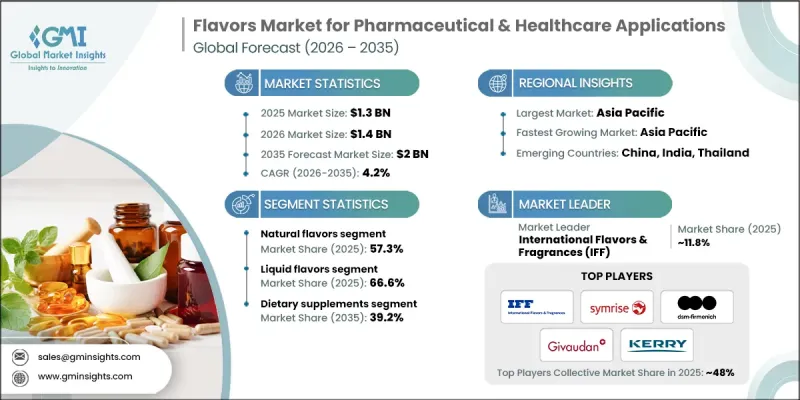
該市場為製藥和保健品製造商提供功能性香精系統,旨在提升藥品和保健食品配方的偏好、提高患者依從性並改善整體感官品質。這些解決方案旨在消除不良口味、改善配方可接受性,並滿足不斷變化的法規和消費者期望。藥用級香精適用於多種配方類別,在最佳化劑量、實現感官平衡和配方一致性方面發揮關鍵作用。藥品產量持續成長、消費者對健康產品的日益成長的需求以及香精科學的不斷創新共同推動了市場的發展。製造商正大力投資先進的掩味技術和以性能為導向的香精開發,以支持各種治療應用。與此同時,該行業正經歷著向潔淨標示、更加重視天然成分以及需要符合監管標準和全球醫療保健體系中不斷變化的消費者偏好的透明配方方法的轉變。
| 市場覆蓋範圍 | |
|---|---|
| 開始年份 | 2025 |
| 預測年份 | 2026-2035 |
| 起始值 | 13億美元 |
| 預測金額 | 20億美元 |
| 複合年成長率 | 4.2% |
2025年,天然香料市佔率達到57.3%,預計2026年至2035年將以4.2%的複合年成長率成長。其市場主導地位得益於其在藥品製劑中的高接受度、與潔淨標示理念的契合以及在多個產品類型中始終如一的卓越表現。這些香料解決方案在有效最佳化口味的同時,也能確保符合監管要求和製劑穩定性。與藥品成分和劑型的廣泛兼容性進一步鞏固了其在全球主要生產區域的主導地位。
預計到2025年,液體香精製劑市場佔有率將達到66.6%,並預計到2035年將以4.2%的複合年成長率成長。此細分市場的主導地位歸功於其與製藥生產流程的高效整合、均勻分散性和可靠的香精輸送。液體系統能夠實現均勻的感官特性,同時兼顧可擴展性和運作效率。其對各種配方需求的適應性不斷增強,進一步鞏固了其在全球醫藥和醫療保健產品開發中的作用。
預計到2025年,美國醫藥和醫療保健應用香精市場規模將達3.276億美元。推動美國市場成長的主要因素包括持續的製藥生產活動、日益複雜的製劑配方以及對能夠遵守用藥和產品差異化的香精系統的強勁需求。先進的生產基礎設施和製劑技術的不斷創新也持續支撐著美國市場的穩定需求。
目錄
第1章調查方法和範圍
第2章執行摘要
第3章業界考察
- 生態系分析
- 供應商情況
- 利潤率
- 每個階段的附加價值
- 影響價值鏈的因素
- 中斷
- 產業影響因素
- 促進要素
- 產業潛在風險與挑戰
- 市場機遇
- 成長潛力分析
- 監管環境
- 北美洲
- 歐洲
- 亞太地區
- 拉丁美洲
- 中東和非洲
- 波特五力分析
- PESTEL 分析
- 科技與創新趨勢
- 當前技術趨勢
- 新興技術
- 價格趨勢
- 按地區
- 按口味
- 未來市場趨勢
- 專利狀態
- 貿易統計(HS編碼)(註:僅提供主要國家的貿易統計)
- 主要進口國
- 主要出口國
- 永續性和環境方面
- 永續努力
- 減少廢棄物策略
- 生產中的能源效率
- 環保舉措
- 考慮到碳足跡
第4章 競爭情勢
- 介紹
- 公司市佔率分析
- 按地區
- 北美洲
- 歐洲
- 亞太地區
- 拉丁美洲
- 中東和非洲
- 按地區
- 企業矩陣分析
- 主要市場公司的競爭分析
- 競爭定位矩陣
- 重大進展
- 併購
- 夥伴關係與合作
- 新產品發布
- 擴張計劃
第5章 依口味分類的市場估計與預測,2022-2035年
- 天然香氛
- 水果口味
- 薄荷味
- 香草口味
- 巧克力口味
- 其他
- 合成/人工香料
- 其他
第6章 按類型分類的市場估算與預測,2022-2035年
- 液態香精
- 粉/乾香精
- 膏狀/凝膠狀香精
- 其他
第7章 按應用領域分類的市場估算與預測,2022-2035年
- 非處方藥
- 營養補充品
- 維生素和礦物質
- 蛋白質和胺基酸
- 膳食纖維
- 歐米伽脂肪酸
- 其他
- 治療性營養
- 醫學營養
- 嬰兒營養
- 運動營養
- 臨床營養不良
- 其他
第8章 2022-2035年各地區市場估算與預測
- 北美洲
- 美國
- 加拿大
- 歐洲
- 德國
- 英國
- 法國
- 西班牙
- 義大利
- 其他歐洲地區
- 亞太地區
- 中國
- 印度
- 日本
- 澳洲
- 韓國
- 亞太其他地區
- 拉丁美洲
- 巴西
- 墨西哥
- 阿根廷
- 其他拉丁美洲地區
- 中東和非洲
- 沙烏地阿拉伯
- 南非
- 阿拉伯聯合大公國
- 其他中東和非洲地區
第9章:公司簡介
- International Flavors &Fragrances(IFF)
- Symrise AG
- DSM-Firmenich
- Givaudan
- Takasago International Corporation
- Kerry Group
- Sensient Technologies
- MANE SA
- Glanbia Nutritionals
- Prinova(Nagase Group)
- Metarom Group
- Roquette
- FONA International
- Keva Flavours
- Sensapure
The Global Flavors Market for Pharmaceutical & Healthcare Applications was valued at USD 1.3 billion in 2025 and is estimated to grow at a CAGR of 4.2% to reach USD 2 billion by 2035.
The market supports pharmaceutical and healthcare manufacturers by providing functional flavor systems designed to improve palatability, support patient adherence, and enhance overall sensory quality in medicinal and wellness formulations. These solutions are engineered to neutralize unpleasant taste profiles, improve formulation acceptance, and align with evolving regulatory and consumer expectations. Available across multiple formulation categories, pharmaceutical-grade flavors serve critical roles in dosage optimization, sensory balance, and formulation consistency. Ongoing growth in pharmaceutical production volumes, increasing consumption of health-focused products, and continuous innovation in flavor science are collectively shaping market momentum. Manufacturers are investing heavily in advanced taste-masking techniques and performance-focused flavor development to support a wide range of therapeutic applications. At the same time, the industry is undergoing a clean-label transformation, with growing emphasis on naturally sourced ingredients and transparent formulation practices that align with regulatory standards and shifting consumer preferences across global healthcare systems.
| Market Scope | |
|---|---|
| Start Year | 2025 |
| Forecast Year | 2026-2035 |
| Start Value | $1.3 Billion |
| Forecast Value | $2 Billion |
| CAGR | 4.2% |
The natural flavors segment accounted for 57.3% share in 2025 and is expected to grow at a CAGR of 4.2% from 2026 to 2035. Their dominance is supported by strong acceptance across pharmaceutical formulations, alignment with clean-label initiatives, and consistent performance across multiple product categories. These flavor solutions offer effective taste optimization while maintaining regulatory compliance and formulation stability. Their broad compatibility with pharmaceutical ingredients and delivery formats reinforces their leading position across major production regions worldwide.
The liquid flavor formats segment held a 66.6% share in 2025 and is forecast to grow at a CAGR of 4.2% through 2035. This segment leads due to efficient incorporation into pharmaceutical manufacturing processes, consistent dispersion, and reliable flavor delivery. Liquid systems support uniform sensory outcomes while enabling scalable production and operational efficiency. Their adaptability across diverse formulation requirements continues to strengthen their role in pharmaceutical and healthcare product development globally.
U.S. Flavors Market for Pharmaceutical & Healthcare Applications generated USD 327.6 million in 2025. Growth in the country is driven by sustained pharmaceutical manufacturing activity, rising formulation complexity, and strong demand for flavor systems that enhance compliance and product differentiation. Advanced production infrastructure and continuous innovation in formulation technologies continue to support steady demand across the United States.
Key companies active in the Global Flavors Market for Pharmaceutical & Healthcare Applications include Givaudan, DSM-Firmenich, Sensient Technologies, International Flavors & Fragrances, Kerry Group, MANE SA, Takasago International Corporation, Glanbia Nutritionals, Metarom Group, Prinova under the Nagase Group, Roquette, Keva Flavours, Sensapure, FONA International, and Symrise AG. These players maintain competitive positions through innovation, regulatory expertise, and diversified flavor portfolios. To strengthen their presence, companies in the pharmaceutical and healthcare flavors sector focus on continuous investment in research and development to enhance taste-masking efficiency and formulation performance. Strategic expansion into high-growth regions and long-term partnerships with pharmaceutical manufacturers help secure stable demand. Many firms emphasize clean-label innovation and natural ingredient sourcing to align with regulatory trends and customer expectations.
Table of Contents
Chapter 1 Methodology & Scope
- 1.1 Market scope and definition
- 1.2 Research design
- 1.2.1 Research approach
- 1.2.2 Data collection methods
- 1.3 Data mining sources
- 1.3.1 Global
- 1.3.2 Regional/Country
- 1.4 Base estimates and calculations
- 1.4.1 Base year calculation
- 1.4.2 Key trends for market estimation
- 1.5 Primary research and validation
- 1.5.1 Primary sources
- 1.6 Forecast model
- 1.7 Research assumptions and limitations
Chapter 2 Executive Summary
- 2.1 Industry 3600 synopsis
- 2.2 Key market trends
- 2.2.1 Product
- 2.2.2 Application
- 2.2.3 Regional
- 2.3 TAM Analysis, 2026-2035
- 2.4 CXO perspectives: Strategic imperatives
- 2.4.1 Executive decision points
- 2.4.2 Critical success factors
- 2.5 Future outlook and strategic recommendations
Chapter 3 Industry Insights
- 3.1 Industry ecosystem analysis
- 3.1.1 Supplier landscape
- 3.1.2 Profit margin
- 3.1.3 Value addition at each stage
- 3.1.4 Factor affecting the value chain
- 3.1.5 Disruptions
- 3.2 Industry impact forces
- 3.2.1 Growth drivers
- 3.2.2 Industry pitfalls and challenges
- 3.2.3 Market opportunities
- 3.3 Growth potential analysis
- 3.4 Regulatory landscape
- 3.4.1 North America
- 3.4.2 Europe
- 3.4.3 Asia Pacific
- 3.4.4 Latin America
- 3.4.5 Middle East & Africa
- 3.5 Porter's analysis
- 3.6 PESTEL analysis
- 3.7 Technology and innovation landscape
- 3.7.1 Current technological trends
- 3.7.2 Emerging technologies
- 3.8 Price trends
- 3.8.1 By region
- 3.8.2 By flavor
- 3.9 Future market trends
- 3.10 Patent landscape
- 3.11 Trade statistics (HS code) (Note: the trade statistics will be provided for key countries only)
- 3.11.1 Major importing countries
- 3.11.2 Major exporting countries
- 3.12 Sustainability and environmental aspects
- 3.12.1 Sustainable practices
- 3.12.2 Waste reduction strategies
- 3.12.3 Energy efficiency in production
- 3.12.4 Eco-friendly initiatives
- 3.13 Carbon footprint consideration
Chapter 4 Competitive Landscape, 2025
- 4.1 Introduction
- 4.2 Company market share analysis
- 4.2.1 By region
- 4.2.1.1 North America
- 4.2.1.2 Europe
- 4.2.1.3 Asia Pacific
- 4.2.1.4 LATAM
- 4.2.1.5 MEA
- 4.2.1 By region
- 4.3 Company matrix analysis
- 4.4 Competitive analysis of major market players
- 4.5 Competitive positioning matrix
- 4.6 Key developments
- 4.6.1 Mergers & acquisitions
- 4.6.2 Partnerships & collaborations
- 4.6.3 New product launches
- 4.6.4 Expansion plans
Chapter 5 Market Estimates and Forecast, By Flavor, 2022-2035 (USD Million) (Kilo Tons)
- 5.1 Key trends
- 5.2 Natural flavors
- 5.2.1 Fruit-based flavors
- 5.2.2 Mint flavors
- 5.2.3 Vanilla flavors
- 5.2.4 Chocolate flavors
- 5.2.5 Others
- 5.3 Synthetic / artificial flavors
- 5.4 Others
Chapter 6 Market Estimates and Forecast, By Form, 2022-2035 (USD Million) (Kilo Tons)
- 6.1 Key trends
- 6.2 Liquid flavors
- 6.3 Powder / dry flavors
- 6.4 Paste / gel flavors
- 6.5 Others
Chapter 7 Market Estimates and Forecast, By Application, 2022-2035 (USD Million) (Kilo Tons)
- 7.1 OTC drugs
- 7.2 Dietary supplements
- 7.2.1 Vitamins & minerals
- 7.2.2 Proteins & amino acids
- 7.2.3 Dietary fibers
- 7.2.4 Omega fatty acids
- 7.2.5 Others
- 7.3 Therapeutic nutrition
- 7.4 Healthcare nutrition
- 7.4.1 Infant nutrition
- 7.4.2 Sports nutrition
- 7.4.3 Clinical malnutrition
- 7.4.4 Others
Chapter 8 Market Estimates and Forecast, By Region, 2022-2035 (USD Million) (Kilo Tons)
- 8.1 Key trends
- 8.2 North America
- 8.2.1 U.S.
- 8.2.2 Canada
- 8.3 Europe
- 8.3.1 Germany
- 8.3.2 UK
- 8.3.3 France
- 8.3.4 Spain
- 8.3.5 Italy
- 8.3.6 Rest of Europe
- 8.4 Asia Pacific
- 8.4.1 China
- 8.4.2 India
- 8.4.3 Japan
- 8.4.4 Australia
- 8.4.5 South Korea
- 8.4.6 Rest of Asia Pacific
- 8.5 Latin America
- 8.5.1 Brazil
- 8.5.2 Mexico
- 8.5.3 Argentina
- 8.5.4 Rest of Latin America
- 8.6 Middle East and Africa
- 8.6.1 Saudi Arabia
- 8.6.2 South Africa
- 8.6.3 UAE
- 8.6.4 Rest of Middle East and Africa
Chapter 9 Company Profiles
- 9.1 International Flavors & Fragrances (IFF)
- 9.2 Symrise AG
- 9.3 DSM-Firmenich
- 9.4 Givaudan
- 9.5 Takasago International Corporation
- 9.6 Kerry Group
- 9.7 Sensient Technologies
- 9.8 MANE SA
- 9.9 Glanbia Nutritionals
- 9.10 Prinova (Nagase Group)
- 9.11 Metarom Group
- 9.12 Roquette
- 9.13 FONA International
- 9.14 Keva Flavours
- 9.15 Sensapure

 全球香精香料市場規模、佔有率、趨勢及成長分析報告(2026-2034年)
 傳統風味飲料市場預測至2034年:按產品類型、風味特徵、功能、消費者屬性、包裝、分銷管道和地區分類的全球分析
 封裝香精市場規模、佔有率和成長分析:按封裝技術、產品風味特徵、主要食品應用和地區分類-2026-2033年產業預測
 全球生物技術香精市場
 生物技術香料市場機會、成長要素、產業趨勢分析及2026-2035年預測。生物技術香精市場規模、佔有率、成長及全球產業分析:按類型和應用、區域洞察及2026-2034年預測FTNF香精市場-2026-2031年預測
 純素香精市場-全球產業規模、佔有率、趨勢、機會和預測:按形狀、應用、分銷管道、地區和競爭格局分類,2021-2031年全球植物香料市場全球純素風味市場