

 |
市場調查報告書
商品編碼
1936656
智慧床墊市場機會、成長要素、產業趨勢分析及2026年至2035年預測Smart Mattress Market Opportunity, Growth Drivers, Industry Trend Analysis, and Forecast 2026 - 2035 |
||||||

全球智慧床墊市場預計到 2025 年將達到 17.6 億美元,到 2035 年將達到 33.4 億美元,年複合成長率為 6.6%。
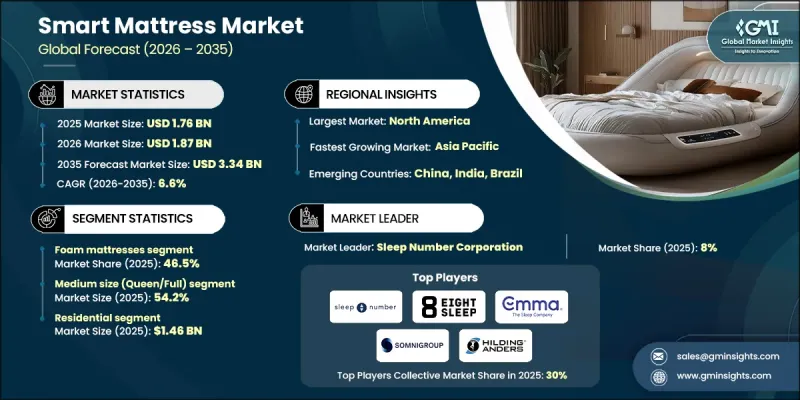
市場成長動能主要源自於消費者對長期個人健康管理的日益關注以及與數位化健康框架的日益融合。智慧床墊提供超越傳統睡眠支撐的數據驅動型洞察,正逐漸成為健康生活方式的重要組成部分。產業整合的加劇加速了創新週期,強化了品牌組合,並擴大了全球影響力,從而進一步推動了市場成長。隨著消費者尋求能夠主動回應身體狀況和行為模式的智慧系統,以基礎泡棉和整形外科結構為中心的傳統睡眠解決方案正逐漸失去市場地位。智慧床墊將實體舒適度與數位監測結合,打造更具適應性的睡眠環境,從而強化其在健康最佳化方面的作用。這一發展趨勢與消費者對數據驅動型健康解決方案日益成長的需求密切相關。連網家庭科技的日益普及、北美地區消費者在高階生活方式方面的自由裁量權支出不斷成長,以及歐洲和亞太部分市場在醫療保健和健康領域的投資不斷增加,都提升了智慧床墊解決方案的商業性吸引力。
| 市場覆蓋範圍 | |
|---|---|
| 開始年份 | 2025 |
| 預測年份 | 2026-2035 |
| 起始值 | 17.6億美元 |
| 預測金額 | 33.4億美元 |
| 複合年成長率 | 6.6% |
到2025年,泡棉智慧床墊市場佔有率將達到46.5%,這反映了消費者強勁且持續的需求。該細分市場持續成長,因為它非常適合整合先進的感測技術和溫度調節組件,同時又不影響舒適度。泡沫材料在高階住宅領域尤其受歡迎,因為它們能夠有效分散壓力,並支持姿勢調整。舒適性、性能和無縫技術整合的完美結合,正在推動市場需求,並支撐該細分市場的長期成長。
預計到2025年,住宅市場將佔據82.7%的佔有率,市場規模將達到14.6億美元。隨著消費者越來越重視睡眠質量,並將其視為整體健康和福祉的核心組成部分,住宅市場的普及仍然是推動成長要素。對智慧家庭生態系統和個人化健康解決方案的投資正在推動住宅的需求,使智慧床墊成為家庭健康最佳化策略的核心組成部分。
預計到2025年,北美智慧床墊市場規模將達到5.373億美元,並在2035年之前維持7.2%的年均複合成長率。在北美,智慧床墊被廣泛視為先進的健康監測產品,而非傳統的床上用品。消費者對智慧床墊的高度認知、對高階健康解決方案的投資意願以及與連網家庭系統的無縫整合,都推動了強勁的市場需求。自動舒適度調節和溫度控制等先進功能滿足了注重健康的消費者群體的期望。完善的零售網路和快速發展的消費者數位管道正在提升智慧床墊在全部區域的普及率,並持續加速其市場推廣。
目錄
第1章調查方法和範圍
第2章執行摘要
第3章業界考察
- 生態系分析
- 供應商情況
- 利潤率
- 每個階段的附加價值
- 影響價值鏈的因素
- 產業影響因素
- 促進要素
- 人們對睡眠衛生和健康的認知不斷提高
- 與智慧家庭生態系統整合
- 豪華酒店和醫療保健行業的成長
- 產業潛在風險與挑戰
- 價格範圍高,更換週期長
- 資料隱私和安全問題
- 機會
- 人工智慧驅動的個人化睡眠指導
- 訂閱式“健康即服務”
- 促進要素
- 成長潛力分析
- 未來市場趨勢
- 科技與創新趨勢
- 當前技術趨勢
- 新興技術
- 價格趨勢
- 按地區
- 按類型
- 監管環境
- 標準和合規要求
- 區域法規結構
- 認證標準
- 波特五力分析
- PESTEL 分析
第4章 競爭情勢
- 介紹
- 公司市佔率分析
- 按地區
- 企業矩陣分析
- 主要市場公司的競爭分析
- 競爭定位矩陣
- 重大進展
- 併購
- 夥伴關係與合作
- 新產品發布
- 擴張計劃
第5章 依產品類型分類的市場估算與預測,2022-2035年
- 泡棉床墊
- 彈簧床墊
- 混合床墊
- 乳膠床墊
- 其他
第6章 2022-2035年按規模分類的市場估算與預測
- 小規模
- 中號
- 大規模
第7章 依高度分類的市場估計與預測,2022-2035年
- 小於5英寸
- 5英寸到10英寸
- 10吋或以上
8. 依硬度等級分類的市場估計與預測,2022-2035 年
- 柔軟的
- 中等硬度
- 難的
第9章 依價格區間分類的市場估計與預測,2022-2035年
- 低價位
- 中價位
- 高價位範圍
第10章 依應用領域分類的市場估計與預測,2022-2035年
- 住宅
- 商業的
第11章 按分銷管道分類的市場估算與預測,2022-2035年
- 線上
- 離線
第12章 2022-2035年各地區市場估算與預測
- 北美洲
- 美國
- 加拿大
- 歐洲
- 德國
- 英國
- 法國
- 義大利
- 西班牙
- 亞太地區
- 中國
- 日本
- 印度
- 澳洲
- 韓國
- 拉丁美洲
- 巴西
- 墨西哥
- 阿根廷
- 中東和非洲
- 南非
- 沙烏地阿拉伯
- 阿拉伯聯合大公國
第13章:公司簡介
- Amerisleep
- Casper Sleep Inc.
- Eight Sleep
- Emma Sleep
- Hilding Anders
- iOBED
- Kingsdown, Inc.
- Leesa Sleep
- Nolah Sleep
- Purple Innovation, LLC
- ReST(Responsive Surface Technology)
- Sleep Number Corporation
- Somnigroup International
- Tempur Sealy International, Inc.
- The Sleep Company
The Global Smart Mattress Market was valued at USD 1.76 billion in 2025 and is estimated to grow at a CAGR of 6.6% to reach USD 3.34 billion by 2035.
Market momentum is driven by growing consumer focus on long-term personal health management and increasing alignment with digital health frameworks. Smart mattresses are increasingly positioned as integral components of wellness-oriented lifestyles, offering data-enabled insights that go beyond traditional sleep support. Industry consolidation is accelerating innovation cycles, strengthening brand portfolios, and expanding global reach, which is further supporting market growth. Conventional sleep solutions centered on basic foam or orthopedic structures are losing relevance as consumers seek intelligent systems that actively respond to physical conditions and behavioral patterns. Smart mattresses create a more adaptive sleep environment by combining physical comfort with digital monitoring, reinforcing their role in health optimization. This evolution aligns closely with rising consumer demand for data-driven wellness solutions. Expanding adoption of connected home technologies, higher discretionary spending on premium lifestyles in North America, and growing healthcare and wellness investments across Europe and select Asia-Pacific markets are collectively enhancing the commercial attractiveness of smart mattress solutions.
| Market Scope | |
|---|---|
| Start Year | 2025 |
| Forecast Year | 2026-2035 |
| Start Value | $1.76 Billion |
| Forecast Value | $3.34 Billion |
| CAGR | 6.6% |
The foam-based smart mattresses segment accounted for 46.5% share in 2025, reflecting strong and sustained consumer preference. This segment continues to expand due to its suitability for embedding advanced sensing technologies and temperature regulation components without compromising comfort. Foam materials enable effective pressure distribution while supporting posture-responsive features, making them particularly appealing within the premium residential category. The combination of comfort, performance, and seamless technology integration is reinforcing demand and supporting long-term segment growth.
The residential segment held 82.7% share, generating USD 1.46 billion in 2025. Residential adoption remains the primary growth driver as consumers increasingly prioritize sleep quality as a core element of overall health and well-being. Investment in smart home ecosystems and personalized wellness solutions is reinforcing residential demand, with smart mattresses positioned as central components of home-based health optimization strategies.
North America Smart Mattress Market generated USD 537.3 million in 2025 and a projected growth rate of 7.2% through 2035. In this region, smart mattresses are widely perceived as advanced health-monitoring products rather than conventional bedding. Strong demand is supported by high consumer awareness, willingness to invest in premium wellness solutions, and seamless integration with connected home systems. Advanced features such as automated comfort adjustment and thermal regulation are meeting the expectations of a health-focused consumer base. Well-developed retail networks and the rapid expansion of direct-to-consumer digital channels continue to improve accessibility and accelerate adoption across the region.
Key companies operating in the Global Smart Mattress Market include Tempur Sealy International, Inc., Sleep Number Corporation, Eight Sleep, Casper Sleep Inc., Purple Innovation, LLC, Emma Sleep, Hilding Anders, Somnigroup International, Kingsdown, Inc., Amerisleep, Leesa Sleep, Nolah Sleep, ReST (Responsive Surface Technology), iOBED, and The Sleep Company. Companies active in the smart mattress market are strengthening their market position through product innovation, technology integration, and brand expansion strategies. Leading players are investing in advanced sensor technology, AI-driven sleep analytics, and adaptive comfort systems to differentiate their offerings. Many companies are expanding direct-to-consumer channels to improve margins and deepen customer engagement. Strategic collaborations across the health and smart home ecosystems are enhancing interoperability and value perception.
Table of Contents
Chapter 1 Methodology and Scope
- 1.1 Market scope and definition
- 1.2 Research design
- 1.2.1 Research approach
- 1.2.2 Data collection methods
- 1.3 Data mining sources
- 1.3.1 Global
- 1.3.2 Regional/Country
- 1.4 Base estimates and calculations
- 1.4.1 Base year calculation
- 1.4.2 Key trends for market estimation
- 1.5 Primary research and validation
- 1.5.1 Primary sources
- 1.6 Forecast model
- 1.7 Research assumptions and limitations
Chapter 2 Executive Summary
- 2.1 Industry 360° synopsis
- 2.2 Key market trends
- 2.2.1 Regional
- 2.2.2 Product Type
- 2.2.3 Size
- 2.2.4 Height
- 2.2.5 Firmness Level
- 2.2.6 Price Range
- 2.2.7 Application
- 2.2.8 Distribution Channel
- 2.3 CXO perspectives: Strategic imperatives
- 2.3.1 Key decision points for industry executives
- 2.3.2 Critical success factors for market players
- 2.4 Future outlook and strategic recommendations
Chapter 3 Industry Insights
- 3.1 Industry ecosystem analysis
- 3.1.1 Supplier landscape
- 3.1.2 Profit margin
- 3.1.3 Value addition at each stage
- 3.1.4 Factor affecting the value chain
- 3.2 Industry impact forces
- 3.2.1 Growth drivers
- 3.2.1.1 Rising Awareness of Sleep Hygiene & Wellness
- 3.2.1.2 Integration with Smart Home Ecosystems
- 3.2.1.3 Growth in the Luxury Hospitality & Healthcare Sector
- 3.2.2 Industry pitfalls & challenges
- 3.2.2.1 High Price Point and Long Replacement Cycles
- 3.2.2.2 Concerns over Data Privacy & Security
- 3.2.3 Opportunities
- 3.2.3.1 AI-Driven Personalized Sleep Coaching
- 3.2.3.2 Subscription-Based "Wellness-as-a-Service"
- 3.2.1 Growth drivers
- 3.3 Growth potential analysis
- 3.4 Future market trends
- 3.5 Technology and innovation landscape
- 3.5.1 Current technological trends
- 3.5.2 Emerging technologies
- 3.6 Price trends
- 3.6.1 By region
- 3.6.2 By type
- 3.7 Regulatory landscape
- 3.7.1 Standards and compliance requirements
- 3.7.2 Regional regulatory frameworks
- 3.7.3 Certification standards
- 3.8 Porter's analysis
- 3.9 PESTEL analysis
Chapter 4 Competitive Landscape, 2025
- 4.1 Introduction
- 4.2 Company market share analysis
- 4.2.1 By region
- 4.2.1.1 North America
- 4.2.1.2 Europe
- 4.2.1.3 Asia Pacific
- 4.2.1.4 Latin America
- 4.2.1.5 Middle East and Africa
- 4.2.1 By region
- 4.3 Company matrix analysis
- 4.4 Competitive analysis of major market players
- 4.5 Competitive positioning matrix
- 4.6 Key developments
- 4.6.1 Mergers & acquisitions
- 4.6.2 Partnerships & collaborations
- 4.6.3 New product launches
- 4.6.4 Expansion plans
Chapter 5 Market Estimates and Forecast, By Product Type, 2022 - 2035 (USD Billion) (Thousand Units)
- 5.1 Key trends
- 5.2 Foam Mattresses
- 5.3 Innerspring Mattresses
- 5.4 Hybrid Mattresses
- 5.5 Latex Mattress
- 5.6 Others
Chapter 6 Market Estimates and Forecast, By Size, 2022 - 2035 (USD Billion) (Thousand Units)
- 6.1 Key trends
- 6.2 Small
- 6.3 Medium
- 6.4 Large
Chapter 7 Market Estimates and Forecast, By Height, 2022 - 2035 (USD Billion) (Thousand Units)
- 7.1 Key trends
- 7.2 Below 5 inch
- 7.3 5 inch - 10 inch
- 7.4 Above 10 inch
Chapter 8 Market Estimates and Forecast, By Firmness Level, 2022 - 2035 (USD Billion) (Thousand Units)
- 8.1 Key trends
- 8.2 Soft
- 8.3 Medium
- 8.4 Firm
Chapter 9 Market Estimates and Forecast,By Price Range, 2022 - 2035 (USD Billion) (Thousand Units)
- 9.1 Key trends
- 9.2 Low
- 9.3 Medium
- 9.4 High
Chapter 10 Market Estimates and Forecast, By Application, 2022 - 2035 (USD Billion) (Thousand Units)
- 10.1 Key trends
- 10.2 Residential
- 10.3 Commercial
Chapter 11 Market Estimates and Forecast, By Distribution Channel, 2022 - 2035 (USD Billion) (Thousand Units)
- 11.1 Key trends
- 11.2 Online
- 11.3 Offline
Chapter 12 Market Estimates and Forecast, By Region, 2022 - 2035 (USD Billion) (Thousand Units)
- 12.1 Key trends
- 12.2 North America
- 12.2.1 U.S.
- 12.2.2 Canada
- 12.3 Europe
- 12.3.1 Germany
- 12.3.2 UK
- 12.3.3 France
- 12.3.4 Italy
- 12.3.5 Spain
- 12.4 Asia Pacific
- 12.4.1 China
- 12.4.2 Japan
- 12.4.3 India
- 12.4.4 Australia
- 12.4.5 South Korea
- 12.5 Latin America
- 12.5.1 Brazil
- 12.5.2 Mexico
- 12.5.3 Argentina
- 12.6 Middle East and Africa
- 12.6.1 South Africa
- 12.6.2 Saudi Arabia
- 12.6.3 UAE
Chapter 13 Company Profiles
- 13.1 Amerisleep
- 13.2 Casper Sleep Inc.
- 13.3 Eight Sleep
- 13.4 Emma Sleep
- 13.5 Hilding Anders
- 13.6 iOBED
- 13.7 Kingsdown, Inc.
- 13.8 Leesa Sleep
- 13.9 Nolah Sleep
- 13.10 Purple Innovation, LLC
- 13.11 ReST (Responsive Surface Technology)
- 13.12 Sleep Number Corporation
- 13.13 Somnigroup International
- 13.14 Tempur Sealy International, Inc.
- 13.15 The Sleep Company


