


 |
市場調查報告書
商品編碼
1936648
生物過程分析儀器市場機會、成長要素、產業趨勢分析及2026年至2035年預測Bioprocess Analyzers Market Opportunity, Growth Drivers, Industry Trend Analysis, and Forecast 2026 - 2035 |
||||||

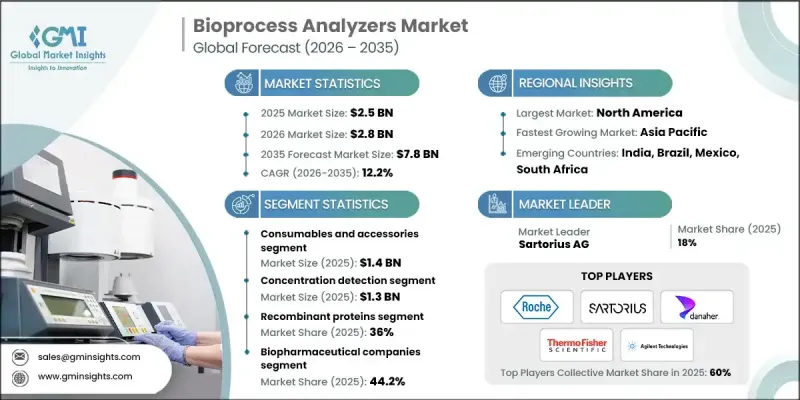
全球生物過程分析儀市場預計到 2025 年將達到 25 億美元,到 2035 年將達到 78 億美元,年複合成長率為 12.2%。
生物製藥產業的強勁成長得益於市場對生物製藥產品需求的不斷成長、生物加工技術的進步、生物相似藥生產的擴張以及政府的大力主導和資金投入。生物製程分析儀器是專門用於監測和測量整個生產過程中關鍵參數的儀器,確保符合監管標準,同時維持產品品質和療效。隨著癌症、糖尿病和心血管疾病等慢性疾病的日益普遍,對先進、標靶和個人化療法的需求也隨之飆升。這些治療方法需要精確的製程控制,以確保安全性、有效性和符合監管要求,從而推動了即時分析儀器在監測基材、代謝物和產物濃度方面的廣泛應用。此外,政府支持計畫、研究經費以及公私合營也為高性能分析儀器的應用創造了有利環境,進一步加速了其在生物製藥產業的市場滲透。
| 市場覆蓋範圍 | |
|---|---|
| 開始年份 | 2025 |
| 預測年份 | 2026-2035 |
| 起始值 | 25億美元 |
| 預測金額 | 78億美元 |
| 複合年成長率 | 12.2% |
預計到2025年,耗材及配件市場收入將達到14億美元,並在2026年至2035年間以12.1%的複合年成長率成長。這些組件,例如一次性感測器、樣品管、過濾器、校準試劑盒和分析試劑,對於確保操作順暢、符合法規要求以及製程完整性至關重要。自動化和連續生物製程的興起顯著增加了對與先進分析設備相容的耗材的需求,從而實現了高通量工作流程,同時減少了人工干預和操作失誤。
2025年,濃度檢測領域的市場規模達到13億美元,預計2035年將以12.2%的複合年成長率成長。濃度檢測分析儀能夠高精度地測量生產過程中蛋白質、抗體和其他生物製藥等關鍵成分。紫外-可見光光譜、拉曼光譜和可變光程系統等技術無需繁瑣的樣品製備即可即時監測。生物製藥和生物相似藥生產中最佳化產量、減少批次廢品率和提高整體效率的需求,正在推動這些技術的應用。
預計到2025年,美國生物製程分析設備市場規模將達到8.602億美元。該地區引領北美市場,主要受慢性病發病率上升以及生物製藥和個人化醫療需求成長的推動。這種不斷成長的需求正促使企業加快對先進分析設備的投資,以確保生產效率、維持產品品質並滿足嚴格的監管標準。
目錄
第1章調查方法和範圍
第2章執行摘要
第3章業界考察
- 生態系分析
- 產業影響因素
- 促進要素
- 生物製藥產品需求不斷成長
- 生物技術和生物加工的進展
- 生物相似藥需求不斷成長
- 政府加大主導和資金投入
- 產業潛在風險與挑戰
- 設備高成本
- 複雜性和技術專長
- 市場機遇
- 新興市場的成長
- 高級數據分析和人工智慧整合
- 促進要素
- 成長潛力分析
- 監管環境
- 技術進步
- 當前技術趨勢
- 新興技術
- 供應鏈分析
- 救贖方案
- 2024年定價分析
- 未來市場趨勢
- 波特五力分析
- PESTEL 分析
第4章 競爭情勢
- 介紹
- 公司市佔率分析
- 企業矩陣分析
- 主要市場公司的競爭分析
- 競爭定位矩陣
- 重大進展
- 併購
- 合作夥伴關係和合資企業
- 新產品發布
- 擴張計劃
第5章 2022-2035年按產品分類的市場估算與預測
- 裝置
- 耗材和配件
第6章 依分析類型分類的市場估計與預測,2022-2035年
- 基材分析
- 代謝物分析
- 濃度檢測
第7章 按應用領域分類的市場估算與預測,2022-2035年
- 抗生素
- 重組蛋白
- 生物相似藥
- 其他用途
第8章 依最終用途分類的市場估算與預測,2022-2035年
- 生物製藥公司
- 合約研究組織 (CRO) 和合約生產組織 (CMO)
- 研究和學術機構
- 其他最終用途
第9章 2022-2035年各地區市場估算與預測
- 北美洲
- 美國
- 加拿大
- 歐洲
- 德國
- 英國
- 法國
- 西班牙
- 義大利
- 荷蘭
- 亞太地區
- 中國
- 印度
- 日本
- 澳洲
- 韓國
- 拉丁美洲
- 巴西
- 墨西哥
- 阿根廷
- 中東和非洲
- 沙烏地阿拉伯
- 南非
- 阿拉伯聯合大公國
第10章:公司簡介
- 4BioCell GmbH &Co. KG
- Agilent Technologies, Inc.
- Beckman Coulter Life Sciences
- Danaher Corporation
- Endress+Hauser Group Services AG
- Eppendorf AG
- F. Hoffmann-La Roche Ltd.
- Nova Biomedical
- Randox Laboratories Ltd.
- Sartorius AG
- Solida Biotech GmbH
- SYSBIOTECH GmbH
- Thermo Fisher Scientific Inc.
- Waters Corporation
- Xylem Inc.
The Global Bioprocess Analyzers Market was valued at USD 2.5 billion in 2025 and is estimated to grow at a CAGR of 12.2% to reach USD 7.8 billion by 2035.
The robust growth is fueled by rising demand for biopharmaceutical products, technological advancements in bioprocessing, increasing production of biosimilars, and strong governmental initiatives and funding. Bioprocess analyzers are specialized instruments that monitor and measure key parameters throughout the manufacturing process, ensuring compliance with regulatory standards while maintaining product quality and efficacy. As chronic diseases like cancer, diabetes, and cardiovascular disorders become more prevalent, the demand for advanced, targeted, and personalized therapies is surging. These therapies require precise process control to guarantee safety, effectiveness, and regulatory adherence, driving widespread adoption of real-time analyzers for monitoring substrates, metabolites, and product concentrations. Additionally, supportive government programs, funding for research, and public-private partnerships provide a favorable environment for integrating high-performance analyzers, further accelerating market adoption across the biopharmaceutical industry.
| Market Scope | |
|---|---|
| Start Year | 2025 |
| Forecast Year | 2026-2035 |
| Start Value | $2.5 Billion |
| Forecast Value | $7.8 Billion |
| CAGR | 12.2% |
The consumables and accessories segment generated USD 1.4 billion in 2025 and is anticipated to grow at a CAGR of 12.1% through 2026-2035. These components, including disposable sensors, sample tubes, filters, calibration kits, and analytical reagents, are crucial for smooth operation, regulatory compliance, and process integrity. The rise of automation and continuous bioprocessing has significantly increased the demand for consumables compatible with advanced analyzers, enabling high-throughput workflows while reducing manual interventions and operational errors.
The concentration detection segment accounted for USD 1.3 billion in 2025 and is expected to grow at a CAGR of 12.2% through 2035. Concentration detection analyzers measure critical components such as proteins, antibodies, and other biologics during production with high precision. Technologies such as UV-Vis spectroscopy, Raman spectroscopy, and variable pathlength systems allow real-time monitoring without extensive sample preparation. Increasing adoption is driven by the need to optimize yields, minimize batch failures, and improve overall efficiency in biologics and biosimilar production.
U.S. Bioprocess Analyzers Market reached USD 860.2 million in 2025. The region leads North America, supported by the growing prevalence of chronic illnesses and the rising demand for biologics and personalized medicine. This demand is prompting companies to invest in advanced analyzers that ensure production efficiency, maintain quality, and adhere to strict regulatory standards.
Key players operating in the Global Bioprocess Analyzers Market include Nova Biomedical, Thermo Fisher Scientific Inc., 4BioCell GmbH & Co. KG, Sartorius AG, Danaher Corporation, Waters Corporation, Beckman Coulter Life Sciences, F. Hoffmann-La Roche Ltd., Agilent Technologies, Inc., SYSBIOTECH GmbH, Endress+Hauser Group Services AG, Solida Biotech GmbH, Xylem Inc., Eppendorf AG, and Randox Laboratories Ltd. Companies in the bioprocess analyzers market are strengthening their position through multiple strategies. They are investing heavily in research and development to improve analyzer accuracy, integration, and automation compatibility. Strategic collaborations and partnerships with pharmaceutical and biotechnology firms allow access to emerging markets and specialized applications. Firms are also focusing on expanding their product portfolios, offering consumables and accessories to complement analyzers for complete process solutions. Geographic expansion, especially into emerging regions with growing biopharmaceutical sectors, is another key approach.
Table of Contents
Chapter 1 Methodology and Scope
- 1.1 Market scope and definition
- 1.2 Research design
- 1.2.1 Research approach
- 1.2.2 Data collection methods
- 1.3 Data mining sources
- 1.3.1 Global
- 1.3.2 Regional/country
- 1.4 Base estimates and calculations
- 1.4.1 Base year calculation
- 1.4.2 Key trends for market estimation
- 1.5 Primary research and validation
- 1.5.1 Primary sources
- 1.6 Forecast model
- 1.7 Research assumptions and limitations
Chapter 2 Executive Summary
- 2.1 Industry 360° synopsis
- 2.2 Key market trends
- 2.2.1 Regional trends
- 2.2.2 Product trends
- 2.2.3 Analysis type trends
- 2.2.4 Application trends
- 2.2.5 End use trends
- 2.3 CXO perspectives: Strategic imperatives
- 2.3.1 Key decision points for industry executives
- 2.3.2 Critical success factors for market players
- 2.4 Future outlook and strategic recommendations
Chapter 3 Industry Insights
- 3.1 Industry ecosystem analysis
- 3.2 Industry impact forces
- 3.2.1 Growth drivers
- 3.2.1.1 Growing demand for biopharmaceutical products
- 3.2.1.2 Advancements in biotechnology and bioprocessing
- 3.2.1.3 Increasing demand for biosimilars
- 3.2.1.4 Rising government initiatives and funding
- 3.2.2 Industry pitfalls and challenges
- 3.2.2.1 High cost of instruments
- 3.2.2.2 Complexity and technical expertise
- 3.2.3 Market opportunities
- 3.2.3.1 Growth in emerging markets
- 3.2.3.2 Integration with advanced data analytics and AI
- 3.2.1 Growth drivers
- 3.3 Growth potential analysis
- 3.4 Regulatory landscape
- 3.5 Technological advancements
- 3.5.1 Current technological trends
- 3.5.2 Emerging technologies
- 3.6 Supply chain analysis
- 3.7 Reimbursement scenario
- 3.8 Pricing analysis, 2024
- 3.9 Future market trends
- 3.10 Porter's analysis
- 3.11 PESTEL analysis
Chapter 4 Competitive Landscape, 2025
- 4.1 Introduction
- 4.2 Company market share analysis
- 4.3 Company matrix analysis
- 4.4 Competitive analysis of major market players
- 4.5 Competitive positioning matrix
- 4.6 Key developments
- 4.6.1 Mergers and acquisitions
- 4.6.2 Partnerships and collaborations
- 4.6.3 New product launches
- 4.6.4 Expansion plans
Chapter 5 Market Estimates and Forecast, By Product, 2022 - 2035 ($ Mn)
- 5.1 Key trends
- 5.2 Instruments
- 5.3 Consumables and accessories
Chapter 6 Market Estimates and Forecast, By Analysis Type, 2022 - 2035 ($ Mn)
- 6.1 Key trends
- 6.2 Substrate analysis
- 6.3 Metabolite analysis
- 6.4 Concentration detection
Chapter 7 Market Estimates and Forecast, By Application, 2022 - 2035 ($ Mn)
- 7.1 Key trends
- 7.2 Antibiotics
- 7.3 Recombinant proteins
- 7.4 Biosimilars
- 7.5 Other applications
Chapter 8 Market Estimates and Forecast, By End Use, 2022 - 2035 ($ Mn)
- 8.1 Key trends
- 8.2 Biopharmaceutical companies
- 8.3 CROs and CMOs
- 8.4 Research and academic institutes
- 8.5 Other end use
Chapter 9 Market Estimates and Forecast, By Region, 2022 - 2035 ($ Mn)
- 9.1 Key trends
- 9.2 North America
- 9.2.1 U.S.
- 9.2.2 Canada
- 9.3 Europe
- 9.3.1 Germany
- 9.3.2 UK
- 9.3.3 France
- 9.3.4 Spain
- 9.3.5 Italy
- 9.3.6 Netherlands
- 9.4 Asia Pacific
- 9.4.1 China
- 9.4.2 India
- 9.4.3 Japan
- 9.4.4 Australia
- 9.4.5 South Korea
- 9.5 Latin America
- 9.5.1 Brazil
- 9.5.2 Mexico
- 9.5.3 Argentina
- 9.6 Middle East and Africa
- 9.6.1 Saudi Arabia
- 9.6.2 South Africa
- 9.6.3 UAE
Chapter 10 Company Profiles
- 10.1 4BioCell GmbH & Co. KG
- 10.2 Agilent Technologies, Inc.
- 10.3 Beckman Coulter Life Sciences
- 10.4 Danaher Corporation
- 10.5 Endress+Hauser Group Services AG
- 10.6 Eppendorf AG
- 10.7 F. Hoffmann-La Roche Ltd.
- 10.8 Nova Biomedical
- 10.9 Randox Laboratories Ltd.
- 10.10 Sartorius AG
- 10.11 Solida Biotech GmbH
- 10.12 SYSBIOTECH GmbH
- 10.13 Thermo Fisher Scientific Inc.
- 10.14 Waters Corporation
- 10.15 Xylem Inc.

 生物製程分析儀器市場規模、佔有率和成長分析:按產品類型、應用、最終用戶和地區分類-2026-2033年產業預測
 生物製程分析儀器市場:依產品、分析方法、應用和最終用戶分類-2026-2032年全球市場預測
 2026年全球生物過程分析儀器市場報告
 生物製程分析設備市場分析及預測(至2035年):依類型、產品類型、技術、應用、組件、製程、最終用戶、部署類型及功能分類
 全球生物過程分析設備市場規模、佔有率、趨勢和成長分析報告(2026-2034年)
 全球生物過程分析儀器市場:市場規模、佔有率和趨勢分析(按產品、類型、應用、最終用途和地區分類),細分市場預測(2025-2033 年)