


 |
市場調查報告書
商品編碼
1936639
鍊式輸送機市場機會、成長要素、產業趨勢分析及預測(2026年至2035年)Chain Conveyors Market Opportunity, Growth Drivers, Industry Trend Analysis, and Forecast 2026 - 2035 |
||||||

預計到 2025 年,全球鍊式輸送機市場價值將達到 6.165 億美元,到 2035 年將達到 10.5 億美元,年複合成長率為 5.6%。
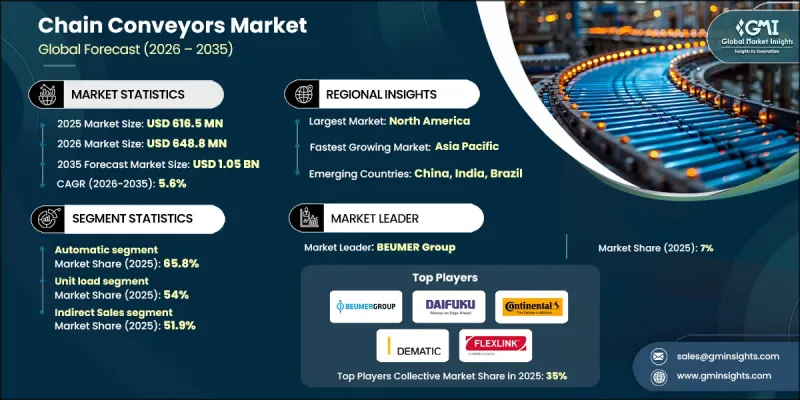
人們對永續供應鏈營運的日益關注,以及對營運效率的需求,正在推動對先進輸送鏈系統的需求。各行各業的公司都在逐步淘汰傳統的人工物料搬運方式,例如堆高機、簡易托盤分揀機和重力式系統,這些方式效率低、勞力密集且對環境不永續。現代鍊式輸送機擴大配備高扭矩、節能型馬達、再生煞車系統和智慧物料輸送機制,可將電力消耗降低30-39%,並顯著減少對環境的影響。這種機械化趨勢在食品飲料、汽車和電子商務物流等行業尤其明顯,這些行業對高吞吐量、快速交付和穩定的物料流至關重要。主要企業之間的併購也在推動創新和擴張,創造出整合解決方案,進一步提升全球供應鏈的效率、可靠性和永續性。
| 市場覆蓋範圍 | |
|---|---|
| 開始年份 | 2025 |
| 預測年份 | 2026-2035 |
| 起始值 | 6.165億美元 |
| 預測金額 | 10.5億美元 |
| 複合年成長率 | 5.6% |
到2025年,自動化鍊式輸送機機市佔率將達到65.8%,創造4.055億美元的收入。自動化鍊式系統透過提高安全性、減少物料輸送誤差來提升生產效率,同時降低對人事費用的依賴。與機器人、感測器和人工智慧的整合,實現了即時監控、預測性維護和自適應控制,從而在高需求環境下最佳化吞吐量。這一轉變反映了「工業4.0」的廣泛應用,智慧工廠和全互聯倉庫優先考慮自動化,以實現卓越營運、節能和縮短週期時間。如今,自動化輸送機已被視為現代配銷中心、大規模生產工廠和加工廠的關鍵基礎設施,因為在這些場所,物料運輸的速度和精確度至關重要。
到2025年,間接銷售通路將佔據51.9%的市場佔有率,凸顯了市場對經銷商、系統整合商和第三方合作夥伴提供專業解決方案的高度依賴。終端用戶更傾向於透過這些管道獲得本地支援、售後服務和維護契約,這對於最大限度地減少大規模運營中的停機時間至關重要。間接通路還能實現快速的零件更換、客製化解決方案以及針對特定運作環境量身訂製的安裝服務。隨著輸送系統技術的日益複雜,第三方整合商在確保無縫實施、系統正確調優和持續技術支援方面發揮關鍵作用,這使得間接銷售成為市場成長的基石。
預計到2025年,美國鍊式輸送機市佔率將達到84.5%,主要得益於倉儲自動化、物流最佳化和電子商務網路擴張的大規模投資。對符合人體工學的操作解決方案和職場安全標準的高需求,正促使企業以自動化鍊式輸送系統取代人工操作。大型配送中心、履約中心和工業廠房的投資,進一步推動了節能、高容量輸送機的應用。此外,企業還利用互聯解決方案來改善庫存管理、減少營運瓶頸並確保及時完成訂單,從而鞏固了美國在全球鍊式輸送機應用領域的領先地位。
目錄
第1章調查方法和範圍
第2章執行摘要
第3章業界考察
- 生態系分析
- 供應商情況
- 利潤率
- 每個階段的附加價值
- 影響價值鏈的因素
- 產業影響因素
- 促進要素
- 電子商務和履約的快速成長
- 工業4.0和智慧製造
- 永續性和能源效率
- 產業潛在風險與挑戰
- 初始投資額高,投資回收期長
- 對遺留網站維修的複雜性
- 機會
- 物聯網與預測性維護的整合
- 模組化和靈活的輸送機設計
- 促進要素
- 成長潛力分析
- 未來市場趨勢
- 科技與創新趨勢
- 當前技術趨勢
- 新興技術
- 價格趨勢
- 按地區
- 透過操作
- 監管環境
- 標準和合規要求
- 區域法規結構
- 認證標準
- 波特五力分析
- PESTEL 分析
第4章 競爭情勢
- 介紹
- 公司市佔率分析
- 按地區
- 企業矩陣分析
- 主要市場公司的競爭分析
- 競爭定位矩陣
- 重大進展
- 併購
- 夥伴關係與合作
- 新產品發布
- 擴張計劃
5. 2022-2035年按營運方式分類的市場估算與預測
- 手動的
- 自動的
- 半自動
第6章 依負載分類的市場估計與預測,2022-2035年
- 散裝貨物
- 單元貨載
第7章 依安裝地點分類的市場估計與預測,2022-2035年
- 地板下植入式
- 落地式
- 吸頂式
8. 2022-2035年按最終用戶產業分類的市場估算與預測
- 食品/飲料
- 製藥
- 汽車與運輸
- 礦業
- 製造業
- 飛機場
- 倉庫和物流中心
- 其他(航運、石油和天然氣等)
9. 2022-2035年按分銷管道分類的市場估算與預測
- 直接地
- 間接
第10章 2022-2035年各地區市場估計與預測
- 北美洲
- 美國
- 加拿大
- 歐洲
- 德國
- 英國
- 法國
- 義大利
- 西班牙
- 亞太地區
- 中國
- 日本
- 印度
- 澳洲
- 韓國
- 拉丁美洲
- 巴西
- 墨西哥
- 阿根廷
- 中東和非洲
- 南非
- 沙烏地阿拉伯
- 阿拉伯聯合大公國
第11章:公司簡介
- BEUMER Group
- Daifuku Co., Ltd.
- Dematic
- Fives
- FlexLink
- Honeywell International Inc
- Hytrol Conveyor Company, Inc.
- Interroll Group
- Kardex
- Regal Rexnord Corporation
- Shuttleworth
- Siemens
- Taikisha Ltd.
- Ultimation Industries, LLC.
- WAMGROUP SpA
The Global Chain Conveyors Market was valued at USD 616.5 million in 2025 and is estimated to grow at a CAGR of 5.6% to reach USD 1.05 billion by 2035.
The rising emphasis on sustainable supply chain operations, coupled with the need for operational efficiency, is fueling demand for advanced conveyor chain systems. Companies across industries are moving away from traditional, manual material handling methods, such as forklifts, basic pallet sorting, and gravity-fed systems, which are less efficient, labor-intensive, and environmentally unsustainable. Modern chain conveyors are increasingly being equipped with high-torque, energy-efficient motors, regenerative braking systems, and smart control mechanisms, capable of reducing power consumption by up to 30-39%, significantly lowering environmental impact. The trend toward mechanization is especially strong in industries such as food & beverage, automotive, and e-commerce logistics, where high throughput, faster delivery, and consistent material flow are critical. Mergers and acquisitions among key players are also driving innovation and expansion, creating integrated solutions that further improve efficiency, reliability, and sustainability of supply chains globally.
| Market Scope | |
|---|---|
| Start Year | 2025 |
| Forecast Year | 2026-2035 |
| Start Value | $616.5 Million |
| Forecast Value | $1.05 Billion |
| CAGR | 5.6% |
In 2025, the automatic chain conveyors segment held 65.8% share, generating USD 405.5 million. Automated chain systems enhance productivity by reducing reliance on manual labor while improving safety and minimizing errors in material handling. Integration with robotics, sensors, and AI enables real-time monitoring, predictive maintenance, and adaptive control, optimizing throughput in high-demand environments. This shift reflects the broader Industry 4.0 adoption, where smart factories and fully connected warehouses prioritize automation to achieve operational excellence, energy savings, and faster cycle times. Automated conveyors are now seen as essential infrastructure in modern distribution centers, high-volume manufacturing plants, and processing facilities that require both speed and precision in material transport.
The indirect sales segment accounted for 51.9% share in 2025, highlighting the reliance on distributors, system integrators, and third-party partners to deliver specialized solutions. End users prefer these channels for localized support, aftermarket services, and maintenance contracts, which are critical for minimizing downtime in high-volume operations. Indirect channels also facilitate rapid part replacements, customized solutions, and installation services tailored to specific operational environments. As conveyor systems become more technologically advanced, third-party integrators play a key role in ensuring seamless deployment, proper system calibration, and ongoing technical assistance, making indirect sales a cornerstone of market growth.
U.S. Chain Conveyors Market held an 84.5% share in 2025, driven by extensive investment in warehouse automation, logistics optimization, and e-commerce network expansion. High demand for ergonomic handling solutions and workplace safety standards encourages companies to replace manual processes with automated chain conveyor systems. Investments in large-scale distribution hubs, fulfillment centers, and industrial plants further support the adoption of energy-efficient and high-capacity conveyors. Additionally, companies are leveraging connected solutions to improve inventory management, reduce operational bottlenecks, and ensure timely order fulfillment, cementing the U.S. as a global leader in chain conveyor deployment.
Key players operating in the Global Chain Conveyors Market include Daifuku Co., Ltd., Siemens, BEUMER Group, Hytrol Conveyor Company, Inc., Interroll Group, Shuttleworth, Honeywell International Inc., FlexLink, Ultimation Industries, LLC., WAMGROUP S.p.A., Kardex, Regal Rexnord Corporation, Taikisha Ltd., Continental AG, and Dematic. Companies in the chain conveyors market are strengthening their position through strategies such as continuous R&D to develop energy-efficient, modular, and high-throughput systems suitable for automated warehouses and production lines. Strategic partnerships with distributors and integrators expand geographic reach while ensuring localized technical support. Firms are investing in AI, IoT, and predictive maintenance technologies to enhance system reliability and reduce operational downtime. Mergers and acquisitions allow them to consolidate expertise, enter new industrial verticals, and offer integrated solutions.
Table of Contents
Chapter 1 Methodology and Scope
- 1.1 Market scope and definition
- 1.2 Research design
- 1.2.1 Research approach
- 1.2.2 Data collection methods
- 1.3 Data mining sources
- 1.3.1 Global
- 1.3.2 Regional/Country
- 1.4 Base estimates and calculations
- 1.4.1 Base year calculation
- 1.4.2 Key trends for market estimation
- 1.5 Primary research and validation
- 1.5.1 Primary sources
- 1.6 Forecast model
- 1.7 Research assumptions and limitations
Chapter 2 Executive Summary
- 2.1 Industry 360° synopsis
- 2.2 Key market trends
- 2.2.1 Regional
- 2.2.2 Operation
- 2.2.3 Load
- 2.2.4 Location
- 2.2.5 End-Use
- 2.2.6 Distribution Channel
- 2.3 CXO perspectives: Strategic imperatives
- 2.3.1 Key decision points for industry executives
- 2.3.2 Critical success factors for market players
- 2.4 Future outlook and strategic recommendations
Chapter 3 Industry Insights
- 3.1 Industry ecosystem analysis
- 3.1.1 Supplier landscape
- 3.1.2 Profit margin
- 3.1.3 Value addition at each stage
- 3.1.4 Factor affecting the value chain
- 3.2 Industry impact forces
- 3.2.1 Growth drivers
- 3.2.1.1 Rapid E-commerce & Fulfillment Growth
- 3.2.1.2 Industry 4.0 & Smart Manufacturing
- 3.2.1.3 Sustainability & Energy Efficiency
- 3.2.2 Industry pitfalls & challenges
- 3.2.2.1 High Initial CAPEX & Long ROI
- 3.2.2.2 Complexity of Retrofitting Legacy Sites
- 3.2.3 Opportunities
- 3.2.3.1 IoT & Predictive Maintenance Integration
- 3.2.3.2 Modular & Flexible Conveyor Design
- 3.2.1 Growth drivers
- 3.3 Growth potential analysis
- 3.4 Future market trends
- 3.5 Technology and innovation landscape
- 3.5.1 Current technological trends
- 3.5.2 Emerging technologies
- 3.6 Price trends
- 3.6.1 By region
- 3.6.2 By Operation
- 3.7 Regulatory landscape
- 3.7.1 Standards and compliance requirements
- 3.7.2 Regional regulatory frameworks
- 3.7.3 Certification standards
- 3.8 Porter's analysis
- 3.9 PESTEL analysis
Chapter 4 Competitive Landscape, 2025
- 4.1 Introduction
- 4.2 Company market share analysis
- 4.2.1 By region
- 4.2.1.1 North America
- 4.2.1.2 Europe
- 4.2.1.3 Asia Pacific
- 4.2.1.4 Latin America
- 4.2.1.5 Middle East and Africa
- 4.2.1 By region
- 4.3 Company matrix analysis
- 4.4 Competitive analysis of major market players
- 4.5 Competitive positioning matrix
- 4.6 Key developments
- 4.6.1 Mergers & acquisitions
- 4.6.2 Partnerships & collaborations
- 4.6.3 New product launches
- 4.6.4 Expansion plans
Chapter 5 Market Estimates and Forecast, By Operation, 2022 - 2035 (USD Million) (Thousand Units)
- 5.1 Key trends
- 5.2 Manual
- 5.3 Automatic
- 5.4 Semi-automatic
Chapter 6 Market Estimates and Forecast, By Load, 2022 - 2035 (USD Million) (Thousand Units)
- 6.1 Key trends
- 6.2 Bulk load
- 6.3 Unit load
Chapter 7 Market Estimates and Forecast, By Location, 2022 - 2035 (USD Million) (Thousand Units)
- 7.1 Key trends
- 7.2 In-floor
- 7.3 On-floor
- 7.4 Overhead
Chapter 8 Market Estimates and Forecast, By End-User Vertical, 2022 - 2035 (USD Million) (Thousand Units)
- 8.1 Key trends
- 8.2 Food & beverages
- 8.3 Pharmaceuticals
- 8.4 Automotive & transport
- 8.5 Mining
- 8.6 Manufacturing
- 8.7 Airport
- 8.8 Warehouses & Logistic Centers
- 8.9 Others (Marine, oil & gas, etc.)
Chapter 9 Market Estimates and Forecast, By Distribution Channel, 2022 - 2035 (USD Million) (Thousand Units)
- 9.1 Key trends
- 9.2 Direct
- 9.3 Indirect
Chapter 10 Market Estimates and Forecast, By Region, 2022 - 2035 (USD Million) (Thousand Units)
- 10.1 Key trends
- 10.2 North America
- 10.2.1 U.S.
- 10.2.2 Canada
- 10.3 Europe
- 10.3.1 Germany
- 10.3.2 UK
- 10.3.3 France
- 10.3.4 Italy
- 10.3.5 Spain
- 10.4 Asia Pacific
- 10.4.1 China
- 10.4.2 Japan
- 10.4.3 India
- 10.4.4 Australia
- 10.4.5 South Korea
- 10.5 Latin America
- 10.5.1 Brazil
- 10.5.2 Mexico
- 10.5.3 Argentina
- 10.6 Middle East and Africa
- 10.6.1 South Africa
- 10.6.2 Saudi Arabia
- 10.6.3 UAE
Chapter 11 Company Profiles
- 11.1 BEUMER Group
- 11.2 Daifuku Co., Ltd.
- 11.3 Dematic
- 11.4 Fives
- 11.5 FlexLink
- 11.6 Honeywell International Inc
- 11.7 Hytrol Conveyor Company, Inc.
- 11.8 Interroll Group
- 11.9 Kardex
- 11.10 Regal Rexnord Corporation
- 11.11 Shuttleworth
- 11.12 Siemens
- 11.13 Taikisha Ltd.
- 11.14 Ultimation Industries, LLC.
- 11.15 WAMGROUP S.p.A.

 輸送秤市場:2026-2032年全球市場預測(以秤類型、技術、容量、精準度等級、銷售管道和最終用戶分類)分類輸送機市場:按分類機類型、設備、驅動類型、皮帶材質和終端用戶產業分類,全球預測,2026-2032年輸送機自動化系統市場:按類型、運作模式、組件、應用和最終用戶產業分類,全球預測,2026-2032年高速輸送機市場按類型、自動化程度、運作模式、驅動系統、負載能力和最終用戶產業分類,全球預測,2026-2032年
 全球振動給料輸送機市場規模、佔有率、趨勢及成長分析報告(2026-2034)全球振動輸送機市場規模、佔有率、趨勢和成長分析報告(2026-2034)
 日本工業輸送系統市場規模、佔有率、趨勢及預測(按類型、承載能力、運作類型、最終用途產業及地區分類),2026-2034年日本智慧輸送系統市場規模、佔有率、趨勢及預測(按組件、產品類型、技術、自動化程度、產業領域及地區分類),2026-2034年
 2026年全球包裝輸送機市場報告2026年全球輸送機系統市場報告