


 |
市場調查報告書
商品編碼
1936628
船舶推進引擎市場機會、成長要素、產業趨勢分析及預測(2026年至2035年)Marine Propulsion Engine Market Opportunity, Growth Drivers, Industry Trend Analysis, and Forecast 2026 - 2035 |
||||||

全球船舶推進引擎市場預計到 2025 年將達到 226 億美元,到 2035 年將達到 329 億美元,年複合成長率為 3.8%。
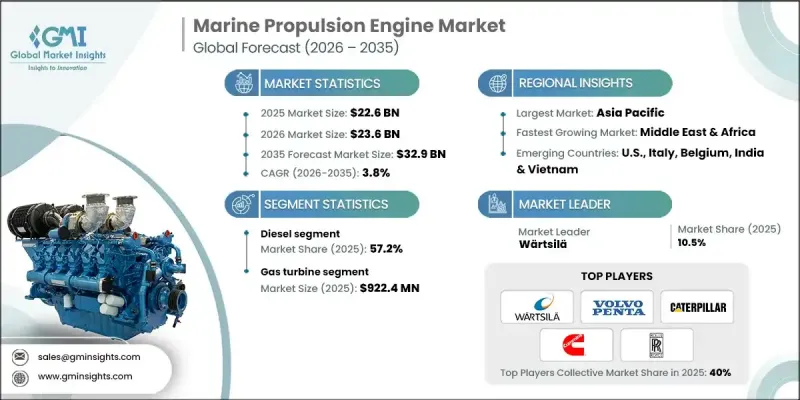
全球範圍內為減少海上作業排放而不斷加大力度,推動了市場成長,迫使船隊營運商重新評估推進技術,以滿足長期監管要求。市場需求正轉向更清潔、更有效率的推進系統,這些系統能夠運作替代燃料和低碳燃料,同時保持可靠性和動力性能。船舶推進引擎作為核心機械系統,透過整合推進組件將能量轉化為可控運動,從而產生船舶航行所需的推力。全球貿易量的成長和航線的延長,促使人們需要更耐用、更有效率、性能更穩定的引擎。商業、海上和政府部門針對老舊船舶的船隊更新計劃,推動了對數位化先進推進平台的投資。整合即時監控、數據分析和預測性維護功能的智慧引擎架構正日益受到重視,以提高運作和全生命週期效率。船東也傾向於靈活的推進配置,這種配置能夠在不影響耐用性和運作穩定性的前提下,可支援燃料適應性。
| 市場覆蓋範圍 | |
|---|---|
| 開始年份 | 2025 |
| 預測年份 | 2026-2035 |
| 起始值 | 226億美元 |
| 預測金額 | 329億美元 |
| 複合年成長率 | 3.8% |
預計2035年,風能和太陽能船舶推進引擎市場規模將達15億美元。混合動力推進架構將可再生能源與船上儲能和控制系統結合,隨著營運商尋求在低負載運轉條件下最佳化燃料利用,混合動力推進架構正日益受到青睞。先進的能源管理框架在改善負載平衡和排放性能的同時,也支援更有效率的航程規劃。
預計2025年,燃料電池船用推進引擎市佔率將達到3.9%。隨著船舶營運商為遵守不斷變化的環境法規而尋求零排放推進方案,燃料電池的應用正在逐漸增加。可擴展的系統設計和模組化整合方法能夠實現逐步部署,同時確保運行冗餘並適應各種船舶需求。
預計到2025年,美國船舶推進引擎市場將佔據68.6%的市場佔有率,市場規模達22億美元。這一成長主要得益於國內海事活動的增加,包括沿海航運、內河航運和近海作業,從而推動了對高效高性能推進系統的需求。此外,造船業,特別是商船和軍艦的大量投資,也進一步促進了市場擴張,因為新船擴大採用低排放氣體和數位化技術的引擎。
目錄
第1章調查方法和範圍
第2章執行摘要
第3章業界考察
- 生態系分析
- 原物料供應及採購分析
- 製造能力評估
- 供應鏈韌性與風險因素
- 配電網路分析
- 監管環境
- 產業影響因素
- 促進要素
- 產業潛在風險與挑戰
- 成長潛力分析
- 波特五力分析
- PESTEL 分析
- 船用推進引擎成本結構分析
- 價格趨勢分析
- 依產品
- 按地區
- 新的機會與趨勢
- 數位化和物聯網整合
第4章 競爭情勢
- 介紹
- 按地區分類的公司市佔率分析
- 北美洲
- 歐洲
- 亞太地區
- 中東和非洲
- 拉丁美洲
- 戰略儀錶板
- Key partnerships &collaborations
- Major M&A activities
- Product innovations &launches
- Market expansion strategies
- 策略舉措
- 競爭標竿分析
- 創新與科技趨勢
第5章 2022-2035年依產品分類的市場規模及預測
- 柴油引擎
- 風能/太陽能
- 燃氣渦輪機
- 燃料電池
- 蒸氣渦輪
- 天然氣
第6章 2022-2035年各地區市場規模及預測
- 北美洲
- 美國
- 加拿大
- 歐洲
- 德國
- 英國
- 義大利
- 法國
- 俄羅斯
- 丹麥
- 荷蘭
- 亞太地區
- 中國
- 日本
- 印度
- 韓國
- 澳洲
- 越南
- 新加坡
- 中東和非洲
- 沙烏地阿拉伯
- 阿拉伯聯合大公國
- 伊朗
- 安哥拉
- 埃及
- 南非
- 拉丁美洲
- 巴西
- 阿根廷
- 墨西哥
第7章 公司簡介
- AB Volvo Penta
- Anglo Belgian Corporation
- Caterpillar
- Cummins
- Deere &Company
- Deutz AG
- HD Hyundai Heavy Industries Engine &Machinery
- Ingeteam
- Isuzu Motors Engine Sales
- Masson Marine
- Mitsubishi Heavy Industries
- Nanni
- Perkins Engines
- Rolls-Royce
- Scania
- Steyr
- Vetus
- Wartsila
- Yamaha Motor
- Yanmar Marine International
The Global Marine Propulsion Engine Market was valued at USD 22.6 billion in 2025 and is estimated to grow at a CAGR of 3.8% to reach USD 32.9 billion by 2035.
Market growth is shaped by the intensifying global push to lower emissions across maritime operations, prompting fleet operators to reassess propulsion technologies for long-term regulatory alignment. Demand is shifting toward cleaner, more efficient propulsion systems capable of operating on alternative and low-carbon fuels while maintaining reliability and power output. Marine propulsion engines serve as the core mechanical systems that generate thrust for vessel movement by converting energy into controlled motion through integrated propulsion components. Rising global trade volumes and extended shipping routes are reinforcing the need for engines that deliver greater endurance, efficiency, and performance consistency. Fleet renewal programs targeting aging vessels across commercial, offshore, and government segments are driving investment in digitally advanced propulsion platforms. Intelligent engine architectures that incorporate real-time monitoring, data analytics, and predictive maintenance capabilities are increasingly prioritized to improve uptime and lifecycle efficiency. Shipowners are also favoring flexible propulsion configurations that support fuel adaptability without compromising durability or operational stability.
| Market Scope | |
|---|---|
| Start Year | 2025 |
| Forecast Year | 2026-2035 |
| Start Value | $22.6 Billion |
| Forecast Value | $32.9 Billion |
| CAGR | 3.8% |
The wind and solar-based marine propulsion engine segment is projected to reach USD 1.5 billion by 2035. Hybridized propulsion architectures that combine renewable inputs with onboard energy storage and control systems are gaining traction as operators seek to optimize fuel usage during low-demand operating conditions. Advanced energy management frameworks are improving load balancing and emissions performance while supporting more efficient voyage planning.
The fuel cell-based marine propulsion engines segment accounted for a 3.9% share in 2025. Adoption is gradually increasing as vessel operators pursue zero-emission propulsion options aligned with evolving environmental mandates. Scalable system designs and modular integration approaches are enabling gradual deployment while ensuring operational redundancy and adaptability to different vessel requirements.
United States Marine Propulsion Engine Market held a 68.6% share in 2025, generating USD 2.2 billion. This growth is being fueled by increasing domestic maritime activity, including coastal shipping, inland waterways, and offshore operations, which are driving demand for efficient, high-performance propulsion systems. Substantial investments in shipbuilding, particularly for commercial and naval fleets, are further bolstering market expansion, as new vessels are increasingly being equipped with low-emission, digitally enabled engines.
Key participants active in the Global Marine Propulsion Engine Market include Wartsila, Caterpillar, Rolls-Royce, Yanmar Marine International, Cummins, AB Volvo Penta, Mitsubishi Heavy Industries, Scania, Deutz AG, HD Hyundai Heavy Industries Engine & Machinery, Yamaha Motor, Perkins Engines, Anglo Belgian Corporation, Vetus, Nanni, Masson Marine, Ingeteam, Steyr, Deere & Company, and Isuzu Motors Engine Sales. These companies maintain competitive positioning through innovation, portfolio diversification, and global service networks. To strengthen their foothold in pharmaceutical and healthcare-related marine applications, propulsion engine manufacturers are prioritizing reliability, precision control, and low-emission performance. Companies are developing propulsion solutions optimized for vessels supporting medical logistics, offshore healthcare access, and temperature-sensitive cargo transport. Strategic investments focus on noise reduction, vibration control, and stable power delivery to protect sensitive onboard equipment. Manufacturers are also expanding service agreements and remote diagnostics to ensure uninterrupted operations in critical missions.
Table of Contents
Chapter 1 Methodology & Scope
- 1.1 Research approach
- 1.2 Quality commitments
- 1.2.1 GMI AI policy & data integrity commitment
- 1.2.1.1 Source consistency protocol
- 1.2.1 GMI AI policy & data integrity commitment
- 1.3 Research trail & confidence scoring
- 1.3.1 Research trail components
- 1.3.2 Scoring components
- 1.4 Data collection
- 1.4.1 Partial list of primary sources
- 1.5 Data mining sources
- 1.5.1 Paid sources
- 1.5.1.1 Sources, by region
- 1.5.1 Paid sources
- 1.6 Base estimates and calculations
- 1.6.1 Base year calculation for any one approach
- 1.7 Market estimates & forecasts parameters
- 1.8 Forecast model
- 1.8.1 Quantified market impact analysis
- 1.8.1.1 Mathematical impact of growth parameters on forecast
- 1.8.1 Quantified market impact analysis
- 1.9 Research transparency addendum
- 1.9.1 Source attribution framework
- 1.9.2 Quality assurance metrics
- 1.9.3 Our commitment to trust
- 1.10 Market definitions
Chapter 2 Executive Summary
- 2.1 Industry synopsis, 2022 - 2035
- 2.2 Business trends
- 2.3 Product trends
- 2.4 Regional trends
Chapter 3 Industry Insights
- 3.1 Industry ecosystem analysis
- 3.1.1 Raw material availability & sourcing analysis
- 3.1.2 Manufacturing capacity assessment
- 3.1.3 Supply chain resilience & risk factors
- 3.1.4 Distribution network analysis
- 3.2 Regulatory landscape
- 3.3 Industry impact forces
- 3.3.1 Growth drivers
- 3.3.2 Industry pitfalls & challenges
- 3.4 Growth potential analysis
- 3.5 Porter's analysis
- 3.5.1 Bargaining power of suppliers
- 3.5.2 Bargaining power of buyers
- 3.5.3 Threat of new entrants
- 3.5.4 Threat of substitutes
- 3.6 PESTEL analysis
- 3.6.1 Political factors
- 3.6.2 Economic factors
- 3.6.3 Social factors
- 3.6.4 Technological factors
- 3.6.5 Legal factors
- 3.6.6 Environmental factors
- 3.7 Cost structure analysis of marine propulsion engine
- 3.8 Price trend analysis
- 3.8.1 By product
- 3.8.2 By region
- 3.9 Emerging opportunities & trends
- 3.10 Digitalization and IoT integration
Chapter 4 Competitive Landscape, 2026
- 4.1 Introduction
- 4.2 Company market share analysis, by region, 2025
- 4.2.1 North America
- 4.2.2 Europe
- 4.2.3 Asia Pacific
- 4.2.4 Middle East & Africa
- 4.2.5 Latin America
- 4.3 Strategic dashboard
- 4.3.1 Key partnerships & collaborations
- 4.3.2 Major M&A activities
- 4.3.3 Product innovations & launches
- 4.3.4 Market expansion strategies
- 4.4 Strategic initiatives
- 4.5 Competitive benchmarking
- 4.6 Innovation & technology landscape
Chapter 5 Market Size and Forecast, By Product, 2022 - 2035 (USD Million)
- 5.1 Key trends
- 5.2 Diesel
- 5.3 Wind & solar
- 5.4 Gas turbine
- 5.5 Fuel cell
- 5.6 Steam turbine
- 5.7 Natural gas
Chapter 6 Market Size and Forecast, By Region, 2022 - 2035 (USD Million)
- 6.1 Key trends
- 6.2 North America
- 6.2.1 U.S.
- 6.2.2 Canada
- 6.3 Europe
- 6.3.1 Germany
- 6.3.2 UK
- 6.3.3 Italy
- 6.3.4 France
- 6.3.5 Russia
- 6.3.6 Denmark
- 6.3.7 Netherlands
- 6.4 Asia Pacific
- 6.4.1 China
- 6.4.2 Japan
- 6.4.3 India
- 6.4.4 South Korea
- 6.4.5 Australia
- 6.4.6 Vietnam
- 6.4.7 Singapore
- 6.5 Middle East & Africa
- 6.5.1 Saudi Arabia
- 6.5.2 UAE
- 6.5.3 Iran
- 6.5.4 Angola
- 6.5.5 Egypt
- 6.5.6 South Africa
- 6.6 Latin America
- 6.6.1 Brazil
- 6.6.2 Argentina
- 6.6.3 Mexico
Chapter 7 Company Profiles
- 7.1 AB Volvo Penta
- 7.2 Anglo Belgian Corporation
- 7.3 Caterpillar
- 7.4 Cummins
- 7.5 Deere & Company
- 7.6 Deutz AG
- 7.7 HD Hyundai Heavy Industries Engine & Machinery
- 7.8 Ingeteam
- 7.9 Isuzu Motors Engine Sales
- 7.10 Masson Marine
- 7.11 Mitsubishi Heavy Industries
- 7.12 Nanni
- 7.13 Perkins Engines
- 7.14 Rolls-Royce
- 7.15 Scania
- 7.16 Steyr
- 7.17 Vetus
- 7.18 Wartsila
- 7.19 Yamaha Motor
- 7.20 Yanmar Marine International

 2026-2034年全球混合動力和純電動船舶推進系統市場規模、佔有率、趨勢和成長分析報告
 船舶推進引擎市場:2026-2032年全球市場預測(按引擎類型、功率輸出、引擎佈置、安裝方式、引擎轉速等級、船舶類型和最終用戶分類)
 船舶吊艙驅動市場規模、佔有率和成長分析:按推進系統、功率輸出、安裝配置、船舶類型、銷售管道和地區分類-產業預測,2026-2033年
 船舶推進引擎市場:按引擎類型、功率輸出、燃料類型和地區分類。
 船舶推進系統市場:商業機會、成長要素、產業趨勢分析及2026-2035年預測電動船舶吊艙推進器市場:按船舶類型、推進系統、應用和終端用戶產業分類-全球預測,2026-2032年
 2026年全球船舶推進引擎市場報告
 船舶推進引擎市場-全球產業規模、佔有率、趨勢、機會、預測:按引擎類型、應用、船舶類型、地區和競爭對手分類,2021-2031年
 船舶推進引擎市場規模、佔有率和成長分析(按燃料類型、應用、船舶類型和地區分類)—產業預測(2026-2033 年)船舶推進及輔助動力市場-全球產業規模、佔有率、趨勢、機會及預測,依燃料類型、應用、功率等級、船舶類型、地區及競爭格局分類,2020-2030年預測