


 |
市場調查報告書
商品編碼
1936626
磺酸鹽聚合物市場機會、成長要素、產業趨勢分析及2026年至2035年預測Sulfone Polymers Market Opportunity, Growth Drivers, Industry Trend Analysis, and Forecast 2026 - 2035 |
||||||

全球磺酸鹽聚合物市場預計到 2025 年將達到 21 億美元,到 2035 年將達到 36 億美元,年複合成長率為 5.6%。
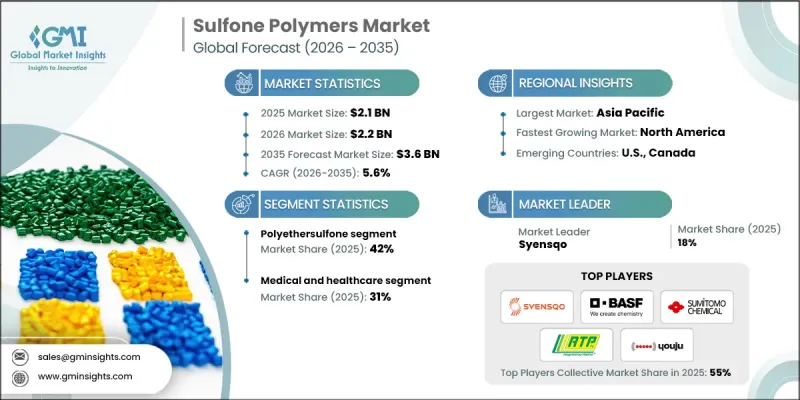
該市場涵蓋聚碸(PSU)、聚醚碸(PESU)、聚苯碸(PPSU) 和聚醚醯亞胺 (PEI) 的收入,這些產品以原生顆粒、膜級粉末和複合配方的形式供應。定價受多種因素影響,例如分子量分佈、材料純度、滅菌認證、阻燃等級以及食品和水接觸認證,其中特種等級的產品價格通常高出 20-40%。由於這些等級產品的高附加價值特性,即使需求略微轉向醫療和膜應用領域,也可能對收入產生不成比例的影響。在醫療領域,生物相容性、滅菌耐久性和長壽命性能是買家優先考慮的因素,而 PPSU 醫療組件可以承受多次蒸氣滅菌循環。在水處理領域,薄膜性能(包括通量效率和污垢恢復能力)至關重要,而基於 PES 的薄膜已展現出高通量和清洗後快速恢復的特性。在電子和航太產業中,高玻璃化轉變溫度、尺寸穩定性和熱變形溫度能夠滿足嚴苛環境下的關鍵應用需求,進而推動穩定的需求和高產品良率。高性能材料的特性以及滿足嚴格監管標準的能力,正在推動其在全球多個行業的市場擴張。
| 市場覆蓋範圍 | |
|---|---|
| 開始年份 | 2025 |
| 預測年份 | 2026-2035 |
| 起始值 | 21億美元 |
| 預測金額 | 36億美元 |
| 複合年成長率 | 5.6% |
預計到2025年,聚醚碸(PESU)市佔率將達到42%。 PESU具有均衡的性能成本比,加上其親水性、優異的耐化學性和高達220°C的熱穩定性,使其非常適合用於水過濾、血液透析和工業分離膜。市售PESU粉末的分子量範圍為45,000至68,000,其設計兼顧了溶解性和易於膜製備的特性。
預計到2025年,電子電氣應用領域將佔據22%的市場佔有率,這主要得益於磺酸鹽聚合物的熱穩定性、耐化學性和精確的尺寸控制。這些材料擴大應用於電子元件、絕緣模組以及需要在高溫環境下運作並能保持性能公差的組件中,即使在高化學腐蝕條件下也能如此。對於照明應用而言,具有透明性和紫外線穩定性的碸類聚合物也是首選,因為這些應用對長期可靠性和耐熱劣化要求極高。磺酸鹽聚合物的多功能性和在嚴苛工作環境下的優異性能,使其在各種工業應用中得到更廣泛的應用。
預計到2025年,北美磺酸鹽聚合物市佔率將達到27%。這項強勁的區域需求主要得益於先進的醫療設備製造、嚴格的醫療品質標準以及蓬勃發展的航太業。包括FDA核准和ASTM醫療應用標準在內的法規結構,為磺酸鹽聚合物在關鍵醫療器材中的應用提供了支持。為減少廢棄物和降低單次手術成本,可重複使用醫療設備的普及進一步提升了耐滅菌材料(如PSU和PPSU)的吸引力。此外,美國和加拿大航太製造業的集中,以及其龐大的供應鏈和工業基礎,也推動了對航太磺酸鹽聚合物的需求。
目錄
第1章調查方法和範圍
第2章執行摘要
第3章業界考察
- 生態系分析
- 供應商情況
- 利潤率
- 每個階段的附加價值
- 影響價值鏈的因素
- 中斷
- 產業影響因素
- 促進要素
- 產業潛在風險與挑戰
- 市場機遇
- 成長潛力分析
- 監管環境
- 北美洲
- 歐洲
- 亞太地區
- 拉丁美洲
- 中東和非洲
- 波特五力分析
- PESTEL 分析
- 價格趨勢
- 按地區
- 未來市場趨勢
- 科技與創新趨勢
- 當前技術趨勢
- 新興技術
- 專利狀態
- 貿易統計(HS編碼)(註:僅提供主要國家的貿易統計)
- 主要進口國
- 主要出口國
- 永續性和環境方面
- 永續努力
- 減少廢棄物策略
- 生產中的能源效率
- 環保舉措
- 碳足跡考量
第4章 競爭情勢
- 介紹
- 公司市佔率分析
- 按地區
- 北美洲
- 歐洲
- 亞太地區
- 拉丁美洲
- 中東和非洲
- 按地區
- 企業矩陣分析
- 主要市場公司的競爭分析
- 競爭定位矩陣
- 重大進展
- 併購
- 夥伴關係與合作
- 新產品發布
- 擴張計劃
第5章 2022-2035年依產品分類的市場規模及預測
- 聚碸(PSU)
- 聚醚碸(PESU)
- 聚苯碸(PPSU)
- 聚醚醯亞胺(PEI)
- 其他
第6章 依性能等級分類的市場規模及預測,2022-2035年
- 標準級/商業級
- 醫療/保健等級
- 食品接觸級
- 航太級
- 阻燃等級
- 其他
7. 依最終用途產業分類的市場規模及預測,2022-2035年
- 醫療保健
- 醫院及透析中心
- 醫療設備製造商
- 製藥加工設備
- 航太
- 商業航空
- 軍用/國防飛機
- 空間應用
- 車
- 內燃機(ICE)車輛
- 電動車(EV)
- 混合動力汽車
- 電氣和電子設備
- 家用電子電器
- 半導體製造
- 資料中心伺服器
- 5G基礎設施
- 水和污水處理
- 地方政府業務
- 工業水處理
- 海水淡化廠
- 食品/飲料加工
- 食品加工設備製造商
- 商用廚房/餐廳
- 電器產品
- 工業和製造業
- 管道和空調設備
- 化學處理設備
- 石油和天然氣應用
- 能源與氫能經濟
- 燃料電池製造商
- 電解設備製造商
- 氫能基礎設施建設
- 其他
第8章 2022-2035年各地區市場規模及預測
- 北美洲
- 美國
- 加拿大
- 歐洲
- 英國
- 德國
- 法國
- 義大利
- 西班牙
- 其他歐洲地區
- 亞太地區
- 中國
- 印度
- 日本
- 韓國
- 澳洲
- 亞太其他地區
- 拉丁美洲
- 巴西
- 墨西哥
- 阿根廷
- 其他拉丁美洲地區
- 中東和非洲
- 南非
- 沙烏地阿拉伯
- 阿拉伯聯合大公國
- 其他中東和非洲地區
第9章:公司簡介
- RTP Company
- Youju New Materials
- BASF SE
- SABIC
- Solvay
- Sumitomo Chemical
- Shandong Haoran Special Plastic
- Syensqo
- Mitsubishi Gas Chemical Company
- Atul Ltd
- Avient Corporation
- Ovation Polymers
- ASEP Industries Sdn Bhd
- Aurorium
- 3DXTech
- Foshan Plolima Material
The Global Sulfone Polymers Market was valued at USD 2.1 billion in 2025 and is estimated to grow at a CAGR of 5.6% to reach USD 3.6 billion by 2035.
The market includes revenue generated from polysulfone (PSU), polyethersulfone (PESU), polyphenylsulfone (PPSU), and polyetherimide (PEI), offered as virgin pellets, membrane-grade powders, and compounded formulations. Pricing structures are influenced by factors such as molecular weight distribution, material purity, sterilization certifications, flame-retardant ratings, and approvals for food and water contact, which can command 20-40% premiums for specialized grades. Even small shifts in volume toward healthcare or membrane applications can have a disproportionate impact on revenue due to the high-value nature of these grades. In the healthcare sector, buyers prioritize biocompatibility, sterilization durability, and long lifecycle performance, which allow PPSU medical components to withstand multiple steam cycles. In water treatment, membrane performance, including flux efficiency and fouling recovery, is critical, and PES-based membranes have demonstrated high throughput with rapid recovery after cleaning. In electronics and aerospace, high glass transition temperatures, dimensional stability, and heat deflection capabilities support critical applications under extreme conditions, driving consistent demand and higher per-unit revenue. The combination of high-performance material properties and the ability to meet stringent regulatory standards is fueling global market expansion across multiple industries.
| Market Scope | |
|---|---|
| Start Year | 2025 |
| Forecast Year | 2026-2035 |
| Start Value | $2.1 Billion |
| Forecast Value | $3.6 Billion |
| CAGR | 5.6% |
The polyethersulfone segment held 42% share in 2025. Its balanced property-to-cost ratio, combined with hydrophilic behavior, excellent chemical resistance, and thermal stability up to 220°C, makes PESU highly suitable for water filtration, hemodialysis, and industrial separation membranes. Commercial powders of PESU, with molecular weights ranging from 45,000 to 68,000, are designed for ease of dissolution and membrane fabrication.
The electronics and electrical applications segment held 22% share in 2025, leveraging sulfone polymers' thermal stability, chemical resistance, and precise dimensional control. These materials are increasingly used in high-temperature electronic components, insulating modules, and assemblies where chemical exposure is high, but tolerances must be maintained. Transparent and UV-stable grades are also favored in lighting applications where long-term reliability and resistance to heat degradation are essential. The versatility of sulfone polymers, coupled with their performance in demanding operating environments, continues to reinforce their adoption across diverse industrial applications.
North America Sulfone Polymers Market represented 27% share in 2025. The strong regional demand is driven by advanced medical device manufacturing, strict healthcare quality standards, and a robust aerospace sector. Regulatory frameworks, including FDA recognition and ASTM standards for medical applications, support the use of sulfone polymers for critical devices. Emphasis on reusable medical devices to reduce waste and per-procedure costs further enhances the appeal of sterilization-resistant materials such as PSU and PPSU. The concentration of aerospace manufacturing in the U.S. and Canada, supported by extensive supply chains and large-scale industrial operations, also fuels demand for aerospace-grade sulfone polymers.
Key players operating in the Global Sulfone Polymers Market include Shandong Haoran Special Plastic, Mitsubishi Gas Chemical Company, RTP Company, Sumitomo Chemical, BASF SE, SABIC, Youju New Materials, Syensqo, Atul Ltd, and Solvay. To strengthen their presence, companies in the sulfone polymers industry are adopting multiple strategic initiatives. They are investing heavily in research and development to produce polymers with superior thermal, chemical, and sterilization performance, tailored for healthcare, aerospace, and membrane applications. Strategic collaborations, joint ventures, and mergers allow firms to expand their geographical footprint, access new customer segments, and improve supply chain efficiency. Many companies are optimizing production processes to reduce costs while enhancing material purity and performance. Firms are also focusing on regulatory compliance, obtaining medical and industrial certifications to improve credibility and customer trust. Advanced digital platforms for material testing, real-time quality monitoring, and customer support further enhance operational efficiency.
Table of Contents
Chapter 1 Methodology & Scope
- 1.1 Market scope and definition
- 1.2 Research design
- 1.2.1 Research approach
- 1.2.2 Data collection methods
- 1.3 Data mining sources
- 1.3.1 Global
- 1.3.2 Regional/Country
- 1.4 Base estimates and calculations
- 1.4.1 Base year calculation
- 1.4.2 Key trends for market estimation
- 1.5 Primary research and validation
- 1.5.1 Primary sources
- 1.6 Forecast model
- 1.7 Research assumptions and limitations
Chapter 2 Executive Summary
- 2.1 Industry 3600 synopsis
- 2.2 Key market trends
- 2.2.1 Product
- 2.2.2 Performance grade
- 2.2.3 End use industry
- 2.3 TAM analysis, 2025-2034
- 2.4 CXO perspectives: Strategic imperatives
- 2.4.1 Executive decision points
- 2.4.2 Critical success factors
- 2.5 Outlook and strategic recommendations
Chapter 3 Industry Insights
- 3.1 Industry ecosystem analysis
- 3.1.1 Supplier landscape
- 3.1.2 Profit margin
- 3.1.3 Value addition at each stage
- 3.1.4 Factor affecting the value chain
- 3.1.5 Disruptions
- 3.2 Industry impact forces
- 3.2.1 Growth drivers
- 3.2.2 Industry pitfalls and challenges
- 3.2.3 Market opportunities
- 3.3 Growth potential analysis
- 3.4 Regulatory landscape
- 3.4.1 North America
- 3.4.2 Europe
- 3.4.3 Asia Pacific
- 3.4.4 Latin America
- 3.4.5 Middle East & Africa
- 3.5 Porter's analysis
- 3.6 PESTEL analysis
- 3.7 Price trends
- 3.7.1 By region
- 3.8 Future market trends
- 3.9 Technology and innovation landscape
- 3.9.1 Current technological trends
- 3.9.2 Emerging technologies
- 3.10 Patent landscape
- 3.11 Trade statistics (HS code) (Note: the trade statistics will be provided for key countries only)
- 3.11.1 Major importing countries
- 3.11.2 Major exporting countries
- 3.12 Sustainability and environmental aspects
- 3.12.1 Sustainable practices
- 3.12.2 Waste reduction strategies
- 3.12.3 Energy efficiency in production
- 3.12.4 Eco-friendly initiatives
- 3.13 Carbon footprint considerations
Chapter 4 Competitive Landscape, 2025
- 4.1 Introduction
- 4.2 Company market share analysis
- 4.2.1 By region
- 4.2.1.1 North America
- 4.2.1.2 Europe
- 4.2.1.3 Asia Pacific
- 4.2.1.4 Latin America
- 4.2.1.5 Middle East & Africa
- 4.2.1 By region
- 4.3 Company matrix analysis
- 4.4 Competitive analysis of major market players
- 4.5 Competitive positioning matrix
- 4.6 Key developments
- 4.6.1 Mergers & acquisitions
- 4.6.2 Partnerships & collaborations
- 4.6.3 New product launches
- 4.6.4 Expansion plans
Chapter 5 Market Size and Forecast, By Product, 2022-2035 (USD Billion, Kilo Tons)
- 5.1 Key trends
- 5.2 Polysulfone (PSU)
- 5.3 Polyethersulfone (PESU)
- 5.4 Polyphenylsulfone (PPSU)
- 5.5 Polyetherimide (PEI)
- 5.6 Others
Chapter 6 Market Size and Forecast, By Performance Grade, 2022-2035 (USD Billion, Kilo Tons)
- 6.1 Key trends
- 6.2 Standard/commercial grade
- 6.3 Medical/healthcare grade
- 6.4 Food contact grade
- 6.5 Aerospace grade
- 6.6 Flame retardant grade
- 6.7 Others
Chapter 7 Market Size and Forecast, By End Use Industry , 2022-2035 (USD Billion, Kilo Tons)
- 7.1 Key trends
- 7.2 Medical & healthcare
- 7.2.1 Hospitals & dialysis centers
- 7.2.2 Medical device manufacturers
- 7.2.3 Pharmaceutical processing equipment
- 7.3 Aerospace
- 7.3.1 Commercial aviation
- 7.3.2 Military & defense aircraft
- 7.3.3 Space applications
- 7.4 Automotive
- 7.4.1 Internal combustion engine (ICE) vehicles
- 7.4.2 Electric vehicles (EVs)
- 7.4.3 Hybrid vehicles
- 7.5 Electrical & electronics
- 7.5.1 Consumer electronics
- 7.5.2 Semiconductor manufacturing
- 7.5.3 Data centers & servers
- 7.5.4 5g infrastructure
- 7.6 Water & wastewater treatment
- 7.6.1 Municipal utilities
- 7.6.2 Industrial water treatment
- 7.6.3 Desalination plants
- 7.7 Food & beverage processing
- 7.7.1 Food processing equipment manufacturers
- 7.7.2 Commercial kitchens & restaurants
- 7.7.3 Household appliances
- 7.8 Industrial & manufacturing
- 7.8.1 Plumbing & HVAC
- 7.8.2 Chemical processing equipment
- 7.8.3 Oil & gas applications
- 7.9 Energy & hydrogen economy
- 7.9.1 Fuel cell manufacturers
- 7.9.2 Electrolyzer manufacturers
- 7.9.3 Hydrogen infrastructure development
- 7.10 Others
Chapter 8 Market Size and Forecast, By Region, 2022-2035 (USD Billion, Kilo Tons)
- 8.1 Key trends
- 8.2 North America
- 8.2.1 U.S.
- 8.2.2 Canada
- 8.3 Europe
- 8.3.1 UK
- 8.3.2 Germany
- 8.3.3 France
- 8.3.4 Italy
- 8.3.5 Spain
- 8.3.6 Rest of Europe
- 8.4 Asia Pacific
- 8.4.1 China
- 8.4.2 India
- 8.4.3 Japan
- 8.4.4 South Korea
- 8.4.5 Australia
- 8.4.6 Rest of Asia Pacific
- 8.5 Latin America
- 8.5.1 Brazil
- 8.5.2 Mexico
- 8.5.3 Argentina
- 8.5.4 Rest of Latin America
- 8.6 Middle East & Africa
- 8.6.1 South Africa
- 8.6.2 Saudi Arabia
- 8.6.3 UAE
- 8.6.4 Rest of Middle East & Africa
Chapter 9 Company Profiles
- 9.1 RTP Company
- 9.2 Youju New Materials
- 9.3 BASF SE
- 9.4 SABIC
- 9.5 Solvay
- 9.6 Sumitomo Chemical
- 9.7 Shandong Haoran Special Plastic
- 9.8 Syensqo
- 9.9 Mitsubishi Gas Chemical Company
- 9.10 Atul Ltd
- 9.11 Avient Corporation
- 9.12 Ovation Polymers
- 9.13 ASEP Industries Sdn Bhd
- 9.14 Aurorium
- 9.15 3DXTech
- 9.16 Foshan Plolima Material

 磺酸鹽聚合物市場:全球市場按產品類型、形態、加工技術和應用分類的預測-2026-2032年
 全球磺酸鹽聚合物市場規模、佔有率、趨勢及成長分析報告(2026-2034年)
 聚碸市場規模、佔有率和成長分析(按類型、等級、應用、最終用途產業和地區分類)-2026-2033年產業預測
 磺酸鹽聚醚碸:全球市佔率及排名、總營收及需求預測(2025-2031年)
 苯基三溴磺酸鹽的全球市場聚碸的全球市場碸類聚合物市場(按類型、應用和地區分類),2026 年至 2032 年
 磺酸鹽聚合物市場:依產品類型、應用和地區分類
 聚苯碸市場報告:趨勢、預測和競爭分析(至 2031 年)聚醚碸市場報告:趨勢、預測和競爭分析(至 2031 年)