


 |
市場調查報告書
商品編碼
1936625
麥芽配料市場機會、成長要素、產業趨勢分析及預測(2026年至2035年)Malt Ingredients Market Opportunity, Growth Drivers, Industry Trend Analysis, and Forecast 2026 - 2035 |
||||||

全球麥芽配料市場預計到 2025 年將達到 260 億美元,到 2035 年將達到 434 億美元,年複合成長率為 5.4%。
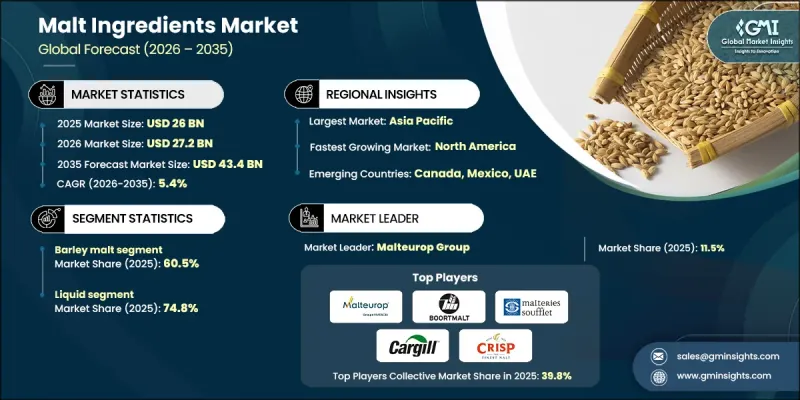
在釀造、蒸餾和食品產業需求不斷成長的推動下,市場持續成長。麥芽由大麥和其他穀物發芽和乾燥製成,為啤酒、烈酒和機能性食品提供必需的可發酵糖、風味和營養成分。在頂級烈酒和威士忌領域,由於消費者對陳年和特色酒精飲料的偏好日益成長,對優質麥芽的需求也不斷增加。除了酒精飲料領域,富含維生素、礦物質和抗氧化劑的麥芽萃取物在營養補充劑和機能性食品領域也越來越受歡迎。麥芽製造技術的進步,例如自動化發芽和精確控制的乾燥,使生產商能夠生產具有特定風味和功能的特殊麥芽,從而提高效率和產品品質。這些進步使市場能夠在滿足傳統釀造和新興健康應用領域不斷成長的需求的同時,保持永續性和生產的穩定性。
| 市場覆蓋範圍 | |
|---|---|
| 開始年份 | 2025 |
| 預測年份 | 2026-2035 |
| 起始值 | 260億美元 |
| 預測金額 | 434億美元 |
| 複合年成長率 | 5.4% |
預計到2025年,麥芽大麥市佔率將達到60.5%,並在2035年之前以5.3%的複合年成長率成長,這主要得益於其在釀造行業的廣泛應用(提供必要的風味、色澤和可發酵糖)。麥芽大麥天然的酵素活性、豐富的營養成分以及在釀造和食品加工領域長期以來的廣泛應用,使其保持了市場主導地位,成為全球麥芽生產商的首選原料。
預計液態麥芽原料市場將維持強勁成長,2025年將佔74.8%的市佔率。液態麥芽因其用途廣泛、易於使用,在釀造、蒸餾和食品行業中廣受歡迎。它無需對設備進行重大調整即可無縫整合到生產線中,從而提高了效率並降低了操作複雜性,推動了其在工業流程中的廣泛應用。
預計2026年至2035年,北美麥芽配料市場將以5.3%的複合年成長率成長。永續性和循環經濟原則正日益影響著該產業,污水回收和產品特定增值技術的進步,既改善了環境影響,又提高了營運效率。在消費者對環保、潔淨標示和功能性配料日益成長的需求推動下,越來越多的品牌在食品、飲料和健康領域採用麥芽基解決方案。這一趨勢進一步凸顯了麥芽配料在滿足不斷變化的消費者偏好以及符合營養和環境標準方面的重要性。
目錄
第1章調查方法和範圍
第2章執行摘要
第3章業界考察
- 生態系分析
- 供應商情況
- 利潤率
- 每個階段的附加價值
- 影響價值鏈的因素
- 中斷
- 產業影響因素
- 促進要素
- 精釀啤酒革命與對特殊麥芽的需求
- 頂級烈酒和威士忌市場的成長
- 對麥芽基營養補充品的需求不斷成長
- 產業潛在風險與挑戰
- 大麥價格和供應波動
- 氣候變遷對麥芽大麥品質的影響
- 市場機遇
- 亞太新興市場(中國、印度、東南亞)
- 無醇啤酒和低醇飲料的趨勢
- 促進要素
- 成長潛力分析
- 監管環境
- 北美洲
- 歐洲
- 亞太地區
- 拉丁美洲
- 中東和非洲
- 波特五力分析
- PESTEL 分析
- 價格趨勢
- 按地區
- 依產品
- 未來市場趨勢
- 科技與創新趨勢
- 當前技術趨勢
- 新興技術
- 專利狀態
- 貿易統計(HS編碼)
- 主要進口國
- 主要出口國
- 永續性和環境方面
- 永續努力
- 減少廢棄物策略
- 生產中的能源效率
- 環保舉措
- 考慮到碳足跡
第4章 競爭情勢
- 介紹
- 公司市佔率分析
- 按地區
- 北美洲
- 歐洲
- 亞太地區
- 拉丁美洲
- 中東和非洲
- 按地區
- 企業矩陣分析
- 主要市場公司的競爭分析
- 競爭定位矩陣
- 重大進展
- 併購
- 夥伴關係與合作
- 新產品發布
- 業務拓展計劃
第5章 2022-2035年按產品分類的市場估算與預測
- 大麥麥芽
- 小麥麥芽
- 玉米麥芽
- 黑麥麥芽
- 其他
第6章 按類型分類的市場估算與預測,2022-2035年
- 乾型
- 液體
第7章 各等級市場估算與預測,2022-2035年
- 標準/商用級
- 特種/優質級
第8章 按應用領域分類的市場估算與預測,2022-2035年
- 酒精飲料製造
- 釀造
- 蒸餾
- 食物(不含酒精)
- 麵包製作
- 糖果甜點
- 麥芽飲料(不含酒精)
- 早餐用麥片穀類
- 營養補充品
- 其他
- 飼料與營養
- 反芻動物飼料
- 家禽飼料
- 豬飼料
- 水產飼料
- 寵物食品
- 製藥
- 片劑輔料
- 營養製劑
- 益生菌載體
- 其他
- 化妝品和個人護理
- 護膚品
- 護髮產品
- 其他
- 其他
第9章 2022-2035年各地區市場估算與預測
- 北美洲
- 美國
- 加拿大
- 歐洲
- 德國
- 英國
- 法國
- 西班牙
- 義大利
- 其他歐洲地區
- 亞太地區
- 中國
- 印度
- 日本
- 澳洲
- 韓國
- 亞太其他地區
- 拉丁美洲
- 巴西
- 墨西哥
- 阿根廷
- 其他拉丁美洲地區
- 中東和非洲
- 沙烏地阿拉伯
- 南非
- 阿拉伯聯合大公國
- 其他中東和非洲地區
第10章:公司簡介
- Bairds Malt
- Boortmalt
- Briess Malt
- Cargill
- Crisp Malt
- Malt Products Corporation
- Malteries Soufflet
- Malteurop Group
- Rahr Corporation
- Simpsons Malt
- The Malt Company
- Weyermann Malz
The Global Malt Ingredients Market was valued at USD 26 billion in 2025 and is estimated to grow at a CAGR of 5.4% to reach USD 43.4 billion by 2035.
The market is expanding due to the growing demand across the brewing, distilling, and food industries. Malt, derived from barley or other grains through germination and drying, contributes essential fermentable sugars, flavor, and nutrition to beer, spirits, and functional foods. Premium spirits and whiskey segments are driving demand for high-quality malt, as consumers increasingly prefer aged and specialty alcoholic beverages. Beyond alcoholic applications, malt extracts are gaining traction in dietary supplements and functional foods for their vitamins, minerals, and antioxidants. Technological advancements in malting, including automated germination and precision-controlled drying, have allowed producers to create specialty malts with specific flavor profiles and functional properties, improving efficiency and product quality. These developments are enabling the market to meet the rising requirements of both traditional brewing and emerging health-focused applications while maintaining sustainability and consistency in production.
| Market Scope | |
|---|---|
| Start Year | 2025 |
| Forecast Year | 2026-2035 |
| Start Value | $26 Billion |
| Forecast Value | $43.4 Billion |
| CAGR | 5.4% |
The barley malt segment held 60.5% share in 2025 and is expected to grow at a CAGR of 5.3% through 2035 due to extensive applications in brewing, where it provides essential flavors, colors, and fermentable sugars. Barley malt's natural enzymatic properties, nutritional content, and long-standing popularity in both brewing and food processing sustain its leadership in the market, making it the preferred choice for malt producers worldwide.
The liquid malt ingredients segment captured 74.8% share in 2025 and is expected to maintain strong growth. The versatility and ease of use of liquid malt make it highly favored for brewing, distilling, and food applications. Its ability to integrate seamlessly into production lines without major equipment adjustments enhances efficiency and reduces operational complexity, driving higher adoption across industrial processes.
North America Malt Ingredients Market is projected to grow at a CAGR of 5.3% between 2026 and 2035. Sustainability and circular economy principles are increasingly influencing the industry, with advancements in recycling wastewater and valorizing by-products improving both environmental impact and operational efficiency. Growing consumer focus on eco-friendly, clean-label, and functional ingredients is pushing brands to adopt malt-based solutions across food, beverages, and health applications. This trend reinforces the importance of malt ingredients in meeting both nutritional and environmental standards while catering to evolving consumer preferences.
Key players operating in the Global Malt Ingredients Market include Briess Malt, Boortmalt, Bairds Malt, Malteurop Group, Malt Products Corporation, Cargill, Rahr Corporation, Malteries Soufflet, Simpsons Malt, Weyermann Malz, Crisp Malt, and The Malt Company. Companies in the malt ingredients industry are implementing multiple strategies to strengthen market presence and secure long-term growth. They are investing in R&D to develop specialty malts with unique flavor profiles, higher nutritional value, and consistent fermentability. Sustainable production practices, including recycling, by-product valorization, and energy-efficient malting processes, are being adopted to meet growing environmental regulations and consumer demand. Strategic partnerships with breweries, distilleries, and functional food manufacturers help expand market reach and ensure reliable supply chains. Product diversification, including liquid and dry malt variants, allows companies to cater to multiple industry segments.
Table of Contents
Chapter 1 Methodology & Scope
- 1.1 Market scope and definition
- 1.2 Research design
- 1.2.1 Research approach
- 1.2.2 Data collection methods
- 1.3 Data mining sources
- 1.3.1 Global
- 1.3.2 Regional/Country
- 1.4 Base estimates and calculations
- 1.4.1 Base year calculation
- 1.4.2 Key trends for market estimation
- 1.5 Primary research and validation
- 1.5.1 Primary sources
- 1.6 Forecast model
- 1.7 Research assumptions and limitations
Chapter 2 Executive Summary
- 2.1 Industry 360° synopsis
- 2.2 Key market trends
- 2.2.1 Regional
- 2.2.2 Product
- 2.2.3 Form
- 2.2.4 Grade
- 2.2.5 Application
- 2.3 TAM Analysis, 2026-2035
- 2.4 CXO perspectives: Strategic imperatives
- 2.4.1 Executive decision points
- 2.4.2 Critical success factors
- 2.5 Future Outlook and Strategic Recommendations
Chapter 3 Industry Insights
- 3.1 Industry ecosystem analysis
- 3.1.1 Supplier landscape
- 3.1.2 Profit margin
- 3.1.3 Value addition at each stage
- 3.1.4 Factor affecting the value chain
- 3.1.5 Disruptions
- 3.2 Industry impact forces
- 3.2.1 Growth drivers
- 3.2.1.1 Craft brewing revolution & specialty malt demand
- 3.2.1.2 Premium spirits & whiskey market growth
- 3.2.1.3 Rising demand for malt-based nutritional supplements
- 3.2.2 Industry pitfalls and challenges
- 3.2.2.1 Volatility in barley prices & supply
- 3.2.2.2 Climate change impact on malting barley quality
- 3.2.3 Market opportunities
- 3.2.3.1 Emerging markets in Asia Pacific (China, India, Southeast Asia)
- 3.2.3.2 Non-alcoholic beer & low-alcohol beverage trends
- 3.2.1 Growth drivers
- 3.3 Growth potential analysis
- 3.4 Regulatory landscape
- 3.4.1 North America
- 3.4.2 Europe
- 3.4.3 Asia Pacific
- 3.4.4 Latin America
- 3.4.5 Middle East & Africa
- 3.5 Porter's analysis
- 3.6 PESTEL analysis
- 3.7 Price trends
- 3.7.1 By region
- 3.7.2 By product
- 3.8 Future market trends
- 3.9 Technology and innovation landscape
- 3.9.1 Current technological trends
- 3.9.2 Emerging technologies
- 3.10 Patent Landscape
- 3.11 Trade statistics (HS code)
- 3.11.1 Major importing countries
- 3.11.2 Major exporting countries
- 3.12 Sustainability and environmental aspects
- 3.12.1 Sustainable practices
- 3.12.2 Waste reduction strategies
- 3.12.3 Energy efficiency in production
- 3.12.4 Eco-friendly initiatives
- 3.13 Carbon footprint consideration
Chapter 4 Competitive Landscape, 2025
- 4.1 Introduction
- 4.2 Company market share analysis
- 4.2.1 By region
- 4.2.1.1 North America
- 4.2.1.2 Europe
- 4.2.1.3 Asia Pacific
- 4.2.1.4 LATAM
- 4.2.1.5 MEA
- 4.2.1 By region
- 4.3 Company matrix analysis
- 4.4 Competitive analysis of major market players
- 4.5 Competitive positioning matrix
- 4.6 Key developments
- 4.6.1 Mergers & acquisitions
- 4.6.2 Partnerships & collaborations
- 4.6.3 New Product Launches
- 4.6.4 Expansion Plans
Chapter 5 Market Estimates and Forecast, By Product, 2022-2035 (USD Billion) (Kilo Tons)
- 5.1 Key trends
- 5.2 Barley Malt
- 5.3 Wheat Malt
- 5.4 Corn Malt
- 5.5 Rye Malt
- 5.6 Others
Chapter 6 Market Estimates and Forecast, By Form, 2022-2035 (USD Billion) (Kilo Tons)
- 6.1 Key trends
- 6.2 Dry
- 6.3 Liquid
Chapter 7 Market Estimates and Forecast, By Grade, 2022-2035 (USD Billion) (Kilo Tons)
- 7.1 Key trends
- 7.2 Standard/commercial grade
- 7.3 Specialty/premium grade
Chapter 8 Market Estimates and Forecast, By Application, 2022-2035 (USD Billion) (Kilo Tons)
- 8.1 Key trends
- 8.2 Alcoholic beverage production
- 8.2.1 Brewing
- 8.2.2 Distilling
- 8.3 Food products (non-alcoholic)
- 8.3.1 Baking
- 8.3.2 Confectionery
- 8.3.3 Malted beverages (non-alcoholic)
- 8.3.4 Breakfast cereals
- 8.3.5 Nutritional supplements
- 8.3.6 Others
- 8.4 Animal feed & nutrition
- 8.4.1 Ruminant feed
- 8.4.2 Poultry feed
- 8.4.3 Swine feed
- 8.4.4 Aquaculture feed
- 8.4.5 Pet food
- 8.5 Pharmaceuticals
- 8.5.1 Tablet excipients
- 8.5.2 Nutritional formulations
- 8.5.3 Probiotic carriers
- 8.5.4 Others
- 8.6 Cosmetics & personal care
- 8.6.1 Skincare products
- 8.6.2 Haircare products
- 8.6.3 Others
- 8.7 Others
Chapter 9 Market Estimates and Forecast, By Region, 2022-2035 (USD Billion) (Kilo Tons)
- 9.1 Key trends
- 9.2 North America
- 9.2.1 U.S.
- 9.2.2 Canada
- 9.3 Europe
- 9.3.1 Germany
- 9.3.2 UK
- 9.3.3 France
- 9.3.4 Spain
- 9.3.5 Italy
- 9.3.6 Rest of Europe
- 9.4 Asia Pacific
- 9.4.1 China
- 9.4.2 India
- 9.4.3 Japan
- 9.4.4 Australia
- 9.4.5 South Korea
- 9.4.6 Rest of Asia Pacific
- 9.5 Latin America
- 9.5.1 Brazil
- 9.5.2 Mexico
- 9.5.3 Argentina
- 9.5.4 Rest of Latin America
- 9.6 Middle East and Africa
- 9.6.1 Saudi Arabia
- 9.6.2 South Africa
- 9.6.3 UAE
- 9.6.4 Rest of Middle East and Africa
Chapter 10 Company Profiles
- 10.1 Bairds Malt
- 10.2 Boortmalt
- 10.3 Briess Malt
- 10.4 Cargill
- 10.5 Crisp Malt
- 10.6 Malt Products Corporation
- 10.7 Malteries Soufflet
- 10.8 Malteurop Group
- 10.9 Rahr Corporation
- 10.10 Simpsons Malt
- 10.11 The Malt Company
- 10.12 Weyermann Malz

