

 |
市場調查報告書
商品編碼
1936614
抗痤瘡皮膚貼片市場機會、成長要素、產業趨勢分析及2026年至2035年預測Anti-acne Dermal Patch Market Opportunity, Growth Drivers, Industry Trend Analysis, and Forecast 2026 - 2035 |
||||||

全球抗痘皮膚貼片市場預計到 2025 年將達到 5.342 億美元,到 2035 年將達到 14 億美元,年複合成長率為 10.2%。
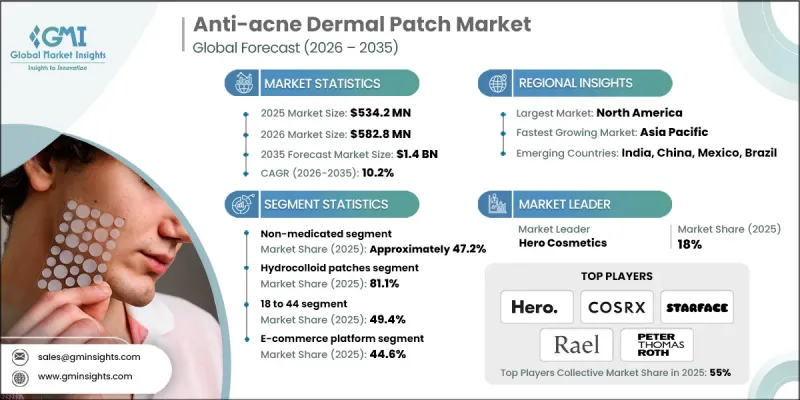
市場成長的促進因素包括重度痤瘡的日益普遍、人們對外觀的日益關注以及意識提升護膚意識的提高。全球痤瘡病例的急劇增加推動了對針對性強、療效顯著的治療方案(例如皮膚貼片)的需求。透過社群媒體、數位健康平台和網路紅人等管道獲得皮膚科醫生指導的管道增多,使消費者更加了解預防性護膚以及痤瘡未治療的風險。許多人,無論年齡大小,都將皮膚健康和便利性放在首位,並尋求能在短時間內帶來明顯效果且副作用最小的產品。抗痤瘡皮膚貼片透過提供局部治療、減輕發炎以及輕鬆融入日常生活,滿足了這些需求。這種趨勢不僅限於年輕消費者;成年人也越來越傾向於投資能夠長期保持皮膚健康無瑕的產品。
| 市場覆蓋範圍 | |
|---|---|
| 開始年份 | 2025 |
| 預測年份 | 2026-2035 |
| 起始值 | 5.342億美元 |
| 預測金額 | 14億美元 |
| 複合年成長率 | 10.2% |
預計到2025年,親水膠體貼片將佔據81.1%的市場。這類貼片利用親水膠體材料營造出保護性的濕潤環境,能夠吸收痤瘡病灶處多餘的皮脂、雜質和液體,同時保護皮膚免受外界污染。這種作用能夠促進癒合、減輕刺激並預防疤痕形成,因此親水膠體貼片在治療輕度至中度痤瘡方面非常有效。
到2025年,18-44歲年齡層將佔據49.4%的市場。該年齡層包括青少年、青年和成熟人士,痤瘡盛行率仍然很高。這部分消費者特別重視皮膚健康和外觀,他們傾向於選擇快速起效、隱密且非侵入性的解決方案,而不是口服藥物和複雜的手術。他們的需求正在推動抗痤瘡貼片市場的創新和普及。
預計到2025年,美國抗痤瘡貼片市場規模將達到1.985億美元。美國重度痤瘡病例的增加是推動市場對先進治療方法(例如抗痤瘡貼片)需求成長的主要因素。消費者越來越傾向於選擇能夠局部輸送活性成分、加速癒合速度並降低疤痕風險的產品。對於那些尋求便利、隱密且非侵入性解決方案,並希望融入其忙碌生活方式的人來說,貼片尤其具有吸引力。
目錄
第1章調查方法和範圍
第2章執行摘要
第3章業界考察
- 生態系分析
- 產業影響因素
- 促進要素
- 嚴重痤瘡問題日益增多
- 人們對外表的興趣日益濃厚。
- 人們越來越關注護膚
- 補丁技術創新
- 產業潛在風險與挑戰
- 一次性痤瘡治療貼片產能不足
- 可萃取物和可浸出物問題
- 市場機遇
- 用於新型醫療應用的精準發酵技術
- 促進要素
- 成長潛力分析
- 監管環境
- 技術進步
- 當前技術趨勢
- 新興技術
- 2024年定價分析
- 未來市場趨勢
- 波特五力分析
- PESTEL 分析
第4章 競爭情勢
- 介紹
- 公司市佔率分析
- 企業矩陣分析
- 主要市場公司的競爭分析
- 競爭定位矩陣
- 重大進展
- 併購
- 合作夥伴關係和合資企業
- 新產品發布
- 擴張計劃
第5章 按類型分類的市場估算與預測,2022-2035年
- 化學
- 草藥
- 非藥品
- 合成的
第6章 按技術分類的市場估計與預測,2022-2035年
- 矽基貼片
- 親水膠體貼劑
- 其他技術
第7章 按年齡層別分類的市場估計與預測,2022-2035年
- 10至17歲
- 18至44歲
- 45至64歲
- 65歲或以上
第8章 按分銷管道分類的市場估算與預測,2022-2035年
- 藥房和藥品商店
- 電子商務平台
- 零售店
第9章 2022-2035年各地區市場估算與預測
- 北美洲
- 美國
- 加拿大
- 歐洲
- 德國
- 英國
- 法國
- 西班牙
- 義大利
- 荷蘭
- 亞太地區
- 中國
- 印度
- 日本
- 澳洲
- 韓國
- 拉丁美洲
- 巴西
- 墨西哥
- 阿根廷
- 中東和非洲
- 沙烏地阿拉伯
- 南非
- 阿拉伯聯合大公國
第10章:公司簡介
- Peter Thomas Roth Labs LLC
- Rael
- 3M
- Starface
- DermaAngel
- Hero Cosmetics
- Sephora USA, Inc
- Peach &Lily
- COSRX
- Alba Botanica
- Eurosirel Spa
- L'Oreal
- Kenvue
- Galderma
The Global Anti-acne Dermal Patch Market was valued at USD 534.2 million in 2025 and is estimated to grow at a CAGR of 10.2% to reach USD 1.4 billion by 2035.
Market growth is fueled by the rising prevalence of severe acne, a growing focus on aesthetic appearance, and heightened awareness of skincare among consumers. The surge in acne cases worldwide is prompting demand for targeted and effective treatment solutions like dermal patches. Increasing access to dermatological guidance through social media, digital health platforms, and influencers has made consumers more informed about preventive skin care and the risks of untreated acne. Individuals across age groups are prioritizing skin health and convenience, seeking products that deliver fast, visible results with minimal side effects. Anti-acne dermal patches meet these expectations by offering localized treatment, reducing inflammation, and fitting seamlessly into daily routines. This trend is not limited to younger consumers; adults are increasingly investing in products that maintain healthy, blemish-free skin over time.
| Market Scope | |
|---|---|
| Start Year | 2025 |
| Forecast Year | 2026-2035 |
| Start Value | $534.2 Million |
| Forecast Value | $1.4 Billion |
| CAGR | 10.2% |
The hydrocolloid patches segment held an 81.1% share in 2025. These patches utilize hydrocolloid material to create a protective, moist environment that absorbs excess oil, impurities, and fluids from acne lesions while shielding the skin from external contaminants. This accelerates healing, reduces irritation, and prevents scarring, making hydrocolloid patches highly effective for mild to moderate acne management.
The 18 to 44 age group held 49.4% share in 2025. Acne remains highly prevalent within this demographic, encompassing teenagers, young adults, and mature adults. Consumers in this group are particularly focused on skin health and appearance, seeking fast-acting, discreet, and non-invasive solutions that avoid oral medications or complex procedures. Their demand drives innovation and adoption in the anti-acne dermal patch market.
U.S. Anti-acne Dermal Patch Market USD 198.5 million in 2025. The rise in severe acne cases in the U.S. is a key factor propelling demand for advanced treatment options like anti-acne dermal patches. Consumers increasingly prefer products that offer targeted delivery of active ingredients, reduce healing time, and lower scarring risk. Dermal patches are especially attractive for individuals seeking convenient, discreet, and non-invasive solutions that align with busy lifestyles.
Leading companies in the Global Anti-acne Dermal Patch Market include Starface, COSRX, Rael, Peter Thomas Roth Labs LLC, Hero Cosmetics, Sephora USA, Inc, DermaAngel, L'Oreal, Kenvue, Alba Botanica, Peach & Lily, 3M, Eurosirel Spa, and Galderma. Companies in the anti-acne dermal patch market are adopting multiple strategies to strengthen their presence and expand market share. Product innovation is a key focus, with firms developing patches infused with novel active ingredients and multifunctional properties for faster healing and reduced scarring. Strategic partnerships with dermatology clinics, e-commerce platforms, and beauty retailers are being leveraged to improve distribution reach and brand visibility. Firms are also investing in digital marketing campaigns to educate consumers about the benefits of targeted acne treatment. Expansion into emerging markets, along with localized product development to meet regional skin concerns and regulatory standards, ensures competitive differentiation.
Table of Contents
Chapter 1 Methodology and Scope
- 1.1 Market scope and definition
- 1.2 Research design
- 1.2.1 Research approach
- 1.2.2 Data collection methods
- 1.3 Data mining sources
- 1.3.1 Global
- 1.3.2 Regional/Country
- 1.4 Base estimates and calculations
- 1.4.1 Base year calculation
- 1.4.2 Key trends for market estimation
- 1.5 Primary research and validation
- 1.5.1 Primary sources
- 1.6 Forecast model
- 1.7 Research assumptions and limitations
Chapter 2 Executive Summary
- 2.1 Industry 360° synopsis
- 2.2 Key market trends
- 2.2.1 Regional trends
- 2.2.2 Type trends
- 2.2.3 Technology trends
- 2.2.4 Age group trends
- 2.2.5 Distribution channel trends
- 2.2.6 Material trends
- 2.3 CXO perspectives: Strategic imperatives
- 2.3.1 Key decision points for industry executives
- 2.3.2 Critical success factors for market players
- 2.4 Future outlook and strategic recommendations
Chapter 3 Industry Insights
- 3.1 Industry ecosystem analysis
- 3.2 Industry impact forces
- 3.2.1 Growth drivers
- 3.2.1.1 Increasing prevalence of severe acne problems
- 3.2.1.2 Growing focus on aesthetic appearance
- 3.2.1.3 Rise in skincare awareness
- 3.2.1.4 Innovation in patch technology
- 3.2.2 Industry pitfalls and challenges
- 3.2.2.1 Low capacity of single-use anti-acne dermal patch
- 3.2.2.2 Concerns regarding extractables and/or leachables
- 3.2.3 Market opportunities
- 3.2.3.1 Precision fermentation for novel healthcare applications
- 3.2.1 Growth drivers
- 3.3 Growth potential analysis
- 3.4 Regulatory landscape
- 3.4.1 North America
- 3.4.2 Europe
- 3.4.3 Asia Pacific
- 3.4.4 Latin America
- 3.4.5 Middle East and Africa
- 3.5 Technological advancements
- 3.5.1 Current technological trends
- 3.5.2 Emerging technologies
- 3.6 Pricing analysis, 2024
- 3.7 Future market trends
- 3.8 Porter's analysis
- 3.9 PESTEL analysis
Chapter 4 Competitive Landscape, 2024
- 4.1 Introduction
- 4.2 Company market share analysis
- 4.3 Company matrix analysis
- 4.4 Competitive analysis of major market players
- 4.5 Competitive positioning matrix
- 4.6 Key developments
- 4.6.1 Mergers and acquisitions
- 4.6.2 Partnerships and collaborations
- 4.6.3 New product launches
- 4.6.4 Expansion plans
Chapter 5 Market Estimates and Forecast, By Type, 2022 - 2035 ($ Mn)
- 5.1 Key trends
- 5.2 Chemical based
- 5.3 Herbal based
- 5.4 Non-medicated
- 5.5 Combination
Chapter 6 Market Estimates and Forecast, By Technology, 2022 - 2035 ($ Mn)
- 6.1 Key trends
- 6.2 Silicone-based patches
- 6.3 Hydrocolloid patches
- 6.4 Other technologies
Chapter 7 Market Estimates and Forecast, By Age group, 2022 - 2035 ($ Mn)
- 7.1 Key trends
- 7.2 10 to 17
- 7.3 18 to 44
- 7.4 45 to 64
- 7.5 65+
Chapter 8 Market Estimates and Forecast, By Distribution Channel, 2022 - 2035 ($ Mn)
- 8.1 Key trends
- 8.2 Pharmacies and drug stores
- 8.3 E-commerce platform
- 8.4 Retail stores
Chapter 9 Market Estimates and Forecast, By Region, 2022 - 2035 ($ Mn)
- 9.1 Key trends
- 9.2 North America
- 9.2.1 U.S.
- 9.2.2 Canada
- 9.3 Europe
- 9.3.1 Germany
- 9.3.2 UK
- 9.3.3 France
- 9.3.4 Spain
- 9.3.5 Italy
- 9.3.6 Netherlands
- 9.4 Asia Pacific
- 9.4.1 China
- 9.4.2 India
- 9.4.3 Japan
- 9.4.4 Australia
- 9.4.5 South Korea
- 9.5 Latin America
- 9.5.1 Brazil
- 9.5.2 Mexico
- 9.5.3 Argentina
- 9.6 Middle East and Africa
- 9.6.1 Saudi Arabia
- 9.6.2 South Africa
- 9.6.3 UAE
Chapter 10 Company Profiles
- 10.1 Peter Thomas Roth Labs LLC
- 10.2 Rael
- 10.3 3M
- 10.4 Starface
- 10.5 DermaAngel
- 10.6 Hero Cosmetics
- 10.7 Sephora USA, Inc
- 10.8 Peach & Lily
- 10.9 COSRX
- 10.10 Alba Botanica
- 10.11 Eurosirel Spa
- 10.12 L’Oreal
- 10.13 Kenvue
- 10.14 Galderma


