

 |
市場調查報告書
商品編碼
1936612
汽車空氣清新劑市場機會、成長要素、產業趨勢分析及2026年至2035年預測Car Air Freshener Market Opportunity, Growth Drivers, Industry Trend Analysis, and Forecast 2026 - 2035 |
||||||

全球汽車空氣清新劑市場預計到 2025 年將達到 29 億美元,到 2035 年將達到 52 億美元,年複合成長率為 6.1%。
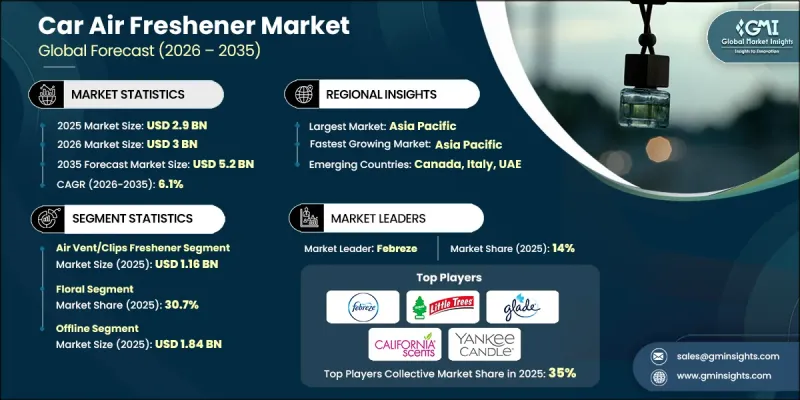
市場成長與生活方式的改變密切相關,消費者在通勤、旅行和處理日常事務時,花費在車內的時間越來越多。汽車不再只是交通工具,而是日益被視為個人空間,這促使人們對舒適性、清潔度和情感健康提出了更高的要求。如今,良好的車內環境被視為緩解駕駛壓力、提升長途旅行滿意度的關鍵。因此,氣味已成為車內體驗中重要的感官元素,如同在生活空間中使用香氛一樣。消費者對擁有更高級內裝的豪華汽車的需求不斷成長,進一步推動了對能夠營造精緻沉浸式車內環境的產品的興趣。如今,消費者將車載空氣清新劑與提升情緒、放鬆身心和自我表達聯繫起來,這持續支撐著各種使用場景下車載空氣清新劑的穩定需求。
| 市場覆蓋範圍 | |
|---|---|
| 開始年份 | 2025 |
| 預測年份 | 2026-2035 |
| 起始值 | 29億美元 |
| 預測金額 | 52億美元 |
| 複合年成長率 | 6.1% |
預計到2025年,車上空調出風口和夾式空氣清新劑的市場規模將達到11.6億美元。這類產品廣受歡迎的原因在於其可控制的香氛擴散功能,能夠根據車輛通風系統的氣流直接調節香味濃度,讓駕駛者在使用過程中輕鬆控制香味強度。其可調節的設計進一步增強了個人化體驗,使消費者能夠靈活地客製化車內環境。此外,其小巧的尺寸、便捷的安裝方式和防漏設計,使其對經常駕駛和長途旅行的人士特別具有吸引力。
截至2025年,花香型香水將佔30.7%的市場。這類香水廣受歡迎,因為它們能營造出清新、潔淨、舒適的車內氛圍。消費者傾向於選擇這類香水,以保持車內環境始終舒適,無論是短途旅行或長途旅行。
預計到2025年,美國汽車空氣清新劑市場將佔據88.6%的市場佔有率,並創造7億美元的收入。高汽車保有量、對個人舒適度的文化重視以及零售商的廣泛銷售,持續推動市場擴張。許多消費者將汽車視為生活空間的延伸,因此對能夠提升車內氛圍和消除異味的汽車空氣清新劑產品有著穩定的需求。
目錄
第1章調查方法和範圍
第2章執行摘要
第3章業界考察
- 生態系分析
- 供應商情況
- 利潤率
- 每個階段的附加價值
- 影響價值鏈的因素
- 產業影響因素
- 促進要素
- 消費者對舒適駕駛體驗的需求日益成長
- 人們對汽車衛生的意識日益增強
- 香氛技術創新與環保配方
- 產業潛在風險與挑戰
- 日益嚴重的環境與健康問題
- 產品壽命短
- 機會
- 環保永續產品
- 與智慧汽車和聯網汽車生態系統的整合
- 促進要素
- 成長潛力分析
- 未來市場趨勢
- 科技與創新趨勢
- 當前技術趨勢
- 新興技術
- 價格趨勢
- 按地區
- 依產品類型
- 監管環境
- 標準和合規要求
- 區域法規結構
- 認證標準
- 波特五力分析
- PESTEL 分析
第4章 競爭情勢
- 介紹
- 公司市佔率分析
- 按地區
- 企業矩陣分析
- 主要市場公司的競爭分析
- 競爭定位矩陣
- 重大進展
- 併購
- 夥伴關係與合作
- 新產品發布
- 擴張計劃
第5章 依產品類型分類的市場估算與預測,2022-2035年
- 吊掛式
- 通風口/夾式空氣清新劑
- 空氣清新劑/氣霧劑
- 其他
第6章 香水市場估算與預測(2022-2035年)
- 花的
- 柑橘
- 果味
- 辛辣的
- 其他香氛
第7章 按材料分類的市場估算與預測,2022-2035年
- 紙
- 凝膠
- 塑膠
- 其他材料
第8章 依最終用途分類的市場估算與預測,2022-2035年
- 搭乘用車
- 商用車輛
9. 2022-2035年按分銷管道分類的市場估算與預測
- 離線
- 超級市場和大賣場
- 百貨公司
- 其他
- 線上
- 電子商務
- 公司網站
第10章 2022-2035年各地區市場估計與預測
- 北美洲
- 美國
- 加拿大
- 歐洲
- 德國
- 英國
- 法國
- 義大利
- 西班牙
- 亞太地區
- 中國
- 日本
- 印度
- 澳洲
- 韓國
- 拉丁美洲
- 巴西
- 墨西哥
- 阿根廷
- 中東和非洲
- 南非
- 沙烏地阿拉伯
- 阿拉伯聯合大公國
第11章:公司簡介
- Air Spencer
- Armor All
- California Scents
- Chemical Guys
- Custom Fresheners
- Elix Scent
- Febreze
- Glade
- Higante Works
- Ikeda Scents
- Little Trees
- MakeMyFreshener
- Meguiar's
- Refresh Your Car!
- Yankee Candle
The Global Car Air Freshener Market was valued at USD 2.9 billion in 2025 and is estimated to grow at a CAGR of 6.1% to reach USD 5.2 billion by 2035.
Market growth is linked to changing lifestyle patterns, as consumers spend more time commuting, traveling, and managing daily activities inside their vehicles. Cars are increasingly viewed as personal spaces rather than simple transportation tools, which has heightened expectations around comfort, cleanliness, and emotional well-being. A well-maintained interior environment is now considered essential for reducing driving-related stress and enhancing overall satisfaction during extended hours on the road. As a result, scent has become an important sensory element of the in-car experience, similar to how fragrance is used within living spaces. Growing demand for premium vehicles with enhanced interior features has further strengthened interest in products that contribute to a refined and immersive cabin atmosphere. Consumers now associate interior fragrance with mood enhancement, relaxation, and personal expression, which continues to support steady demand for car air fresheners across multiple usage scenarios.
| Market Scope | |
|---|---|
| Start Year | 2025 |
| Forecast Year | 2026-2035 |
| Start Value | $2.9 Billion |
| Forecast Value | $5.2 Billion |
| CAGR | 6.1% |
In 2025, the air vent and clip-based fresheners segment generated USD 1.16 billion. Their popularity is supported by controlled fragrance dispersion, which responds directly to airflow from vehicle ventilation systems. This allows drivers to regulate scent intensity easily during use. Adjustable designs further enhance personalization, giving consumers the flexibility to tailor their in-car environment. Their compact form, ease of installation, and spill-free structure make them especially attractive for frequent drivers and long-distance travelers.
The floral fragrances segment accounted for 30.7% share in 2025. These scent profiles remain widely preferred due to their association with freshness, cleanliness, and a soothing interior atmosphere. Consumers often choose such fragrances to maintain a welcoming and comfortable vehicle environment that feels consistently pleasant during both short drives and extended journeys.
United States Car Air Freshener Market held 88.6% share, generating USD 0.7 billion in 2025. Strong vehicle ownership rates, a cultural emphasis on personal comfort, and widespread retail availability continue to support market expansion. Many consumers view their vehicles as extensions of their living space, driving consistent demand for products that enhance interior ambiance and eliminate unwanted odors.
Key companies operating in the Global Car Air Freshener Market include Little Trees, Febreze, Glade, California Scents, Yankee Candle, Meguiar's, Armor All, Refresh Your Car, Chemical Guys, Custom Fresheners, MakeMyFreshener, Air Spencer, Elix Scent, Ikeda Scents, and Higante Works. Companies in the car air freshener market strengthen their market position through fragrance innovation, product differentiation, and broad distribution strategies. Many brands focus on expanding scent portfolios while improving the longevity and consistency of fragrance delivery. Premium packaging and sleek product design help attract style-conscious consumers. Firms also invest in private-label manufacturing and customization options to capture niche demand. Strong retail partnerships and impulse-driven placement enhance visibility, while e-commerce channels support personalization and direct engagement. Sustainability-focused materials and cleaner formulations are increasingly used to appeal to environmentally aware buyers, reinforcing long-term brand loyalty and competitive advantage.
Table of Contents
Chapter 1 Methodology and Scope
- 1.1 Market scope and definition
- 1.2 Research design
- 1.2.1 Research approach
- 1.2.2 Data collection methods
- 1.3 Data mining sources
- 1.3.1 Global
- 1.3.2 Regional/Country
- 1.4 Base estimates and calculations
- 1.4.1 Base year calculation
- 1.4.2 Key trends for market estimation
- 1.5 Primary research and validation
- 1.5.1 Primary sources
- 1.6 Forecast model
- 1.7 Research assumptions and limitations
Chapter 2 Executive Summary
- 2.1 Industry 360° synopsis
- 2.2 Key market trends
- 2.2.1 Regional
- 2.2.2 Product type
- 2.2.3 Fragrance
- 2.2.4 Material
- 2.2.5 End use
- 2.2.6 Distribution channel
- 2.3 CXO perspectives: Strategic imperatives
- 2.3.1 Key decision points for industry executives
- 2.3.2 Critical success factors for market players
- 2.4 Future outlook and strategic recommendations
Chapter 3 Industry Insights
- 3.1 Industry ecosystem analysis
- 3.1.1 Supplier landscape
- 3.1.2 Profit margin
- 3.1.3 Value addition at each stage
- 3.1.4 Factor affecting the value chain
- 3.2 Industry impact forces
- 3.2.1 Growth drivers
- 3.2.1.1 Rising consumer demand for pleasant driving experiences
- 3.2.1.2 Growing awareness of vehicle hygiene
- 3.2.1.3 Innovations in fragrance technology & eco-friendly formulations
- 3.2.2 Industry pitfalls & challenges
- 3.2.2.1 Increasing environmental & health concerns
- 3.2.2.2 Short product lifespan
- 3.2.3 Opportunities
- 3.2.3.1 Eco-friendly & sustainable products
- 3.2.3.2 Integration with smart & connected car ecosystems
- 3.2.1 Growth drivers
- 3.3 Growth potential analysis
- 3.4 Future market trends
- 3.5 Technology and innovation landscape
- 3.5.1 Current technological trends
- 3.5.2 Emerging technologies
- 3.6 Price trends
- 3.6.1 By region
- 3.6.2 By product type
- 3.7 Regulatory landscape
- 3.7.1 Standards and compliance requirements
- 3.7.2 Regional regulatory frameworks
- 3.7.3 Certification standards
- 3.8 Porter's analysis
- 3.9 PESTEL analysis
Chapter 4 Competitive Landscape, 2025
- 4.1 Introduction
- 4.2 Company market share analysis
- 4.2.1 By region
- 4.2.1.1 North America
- 4.2.1.2 Europe
- 4.2.1.3 Asia Pacific
- 4.2.1.4 Latin America
- 4.2.1.5 Middle East and Africa
- 4.2.1 By region
- 4.3 Company matrix analysis
- 4.4 Competitive analysis of major market players
- 4.5 Competitive positioning matrix
- 4.6 Key developments
- 4.6.1 Mergers & acquisitions
- 4.6.2 Partnerships & collaborations
- 4.6.3 New product launches
- 4.6.4 Expansion plans
Chapter 5 Market Estimates and Forecast, By Product Type, 2022 - 2035 (USD Billion) (Thousand Units)
- 5.1 Key trends
- 5.2 Hanging air freshener
- 5.3 Air vent/clips fresheners
- 5.4 Air freshener sprays/aerosols
- 5.5 Others
Chapter 6 Market Estimates and Forecast, By Fragrance, 2022 - 2035 (USD Billion) (Thousand Units)
- 6.1 Key trends
- 6.2 Floral
- 6.3 Citrus
- 6.4 Fruity
- 6.5 Spicy
- 6.6 Other fragrances
Chapter 7 Market Estimates and Forecast, By Material, 2022 - 2035 (USD Billion) (Thousand Units)
- 7.1 Key trends
- 7.2 Paper
- 7.3 Gel
- 7.4 Plastic
- 7.5 Other materials
Chapter 8 Market Estimates and Forecast, By End Use, 2022 - 2035 (USD Billion) (Thousand Units)
- 8.1 Key trends
- 8.2 Passenger vehicles
- 8.3 Commercial vehicles
Chapter 9 Market Estimates and Forecast, By Distribution Channel, 2022 - 2035 (USD Billion) (Thousand Units)
- 9.1 Key trends
- 9.2 Offline
- 9.2.1 Supermarkets & hypermarkets
- 9.2.2 Department stores
- 9.2.3 Others
- 9.3 Online
- 9.3.1 E-commerce
- 9.3.2 Company websites
Chapter 10 Market Estimates and Forecast, By Region, 2022 - 2035 (USD Billion) (Thousand Units)
- 10.1 Key trends
- 10.2 North America
- 10.2.1 U.S.
- 10.2.2 Canada
- 10.3 Europe
- 10.3.1 Germany
- 10.3.2 UK
- 10.3.3 France
- 10.3.4 Italy
- 10.3.5 Spain
- 10.4 Asia Pacific
- 10.4.1 China
- 10.4.2 Japan
- 10.4.3 India
- 10.4.4 Australia
- 10.4.5 South Korea
- 10.5 Latin America
- 10.5.1 Brazil
- 10.5.2 Mexico
- 10.5.3 Argentina
- 10.6 Middle East and Africa
- 10.6.1 South Africa
- 10.6.2 Saudi Arabia
- 10.6.3 UAE
Chapter 11 Company Profiles
- 11.1 Air Spencer
- 11.2 Armor All
- 11.3 California Scents
- 11.4 Chemical Guys
- 11.5 Custom Fresheners
- 11.6 Elix Scent
- 11.7 Febreze
- 11.8 Glade
- 11.9 Higante Works
- 11.10 Ikeda Scents
- 11.11 Little Trees
- 11.12 MakeMyFreshener
- 11.13 Meguiar's
- 11.14 Refresh Your Car!
- 11.15 Yankee Candle


