


 |
市場調查報告書
商品編碼
1936607
汽車高階輪胎市場機會、成長要素、產業趨勢分析及2026年至2035年預測Automotive Premium Tires Market Opportunity, Growth Drivers, Industry Trend Analysis, and Forecast 2026 - 2035 |
||||||

全球高階汽車輪胎市場預計到 2025 年將達到 365 億美元,到 2035 年將達到 675 億美元,年複合成長率為 6.4%。
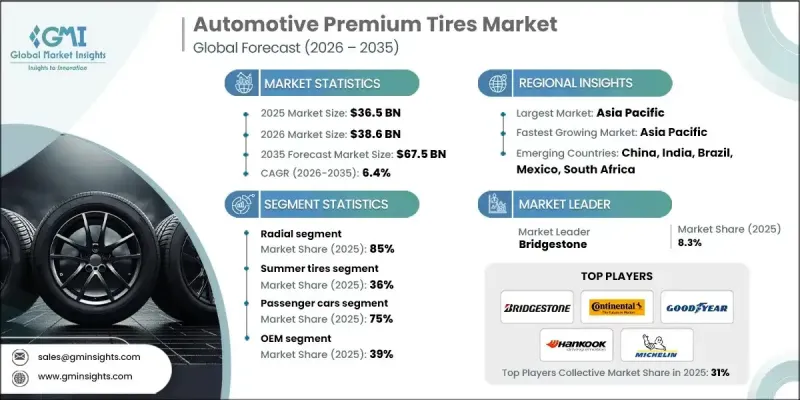
這一成長主要得益於高階乘用車和多用途車銷量的提升,以及整車製造商對抓地力強、高速穩定性好、駕駛舒適性佳的輪胎需求不斷成長。汽車製造商如今將高階輪胎定位為車輛整體性能的重要組成部分,這不僅維持了基準需求,也支撐了長期高價值的供應協議。消費者越來越關注煞車效率、濕地抓地力、低噪音和高速穩定性。高階輪胎憑藉先進的胎面花紋和工程橡膠配方滿足了這些期望,促使消費者升級原廠輪胎並接受更高的更換成本。這一趨勢正在增強整車製造商和售後市場的需求,使高階輪胎從可選項轉變為以價值主導的細分市場。在北美和歐洲,老舊車隊支撐著穩定的輪胎更換需求。豪華車車主擴大選擇性能達到或超過原廠規格的替換輪胎,這推動了售後市場收入的成長,並穩定了成熟汽車市場對高性能輪胎解決方案的需求。
| 市場覆蓋範圍 | |
|---|---|
| 開始年份 | 2025 |
| 預測年份 | 2026-2035 |
| 起始值 | 365億美元 |
| 預測金額 | 675億美元 |
| 複合年成長率 | 6.4% |
到2025年,子午線輪胎市佔率將達到85%,預計2026年至2035年將以6.9%的複合年成長率成長,這主要得益於操控精準、耐用性和低滾動阻力等優勢。隨著燃油效率和乘坐舒適性成為關鍵設計考量因素,汽車製造商(OEM)正持續將子午線輪胎作為高階和高性能車型的標準配備。
預計到 2025 年,夏季輪胎市佔率將達到 36%,到 2035 年將以 5.1% 的複合年成長率成長。這些輪胎專為溫暖氣候設計,優先考慮高速行駛時的牽引力、轉向響應和穩定性,從而提供與高階車輛定位相符的精緻駕駛體驗。
預計到2025年,美國高階汽車輪胎市場規模將達到81.8億美元。隨著國內市場向電動車和大型車輛轉型,對低滾動阻力、高承載能力和有效降噪的高階輪胎的需求日益成長。消費者越來越重視輪胎的胎面壽命、能源效率和全路況性能,這促使製造商在原廠配套和替換市場通路拓展其高階特種輪胎產品線。
目錄
第1章調查方法
第2章執行摘要
第3章業界考察
- 生態系分析
- 供應商情況
- 利潤率
- 成本結構
- 每個階段的附加價值
- 影響價值鏈的因素
- 中斷
- 產業影響因素
- 促進要素
- 對豪華和高性能汽車的需求不斷成長
- 注重安全性、舒適性和操控性。
- 已開發市場汽車擁有量不斷成長
- OEM高階定位
- 產業潛在風險與挑戰
- 價格敏感度高限制了成本敏感型市場中的採用率。
- 原物料價格波動對利潤率的影響
- 市場機遇
- 新興經濟體高階汽車銷售不斷成長
- 電動車輪胎的需求趨勢
- 售後市場的客製化需求
- 智慧永續輪胎
- 促進要素
- 成長潛力分析
- 監管環境
- 北美洲
- 美國運輸部(DOT) 標準
- 職業安全與健康管理局 (OSHA) 指南
- 美國環保署(EPA)
- 歐洲
- EN ISO輪胎標準
- 歐盟海關和安全法規
- BS EN/CEN 標準
- 國家標準(UNE、DIN等)
- 亞太地區
- 中國國家標準(GB標準)
- 日本JIS標準要求
- 韓國KS認證
- 印度BIS標準
- 泰國工業標準協會(TISI)
- 拉丁美洲
- INMETRO(國家計量研究院)
- INTI認證(國家技術研究院)
- NOM 標準(墨西哥官方標準)
- 中東和非洲
- ESMA/阿拉伯聯合大公國合格評定計劃 (ECAS)
- 海灣合作理事會技術法規
- SABS認證
- 北美洲
- 波特五力分析
- PESTEL 分析
- 科技與創新趨勢
- 當前技術趨勢
- 新興技術
- 定價分析
- 產品定價
- 區域定價
- 生產統計
- 生產基地
- 消費基礎
- 出口和進口
- 成本細分分析
- 專利分析
- 永續性和環境方面
- 永續實踐
- 減少廢棄物策略
- 生產中的能源效率
- 環保舉措
- 碳足跡考量
- 電動車專用輪胎的經濟性和設計性權衡
- 滾動阻力和耐用性之間的權衡
- 吸音泡沫的成本溢價
- 對平均售價和利潤率的影響
- 電動車和內燃機汽車之間的替代經濟模式
- 原物料風險和成本敏感度分析
- 通路層面利潤與定價分析
- 消費行為及高級會員採納分析
第4章 競爭情勢
- 介紹
- 公司市佔率分析
- 北美洲
- 歐洲
- 亞太地區
- 拉丁美洲
- 中東和非洲
- 主要市場公司的競爭分析
- 競爭定位矩陣
- 戰略展望矩陣
- 重大進展
- 併購
- 夥伴關係與合作
- 新產品發布
- 企業擴張計畫和資金籌措
第5章 依輪胎類型分類的市場估計與預測,2022-2035年
- 夏季輪胎
- 冬季輪胎
- 全天候輪胎
- 全地形輪胎
- 其他
第6章 依輪胎結構分類的市場估計與預測,2022-2035年
- 子午線輪胎
- 偏見
第7章 依車輛類型分類的市場估計與預測,2022-2035年
- 搭乘用車
- 掀背車
- 轎車
- SUV
- 商用車輛
- 輕型商用車
- 中型商用車(MCV)
- 重型商用車(HCV)
第8章 按輪圈尺寸分類的市場估算與預測,2022-2035年
- 小於15英寸
- 15到20英寸
- 20吋或以上
第9章 依技術分類的市場估計與預測,2022-2035年
- 防爆胎技術
- 自密封輪胎
- 環保輪胎
- 降噪技術
- 其他
第10章 依銷售管道分類的市場估計與預測,2022-2035年
- OEM
- 售後市場
第11章 2022-2035年各地區市場估計與預測
- 北美洲
- 美國
- 加拿大
- 歐洲
- 德國
- 英國
- 法國
- 義大利
- 西班牙
- 北歐國家
- 俄羅斯
- 波蘭
- 羅馬尼亞
- 亞太地區
- 中國
- 印度
- 日本
- 韓國
- ANZ
- 越南
- 印尼
- 拉丁美洲
- 巴西
- 墨西哥
- 阿根廷
- 中東和非洲
- 南非
- 沙烏地阿拉伯
- 阿拉伯聯合大公國
第12章:公司簡介
- 世界公司
- Apollo Tyres
- Bridgestone
- Continental
- Cooper Tire &Rubber Company
- Goodyear Tire &Rubber Company
- Hankook Tire &Technology
- Kumho Tire
- Michelin
- Pirelli
- Sumitomo Rubber Industries
- Toyo Tire
- Yokohama Rubber Company
- 本地製造商
- CEAT
- Giti Tire
- JK Tyre &Industries
- Linglong Tire
- Maxxis International
- MRF Tyres
- Nexen Tire
- Nokian Tyres
- Sailun
- 新興製造商
- Double Coin
- Laufenn
- Petlas
- Radar Tires
- Triangle Tyre
- ZC Rubber
The Global Automotive Premium Tires Market was valued at USD 36.5 billion in 2025 and is estimated to grow at a CAGR of 6.4% to reach USD 67.5 billion by 2035.
Growth is strongly supported by rising sales of high-end passenger vehicles and utility vehicles, along with increasing OEM demand for tires that deliver superior grip, high-speed stability, and refined ride quality. Automakers now position premium tires as an integral part of overall vehicle performance, which sustains baseline demand and supports long-term, higher-value supply agreements. Consumers show heightened awareness of braking efficiency, traction on wet surfaces, reduced road noise, and stability at elevated speeds. Premium tires address these expectations through advanced tread patterns and engineered rubber blends, encouraging customers to upgrade from factory-fitted tires and accept higher replacement costs. This behavior strengthens both OEM and replacement demand and reinforces premium tires as a value-driven segment rather than a discretionary purchase. In North America and Europe, an aging vehicle fleet supports a consistent cycle of replacement tire demand. Owners of premium vehicles increasingly choose replacement tires that match or exceed original specifications, which drives aftermarket revenue growth and stabilizes demand for high-performance tire solutions across mature automotive markets.
| Market Scope | |
|---|---|
| Start Year | 2025 |
| Forecast Year | 2026-2035 |
| Start Value | $36.5 Billion |
| Forecast Value | $67.5 Billion |
| CAGR | 6.4% |
The radial tires segment held an 85% share in 2025 and is forecasted to grow at a CAGR of 6.9% from 2026 to 2035, supported by advantages in handling precision, durability, and reduced rolling resistance. OEMs continue to standardize radial tires across luxury and performance-focused models, particularly as efficiency and ride quality become critical design priorities.
The summer tire segment held a 36% share in 2025 and is expected to grow at a CAGR of 5.1% through 2035. These tires are engineered for warm-weather conditions and prioritize traction, steering response, and stability at higher speeds, delivering a refined driving experience that aligns with premium vehicle positioning.
US Automotive Premium Tires Market reached USD 8.18 billion in 2025. As the domestic market shifts toward electric vehicles and larger vehicle formats, demand is rising for premium tires that offer low rolling resistance, enhanced load capacity, and effective noise control. Buyers increasingly value tread life, energy efficiency, and all-condition performance, prompting manufacturers to expand specialized premium tire offerings across OEM and replacement channels.
Key companies operating in the Global Automotive Premium Tires Market include Michelin, Bridgestone, Goodyear Tire & Rubber Company, Continental, Pirelli, Hankook Tire & Technology, Yokohama Rubber Company, Sumitomo Rubber Industries (Dunlop), Apollo Tyres, and Cooper Tire & Rubber Company. Companies in the automotive premium tires market focus on product innovation, OEM collaboration, and portfolio diversification to strengthen their competitive position. Manufacturers invest heavily in advanced materials and compound technologies to improve durability, efficiency, and ride comfort. Strategic partnerships with automakers help secure long-term supply contracts and early inclusion in new vehicle platforms. Firms also expand premium replacement tire ranges to capture higher-margin aftermarket demand. Geographic expansion and localized production reduce supply chain risk and enhance responsiveness to regional demand trends.
Table of Contents
Chapter 1 Methodology
- 1.1 Research approach
- 1.2 Quality commitments
- 1.3 GMI AI policy & data integrity commitment
- 1.4 Research trail & confidence scoring
- 1.4.1 Research trail components
- 1.4.2 Scoring components
- 1.5 Data collection
- 1.5.1 Partial list of primary sources
- 1.6 Data mining sources
- 1.6.1 Paid sources
- 1.7 Base estimates and calculations
- 1.7.1 Base year calculation
- 1.8 Forecast model
- 1.9 Research transparency addendum
Chapter 2 Executive Summary
- 2.1 Industry 360° synopsis
- 2.2 Key market trends
- 2.2.1 Regional
- 2.2.2 Tire
- 2.2.3 Tire construction
- 2.2.4 Rim size
- 2.2.5 Vehicle
- 2.2.6 Technology
- 2.2.7 Sales channel
- 2.3 TAM analysis, 2026-2035
- 2.4 CXO perspectives: Strategic imperatives
- 2.4.1 Executive decision points
- 2.4.2 Critical success factors
- 2.5 Future outlook
- 2.6 Strategic recommendations
Chapter 3 Industry Insights
- 3.1 Industry ecosystem analysis
- 3.1.1 Supplier landscape
- 3.1.2 Profit margin
- 3.1.3 Cost structure
- 3.1.4 Value addition at each stage
- 3.1.5 Factor affecting the value chain
- 3.1.6 Disruptions
- 3.2 Industry impact forces
- 3.2.1 Growth drivers
- 3.2.1.1 Rising luxury & performance vehicle demand
- 3.2.1.2 Focus on safety, comfort & handling
- 3.2.1.3 Growing vehicle parc in developed markets
- 3.2.1.4 OEM premium positioning
- 3.2.2 Industry pitfalls and challenges
- 3.2.2.1 High price sensitivity limiting adoption in cost-conscious markets
- 3.2.2.2 Volatility in raw material prices impacting margins
- 3.2.3 Market opportunities
- 3.2.3.1 Expanding premium vehicle sales in emerging economies
- 3.2.3.2 EV-specific tire demand
- 3.2.3.3 Aftermarket customization demand
- 3.2.3.4 Smart & sustainable tires
- 3.2.1 Growth drivers
- 3.3 Growth potential analysis
- 3.4 Regulatory landscape
- 3.4.1 North America
- 3.4.1.1 U.S. Department of Transportation (DOT) Standards
- 3.4.1.2 Occupational Safety and Health Administration (OSHA) Guidelines
- 3.4.1.3 U.S. Environmental Protection Agency (EPA)
- 3.4.2 Europe
- 3.4.2.1 EN ISO Tire Standards
- 3.4.2.2 European Union Customs and Safety Regulations
- 3.4.2.3 BS EN / CEN Standards
- 3.4.2.4 National Standards (UNE, DIN, etc.)
- 3.4.3 Asia Pacific
- 3.4.3.1 China GB (Guobiao) Standards
- 3.4.3.2 Japan JIS Requirements
- 3.4.3.3 Korea KS Certification
- 3.4.3.4 Indian BIS Standards
- 3.4.3.5 Thai Industrial Standards Institute (TISI)
- 3.4.4 Latin America
- 3.4.4.1 INMETRO (National Institute of Metrology)
- 3.4.4.2 INTI certification (Instituto Nacional de Tecnologia Industrial)
- 3.4.4.3 NOM standards (Norma Oficial Mexicana)
- 3.4.5 Middle East & Africa
- 3.4.5.1 ESMA / Emirates Conformity Assessment Scheme (ECAS)
- 3.4.5.2 GCC technical regulations
- 3.4.5.3 SABS certification
- 3.4.1 North America
- 3.5 Porter's analysis
- 3.6 PESTEL analysis
- 3.7 Technology and innovation landscape
- 3.7.1 Current technological trends
- 3.7.2 Emerging technologies
- 3.8 Pricing analysis
- 3.8.1 Pricing by product
- 3.8.2 Pricing by region
- 3.9 Production statistics
- 3.9.1 Production hubs
- 3.9.2 Consumption hubs
- 3.9.3 Export and import
- 3.10 Cost breakdown analysis
- 3.11 Patent analysis
- 3.12 Sustainability and environmental aspects
- 3.12.1 Sustainable practices
- 3.12.2 Waste reduction strategies
- 3.12.3 Energy efficiency in production
- 3.12.4 Eco-friendly initiatives
- 3.12.5 Carbon footprint considerations
- 3.13 EV-Specific Tire Economics & Design Trade-offs
- 3.13.1 Rolling resistance vs durability trade-offs
- 3.13.2 Acoustic foam cost premium
- 3.13.3 Impact on ASP and margins
- 3.13.4 EV vs ICE replacement economics
- 3.14 Raw Material Risk & Cost Sensitivity Analysis
- 3.15 Channel-Level Margin & Pricing Analysis
- 3.16 Consumer Behavior & Premium Adoption Analysis
Chapter 4 Competitive Landscape, 2025
- 4.1 Introduction
- 4.2 Company market share analysis
- 4.2.1 North America
- 4.2.2 Europe
- 4.2.3 Asia Pacific
- 4.2.4 LATAM
- 4.2.5 MEA
- 4.3 Competitive analysis of major market players
- 4.4 Competitive positioning matrix
- 4.5 Strategic outlook matrix
- 4.6 Key developments
- 4.6.1 Mergers & acquisitions
- 4.6.2 Partnerships & collaborations
- 4.6.3 New product launches
- 4.6.4 Expansion plans and funding
Chapter 5 Market Estimates & Forecast, By Tire, 2022 - 2035 ($Mn, Units)
- 5.1 Key trends
- 5.2 Summer tires
- 5.3 Winter tires
- 5.4 All-season tires
- 5.5 All terrain tires
- 5.6 Others
Chapter 6 Market Estimates & Forecast, By Tire Construction, 2022 - 2035 ($Mn, Units)
- 6.1 Key trends
- 6.2 Radial
- 6.3 Bias
Chapter 7 Market Estimates & Forecast, By Vehicle, 2022 - 2035 ($Mn, Units)
- 7.1 Key trends
- 7.2 Passenger cars
- 7.2.1 Hatchback
- 7.2.2 Sedan
- 7.2.3 SUV
- 7.3 Commercial vehicle
- 7.3.1 LCV (Light commercial vehicle)
- 7.3.2 MCV (Medium commercial vehicle)
- 7.3.3 HCV (Heavy commercial vehicle)
Chapter 8 Market Estimates & Forecast, By Rim Size, 2022 - 2035 ($Mn, Units)
- 8.1 Key trends
- 8.2 Below 15 inches
- 8.3 15-20 inches
- 8.4 Above 20 inches
Chapter 9 Market Estimates & Forecast, By Technology, 2022 - 2035 ($Mn, Units)
- 9.1 Key trends
- 9.2 Run-flat technology
- 9.3 Self-sealing tires
- 9.4 Eco-friendly tires
- 9.5 Noise reduction technology
- 9.6 Others
Chapter 10 Market Estimates & Forecast, By Sales Channel, 2022 - 2035 ($Mn, Units)
- 10.1 Key trends
- 10.2 OEM
- 10.3 Aftermarket
Chapter 11 Market Estimates & Forecast, By Region, 2022 - 2035 ($Mn, Units)
- 11.1 Key trends
- 11.2 North America
- 11.2.1 US
- 11.2.2 Canada
- 11.3 Europe
- 11.3.1 Germany
- 11.3.2 UK
- 11.3.3 France
- 11.3.4 Italy
- 11.3.5 Spain
- 11.3.6 Nordics
- 11.3.7 Russia
- 11.3.8 Poland
- 11.3.9 Romania
- 11.4 Asia Pacific
- 11.4.1 China
- 11.4.2 India
- 11.4.3 Japan
- 11.4.4 South Korea
- 11.4.5 ANZ
- 11.4.6 Vietnam
- 11.4.7 Indonesia
- 11.5 Latin America
- 11.5.1 Brazil
- 11.5.2 Mexico
- 11.5.3 Argentina
- 11.6 MEA
- 11.6.1 South Africa
- 11.6.2 Saudi Arabia
- 11.6.3 UAE
Chapter 12 Company Profiles
- 12.1 Global companies
- 12.1.1 Apollo Tyres
- 12.1.2 Bridgestone
- 12.1.3 Continental
- 12.1.4 Cooper Tire & Rubber Company
- 12.1.5 Goodyear Tire & Rubber Company
- 12.1.6 Hankook Tire & Technology
- 12.1.7 Kumho Tire
- 12.1.8 Michelin
- 12.1.9 Pirelli
- 12.1.10 Sumitomo Rubber Industries
- 12.1.11 Toyo Tire
- 12.1.12 Yokohama Rubber Company
- 12.2 Regional players
- 12.2.1 CEAT
- 12.2.2 Giti Tire
- 12.2.3 JK Tyre & Industries
- 12.2.4 Linglong Tire
- 12.2.5 Maxxis International
- 12.2.6 MRF Tyres
- 12.2.7 Nexen Tire
- 12.2.8 Nokian Tyres
- 12.2.9 Sailun
- 12.3 Emerging players
- 12.3.1 Double Coin
- 12.3.2 Laufenn
- 12.3.3 Petlas
- 12.3.4 Radar Tires
- 12.3.5 Triangle Tyre
- 12.3.6 ZC Rubber

 智慧輪胎軟體市場機會、成長要素、產業趨勢分析及2026-2035年預測
 智慧輪胎技術市場預測至2034年—全球輪胎類型、感測器類型、驅動系統、分銷管道、技術、應用和區域分析
 汽車高階輪胎市場:按類型、設計與結構、材料成分、銷售管道、應用與消費者細分分類-2026-2032年全球市場預測
 2026年全球高性能車輪市場報告汽車智慧輪胎市場:按車輛類型、輪胎類型、應用和銷售管道分類-2026-2032年全球市場預測
 智慧輪胎市場規模、佔有率和成長分析:按產品類型、技術、感測器類型、車輛類型、連接方式、銷售管道和地區分類-2026-2033年產業預測高性能車輪市場商機、成長要素、產業趨勢分析及2026-2035年預測。
 智慧輪胎市場-全球產業規模、佔有率、趨勢、機會、預測:按類型、車輛類型、技術類型、銷售管道類型、地區和競爭格局分類,2021-2031年超高性能輪胎市場-全球產業規模、佔有率、趨勢、機會和預測:按輪胎類型、需求類別、車輛類型、地區和競爭格局分類,2021-2031年高性能乘用車輪胎市場-全球產業規模、佔有率、趨勢、機會及預測(2021-2031)