


 |
市場調查報告書
商品編碼
1936600
太陽能板清潔市場機會、成長要素、產業趨勢分析及2026年至2035年預測Solar Panel Cleaning Market Opportunity, Growth Drivers, Industry Trend Analysis, and Forecast 2026 - 2035 |
||||||

全球太陽能板清潔市場預計到 2025 年將達到 12.2 億美元,預計到 2035 年將達到 17.2 億美元,年複合成長率為 3.5%。
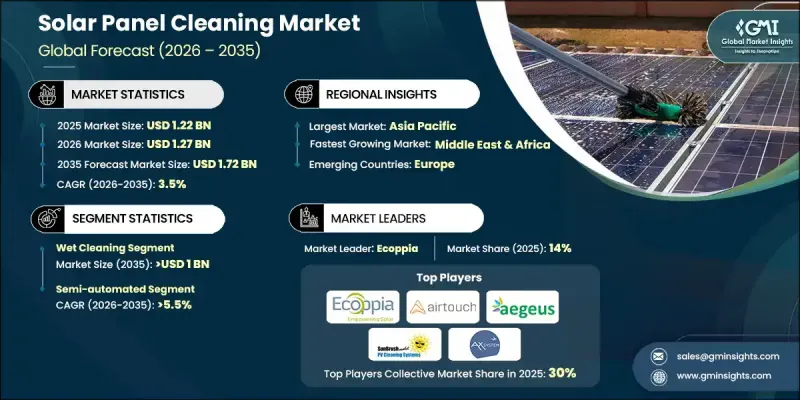
市場成長的驅動力來自於對維持太陽能板最佳性能的需求、清潔技術的進步以及全球大型太陽能發電廠的部署。太陽能板會積聚灰塵、花粉、工業污染物和碎屑,如果不及時清理,會顯著降低其效率。清潔解決方案正從人工清潔發展到自主機器人系統、乾刷和靜電除塵技術。政府支持的研究舉措正在推動防污塗層和機器人清潔技術的創新,在提高效率的同時最大限度地減少對環境的影響。面臨水資源短缺的地區,例如中東、北非部分地區、印度和美國西南部,正擴大轉向無水乾式機器人清潔解決方案。永續的清潔方法不僅節約用水,還有助於乾旱地區大型太陽能發電廠的運作。佔地數百英畝的公用事業規模太陽能發電廠的持續部署,進一步強化了對自動化、高效且環保的清潔解決方案的需求。
| 市場覆蓋範圍 | |
|---|---|
| 開始年份 | 2025 |
| 預測年份 | 2026-2035 |
| 起始值 | 12.2億美元 |
| 預測金額 | 17.2億美元 |
| 複合年成長率 | 3.5% |
預計到2035年,濕式清洗產業規模將達10億美元。濕式清洗使用水和溫和的清潔劑,能夠有效去除頑固污垢和其他污染物,例如花粉和工業粉塵。研究表明,在嚴重污染的條件下,與乾式清洗相比,濕式清洗可使面板效率恢復2-5%,這對於維持尖峰時段能源輸出至關重要。現代濕式清洗方法擴大與自動化系統和智慧水資源管理結合,能夠精確施用去離子水,與傳統的人工清洗相比,用水量最多可減少90%。這些技術在確保有效維護的同時,也滿足了環境永續性和成本效益的目標。
預計到2035年,半自動化太陽能光電發電市場將以5.5%的複合年成長率成長。半自動化系統結合了人工監督和機械工具,為全自動清潔方案提供了高效且經濟的替代方案。這些系統,包括電動刷和攜帶式清潔機,用途廣泛,可適應各種面板配置,包括屋頂式、地面式陣列和傾斜式光學模組。半自動化工具兼具高效性和柔軟性,能夠提供更快、更均勻的清潔效果,使其成為尋求運作可靠性且無需大規模資本投資的中型太陽能電站的理想選擇。
預計到2035年,美國太陽能板清潔市場規模將達到1.38億美元。受大型電站裝置量的推動,美國太陽能發電裝置容量實現了強勁成長。在降雨量低、多塵的州和地區,污垢造成的效率損失可能超過30%,促使人們對自動化和節水型清潔解決方案的需求日益成長。諸如《通貨膨脹控制法案》等政策激勵措施鼓勵大規模太陽能發電項目的發展和預防性維護計劃,間接推動了太陽能板清潔市場的發展。美國市場正優先考慮節水技術、機器人清潔系統和可擴展的維護解決方案,以最佳化不斷成長的太陽能資產的發電效率。
目錄
第1章調查方法和範圍
第2章執行摘要
第3章業界考察
- 生態系分析
- 原料的供應情況;
- 影響價值鏈的因素
- 中斷
- 監管環境
- 產業影響因素
- 促進要素
- 產業潛在風險與挑戰
- 成長潛力分析
- 波特五力分析
- PESTEL 分析
- 新的機會與趨勢
- 投資分析及未來展望
第4章 競爭情勢
- 介紹
- 我們按地區分類的市場佔有率
- 北美洲
- 歐洲
- 亞太地區
- 中東和非洲
- 拉丁美洲
- 策略舉措
- 競爭標竿分析圖示
- 戰略儀錶板
- 創新與科技趨勢
第5章 依技術分類的市場規模及預測(2022-2035年)
- 濕洗
- 半自動
- 自動化
- 水筆
- 其他
- 乾洗
- 靜電
- 自動化機器人
- 其他
第6章 依製程分類的市場規模及預測(2022-2035年)
- 半自動
- 自動化
- 水筆
- 靜電
- 自動化機器人
- 其他
第7章 依營運類型分類的市場規模及預測(2022-2035年)
- 手動的
- 自主
第8章 依應用領域分類的市場規模及預測(2022-2035年)
- 住宅
- 商業的
- 工業和公共產業
第9章 2022-2035年各地區市場規模及預測
- 北美洲
- 美國
- 加拿大
- 墨西哥
- 歐洲
- 英國
- 法國
- 德國
- 義大利
- 俄羅斯
- 西班牙
- 亞太地區
- 中國
- 澳洲
- 印度
- 日本
- 韓國
- 中東和非洲
- 沙烏地阿拉伯
- 阿拉伯聯合大公國
- 土耳其
- 南非
- 埃及
- 拉丁美洲
- 巴西
- 阿根廷
第10章:公司簡介
- Aegeus Technologies
- Airtouch Solar
- AX Solar Robot
- Ecoppia
- Greenleap Robotics
- HekaBot
- hyCLEANER GmbH
- IFBOT
- Karcher
- Leopard Dust
- Premier Solar Cleaning, LLC
- Saint Gobain
- Sharp Clean Limited
- Solabot
- SolarCleano
- Sun pure Technology
- SunBrush mobil Gmbh
- Taypro
- Vayu Solar
- Washpanel
The Global Solar Panel Cleaning Market was valued at USD 1.22 billion in 2025 and is estimated to grow at a CAGR of 3.5% to reach USD 1.72 billion by 2035.
Market growth is fueled by the need to maintain optimal solar panel performance, advances in cleaning technologies, and large-scale solar adoption worldwide. Solar panels accumulate dust, pollen, industrial pollutants, and debris, which can significantly reduce efficiency if left unaddressed. Cleaning solutions have evolved from manual washing to autonomous robotic systems, dry-brush methods, and electrostatic dust removal technologies. Government-supported research initiatives promote anti-soiling coatings and robotic cleaning innovations, enhancing efficiency while minimizing environmental impact. Regions facing water scarcity, including the Middle East, parts of North Africa, India, and the southwestern U.S., are increasingly turning to waterless and dry-robotic cleaning solutions. Sustainable cleaning approaches not only conserve water but also support large-scale solar farm operations in arid zones. Rising adoption of utility-scale solar farms, often covering hundreds of acres, further strengthens demand for automated, efficient, and eco-friendly cleaning solutions.
| Market Scope | |
|---|---|
| Start Year | 2025 |
| Forecast Year | 2026-2035 |
| Start Value | $1.22 Billion |
| Forecast Value | $1.72 Billion |
| CAGR | 3.5% |
The wet cleaning segment is forecasted to reach USD 1 billion by 2035. Wet cleaning, using water and mild detergents, effectively removes stubborn debris such as pollen, industrial dust, and other contaminants. Studies indicate that wet cleaning can restore 2-5% more panel efficiency compared to dry methods under heavily soiled conditions, which is critical for maintaining peak energy output. Modern wet cleaning approaches are increasingly integrated with autonomous systems and smart water management, allowing precise application of demineralized water and reducing consumption by up to 90% compared to traditional manual washing. These technologies ensure effective maintenance while aligning with environmental sustainability and cost-efficiency goals.
The semi-automated segment is expected to grow at a CAGR of 5.5% by 2035. Semi-automated systems blend human oversight with mechanized tools, offering an efficient yet cost-effective alternative to fully robotic cleaning solutions. These systems, including motorized brushes and portable cleaning machines, are versatile and adaptable to varied panel layouts such as rooftop installations, ground-mounted arrays, and tilted solar modules. By combining efficiency with flexibility, semi-automated tools deliver faster, more uniform cleaning results, making them ideal for mid-sized solar farms that need operational reliability without large capital investments.
U.S. Solar Panel Cleaning Market is anticipated to reach USD 138 million by 2035. The country experienced robust solar capacity expansion, with utility-scale installations leading the growth. Dust-prone states and regions with low rainfall face efficiency losses exceeding 30% due to soiling, which drives demand for automated and water-efficient cleaning solutions. Incentives from policies such as the Inflation Reduction Act promote large-scale solar development and preventive maintenance programs, indirectly supporting the solar panel cleaning market. The U.S. market emphasizes water-saving technologies, robotic cleaning systems, and scalable maintenance solutions to optimize energy generation from expanding solar assets.
Key players in the Global Solar Panel Cleaning Market include Aegeus Technologies, Airtouch Solar, AX Solar Robot, Ecoppia, Greenleap Robotics, HekaBot, hyCLEANER GmbH, IFBOT, Karcher, Leopard Dust, Premier Solar Cleaning, LLC, Saint Gobain, Sharp Clean Limited, Solabot, SolarCleano, Sun pure Technology, SunBrush mobil GmbH, Taypro, Vayu Solar, and Washpanel. Companies are strengthening their presence by investing in R&D for autonomous robotic cleaners, waterless technologies, and smart sensor integration to optimize cleaning efficiency. Many are expanding service networks for utility-scale solar farms while developing hybrid wet-dry systems for water-sensitive regions. Strategic partnerships with solar developers and EPC contractors enable broader market penetration, while technology licensing agreements accelerate the deployment of innovative cleaning solutions. Additionally, players focus on modular, scalable offerings, enabling mid-sized and large-scale solar projects to adopt sustainable, cost-efficient maintenance systems, solidifying their foothold in a competitive and growing market.
Table of Contents
Chapter 1 Methodology & Scope
- 1.1 Research design
- 1.2 Market estimates & forecast parameters
- 1.3 Forecast calculation
- 1.4 Data sources
- 1.4.1 Primary
- 1.4.2 Secondary
- 1.4.2.1 Paid
- 1.4.2.2 Public
Chapter 2 Executive Summary
- 2.1 Industry synopsis, 2022 - 2035
Chapter 3 Industry Insights
- 3.1 Industry ecosystem analysis
- 3.1.1 Raw material availability landscape
- 3.1.2 Factors affecting the value chain
- 3.1.3 Disruptions
- 3.2 Regulatory landscape
- 3.3 Industry impact forces
- 3.3.1 Growth drivers
- 3.3.2 Industry pitfalls & challenges
- 3.4 Growth potential analysis
- 3.5 Porter's analysis
- 3.5.1 Bargaining power of suppliers
- 3.5.2 Bargaining power of buyers
- 3.5.3 Threat of new entrants
- 3.5.4 Threat of substitutes
- 3.6 PESTEL analysis
- 3.6.1 Political factors
- 3.6.2 Economic factors
- 3.6.3 Social factors
- 3.6.4 Technological factors
- 3.6.5 Legal factors
- 3.6.6 Environmental factors
- 3.7 Emerging opportunities & trends
- 3.8 Investment analysis & future outlook
Chapter 4 Competitive Landscape, 2025
- 4.1 Introduction
- 4.2 Company market share, by region, 2025
- 4.2.1 North America
- 4.2.2 Europe
- 4.2.3 Asia Pacific
- 4.2.4 Middle East & Africa
- 4.2.5 Latin America
- 4.3 Strategic initiatives
- 4.4 Competitive benchmarking depictions
- 4.5 Strategy dashboard
- 4.6 Innovation & technology landscape
Chapter 5 Market Size and Forecast, By Technology, 2022 - 2035 (USD Million)
- 5.1 Key trends
- 5.2 Wet Cleaning
- 5.2.1 Semi-Automated
- 5.2.2 Automated
- 5.2.3 Water Brushes
- 5.2.4 Others
- 5.3 Dry Cleaning
- 5.3.1 Electrostatic
- 5.3.2 Automated Robotic
- 5.3.3 Others
Chapter 6 Market Size and Forecast, By Process, 2022 - 2035 (USD Million)
- 6.1 Key trends
- 6.2 Semi-Automated
- 6.3 Automated
- 6.4 Water Brushes
- 6.5 Electrostatic
- 6.6 Automated Robotic
- 6.7 Others
Chapter 7 Market Size and Forecast, By Mode of Operation, 2022 - 2035 (USD Million)
- 7.1 Key trends
- 7.2 Manual
- 7.3 Autonomous
Chapter 8 Market Size and Forecast, By Application, 2022 - 2035 (USD Million)
- 8.1 Key trends
- 8.2 Residential
- 8.3 Commercial
- 8.4 Industrial & Utility
Chapter 9 Market Size and Forecast, By Region, 2022 - 2035 (USD Million)
- 9.1 Key trends
- 9.2 North America
- 9.2.1 U.S.
- 9.2.2 Canada
- 9.2.3 Mexico
- 9.3 Europe
- 9.3.1 UK
- 9.3.2 France
- 9.3.3 Germany
- 9.3.4 Italy
- 9.3.5 Russia
- 9.3.6 Spain
- 9.4 Asia Pacific
- 9.4.1 China
- 9.4.2 Australia
- 9.4.3 India
- 9.4.4 Japan
- 9.4.5 South Korea
- 9.5 Middle East & Africa
- 9.5.1 Saudi Arabia
- 9.5.2 UAE
- 9.5.3 Turkey
- 9.5.4 South Africa
- 9.5.5 Egypt
- 9.6 Latin America
- 9.6.1 Brazil
- 9.6.2 Argentina
Chapter 10 Company Profiles
- 10.1 Aegeus Technologies
- 10.2 Airtouch Solar
- 10.3 AX Solar Robot
- 10.4 Ecoppia
- 10.5 Greenleap Robotics
- 10.6 HekaBot
- 10.7 hyCLEANER GmbH
- 10.8 IFBOT
- 10.9 Karcher
- 10.10 Leopard Dust
- 10.11 Premier Solar Cleaning, LLC
- 10.12 Saint Gobain
- 10.13 Sharp Clean Limited
- 10.14 Solabot
- 10.15 SolarCleano
- 10.16 Sun pure Technology
- 10.17 SunBrush mobil Gmbh
- 10.18 Taypro
- 10.19 Vayu Solar
- 10.20 Washpanel

 智慧太陽能板清潔機器人市場:按應用、類型、運作模式、國家和地區分類-全球產業分析、市場規模、市場佔有率及2026年至2033年預測
 太陽能板清潔:市場佔有率分析、行業趨勢和統計數據、成長預測(2026-2031 年)
 太陽能板清潔市場-全球產業規模、佔有率、趨勢、機會、預測:按技術、工藝、應用、運作模式、地區和競爭格局分類,2021-2031年
 太陽能板清潔系統市場:依自動化程度、清潔方法、電源、最終用戶和分銷管道分類-2026-2032年全球市場預測
 全球乾式自動太陽能板清洗市場規模、佔有率、趨勢和成長分析報告(2026-2034年)智慧太陽能清潔機器人市場按類型、電源、清潔模式、應用、最終用戶和分銷管道分類-全球預測(2026-2032 年)
 太陽能板清洗市場規模、佔有率和成長分析(按操作方式、類型、製程、應用和地區分類)—產業預測(2026-2033 年)
 全球太陽能板自動乾式清洗市場全球太陽能板自動清潔市場
 太陽能板清洗系統市場 - 成長、未來展望、競爭分析,2025 年至 2033 年