


 |
市場調查報告書
商品編碼
1936570
蔬果加工設備市場機會、成長要素、產業趨勢分析及預測(2026年至2035年)Fruit and Vegetable Processing Equipment Market Opportunity, Growth Drivers, Industry Trend Analysis, and Forecast 2026 - 2035 |
||||||

全球蔬果加工設備市場預計到 2025 年將達到 71 億美元,到 2035 年將達到 135 億美元,年複合成長率為 6.6%。
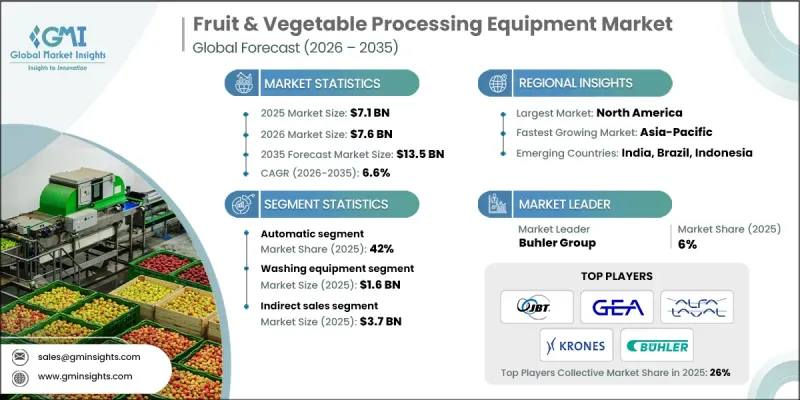
儘管該市場潛力巨大,但也面臨著許多挑戰,例如先進機械設備所需的高初始投資以及嚴格的國際食品安全標準。先進自動化設備的成本等因素可能會限制中小型製造商進入新興市場,從而阻礙該行業充分發揮其潛力。北美地區對便捷即食食品的需求不斷成長等消費趨勢正在推動市場成長,而歐洲不斷變化的法規和亞太地區的快速工業化則為商業化奠定了基礎。消費者對營養豐富、保存期限長的生鮮食品替代品的需求不斷成長,促使加工設備成為關注焦點,而高壓加工 (HPP) 和無菌包裝等技術能夠有效保留食品的風味和營養價值。日益增強的食品安全意識正在推動全球食品製造商採用先進的加工系統,從而持續擴大市場規模。
| 市場覆蓋範圍 | |
|---|---|
| 開始年份 | 2025 |
| 預測年份 | 2026-2035 |
| 起始值 | 71億美元 |
| 預測金額 | 135億美元 |
| 複合年成長率 | 6.6% |
到2025年,自動化領域將佔據42%的市場佔有率,這主要得益於大規模生產的需求、降低人事費用以及對高加工精度的追求。全自動系統利用感測器和可程式邏輯控制器(PLC)完成清洗、去皮和切割等工序,最大限度地減少人工干預。這些系統在工業規模化生產中效率極高,能夠輕柔地處理嬌嫩的水果和蔬菜,減少物理損傷並最大限度地減少廢棄物。然而,傳統的手動操作往往會導致產品品質不穩定和廢棄物增加,因此自動化對大型加工商的吸引力日益增強。
預計到2025年,間接銷售業務將創造37億美元的收入,佔據主要市場佔有率。這一主導地位主要歸功於本地分銷商,他們透過在各個地區提供安裝、維護和售後服務,擴大了設備製造商的業務範圍,確保設備在不同地區可靠、快速地部署。
預計2025年,北美蔬果加工設備市場規模將達16億美元。該地區高昂的人事費用推動了自動化加工解決方案的普及,而消費者日益增強的食品安全意識則推動了對先進設備的需求。北美在食品加工創新方面處於領先地位,高壓加工(HPP)系統和人工智慧分類技術得到了快速應用。此外,美國食品藥物管理局(FDA)的嚴格法規和永續性措施也在推動市場發展,為那些既能最佳化水和能源消耗又能滿足安全和品質標準的設備創造了有利環境。
目錄
第1章調查方法和範圍
第2章執行摘要
第3章業界考察
- 生態系分析
- 供應商情況
- 利潤率
- 每個階段的附加價值
- 影響價值鏈的因素
- 產業影響因素
- 促進要素
- 對簡便食品的需求迅速成長
- 向健康意識消費的轉變
- 自動化和人工智慧整合
- 產業潛在風險與挑戰
- 高初始資本投入
- 複雜的監理合規
- 機會
- 低溫運輸基礎設施的擴展
- 新興市場的採用情況
- 促進要素
- 成長潛力分析
- 未來市場趨勢
- 科技與創新趨勢
- 當前技術趨勢
- 新興技術
- 價格趨勢
- 按地區
- 按類型
- 監管環境
- 標準和合規要求
- 區域法規結構
- 認證標準
- 波特五力分析
- PESTEL 分析
第4章 競爭情勢
- 介紹
- 公司市佔率分析
- 按地區
- 企業矩陣分析
- 主要市場公司的競爭分析
- 競爭定位矩陣
- 重大進展
- 併購
- 夥伴關係與合作
- 新產品發布
- 擴張計劃
第5章 按類型分類的市場估算與預測,2022-2035年
- 打掃
- 去皮
- 斷開
- 果汁生產
- 漂燙
- 包裝
- 其他
第6章 2022-2035年各業務領域的市場估算與預測
- 自動的
- 半自動
- 手動的
7. 按最終用戶分類的市場估計和預測,2022-2035 年
- 食品加工業
- 食品服務供應商
第8章 按類別分類的市場估計和預測,2022-2035年
- 水果
- 蔬菜
第9章 按應用領域分類的市場估算與預測,2022-2035年
- 生鮮產品和切好的蔬菜
- 罐頭
- 乾燥/脫水
- 冷凍
- 其他(泡菜、調味料等)
第10章 依最終用途產業分類的市場估計與預測,2022-2035年
- 小規模加工廠
- 中型加工廠
- 工業/大型加工廠
第11章 按分銷管道分類的市場估算與預測,2022-2035年
- 直銷
- 間接銷售
第12章 2022-2035年各地區市場估算與預測
- 北美洲
- 美國
- 加拿大
- 歐洲
- 德國
- 英國
- 法國
- 義大利
- 西班牙
- 亞太地區
- 中國
- 日本
- 印度
- 澳洲
- 韓國
- 拉丁美洲
- 巴西
- 墨西哥
- 阿根廷
- 中東和非洲
- 南非
- 沙烏地阿拉伯
- 阿拉伯聯合大公國
第13章:公司簡介
- Alfa Laval AB
- Bertuzzi Food Processing Srl
- Bucher Industries AG
- Buhler Group
- FENCO Food Machinery Srl
- GEA Group
- Heat and Control, Inc.
- JBT Corporation
- Key Technology, Inc.
- Krones AG
- Lyco Manufacturing, Inc.
- Marel
- Mepaco
- Navatta Group Food Processing Srl
- Sormac BV
The Global Fruit & Vegetable Processing Equipment Market was valued at USD 7.1 billion in 2025 and is estimated to grow at a CAGR of 6.6% to reach USD 13.5 billion by 2035.
The market holds immense potential, but it faces challenges, primarily due to the high initial investment required for sophisticated machinery and stringent international food safety standards. These factors, particularly the cost of advanced automation, may limit smaller manufacturers from entering emerging markets and hinder the sector from reaching its full potential. Consumer trends, such as the growing demand for convenient, ready-to-eat food in North America, are shaping market growth, while evolving regulations in Europe and rapid industrialization in Asia Pacific are laying the commercial foundation. As demand increases for nutrient-rich, long shelf-life alternatives to fresh produce, processing equipment is gaining traction, offering techniques that preserve flavor and nutritional content, including high-pressure processing (HPP) and aseptic packaging. Heightened awareness of food safety is further motivating food manufacturers worldwide to adopt advanced processing systems, driving sustained market expansion.
| Market Scope | |
|---|---|
| Start Year | 2025 |
| Forecast Year | 2026-2035 |
| Start Value | $7.1 Billion |
| Forecast Value | $13.5 Billion |
| CAGR | 6.6% |
In 2025, the automatic segment accounted for 42% share, driven by the need for high-volume production, labor cost savings, and precision in processing. Fully automated systems move produce through washing, peeling, and cutting stages with minimal human involvement, using sensors and programmable logic controllers (PLCs). These systems are highly efficient for industrial-scale operations and handle delicate fruits and vegetables with care, reducing physical damage and minimizing waste. In contrast, traditional manual methods often lead to inconsistent product quality and higher wastage, making automation increasingly attractive for large-scale processors.
Indirect sales segment generated USD 3.7 billion in 2025, capturing a major market share. This dominance is largely due to local distributors who extend the reach of equipment manufacturers by providing installation, maintenance, and after-sales support in various regions, ensuring equipment reliability and faster adoption across diverse geographies.
North America Fruit & Vegetable Processing Equipment Market reached USD 1.6 billion in 2025. The region's high labor costs encourage the adoption of automated processing solutions, while strong consumer awareness of food safety drives demand for advanced equipment. North America is a leader in food processing innovation, with rapid adoption of HPP systems and AI-enabled sorting technologies. Strict FDA regulations and sustainability initiatives further reinforce the market, creating favorable conditions for equipment that optimizes water and energy consumption while meeting safety and quality standards.
Key players in the Global Fruit & Vegetable Processing Equipment Market include Alfa Laval AB, Bertuzzi Food Processing S.r.l., Bucher Industries AG, Buhler Group, FENCO Food Machinery S.r.l., GEA Group, Heat and Control, Inc., JBT Corporation, Key Technology, Inc., Krones AG, Lyco Manufacturing, Inc., Marel, Mepaco, Navatta Group Food Processing S.r.l., and Sormac B.V. Companies in this market are employing several strategies to strengthen their foothold and expand their presence. They are investing heavily in research and development to deliver high-efficiency, next-generation equipment with advanced automation and food safety features. Long-term partnerships with distributors and OEMs are secured to ensure market reach and reliable after-sales service. Strategic acquisitions and collaborations allow companies to broaden their product portfolios and enter new geographical markets. Manufacturers are also focusing on customizing equipment to meet local regulations and production requirements, while expanding regional production capacities to reduce costs and improve lead times. Additionally, companies are leveraging sustainability-focused innovations, such as energy- and water-efficient systems, to enhance competitiveness and align with global environmental standards, driving long-term growth and market leadership.
Table of Contents
Chapter 1 Methodology and Scope
- 1.1 Market scope and definition
- 1.2 Research design
- 1.2.1 Research approach
- 1.2.2 Data collection methods
- 1.3 Data mining sources
- 1.3.1 Global
- 1.3.2 Regional/Country
- 1.4 Base estimates and calculations
- 1.4.1 Base year calculation
- 1.4.2 Key trends for market estimation
- 1.5 Primary research and validation
- 1.5.1 Primary sources
- 1.6 Forecast model
- 1.7 Research assumptions and limitations
Chapter 2 Executive Summary
- 2.1 Industry 360° synopsis
- 2.2 Key market trends
- 2.2.1 Regional
- 2.2.2 Type
- 2.2.3 Operation
- 2.2.4 End Users
- 2.2.5 Category
- 2.2.6 Application
- 2.2.7 Distribution channel
- 2.3 CXO perspectives: Strategic imperatives
- 2.3.1 Key decision points for industry executives
- 2.3.2 Critical success factors for market players
- 2.4 Future outlook and strategic recommendations
Chapter 3 Industry Insights
- 3.1 Industry ecosystem analysis
- 3.1.1 Supplier landscape
- 3.1.2 Profit margin
- 3.1.3 Value addition at each stage
- 3.1.4 Factor affecting the value chain
- 3.2 Industry impact forces
- 3.2.1 Growth drivers
- 3.2.1.1 Surge in Demand for Convenience Foods
- 3.2.1.2 Shift Toward Health-Conscious Consumption
- 3.2.1.3 Automation and AI Integration
- 3.2.2 Industry pitfalls & challenges
- 3.2.2.1 High Initial Capital Investment
- 3.2.2.2 Complex Regulatory Compliance
- 3.2.3 Opportunities
- 3.2.3.1 Expansion of Cold-Chain Infrastructure
- 3.2.3.2 Emerging Markets Adoption
- 3.2.1 Growth drivers
- 3.3 Growth potential analysis
- 3.4 Future market trends
- 3.5 Technology and innovation landscape
- 3.5.1 Current technological trends
- 3.5.2 Emerging technologies
- 3.6 Price trends
- 3.6.1 By region
- 3.6.2 By type
- 3.7 Regulatory landscape
- 3.7.1 Standards and compliance requirements
- 3.7.2 Regional regulatory frameworks
- 3.7.3 Certification standards
- 3.8 Porter's analysis
- 3.9 PESTEL analysis
Chapter 4 Competitive Landscape, 2025
- 4.1 Introduction
- 4.2 Company market share analysis
- 4.2.1 By region
- 4.2.1.1 North America
- 4.2.1.2 Europe
- 4.2.1.3 Asia Pacific
- 4.2.1.4 Latin America
- 4.2.1.5 Middle East and Africa
- 4.2.1 By region
- 4.3 Company matrix analysis
- 4.4 Competitive analysis of major market players
- 4.5 Competitive positioning matrix
- 4.6 Key developments
- 4.6.1 Mergers & acquisitions
- 4.6.2 Partnerships & collaborations
- 4.6.3 New product launches
- 4.6.4 Expansion plans
Chapter 5 Market Estimates & Forecast, By Type, 2022-2035 (USD Billion) (Thousand Units)
- 5.1 Key trends
- 5.2 Washing
- 5.3 Peeling
- 5.4 Cutting
- 5.5 Juicing
- 5.6 Blanching
- 5.7 Packaging
- 5.8 Others
Chapter 6 Market Estimates & Forecast, By Operation 2022-2035 (USD Billion) (Thousand Units)
- 6.1 Key trends
- 6.2 Automatic
- 6.3 Semi-automatic
- 6.4 Manual
Chapter 7 Market Estimates & Forecast, By End Users, 2022-2035 (USD Billion) (Thousand Units)
- 7.1 Key trends
- 7.2 Food Processing Industries
- 7.3 Foodservice Providers
Chapter 8 Market Estimates & Forecast, By Category, 2022-2035 (USD Billion) (Thousand Units)
- 8.1 Key trends
- 8.2 Fruits
- 8.3 Vegetables
Chapter 9 Market Estimates & Forecast, By Application, 2022-2035 (USD Billion) (Thousand Units)
- 9.1 Key trends
- 9.2 Fresh & Fresh-Cut
- 9.3 Canned
- 9.4 Drying & Dehydration
- 9.5 Frozen
- 9.6 Others (Pickling & seasoning, etc.)
Chapter 10 Market Estimates & Forecast, By End Use Industries, 2022-2035 (USD Billion) (Thousand Units)
- 10.1 Key trends
- 10.2 Small-Scale Processing plants
- 10.3 Medium-Scale Processing plants
- 10.4 Industrial/Large-Scale Processing plants
Chapter 11 Market Estimates & Forecast, By Distribution channel, 2022-2035 (USD Billion) (Thousand Units)
- 11.1 Key trends
- 11.2 Direct sales
- 11.3 Indirect sales
Chapter 12 Market Estimates and Forecast, By Region, 2022 - 2035 (USD Billion) (Thousand Units)
- 12.1 Key trends
- 12.2 North America
- 12.2.1 U.S.
- 12.2.2 Canada
- 12.3 Europe
- 12.3.1 Germany
- 12.3.2 UK
- 12.3.3 France
- 12.3.4 Italy
- 12.3.5 Spain
- 12.4 Asia Pacific
- 12.4.1 China
- 12.4.2 Japan
- 12.4.3 India
- 12.4.4 Australia
- 12.4.5 South Korea
- 12.5 Latin America
- 12.5.1 Brazil
- 12.5.2 Mexico
- 12.5.3 Argentina
- 12.6 Middle East and Africa
- 12.6.1 South Africa
- 12.6.2 Saudi Arabia
- 12.6.3 UAE
Chapter 13 Company Profiles
- 13.1 Alfa Laval AB
- 13.2 Bertuzzi Food Processing S.r.l.
- 13.3 Bucher Industries AG
- 13.4 Buhler Group
- 13.5 FENCO Food Machinery S.r.l.
- 13.6 GEA Group
- 13.7 Heat and Control, Inc.
- 13.8 JBT Corporation
- 13.9 Key Technology, Inc.
- 13.10 Krones AG
- 13.11 Lyco Manufacturing, Inc.
- 13.12 Marel
- 13.13 Mepaco
- 13.14 Navatta Group Food Processing S.r.l.
- 13.15 Sormac B.V.

 食品加工與處理設備市場:2026-2032年全球市場預測(依設備類型、運作模式、技術、加工能力、設備材質及最終用戶分類)乳酪加工設備市場:2026-2032年全球市場預測(按產品類型、技術、產能、乳酪類型和最終用戶分類)雞蛋加工機械市場:2026-2032年全球市場預測(按機器類型、產品類型、製程、最終用途、自動化程度、產能和最終用戶分類)水果加工市場:按產品類型、水果品種、分銷管道和最終用途分類的全球市場預測 - 2026-2032 年商用奶昔機市場:按類型、容量、技術、動力來源、最終用戶和銷售管道分類-2026-2032年全球市場預測商用烤肉設備市場:按設備類型、容量、動力來源、最終用戶和應用分類-2026-2032年全球市場預測醃製和滾揉設備市場:按類型、技術、產能、應用和最終用戶分類-2026-2032年全球預測穀物加工設備市場:按設備類型、穀物類型、最終用途、製程、加工能力、技術和分銷管道分類-全球預測,2026-2032年食品加工機械市場:按設備類型、自動化程度、運作模式、產能範圍、動力來源和最終用途產業分類的全球預測,2026-2032年食品加工機械設備市場:依機器類型、操作方式、技術、應用、最終用戶和分銷管道分類,全球預測,2026-2032年