

 |
市場調查報告書
商品編碼
1936569
洗衣機市場機會、成長要素、產業趨勢分析及預測(2026年至2035年)Washing Machine Market Opportunity, Growth Drivers, Industry Trend Analysis, and Forecast 2026 - 2035 |
||||||

預計到 2025 年,全球洗衣機市場價值將達到 823 億美元,到 2035 年將達到 1,229 億美元,年複合成長率為 4.1%。
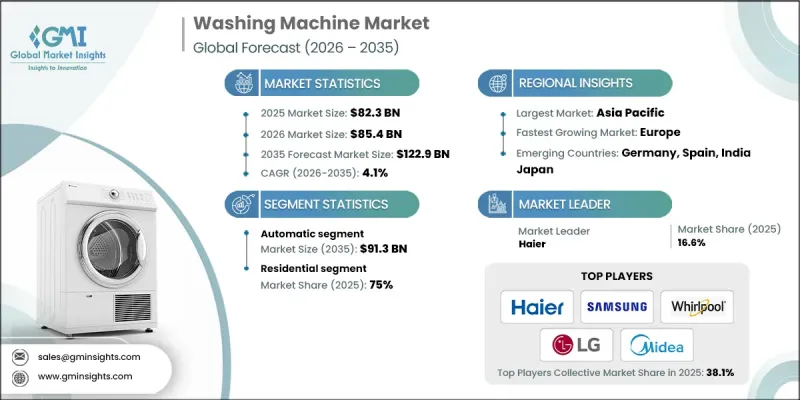
都市化加快、可支配收入增加、消費者對節時、節水、節能家電的需求日益成長,是推動市場成長的主要因素。智慧家庭科技的快速普及,以及消費者對自動化和節能家電的偏好,進一步加速了市場擴張。製造商正積極整合人工智慧洗滌程序、變頻馬達和節水技術等先進功能,以提升用戶體驗並降低營運成本。此外,成熟市場的更換需求以及發展中地區新增裝置量的持續成長,也為洗衣機市場的永續發展提供了強力支撐。
| 市場覆蓋範圍 | |
|---|---|
| 開始年份 | 2025 |
| 預測年份 | 2026-2035 |
| 起始值 | 823億美元 |
| 預測金額 | 1229億美元 |
| 複合年成長率 | 4.1% |
依產品類型分類,預計2025年,全自動洗衣機市場規模將達到9,13億美元。這些洗衣機因其便利性、減少人工操作和卓越的洗滌性能而廣受歡迎。全自動滾筒洗衣機和波輪洗衣機的出現,使消費者能夠根據安裝空間、用水量和衣物護理需求選擇合適的型號。智慧互聯功能、降噪技術和更高的能源效率等持續的技術創新正在推動其進一步普及。全自動洗衣機尤其受到都市區家庭和尋求省時可靠洗衣解決方案的上班族的青睞。
以最終用途分類,預計2025年,住宅領域將佔75%的市場佔有率。核心家庭的增加、公寓式居住的普及以及人們衛生和清潔意識的提高是推動住宅需求的關鍵因素。消費者越來越傾向於購買具有衣物洗滌程序、快速洗滌選項以及節水清潔劑洗滌功能的先進洗衣機。此外,高階家電和智慧家庭的日益普及也推動了洗衣機技術更換,從而提升了該領域的收入貢獻。
預計2026年至2035年,亞太地區洗衣機市場將以4.5%的複合年成長率成長。該地區的領先地位得益於中國、印度和東南亞等國家龐大的人口基數、快速的都市化以及中產階級收入水準的提高。家用電器普及率的提高、零售和電商通路的拓展以及強大的本地製造能力進一步鞏固了亞太地區的主導地位。政府推廣節能家電的措施也促進了全部區域洗衣機普及率的提升。
目錄
第1章調查方法和範圍
第2章執行摘要
第3章業界考察
- 生態系分析
- 供應商情況
- 利潤率
- 每個階段的附加價值
- 影響價值鏈的因素
- 產業影響因素
- 促進要素
- 技術進步
- 可支配所得增加
- 都市化與日益壯大的中產階級
- 產業潛在風險與挑戰
- 激烈的競爭與價格戰
- 環境法規
- 機會
- 節能環保型
- 智慧洗衣機越來越受歡迎
- 促進要素
- 成長潛力分析
- 未來市場趨勢
- 科技與創新趨勢
- 當前技術趨勢
- 新興技術
- 價格趨勢
- 依產品類型
- 按地區
- 監管環境
- 標準和合規要求
- 區域法規結構
- 認證標準
- 貿易統計(HS編碼-8450)
- 主要進口國
- 主要出口國
- 差距分析
- 風險評估與緩解
- 波特五力分析
- PESTEL 分析
- 消費行為分析
- 購買模式
- 偏好分析
- 消費行為的區域差異
- 電子商務如何影響購買決策
第4章 競爭情勢
- 介紹
- 公司市佔率分析
- 按地區
- 企業矩陣分析
- 主要市場公司的競爭分析
- 競爭定位矩陣
- 重大進展
- 併購
- 夥伴關係與合作
- 新產品發布
- 擴張計劃
第5章 按類型分類的市場估算與預測,2022-2035年
- 上裝式
- 前置式
第6章 按營運類型分類的市場估算與預測,2022-2035年
- 半自動
- 自動的
第7章 依產能分類的市場估計與預測,2022-2035年
- 6公斤以下
- 6kg~9kg
- 超過9公斤
第8章 2022-2035年按價格分類的市場估算與預測
- 低價位
- 中號
- 高價位範圍
第9章 依最終用戶分類的市場估算與預測,2022-2035年
- 住宅
- 商業的
第10章 按分銷管道分類的市場估算與預測,2022-2035年
- 線上
- 電子商務
- 我們的網站
- 離線
- 超級市場/大賣場
- 專賣店
- 其他(個體店、百貨公司等)
第11章 2022-2035年各地區市場估計與預測
- 北美洲
- 美國
- 加拿大
- 歐洲
- 德國
- 法國
- 英國
- 義大利
- 西班牙
- 亞太地區
- 中國
- 印度
- 日本
- 韓國
- 澳洲
- 拉丁美洲
- 巴西
- 墨西哥
- 阿根廷
- 中東和非洲
- 南非
- 沙烏地阿拉伯
- 阿拉伯聯合大公國
第12章:公司簡介
- Bosch
- Electrolux
- GE Appliances
- Godrej &Boyce
- Haier
- Hisense
- Hitachi
- LG
- Midea
- Panasonic
- Samsung
- Sharp
- TCL
- Toshiba
- Whirlpool
The Global Washing Machine Market was valued at USD 82.3 billion in 2025 and is estimated to grow at a CAGR of 4.1% to reach USD 122.9 billion by 2035.
Market growth is driven by rising urbanization, increasing disposable incomes, and growing demand for household appliances that save time, water, and energy. Rapid adoption of smart home technologies, coupled with consumer preference for automated and energy-efficient appliances, is further accelerating market expansion. Manufacturers are increasingly integrating advanced features such as AI-enabled wash cycles, inverter motors, and water optimization technologies to enhance user convenience and reduce operating costs. Additionally, replacement demand in mature markets and rising first-time adoption in developing regions continue to support the sustained growth of the washing machine market.
| Market Scope | |
|---|---|
| Start Year | 2025 |
| Forecast Year | 2026-2035 |
| Start Value | $82.3 Billion |
| Forecast Value | $122.9 Billion |
| CAGR | 4.1% |
By product type, the automatic segment reached USD 91.3 billion in 2025. These machines are widely preferred due to their convenience, reduced manual intervention, and superior washing performance. The availability of front-load and top-load fully automatic variants allows consumers to choose models based on space availability, water consumption, and fabric care requirements. Continuous technological advancements, including smart connectivity, noise reduction, and enhanced energy efficiency, are further boosting adoption. Fully automatic machines are particularly popular among urban households and working professionals seeking time-saving and reliable laundry solutions.
In terms of end use, the residential segment held 75% share in 2025. Growing nuclear families, increasing apartment living, and rising awareness of hygiene and cleanliness are key factors driving residential demand. Consumers are increasingly investing in advanced washing machines that offer fabric-specific programs, quick wash options, and reduced water and detergent usage. Additionally, the growing trend of premium home appliances and smart homes is encouraging households to upgrade to technologically advanced washing machines, strengthening the segment's revenue contribution.
Asia Pacific Washing Machine Market is expected to grow at a CAGR of 4.5% during 2026 to 2035. The region's dominance is supported by a large population base, rapid urbanization, and rising middle-class income levels in countries such as China, India, and Southeast Asian nations. Increasing penetration of household appliances, expanding retail and e-commerce channels, and strong local manufacturing capabilities further reinforce Asia Pacific's leading position. Government initiatives promoting energy-efficient appliances are also contributing to higher adoption rates across the region.
Key players operating in the Global Washing Machine Market include LG Electronics, Samsung Electronics, Whirlpool Corporation, Haier Group, Bosch (BSH Home Appliances), Panasonic Corporation, Electrolux AB, IFB Industries, Midea Group, and Toshiba Corporation. These companies compete through product innovation, energy-efficient technologies, strong distribution networks, and competitive pricing strategies. Companies in the washing machine market are focusing on technological innovation, energy efficiency, and product premiumization to strengthen their market position. Leading manufacturers invest heavily in R&D to introduce smart washing machines with AI-driven wash cycles, IoT connectivity, and inverter motor technology that reduces energy consumption and noise. Expanding product portfolios across multiple price points helps companies cater to both budget-conscious and premium consumers. Strategic partnerships with retailers and e-commerce platforms enhance market reach and customer engagement.
Table of Contents
Chapter 1 Methodology & Scope
- 1.1 Market scope and definition
- 1.2 Research design
- 1.2.1 Research approach
- 1.2.2 Data collection methods
- 1.3 Data mining sources
- 1.3.1 Global
- 1.3.2 Regional/Country
- 1.4 Base estimates and calculations
- 1.4.1 Base year calculation
- 1.4.2 Key trends for market estimation
- 1.5 Primary research and validation
- 1.5.1 Primary sources
- 1.6 Forecast model
- 1.7 Research assumptions and limitations
Chapter 2 Executive Summary
- 2.1 Industry 360° synopsis
- 2.2 Key market trends
- 2.2.1 Regional
- 2.2.2 Type
- 2.2.3 Mode of Operation
- 2.2.4 Capacity
- 2.2.5 Price
- 2.2.6 End-user
- 2.2.7 Distribution Channel
- 2.3 CXO perspectives: Strategic imperatives
- 2.3.1 Key decision points for industry executives
- 2.3.2 Critical success factors for market players
- 2.4 Future outlook and strategic recommendations
Chapter 3 Industry Insights
- 3.1 Industry ecosystem analysis
- 3.1.1 Supplier landscape
- 3.1.2 Profit margin
- 3.1.3 Value addition at each stage
- 3.1.4 Factor affecting the value chain
- 3.2 Industry impact forces
- 3.2.1 Growth drivers
- 3.2.1.1 Technological advancements
- 3.2.1.2 Rising disposable income
- 3.2.1.3 Urbanization and the growing middle class
- 3.2.2 Industry pitfalls & challenges
- 3.2.2.1 High competition and price wars
- 3.2.2.2 Environmental regulations
- 3.2.3 Opportunities
- 3.2.3.1 Energy-efficient & eco-friendly models
- 3.2.3.2 Expansion of smart and functional washing machine
- 3.2.1 Growth drivers
- 3.3 Growth potential analysis
- 3.4 Future market trends
- 3.5 Technology and innovation landscape
- 3.5.1 Current technological trends
- 3.5.2 Emerging technologies
- 3.6 Price trends
- 3.6.1 By product type
- 3.6.2 By region
- 3.7 Regulatory landscape
- 3.7.1 Standards and compliance requirements
- 3.7.2 Regional regulatory frameworks
- 3.7.3 Certification standards
- 3.8 Trade statistics (HS Code- 8450)
- 3.8.1 Major importing countries
- 3.8.2 Major exporting countries
- 3.9 Gap analysis
- 3.10 Risk assessment and mitigation
- 3.11 Porter's analysis
- 3.12 PESTEL analysis
- 3.13 Consumer behaviour analysis
- 3.13.1 Purchasing patterns
- 3.13.2 Preference analysis
- 3.13.3 Regional variations in consumer behaviour
- 3.13.4 Impact of e-commerce on buying decisions
Chapter 4 Competitive Landscape, 2025
- 4.1 Introduction
- 4.2 Company market share analysis
- 4.2.1 By region
- 4.2.1.1 North America
- 4.2.1.2 Europe
- 4.2.1.3 Asia Pacific
- 4.2.1.4 Latin America
- 4.2.1.5 Middle East and Africa
- 4.2.1 By region
- 4.3 Company matrix analysis
- 4.4 Competitive analysis of major market players
- 4.5 Competitive positioning matrix
- 4.6 Key developments
- 4.6.1 Mergers & acquisitions
- 4.6.2 Partnerships & collaborations
- 4.6.3 New product launches
- 4.6.4 Expansion plans
Chapter 5 Market Estimates & Forecast, By Type, 2022-2035 (USD Billion) (Thousand Units)
- 5.1 Key trends
- 5.2 Top-Load
- 5.3 Front-Load
Chapter 6 Market Estimates & Forecast, By Mode of Operation, 2022-2035 (USD Billion) (Thousand Units)
- 6.1 Key trends
- 6.2 Semi-automatic
- 6.3 Automatic
Chapter 7 Market Estimates & Forecast, By Capacity, 2022-2035 (USD Billion) (Thousand Units)
- 7.1 Key trends
- 7.2 Below 6 kg
- 7.3 6 kg - 9 kg
- 7.4 Above 9 kg
Chapter 8 Market Estimates & Forecast, By Price, 2022-2035 (USD Billion) (Thousand Units)
- 8.1 Key trends
- 8.2 Low
- 8.3 Medium
- 8.4 High
Chapter 9 Market Estimates & Forecast, By End-user, 2022-2035 (USD Billion) (Thousand Units)
- 9.1 Key trends
- 9.2 Residential
- 9.3 Commercial
Chapter 10 Market Estimates & Forecast, By Distribution Channel, 2022-2035 (USD Billion) (Thousand Units)
- 10.1 Key trends
- 10.2 Online
- 10.2.1 E-Commerce
- 10.2.2 Company website
- 10.3 Offline
- 10.3.1 Supermarkets/Hypermarkets
- 10.3.2 Specialty Stores
- 10.3.3 Others (Individual stores, Departmental stores, etc.)
Chapter 11 Market Estimates & Forecast, By Region, 2022-2035 (USD Billion) (Thousand Units)
- 11.1 Key trends
- 11.2 North America
- 11.2.1 U.S.
- 11.2.2 Canada
- 11.3 Europe
- 11.3.1 Germany
- 11.3.2 France
- 11.3.3 UK
- 11.3.4 Italy
- 11.3.5 Spain
- 11.4 Asia Pacific
- 11.4.1 China
- 11.4.2 India
- 11.4.3 Japan
- 11.4.4 South Korea
- 11.4.5 Australia
- 11.5 Latin America
- 11.5.1 Brazil
- 11.5.2 Mexico
- 11.5.3 Argentina
- 11.6 MEA
- 11.6.1 South Africa
- 11.6.2 Saudi Arabia
- 11.6.3 UAE
Chapter 12 Company Profiles
- 12.1 Bosch
- 12.2 Electrolux
- 12.3 GE Appliances
- 12.4 Godrej & Boyce
- 12.5 Haier
- 12.6 Hisense
- 12.7 Hitachi
- 12.8 LG
- 12.9 Midea
- 12.10 Panasonic
- 12.11 Samsung
- 12.12 Sharp
- 12.13 TCL
- 12.14 Toshiba
- 12.15 Whirlpool

 變頻洗衣機市場規模、佔有率和成長分析:按產品類型、容量、技術、最終用戶和地區分類-2026-2033年產業預測
 住宅洗衣機市場:2026-2032年全球市場預測(按產品類型、裝載方式、容量、自動化程度、價格範圍、驅動系統、安裝方式、配銷通路和用戶分類)——按產品類型、裝載方式、容量、自動化程度、價格範圍、驅動系統、安裝方式、配銷通路和用戶分類——2026-2032年
 智慧連網洗衣機市場報告:按產品、最終用戶和地區分類(2026-2034 年)生薑去皮清洗機市場按類型、自動化程度、產能、最終用戶和分銷管道分類,全球預測(2026-2032年)
 洗衣機市場分析及預測(至2035年):依類型、產品、技術、組件、應用、功能、安裝類型、最終用戶、模式及服務分類
 2026-2034年全球洗衣機市場規模、佔有率、趨勢和成長分析報告住宅洗衣機市場規模、佔有率、趨勢及預測(依產品、技術、洗衣容量、通路及地區分類),2026-2034年洗衣機市場報告:按產品、技術、容量、應用、最終用途和地區分類,2026-2034年
 2026-2030年全球住宅洗衣機市場按操作類型、類型、額定功率、最終用途產業和銷售管道的滾筒式洗衣機市場-全球預測(2026-2032 年)