


 |
市場調查報告書
商品編碼
1936563
非酒精智慧飲料機市場機會、成長要素、產業趨勢分析及預測(2026-2035年)Non-Alcoholic Smart Beverages Machine Market Opportunity, Growth Drivers, Industry Trend Analysis, and Forecast 2026 - 2035 |
||||||

全球非酒精智慧飲料機市場預計到 2025 年將達到 278 億美元,到 2035 年將達到 462 億美元,年複合成長率為 5.2%。
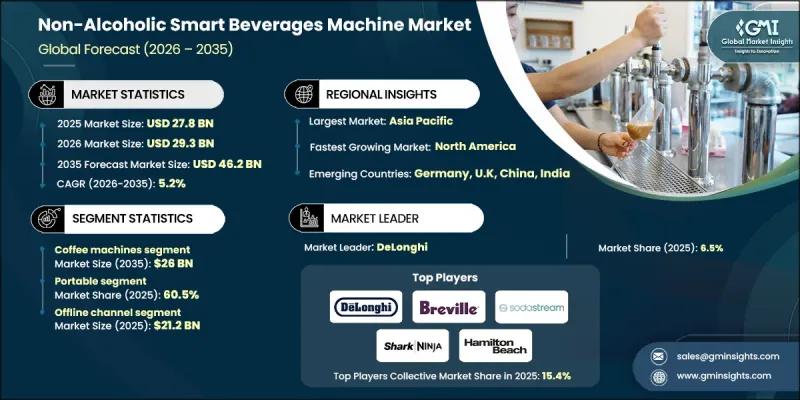
消費者對個人化飲品製作和自動化飲品解決方案日益成長的興趣推動了市場成長。智慧飲品機能夠客製化口味、甜度和飲品成分,滿足現代消費者對個人化消費體驗的需求。日益增強的健康意識也影響消費者的購買行為,促使他們偏好採用天然成分、功能性添加劑和營養強化配方製成的飲品。年輕族群對智慧互聯的家用電器表現出濃厚的興趣,進一步推動了此類產品的普及。然而,製造商面臨著許多挑戰,例如高昂的開發成本以及將先進硬體與智慧軟體平台整合的技術複雜性。開發這些系統需要大量的資金投入、工程技術專長和長期的創新策略。儘管存在這些障礙,智慧家電技術的不斷進步以及消費者對便利解決方案日益成長的需求,將繼續支撐住宅和商業領域的市場長期擴張。
| 市場覆蓋範圍 | |
|---|---|
| 開始年份 | 2025 |
| 預測年份 | 2026-2035 |
| 起始金額 | 278億美元 |
| 預測金額 | 462億美元 |
| 複合年成長率 | 5.2% |
預計到2025年,咖啡機市場規模將達到153億美元,到2035年將達到260億美元。市場成長的驅動力來自全球咖啡需求的不斷成長以及人們對製作特產飲料的日益偏好。自動沖泡功能、遠端控制和可自訂設定等特性提升了用戶的使用便利性,從而促進了咖啡機的普及,尤其是在咖啡消費量持續成長的都市區。
到2025年,可攜式智慧飲料機市佔率預計將達到60.5%。可攜式機型的需求主要源自於其易用性、節省空間的設計以及對忙碌生活方式的適應性。都市區生活環境和有限的居住空間進一步推動了對緊湊、易於存放且功能柔軟性的設備的需求。
線下分銷管道仍將保持最大的市場佔有率,預計到2025年將創造212億美元的收入。實體店持續吸引那些希望在購買前親身了解產品品質、功能和設計的消費者。這種面對面的評估能夠增強買家的信心,並且仍然是支撐線下銷售表現的關鍵因素。
預計到2025年,美國非酒精智慧飲料市佔率將達到83.5%。高購買力、智慧家電的日益普及以及生活方式的日益自動化,將繼續推動市場成長。美國在住宅和商用領域正經歷技術的快速普及,鞏固了在該地區的主導地位。
目錄
第1章調查方法和範圍
第2章執行摘要
第3章業界考察
- 生態系分析
- 供應商情況
- 利潤率
- 每個階段的附加價值
- 影響價值鏈的因素
- 產業影響因素
- 促進要素
- 智慧技術整合
- 全球家庭和餐廳數量不斷增加
- 可支配所得增加與生活水準的改變
- 產業潛在風險與挑戰
- 市面上流通的仿冒品
- 替代產品供應充足
- 機會
- 將業務拓展至注重健康的個人化飲品解決方案領域。
- 住宅和商業領域中聯網物聯網設備的成長
- 促進要素
- 成長潛力分析
- 未來市場趨勢
- 科技與創新趨勢
- 當前技術趨勢
- 新興技術
- 價格趨勢
- 依產品類型
- 按地區
- 監管環境
- 標準和合規要求
- 區域法規結構
- 認證標準
- 貿易統計
- 主要進口國
- 主要出口國
- 差距分析
- 風險評估與緩解
- 波特五力分析
- PESTEL 分析
- 消費行為分析
- 購買模式
- 偏好分析
- 消費行為的區域差異
- 電子商務對購買決策的影響
第4章 競爭情勢
- 介紹
- 公司市佔率分析
- 按地區
- 企業矩陣分析
- 主要市場公司的競爭分析
- 競爭定位矩陣
- 重大進展
- 併購
- 夥伴關係與合作
- 新產品發布
- 擴張計劃
第5章 依產品類型分類的市場估算與預測,2022-2035年
- 汽水機
- 咖啡機
- 濃縮咖啡機
- 滴濾咖啡機
- 膠囊咖啡機
- 果汁/軟性飲料機
- 其他(海水淡化器等)
第6章 依類別分類的市場估計與預測,2022-2035年
- 檯面
- 可攜式的
第7章 2022-2035年按價格分類的市場估計與預測
- 低價
- 中價位
- 高價
第8章 依最終用途分類的市場估算與預測,2022-2035年
- 住宅
- 商業
- 飯店
- 餐廳
- 其他
第9章 按分銷管道分類的市場估算與預測,2022-2035年
- 線上管道
- 電子商務
- 公司經營的網站
- 離線頻道
- 專賣店
- 大型零售商店
- 其他
第10章 2022-2035年各地區市場估計與預測
- 北美洲
- 美國
- 加拿大
- 歐洲
- 德國
- 法國
- 英國
- 義大利
- 西班牙
- 亞太地區
- 中國
- 印度
- 日本
- 韓國
- 澳洲
- 拉丁美洲
- 巴西
- 墨西哥
- 阿根廷
- 中東和非洲
- 南非
- 沙烏地阿拉伯
- 阿拉伯聯合大公國
第11章 公司簡介
- Aicook
- Breville
- Cuisinart
- DeLonghi
- Hamilton Beach
- IFB Appliances
- Isoda
- Moccamaster
- Mr. Coffee
- Nebula
- Omega and Cold Press
- SharkNinja
- Smarter
- SodaStream
- Wonderchef
The Global Non-Alcoholic Smart Beverages Machine Market was valued at USD 27.8 billion in 2025 and is estimated to grow at a CAGR of 5.2% to reach USD 46.2 billion by 2035.
Growth is supported by increasing consumer interest in personalized beverage preparation and automated drink solutions. Smart beverage machines allow users to customize flavor profiles, sweetness intensity, and beverage composition, aligning well with modern expectations for tailored consumption experiences. Rising health awareness is also influencing purchasing behavior, with consumers favoring beverages that incorporate natural ingredients, functional additives, and enhanced nutritional profiles. Younger demographics demonstrate a strong interest in connected and technology-enabled appliances, further encouraging their adoption. However, manufacturers face challenges related to high development costs and the technical complexity of integrating advanced hardware with intelligent software platforms. Developing these systems requires significant financial investment, engineering expertise, and long-term innovation strategies. Despite these barriers, ongoing advancements in smart appliance technology and increasing demand for convenience-driven solutions continue to support long-term market expansion across both residential and commercial environments.
| Market Scope | |
|---|---|
| Start Year | 2025 |
| Forecast Year | 2026-2035 |
| Start Value | $27.8 Billion |
| Forecast Value | $46.2 Billion |
| CAGR | 5.2% |
The coffee machines segment generated USD 15.3 billion in 2025 and is expected to reach USD 26 billion by 2035. This segment leads the market due to strong global demand for coffee and growing preference for specialty beverage preparation. Automated brewing, remote operation, and customizable settings enhance user convenience and contribute to widespread adoption, particularly in urban areas where coffee consumption continues to rise.
The portable smart beverage machines segment accounted for 60.5% share in 2025. Demand for portable models is driven by their ease of use, space-saving design, and suitability for fast-paced lifestyles. Urban living conditions and limited household space further support demand for compact and easily stored devices that offer flexibility without compromising functionality.
The offline distribution channel generated USD 21.2 billion in revenue in 2025 and maintained the largest share of the market. Physical retail locations continue to attract consumers who prefer to assess product quality, functionality, and design in person before purchasing. This hands-on evaluation strengthens buyer confidence and remains a key factor supporting offline sales performance.
US Non-Alcoholic Smart Beverages Machine Market accounted for 83.5% share in 2025. Strong purchasing power, widespread adoption of connected home appliances, and increasingly automated lifestyles continue to drive growth. The country benefits from rapid technology adoption across both household and commercial settings, reinforcing its leadership position within the region.
Key companies operating in the Global Non-Alcoholic Smart Beverages Machine Market include Breville, SodaStream, SharkNinja, DeLonghi, Hamilton Beach, Mr. Coffee, Cuisinart, Smarter, Wonderchef, Aicook, IFB Appliances, Nebula, Isoda, Omega, Cold Press, and Moccamaster. Companies in the non-alcoholic smart beverages machine market strengthen their market position by focusing on product innovation, enhanced customization features, and smart connectivity integration. Many manufacturers invest in user-friendly interfaces, mobile app compatibility, and energy-efficient designs to improve consumer appeal. Expanding product portfolios across price points helps brands reach broader customer segments. Strategic partnerships with retail distributors and lifestyle brands support visibility and market penetration. Firms also emphasize design aesthetics and compact form factors to suit urban households.
Table of Contents
Chapter 1 Methodology & Scope
- 1.1 Market scope and definition
- 1.2 Research design
- 1.2.1 Research approach
- 1.2.2 Data collection methods
- 1.3 Data mining sources
- 1.3.1 Global
- 1.3.2 Regional/Country
- 1.4 Base estimates and calculations
- 1.4.1 Base year calculation
- 1.4.2 Key trends for market estimation
- 1.5 Primary research and validation
- 1.5.1 Primary sources
- 1.6 Forecast model
- 1.7 Research assumptions and limitations
Chapter 2 Executive Summary
- 2.1 Industry 3600 synopsis
- 2.2 Key market trends
- 2.2.1 Regional
- 2.2.2 Product Type
- 2.2.3 Category
- 2.2.4 Price
- 2.2.5 End Use
- 2.2.6 Distribution channel
- 2.3 CXO perspectives: Strategic imperatives
- 2.3.1 Key decision points for industry executives
- 2.3.2 Critical success factors for market players
- 2.4 Future outlook and strategic recommendations
Chapter 3 Industry Insights
- 3.1 Industry ecosystem analysis
- 3.1.1 Supplier landscape
- 3.1.2 Profit margin
- 3.1.3 Value addition at each stage
- 3.1.4 Factor affecting the value chain
- 3.2 Industry impact forces
- 3.2.1 Growth drivers
- 3.2.1.1 Smart technology integration
- 3.2.1.2 Growing numbers of household and restaurants across the world
- 3.2.1.3 Growing disposable income and change in the standard of living
- 3.2.2 Industry pitfalls & challenges
- 3.2.2.1 Availability of counterfeit products
- 3.2.2.2 Easy availability of substitute products
- 3.2.3 Opportunities
- 3.2.3.1 Expansion into health-focused, personalized beverage solutions.
- 3.2.3.2 Growth in connected, IoT-enabled machines for residential and commercial segments
- 3.2.1 Growth drivers
- 3.3 Growth potential analysis
- 3.4 Future market trends
- 3.5 Technology and innovation landscape
- 3.5.1 Current technological trends
- 3.5.2 Emerging technologies
- 3.6 Price trends
- 3.6.1 By Product type
- 3.6.2 By Region
- 3.7 Regulatory landscape
- 3.7.1 Standards and compliance requirements
- 3.7.2 Regional regulatory frameworks
- 3.7.3 Certification standards
- 3.8 Trade statistics
- 3.8.1 Major importing countries
- 3.8.2 Major exporting countries
- 3.9 Gap analysis
- 3.10 Risk assessment and mitigation
- 3.11 Porter's analysis
- 3.12 PESTEL analysis
- 3.13 Consumer behaviour analysis
- 3.13.1 Purchasing patterns
- 3.13.2 Preference analysis
- 3.13.3 Regional variations in consumer behaviour
- 3.13.4 Impact of e-commerce on buying decisions
Chapter 4 Competitive Landscape, 2025
- 4.1 Introduction
- 4.2 Company market share analysis
- 4.2.1 By Region
- 4.2.1.1 North America
- 4.2.1.2 Europe
- 4.2.1.3 Asia Pacific
- 4.2.1.4 Latin America
- 4.2.1.5 Middle East and Africa
- 4.2.1 By Region
- 4.3 Company matrix analysis
- 4.4 Competitive analysis of major market players
- 4.5 Competitive positioning matrix
- 4.6 Key developments
- 4.6.1 Mergers & acquisitions
- 4.6.2 Partnerships & collaborations
- 4.6.3 New product launches
- 4.6.4 Expansion plans
Chapter 5 Market Estimates & Forecast, By Product Type, 2022-2035 (USD Billion) (Thousand Units)
- 5.1 Key trends
- 5.2 Soda Machine
- 5.3 Coffee Machine
- 5.3.1 Espresso Machines
- 5.3.2 Drip Coffee Makers
- 5.3.3 Pod Machines
- 5.4 Juice/ Soft Drink Machine
- 5.5 Others (Water Maker Machine, etc.)
Chapter 6 Market Estimates & Forecast, By Category, 2022-2035 (USD Billion) (Thousand Units)
- 6.1 Key trends
- 6.2 Countertop
- 6.3 Portable
Chapter 7 Market Estimates & Forecast, By Price, 2022-2035 (USD Billion) (Thousand Units)
- 7.1 Key trends
- 7.2 Low
- 7.3 Medium
- 7.4 High
Chapter 8 Market Estimates & Forecast, By End Use, 2022-2035 (USD Billion) (Thousand Units)
- 8.1 Key trends
- 8.2 Residential
- 8.3 Commercial
- 8.3.1 Hotels
- 8.3.2 Restaurants
- 8.3.3 Others
Chapter 9 Market Estimates & Forecast, By Distribution Channel, 2022-2035 (USD Billion) (Thousand Units)
- 9.1 Key trends
- 9.2 Online channels
- 9.2.1 Ecommerce
- 9.2.2 Company Owned Website
- 9.3 Offline Channels
- 9.3.1 Specialty Stores
- 9.3.2 Mega Retail stores
- 9.3.3 Others
Chapter 10 Market Estimates & Forecast, By Region, 2022-2035 (USD Billion) (Thousand Units)
- 10.1 Key trends
- 10.2 North America
- 10.2.1 U.S.
- 10.2.2 Canada
- 10.3 Europe
- 10.3.1 Germany
- 10.3.2 France
- 10.3.3 UK
- 10.3.4 Italy
- 10.3.5 Spain
- 10.4 Asia Pacific
- 10.4.1 China
- 10.4.2 India
- 10.4.3 Japan
- 10.4.4 South Korea
- 10.4.5 Australia
- 10.5 Latin America
- 10.5.1 Brazil
- 10.5.2 Mexico
- 10.5.3 Argentina
- 10.6 MEA
- 10.6.1 South Africa
- 10.6.2 Saudi Arabia
- 10.6.3 UAE
Chapter 11 Company Profiles
- 11.1 Aicook
- 11.2 Breville
- 11.3 Cuisinart
- 11.4 DeLonghi
- 11.5 Hamilton Beach
- 11.6 IFB Appliances
- 11.7 Isoda
- 11.8 Moccamaster
- 11.9 Mr. Coffee
- 11.10 Nebula
- 11.11 Omega and Cold Press
- 11.12 SharkNinja
- 11.13 Smarter
- 11.14 SodaStream
- 11.15 Wonderchef


