


 |
市場調查報告書
商品編碼
1936530
犬類關節炎治療市場機會、成長要素、產業趨勢分析及2026年至2035年預測Canine Arthritis Treatment Market Opportunity, Growth Drivers, Industry Trend Analysis, and Forecast 2026 - 2035 |
||||||

全球犬類關節炎治療市場預計到 2025 年將達到 38 億美元,到 2035 年將達到 79 億美元,年複合成長率為 7.8%。
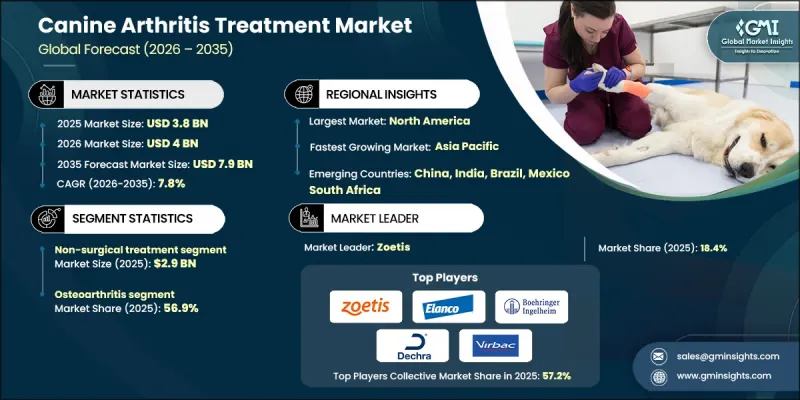
犬類骨關節炎(OA)發生率的上升推動了市場擴張。犬類關節炎的治療方法多種多樣,旨在緩解患有骨關節炎和其他退化性關節疾病的犬隻的關節疼痛、發炎和活動受限。這些治療方法旨在透過個人化的多學科方法,根據疾病的嚴重程度和犬隻的個別需求,減輕不適、恢復關節功能並改善整體健康狀況。治療方案包括藥物療法,例如非類固醇消炎劑(NSAIDs)、皮質類固醇和鴉片類止痛藥,以及新型生物療法,例如單株抗體、含有葡萄糖胺和Omega-3脂肪酸的營養補充劑、物理療法,以及在某些情況下進行的手術。多方面治療策略的採用正在推動市場成長,因為藥物療法、補充劑和物理療法的結合提供了一種更全面的管理方法,旨在改善犬隻的長期關節健康和活動能力。
| 市場覆蓋範圍 | |
|---|---|
| 開始年份 | 2025 |
| 預測年份 | 2026-2035 |
| 起始值 | 38億美元 |
| 預測金額 | 79億美元 |
| 複合年成長率 | 7.8% |
到2025年,非手術治療市場將佔據77.1%的佔有率,創造29億美元的收入。這一主導地位反映出寵物飼主和獸醫越來越傾向於在考慮手術干預之前,先嘗試藥物、單株抗體、補充劑和物理復健等非侵入性療法。非手術療法還具有成本效益高、易於取得等優勢,可用於慢性疾病的長期管理。人們日益認知到疾病預防和延緩關節炎進展的重要性,這正推動著這些治療方法在全球範圍內被寵物廣泛採用。
預計到2025年,骨關節炎細分市場將佔犬類關節炎治療市場56.9%的佔有率。骨關節炎是犬隻最常見的退化性關節疾病之一,也是犬類關節炎整體負擔的重要組成部分。骨關節炎在各年齡層犬類中的發生率不斷上升,凸顯了製定有效長期管理策略的必要性,這也使得骨關節炎成為犬類關節炎治療市場的主要細分領域。
預計到2025年,北美犬類關節炎治療市佔率將達到43.3%。該地區市場成長得益於寵物擁有率高、獸醫護理支出高以及先進的獸醫基礎設施。強大的診所、專科醫院和診斷中心網路確保了對關節炎等慢性疾病的早期診斷和持續管理。北美寵物飼主對創新治療方法的投入意願進一步推動了多模式治療方法和高品質獸藥產品的普及。
目錄
第1章調查方法和範圍
第2章執行摘要
第3章業界考察
- 生態系分析
- 產業影響因素
- 促進要素
- 寵物擁有率不斷提高以及寵物的人性化
- 犬類骨關節炎發生率不斷上升
- 動物醫藥和治療方法的進展
- 擴大獸醫基礎設施和遠端醫療
- 產業潛在風險與挑戰
- 長期治療高成本
- 來自替代療法的競爭
- 市場機遇
- 下一代治療方法的研發與商業化進展
- 促進要素
- 成長潛力分析
- 監管環境
- 各國養狗數量統計數據
- 管道分析
- 未來市場趨勢
- 波特五力分析
- PESTEL 分析
第4章 競爭情勢
- 介紹
- 公司市佔率分析
- 世界
- 北美洲
- 歐洲
- 亞太地區
- 企業矩陣分析
- 主要市場公司的競爭分析
- 競爭定位矩陣
- 重大進展
- 併購
- 夥伴關係與合作
- 新產品發布
- 擴張計劃
5. 按治療類型分類的市場估算與預測,2022-2035 年
- 非手術治療
- 按類型
- 製藥
- 非類固醇消炎劑(NSAIDs)
- 皮質類固醇
- 鴉片類止痛藥
- 其他藥物
- 補充
- 葡萄糖胺
- 軟骨素
- 甲基磺醯甲烷
- 其他補充劑
- 製藥
- 透過行政途徑
- 口服
- 注射
- 其他給藥途徑
- 透過分銷管道
- 獸醫院藥房
- 零售藥房
- 網路藥房
- 按類型
- 外科手術
- 其他治療方法
6. 按關節炎類型分類的市場估計和預測,2022-2035 年
- 骨關節炎
- 創傷性關節炎
- 骨軟骨病
- 類風濕性關節炎
第7章 2022-2035年各地區市場估算與預測
- 北美洲
- 美國
- 加拿大
- 歐洲
- 德國
- 英國
- 法國
- 西班牙
- 義大利
- 荷蘭
- 亞太地區
- 中國
- 印度
- 日本
- 澳洲
- 韓國
- 拉丁美洲
- 巴西
- 墨西哥
- 阿根廷
- 中東和非洲
- 南非
- 沙烏地阿拉伯
- 阿拉伯聯合大公國
第8章:公司簡介
- AdvaCare Pharma
- American Regent
- Auburn Laboratories
- Boehringer Ingelheim Animal Health
- CEVA Sante Animale
- Dechra Pharmaceuticals
- Deley Naturals
- Elanco Animal Health
- K9 Vitality
- Norbrook Laboratories
- Nutramax Laboratories Veterinary Sciences
- Thorne Vet
- Vetoquinol
- VetriScience
- VetStem
- Virbac
- Zoetis
The Global Canine Arthritis Treatment Market was valued at USD 3.8 billion in 2025 and is estimated to grow at a CAGR of 7.8% to reach USD 7.9 billion by 2035.
The market expansion is driven by the rising incidence of osteoarthritis (OA) in dogs. Canine arthritis treatment encompasses a range of therapies designed to manage joint pain, inflammation, and reduced mobility in dogs affected by osteoarthritis or other degenerative joint disorders. These treatments aim to alleviate discomfort, restore joint function, and improve overall well-being through individualized, multimodal approaches that match disease severity and the dog's specific needs. Options include pharmaceutical interventions such as NSAIDs, corticosteroids, and opioid pain relievers, along with newer biologic therapies like monoclonal antibodies, nutritional supplements including glucosamine and omega-3 fatty acids, physical therapy, and, in certain cases, surgical procedures. Adoption of multimodal treatment strategies has strengthened market growth, as combining medications, supplements, and physical therapies provides more comprehensive management for long-term joint health and improved mobility in dogs.
| Market Scope | |
|---|---|
| Start Year | 2025 |
| Forecast Year | 2026-2035 |
| Start Value | $3.8 Billion |
| Forecast Value | $7.9 Billion |
| CAGR | 7.8% |
In 2025, the non-surgical treatments segment held a 77.1% share, generating USD 2.9 billion. This dominance reflects the growing preference among pet owners and veterinarians for non-invasive therapies, such as pharmaceuticals, monoclonal antibodies, supplements, and physical rehabilitation, before considering surgical intervention. Non-surgical approaches are also more cost-effective and accessible for managing chronic conditions over the long term. Increased awareness of disease prevention and the importance of slowing arthritis progression is encouraging broader adoption of these therapies among pet populations worldwide.
The osteoarthritis segment held 56.9% share in 2025. Osteoarthritis is one of the most common degenerative joint disorders in dogs, contributing significantly to the overall burden of canine arthritis. Rising OA prevalence across age groups emphasizes the need for effective, long-term management strategies, positioning osteoarthritis as the dominant segment in the canine arthritis treatment market.
North America Canine Arthritis Treatment Market accounted for 43.3% share in 2025. Market growth in this region is fueled by high pet ownership rates, substantial spending on veterinary care, and advanced veterinary infrastructure. A strong network of clinics, specialty hospitals, and diagnostic centers ensures early diagnosis and continuous management of chronic conditions such as arthritis. North American pet owners' willingness to invest in innovative treatments further drives the adoption of multimodal therapies and high-quality veterinary products.
Key players in the Global Canine Arthritis Treatment Market include Zoetis, VetriScience, Elanco Animal Health, Boehringer Ingelheim Animal Health, K9 Vitality, Dechra Pharmaceuticals, CEVA Sante Animale, Norbrook Laboratories, Nutramax Laboratories Veterinary Sciences, VetStem, Thorne Vet, Auburn Laboratories, Virbac, AdvaCare Pharma, Deley Naturals, American Regent, and JBT Corporation. Leading companies in the canine arthritis treatment market are implementing a range of strategies to strengthen their position and expand their market footprint. They are heavily investing in research and development to introduce innovative pharmaceuticals, biologics, and nutritional supplements tailored for canine joint health. Strategic partnerships with veterinary clinics, specialty hospitals, and distributors are being established to expand market access and provide localized support. Companies are also focusing on acquiring smaller firms with complementary technologies, allowing rapid portfolio expansion and entry into new geographies.
Table of Contents
Chapter 1 Methodology and Scope
- 1.1 Market scope and definition
- 1.2 Research approach
- 1.3 Quality commitments
- 1.3.1 GMI AI policy and data integrity commitment
- 1.3.1.1 Source consistency protocol
- 1.3.1 GMI AI policy and data integrity commitment
- 1.4 Research trail and confidence scoring
- 1.4.1 Research trail components
- 1.4.2 Scoring components
- 1.5 Data collection
- 1.5.1 Partial list of primary sources
- 1.6 Data mining sources
- 1.6.1 Paid sources
- 1.6.1.1 Sources, by region
- 1.6.1 Paid sources
- 1.7 Base estimates and calculations
- 1.7.1 Revenue share analysis
- 1.7.2 Base year calculation
- 1.8 Forecast model
- 1.9 Research transparency addendum
- 1.9.1 Source attribution framework
- 1.9.2 Quality assurance metrics
- 1.9.3 Our commitment to trust
Chapter 2 Executive Summary
- 2.1 Industry 360° synopsis
- 2.2 Key market trends
- 2.2.1 Regional trends
- 2.2.2 Treatment type trends
- 2.2.3 Arthritis type trends
- 2.3 CXO perspectives: Strategic imperatives
- 2.3.1 Key decision points for industry executives
- 2.3.2 Critical success factors for market players
- 2.4 Future outlook and strategic recommendations
Chapter 3 Industry Insights
- 3.1 Industry ecosystem analysis
- 3.2 Industry impact forces
- 3.2.1 Growth drivers
- 3.2.1.1 Rising pet ownership and humanization of pets
- 3.2.1.2 Increasing prevalence of osteoarthritis in dogs
- 3.2.1.3 Advancements in veterinary pharmaceuticals and therapies
- 3.2.1.4 Expansion of veterinary infrastructure and telemedicine
- 3.2.2 Industry pitfalls and challenges
- 3.2.2.1 High cost of long-term treatment
- 3.2.2.2 Competition from alternative therapies
- 3.2.3 Market opportunities
- 3.2.3.1 Growing development and commercialization of next-generation therapies
- 3.2.1 Growth drivers
- 3.3 Growth potential analysis
- 3.4 Regulatory landscape
- 3.4.1 North America
- 3.4.2 Europe
- 3.4.3 Asia Pacific
- 3.4.4 Latin America
- 3.4.5 Middle East and Africa
- 3.5 Canine population statistics, by country
- 3.6 Pipeline analysis
- 3.7 Future market trends
- 3.8 Porter's analysis
- 3.9 PESTEL analysis
Chapter 4 Competitive Landscape, 2025
- 4.1 Introduction
- 4.2 Company market share analysis
- 4.2.1 Global
- 4.2.2 North America
- 4.2.3 Europe
- 4.2.4 Asia Pacific
- 4.3 Company matrix analysis
- 4.4 Competitive analysis of major market players
- 4.5 Competitive positioning matrix
- 4.6 Key developments
- 4.6.1 Merger and acquisition
- 4.6.2 Partnership and collaboration
- 4.6.3 New product launches
- 4.6.4 Expansion plans
Chapter 5 Market Estimates and Forecast, By Treatment Type, 2022 - 2035 ($ Mn)
- 5.1 Key trends
- 5.2 Non-surgical treatment
- 5.2.1 By type
- 5.2.1.1 Pharmaceuticals
- 5.2.1.1.1 Non-steroidal anti-inflammatory drugs (NSAIDs)
- 5.2.1.1.2 Corticosteroids
- 5.2.1.1.3 Opioid pain relievers
- 5.2.1.1.4 Other pharmaceuticals
- 5.2.1.2 Supplements
- 5.2.1.2.1 Glucosamine
- 5.2.1.2.2 Chondroitin
- 5.2.1.2.3 Methylsulfonylmethane
- 5.2.1.2.4 Other supplements
- 5.2.1.1 Pharmaceuticals
- 5.2.2 By route of administration
- 5.2.2.1 Oral
- 5.2.2.2 Injectable
- 5.2.2.3 Other routes of administration
- 5.2.3 By distribution channel
- 5.2.3.1 Veterinary hospital pharmacies
- 5.2.3.2 Retail pharmacies
- 5.2.3.3 Online pharmacies
- 5.2.1 By type
- 5.3 Surgical procedures
- 5.4 Other treatment types
Chapter 6 Market Estimates and Forecast, By Arthritis Type, 2022 - 2035 ($ Mn)
- 6.1 Key trends
- 6.2 Osteoarthritis
- 6.3 Traumatic arthritis
- 6.4 Osteochondrosis
- 6.5 Rheumatoid arthritis
Chapter 7 Market Estimates and Forecast, By Region, 2022 - 2035 ($ Mn)
- 7.1 Key trends
- 7.2 North America
- 7.2.1 U.S.
- 7.2.2 Canada
- 7.3 Europe
- 7.3.1 Germany
- 7.3.2 UK
- 7.3.3 France
- 7.3.4 Spain
- 7.3.5 Italy
- 7.3.6 Netherlands
- 7.4 Asia Pacific
- 7.4.1 China
- 7.4.2 India
- 7.4.3 Japan
- 7.4.4 Australia
- 7.4.5 South Korea
- 7.5 Latin America
- 7.5.1 Brazil
- 7.5.2 Mexico
- 7.5.3 Argentina
- 7.6 Middle East and Africa
- 7.6.1 South Africa
- 7.6.2 Saudi Arabia
- 7.6.3 UAE
Chapter 8 Company Profiles
- 8.1 AdvaCare Pharma
- 8.2 American Regent
- 8.3 Auburn Laboratories
- 8.4 Boehringer Ingelheim Animal Health
- 8.5 CEVA Sante Animale
- 8.6 Dechra Pharmaceuticals
- 8.7 Deley Naturals
- 8.8 Elanco Animal Health
- 8.9 K9 Vitality
- 8.10 Norbrook Laboratories
- 8.11 Nutramax Laboratories Veterinary Sciences
- 8.12 Thorne Vet
- 8.13 Vetoquinol
- 8.14 VetriScience
- 8.15 VetStem
- 8.16 Virbac
- 8.17 Zoetis

 維生素D咀嚼片市場:全球市場預測,2026-2032年
 犬類關節炎市場:依產品類型、最終用戶、治療方法和地區分類犬類關節炎市場:2026-2032年全球市場預測(依治療方法、藥物類別、給藥途徑、最終用戶和分銷管道分類)犬用咀嚼片市場:依給藥頻率、分銷形式、動物年齡層、成分類型、包裝規格、價格範圍、重量分類、口味、產品類型、最終用戶、分銷管道分類-全球預測,2026-2032年拉米夫定咀嚼片市場按包裝類型、年齡層、劑量強度、口味、治療適應症、分銷管道和最終用戶分類,全球預測,2026-2032年
 犬類關節炎治療市場規模、佔有率和成長分析(按關節炎類型、給藥途徑、治療方法、最終用戶、分銷管道和地區分類)—產業預測(2026-2033 年)