

 |
市場調查報告書
商品編碼
1936518
化妝品市場升級再造原料的成長機會、成長要素、產業趨勢分析及2026年至2035年預測Upcycled Ingredients in Cosmetics Market Opportunity, Growth Drivers, Industry Trend Analysis, and Forecast 2026 - 2035 |
||||||

全球化妝品用再生原料市場預計到 2025 年將達到 3.013 億美元,到 2035 年將達到 6.346 億美元,年複合成長率為 7.7%。
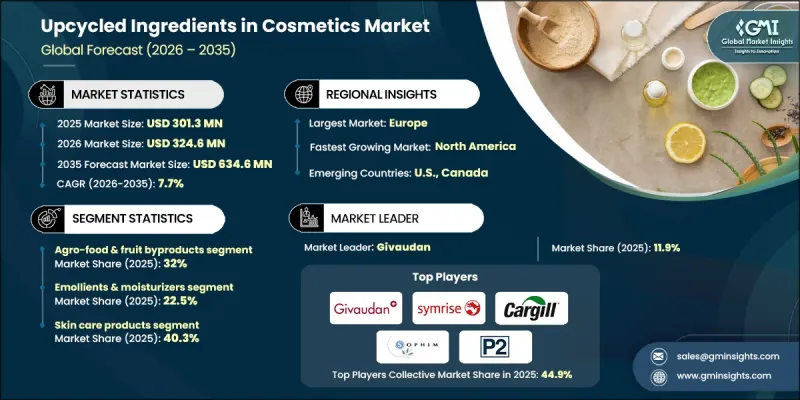
隨著消費者越來越重視永續性和環保意識,化妝品產業對升級再造原料的需求強勁成長。各大品牌正利用從食品、飲料和工業領域回收的材料,打造高價值的化妝品原料,同時支持循環經濟的目標。這種方法有助於最大限度地減少廢棄物和環境影響,滿足消費者對清潔、符合道德標準的美容產品日益成長的需求。升級再造原料具有重要的功能性優勢,例如保濕、抗氧化和抗衰老功效,同時也能提升品牌在環保意識強的消費者中的信譽度。透過重複利用原本會被丟棄的材料,製造商還能提高成本效益,並有助於建立更具韌性和永續的供應鏈。整個生產週期中廢棄物和碳排放的減少,進一步強化了使用升級再造化妝品原料的商業價值。
| 市場覆蓋範圍 | |
|---|---|
| 開始年份 | 2025 |
| 預測年份 | 2026-2035 |
| 起始值 | 3.013億美元 |
| 預測金額 | 6.346億美元 |
| 複合年成長率 | 7.7% |
預計到2025年,農產品和水果製品將佔據32%的市場佔有率,並在2035年之前以7.8%的複合年成長率成長。隨著永續性和清潔美容理念在全球消費行為中日益受到重視,對這些成分的需求持續成長。這些產品富含天然生物活性化合物、維生素和抗氧化劑,這些成分在化妝品配方中備受推崇。隨著企業不斷改進加工和回收技術以高效提取功能性成分,食品加工業正在探索新的收入來源,同時減少廢棄物。各大品牌積極推廣負責任的採購慣例,以滿足消費者對環保和符合道德規範的成分生產的期望。
預計到2025年,護膚應用領域將佔據40.3%的市場佔有率,並在2035年之前以8%的複合年成長率成長。這項成長主要得益於消費者對多功能、天然成分配方產品日益成長的興趣,這些產品在維護肌膚健康的同時,也能減少對環境的影響。具有保濕、抗氧化和煥活功效的升級再造植物、種子萃取物和植物性成分正擴大被添加到乳霜、精華液和護理產品中。化妝品品牌持續優先考慮永續產品開發,力求在提升產品性能的同時減少廢棄物。 「清潔美容」強調功效與環境責任之間的平衡,正深刻影響消費者的購買決策,尤其是在日常護膚品領域。
預計到2025年,北美化妝品再生原料市場將佔據30%的市場佔有率,使該地區成為再生化妝品原料的關鍵成長中心。消費者意識的提高以及對永續個人護理解決方案的強勁需求,持續推動再生原料的普及。該地區的美容品牌正著重強調透明度、負責任的採購和環保的生產流程,以增強消費者的信任。完善的經銷網路和大規模的、具有永續性意識的消費者群體,正助力護膚、護髮和彩妝品類市場的快速擴張。
目錄
第1章調查方法和範圍
第2章執行摘要
第3章業界考察
- 生態系分析
- 供應商情況
- 利潤率
- 每個階段的附加價值
- 影響價值鏈的因素
- 中斷
- 產業影響因素
- 促進要素
- 產業潛在風險與挑戰
- 市場機遇
- 成長潛力分析
- 監管環境
- 北美洲
- 歐洲
- 亞太地區
- 拉丁美洲
- 中東和非洲
- 波特五力分析
- PESTEL 分析
- 價格趨勢
- 按地區
- 按來源
- 未來市場趨勢
- 科技與創新趨勢
- 當前技術趨勢
- 新興技術
- 專利狀態
- 貿易統計(HS編碼)
- 主要進口國
- 主要出口國
- 永續性和環境方面
- 永續努力
- 減少廢棄物策略
- 生產中的能源效率
- 環保舉措
- 考慮到碳足跡
第4章 競爭情勢
- 介紹
- 公司市佔率分析
- 按地區
- 北美洲
- 歐洲
- 亞太地區
- 拉丁美洲
- 中東和非洲
- 按地區
- 企業矩陣分析
- 主要市場公司的競爭分析
- 競爭定位矩陣
- 重大進展
- 併購
- 夥伴關係與合作
- 新產品發布
- 業務拓展計劃
5. 2022-2035年按來源分類的市場估計與預測
- 農產品和水果
- 種子和堅果製品
- 透過木材和林產品
- 依植物/花卉產品分類
- 其他
第6章 市場估計與預測:功能類別,2022-2035年
- 潤膚劑和保濕劑
- 抗氧化和抗衰老活性成分
- 去角質產品和磨砂膏
- 防腐劑和抗菌劑
- 表面活性劑和乳化劑
- 紫外線吸收劑和光保護劑
- 著色劑和顏料
- 增稠劑和流變改性劑
- 香精/精油成分
- 其他
第7章 按應用領域分類的市場估算與預測,2022-2035年
- 護膚品
- 保濕霜和乳霜
- 精華液和抗衰老產品
- 防曬油
- 洗面乳和化妝水
- 其他(面膜、去角質產品等)
- 護髮產品
- 洗髮精和護髮素
- 頭髮護理和髮膜
- 造型產品
- 其他
- 彩妝及彩妝品
- 粉底液,BB/CC霜
- 唇膏和唇部護理
- 眼部彩妝產品
- 腮紅和修容粉
- 其他
- 身體保養產品
- 身體乳和潤膚霜
- 沐浴露及磨砂膏
- 其他
- 口腔護理產品
- 個人衛生用品
- 其他
第8章 2022-2035年各地區市場估算與預測
- 北美洲
- 美國
- 加拿大
- 歐洲
- 德國
- 英國
- 法國
- 西班牙
- 義大利
- 其他歐洲地區
- 亞太地區
- 中國
- 印度
- 日本
- 澳洲
- 韓國
- 亞太其他地區
- 拉丁美洲
- 巴西
- 墨西哥
- 阿根廷
- 其他拉丁美洲地區
- 中東和非洲
- 沙烏地阿拉伯
- 南非
- 阿拉伯聯合大公國
- 其他中東和非洲地區
第9章:公司簡介
- Cargill
- Givaudan
- Innomost Oy
- Lignopure
- Mibelle Ltd.
- OLVEA Group
- P2 Science, Inc
- SOPHIM IBERIA SL
- Symrise
- Upcycled Beauty Ltd
The Global Upcycled Ingredients in Cosmetics Market was valued at USD 301.3 million in 2025 and is estimated to grow at a CAGR of 7.7% to reach USD 634.6 million by 2035.
The cosmetics sector is witnessing strong momentum for upcycled ingredients as consumers increasingly prioritize sustainability and environmentally responsible purchasing decisions. Brands are incorporating materials recovered from food, beverage, and industrial by-products to create high-value cosmetic inputs while supporting circular economy objectives. This approach helps minimize waste, lowers environmental impact, and aligns with the growing demand for clean and ethically sourced beauty solutions. Upcycled ingredients deliver essential functional benefits, including hydration support, antioxidant protection, and age-defying properties, while reinforcing brand credibility among eco-conscious buyers. Manufacturers also gain cost efficiencies by repurposing materials that would otherwise be discarded, contributing to a more resilient and sustainable supply chain. Reduced waste generation and lower carbon emissions across production cycles further strengthen the business case for adopting upcycled cosmetic inputs.
| Market Scope | |
|---|---|
| Start Year | 2025 |
| Forecast Year | 2026-2035 |
| Start Value | $301.3 Million |
| Forecast Value | $634.6 Million |
| CAGR | 7.7% |
The agro-food and fruit byproducts segment accounted for 32% share in 2025 and is forecast to grow at a CAGR of 7.8% through 2035. Demand for these inputs continues to rise as sustainability and clean beauty become increasingly influential in global purchasing behavior. These byproducts contain high concentrations of naturally occurring bioactive compounds, vitamins, and antioxidants that are highly valued in cosmetic formulations. Companies are advancing processing and recovery methods to extract functional ingredients efficiently, allowing the food processing sector to unlock additional revenue streams while reducing waste. Brands actively promote responsible sourcing practices, responding to consumer expectations for environmentally sound and ethically produced ingredients.
The skincare applications segment held 40.3% share in 2025 and is anticipated to grow at a CAGR of 8% by 2035. Growth is driven by rising consumer interest in multifunctional and naturally derived formulations that support skin health while reducing environmental impact. Upcycled botanical, seed, and plant-based materials are increasingly incorporated into creams, serums, and treatment products due to their moisturizing, antioxidant, and rejuvenating properties. Cosmetic brands continue to prioritize sustainable product development, combining performance enhancement with waste reduction. Clean beauty preferences strongly influence purchasing decisions, particularly for daily-use skincare products designed to balance efficacy with environmental responsibility.
North America Upcycled Ingredients in Cosmetics Market held 30% share in 2025, positioning the region as a key growth hub for upcycled cosmetic ingredients. High consumer awareness, combined with strong demand for sustainable personal care solutions, continues to drive adoption. Beauty brands across the region emphasize transparency, responsible sourcing, and environmentally friendly manufacturing practices to strengthen consumer trust. The presence of established distribution networks and a large base of sustainability-focused buyers supports rapid market expansion across skincare, hair care, and color cosmetics categories.
Key companies active in the Global Upcycled Ingredients in Cosmetics Market include Givaudan, Cargill, Symrise, Mibelle Ltd., OLVEA Group, SOPHIM IBERIA S.L., P2 Science, Inc, Innomost Oy, Lignopure, and Upcycled Beauty Ltd. To strengthen their position, companies operating in the upcycled ingredients in cosmetics sector are focusing on innovation-driven product development, strategic partnerships, and advanced sourcing capabilities. Many players are investing in proprietary extraction and processing technologies to enhance ingredient purity, functionality, and scalability. Collaboration with food processors and agricultural suppliers enables consistent access to high-quality byproducts while reinforcing circular supply chains. Brands are also expanding their portfolios to address multiple cosmetic applications, improving customer reach. Transparent sustainability messaging, third-party certifications, and clean-label positioning are widely used to build consumer trust.
Table of Contents
Chapter 1 Methodology & Scope
- 1.1 Market scope and definition
- 1.2 Research design
- 1.2.1 Research approach
- 1.2.2 Data collection methods
- 1.3 Data mining sources
- 1.3.1 Global
- 1.3.2 Regional/Country
- 1.4 Base estimates and calculations
- 1.4.1 Base year calculation
- 1.4.2 Key trends for market estimation
- 1.5 Primary research and validation
- 1.5.1 Primary sources
- 1.6 Forecast model
- 1.7 Research assumptions and limitations
Chapter 2 Executive Summary
- 2.1 Industry 360° synopsis
- 2.2 Key market trends
- 2.2.1 Regional
- 2.2.2 Source
- 2.2.3 Functional category
- 2.2.4 Application
- 2.3 TAM Analysis, 2026-2035
- 2.4 CXO perspectives: Strategic imperatives
- 2.4.1 Executive decision points
- 2.4.2 Critical success factors
- 2.5 Future Outlook and Strategic Recommendations
Chapter 3 Industry Insights
- 3.1 Industry ecosystem analysis
- 3.1.1 Supplier landscape
- 3.1.2 Profit margin
- 3.1.3 Value addition at each stage
- 3.1.4 Factor affecting the value chain
- 3.1.5 Disruptions
- 3.2 Industry impact forces
- 3.2.1 Growth drivers
- 3.2.2 Industry pitfalls and challenges
- 3.2.3 Market opportunities
- 3.3 Growth potential analysis
- 3.4 Regulatory landscape
- 3.4.1 North America
- 3.4.2 Europe
- 3.4.3 Asia Pacific
- 3.4.4 Latin America
- 3.4.5 Middle East & Africa
- 3.5 Porter's analysis
- 3.6 PESTEL analysis
- 3.7 Price trends
- 3.7.1 By region
- 3.7.2 By source
- 3.8 Future market trends
- 3.9 Technology and Innovation landscape
- 3.9.1 Current technological trends
- 3.9.2 Emerging technologies
- 3.10 Patent Landscape
- 3.11 Trade statistics (HS code)
- 3.11.1 Major importing countries
- 3.11.2 Major exporting countries
- 3.12 Sustainability and environmental aspects
- 3.12.1 Sustainable practices
- 3.12.2 Waste reduction strategies
- 3.12.3 Energy efficiency in production
- 3.12.4 Eco-friendly initiatives
- 3.13 Carbon footprint consideration
Chapter 4 Competitive Landscape, 2025
- 4.1 Introduction
- 4.2 Company market share analysis
- 4.2.1 By region
- 4.2.1.1 North America
- 4.2.1.2 Europe
- 4.2.1.3 Asia Pacific
- 4.2.1.4 LATAM
- 4.2.1.5 MEA
- 4.2.1 By region
- 4.3 Company matrix analysis
- 4.4 Competitive analysis of major market players
- 4.5 Competitive positioning matrix
- 4.6 Key developments
- 4.6.1 Mergers & acquisitions
- 4.6.2 Partnerships & collaborations
- 4.6.3 New Product Launches
- 4.6.4 Expansion Plans
Chapter 5 Market Estimates and Forecast, By Source, 2022-2035 (USD Million) (Kilo Tons)
- 5.1 Key trends
- 5.2 Agro-food & fruit byproducts
- 5.3 Seed & nut byproducts
- 5.4 Wood & forestry byproducts
- 5.5 Botanical & floral byproducts
- 5.6 Others
Chapter 6 Market Estimates and Forecast, By Functional Category, 2022-2035 (USD Million) (Kilo Tons)
- 6.1 Key trends
- 6.2 Emollients & moisturizers
- 6.3 Antioxidants & anti-aging actives
- 6.4 Exfoliants & scrubs
- 6.5 Preservatives & antimicrobials
- 6.6 Surfactants & emulsifiers
- 6.7 UV filters & photoprotection agents
- 6.8 Colorants & pigments
- 6.9 Thickeners & rheology modifiers
- 6.10 Fragrances & essential oils components
- 6.11 Others
Chapter 7 Market Estimates and Forecast, By Application, 2022-2035 (USD Million) (Kilo Tons)
- 7.1 Key trends
- 7.2 Skin care products
- 7.2.1 Moisturizers & creams
- 7.2.2 Serums & anti-aging products
- 7.2.3 Sunscreens
- 7.2.4 Facial cleansers & toners
- 7.2.5 Others (masks & exfoliators, etc.)
- 7.3 Hair care products
- 7.3.1 Shampoos & conditioners
- 7.3.2 Hair treatments & masks
- 7.3.3 Styling products
- 7.3.4 Others
- 7.4 Makeup & color cosmetics
- 7.4.1 Foundations & BB/CC creams
- 7.4.2 Lipsticks & lip care
- 7.4.3 Eye makeup products
- 7.4.4 Blush & bronzers
- 7.4.5 Others
- 7.5 Body care products
- 7.5.1 Body lotions & butters
- 7.5.2 Body washes & scrubs
- 7.5.3 Others
- 7.6 Oral care products
- 7.7 Personal hygiene products
- 7.8 Others
Chapter 8 Market Estimates and Forecast, By Region, 2022-2035 (USD Million) (Kilo Tons)
- 8.1 Key trends
- 8.2 North America
- 8.2.1 U.S.
- 8.2.2 Canada
- 8.3 Europe
- 8.3.1 Germany
- 8.3.2 UK
- 8.3.3 France
- 8.3.4 Spain
- 8.3.5 Italy
- 8.3.6 Rest of Europe
- 8.4 Asia Pacific
- 8.4.1 China
- 8.4.2 India
- 8.4.3 Japan
- 8.4.4 Australia
- 8.4.5 South Korea
- 8.4.6 Rest of Asia Pacific
- 8.5 Latin America
- 8.5.1 Brazil
- 8.5.2 Mexico
- 8.5.3 Argentina
- 8.5.4 Rest of Latin America
- 8.6 Middle East and Africa
- 8.6.1 Saudi Arabia
- 8.6.2 South Africa
- 8.6.3 UAE
- 8.6.4 Rest of Middle East and Africa
Chapter 9 Company Profiles
- 9.1 Cargill
- 9.2 Givaudan
- 9.3 Innomost Oy
- 9.4 Lignopure
- 9.5 Mibelle Ltd.
- 9.6 OLVEA Group
- 9.7 P2 Science, Inc
- 9.8 SOPHIM IBERIA S.L.
- 9.9 Symrise
- 9.10 Upcycled Beauty Ltd

 化妝品原料市場:按類型、原料類型、物理形態、原料等級、粒徑和應用分類-2026-2032年全球市場預測化妝品及個人護理原料市場:依來源、化學分類、形態、溶解度、成分、功能、應用及通路分類-2026-2032年全球市場預測非基因改造化妝品和個人護理原料市場:按成分類型、化妝品、劑型、純度等級、來源和分銷管道分類-2026-2032年全球市場預測
 2026-2030年全球化妝品原料市場
 神經美容活性成分市場預測至2034年-按成分類型、功能效果、原料、應用、劑型、最終用戶和地區分類的全球分析
 化妝品原料市場:依產品類型、應用、功能及地區分類
 2026-2034年全球指甲花粉市場規模、佔有率、趨勢和成長分析報告升級再造化妝品原料市場:規模、佔有率、成長和全球產業分析:按類型和應用、區域洞察以及2026-2034年預測
 抗壞血酸棕櫚酸酯市場機會、成長要素、產業趨勢分析及2026-2035年預測。全球化妝品原料市場規模、佔有率、趨勢和成長分析報告(2026-2034年)