

 |
市場調查報告書
商品編碼
1936508
面膜市場機會、成長要素、產業趨勢分析及2026年至2035年預測Facial Mask Market Opportunity, Growth Drivers, Industry Trend Analysis, and Forecast 2026 - 2035 |
||||||

全球面膜市場預計到 2025 年將達到 69 億美元,到 2035 年將達到 116 億美元,年複合成長率為 5.4%。
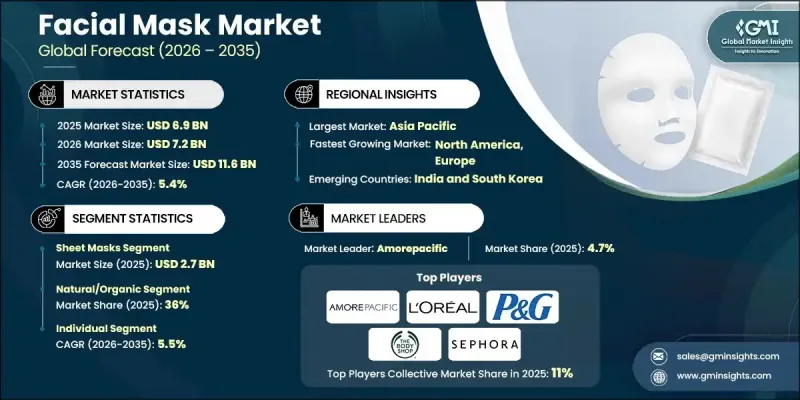
隨著消費者尋求實用、省時且效果顯著的美容解決方案,市場需求持續成長。護膚意識顯著提升,人們越來越重視保持肌膚健康,將其視為整體健康的重要組成部分。對痘痘和敏感肌膚等皮膚問題的日益關注進一步推動了市場成長。消費者對潔淨標示的美容產品偏好,積極查看產品成分,並傾向於選擇被認為更安全、適合長期使用的產品,這極大地影響了他們的購買決策。對合成成分副作用的擔憂促使消費者追求採用天然有機成分配製、溫和不刺激的護膚產品。面膜能夠快速見效,輕鬆融入忙碌的生活方式,滿足了消費者的期望。面膜使用便利、方便攜帶,且能與各種護膚流程完美融合,因此深受各個年齡層和收入群體的青睞,從而確保了市場的長期穩定發展。
| 市場覆蓋範圍 | |
|---|---|
| 開始年份 | 2025 |
| 預測年份 | 2026-2035 |
| 起始值 | 69億美元 |
| 預測金額 | 116億美元 |
| 複合年成長率 | 5.4% |
預計到2025年,片狀面膜市場規模將達27億美元。這類產品需求強勁,是因為它們能夠在提供保濕、平衡、舒緩、保濕和提亮膚色等功效的同時,避免肌膚在使用過程中乾燥。其獨特的結構使其能均勻貼合肌膚,提升吸收效率和舒適度。片狀面膜採用輕薄柔韌的基底,浸潤濃縮精華液,旨在將滋養成分均勻輸送至臉部。這種便捷高效的敷面方式,使其深受追求快速便捷護膚方案的消費者的青睞。
預計到2025年,天然和有機產品市佔率將達到36%,並在2026年至2035年間以5.8%的複合年成長率成長。這一成長主要得益於全球對清潔美容的趨勢轉變、消費者意識提升的提高以及對長期接觸合成化學物質的日益關注。消費者越來越重視成分透明度,傾向選擇宣稱溫和、無刺激且來源可靠的產品。這一趨勢推動了天然面膜解決方案的持續創新。
預計到2025年,美國面膜市場將佔據80%的市場佔有率,規模達16億美元。市場成長的促進因素包括護膚意識的提高、對成分導向產品日益成長的興趣,以及數位平台對美容潮流的影響。各種面膜產品的創新不斷滿足不同的肌膚需求,進而支撐著市場的持續需求。
目錄
第1章調查方法和範圍
第2章執行摘要
第3章業界考察
- 生態系分析
- 供應商情況
- 利潤率
- 每個階段的附加價值
- 影響價值鏈的因素
- 中斷
- 產業影響因素
- 促進要素
- 產業潛在風險與挑戰
- 機會
- 成長潛力分析
- 未來市場趨勢
- 科技與創新趨勢
- 當前技術趨勢
- 新興技術
- 價格趨勢
- 按地區
- 依產品類型
- 法律規範
- 標準與認證
- 環境法規
- 進出口限制
- 貿易統計(HS編碼)
- 主要進口國
- 主要出口國
- 波特五力分析
- PESTEL 分析
- 消費行為分析
- 購買模式
- 偏好分析
- 消費行為的區域差異
- 電子商務如何影響購買決策
第4章 競爭情勢
- 介紹
- 公司市佔率分析
- 按地區
- 企業矩陣分析
- 主要市場公司的競爭分析
- 競爭定位矩陣
- 重大進展
- 併購
- 夥伴關係與合作
- 新產品發布
- 擴張計劃
第5章 依產品類型分類的市場估算與預測,2022-2035年
- 炭泥面膜
- 面膜
- 撕拉式面膜
- 其他(免洗面膜等)
第6章 依原料分類的市場估算與預測,2022-2035年
- 天然/有機
- 合成
第7章 依包裝類型分類的市場估計與預測,2022-2035年
- 管子
- 瓶子
- 盒子
- 瓶子
- 其他(小包等)
第8章 依膚質類型分類的市場估算與預測,2022-2035年
- 乾性皮膚
- 混合性肌膚
- 敏感肌膚
- 正常皮膚
- 油性肌膚
- 所有膚質
第9章 2022-2035年按價格分類的市場估計與預測
- 最高可達 10 美元
- 10至15美元
- 15至20美元
- 超過 20 美元
第10章 依應用領域分類的市場估計與預測,2022-2035年
- 保濕
- 打掃
- 抗衰老
- 粉刺
- 提亮
- 其他(鎮靜作用等)
第11章 依消費群組的市場估計與預測,2022-2035年
- 男性
- 女士
- 男女通用的
第12章 依最終用途分類的市場估計與預測,2022-2035年
- 個人
- 商業的
- 專業美容院
- 健康中心
- 美容研究所
- 其他
第13章 依分銷管道分類的市場估計與預測,2022-2035年
- 線上
- 電子商務
- 公司網站
- 離線
- 超級市場/大賣場
- 專賣店
- 其他(例如,獨立零售商)
第14章 2022-2035年各地區市場估算與預測
- 北美洲
- 美國
- 加拿大
- 歐洲
- 德國
- 英國
- 法國
- 西班牙
- 義大利
- 荷蘭
- 亞太地區
- 中國
- 日本
- 印度
- 澳洲
- 韓國
- 拉丁美洲
- 巴西
- 墨西哥
- 阿根廷
- 中東和非洲
- 南非
- 沙烏地阿拉伯
- 阿拉伯聯合大公國
第15章 公司簡介
- Allure
- Amorepacific
- Beauty Barn
- Dr.Jart+
- HCP Wellness
- Lessonia
- Loops Beauty
- L'Oreal(Garnier)
- Mirabelle
- Procter &Gamble(Olay)
- Renee Cosmetics
- Revlon
- Sephora
- Taiki
- The Body Shop
The Global Facial Mask Market was valued at USD 6.9 billion in 2025 and is estimated to grow at a CAGR of 5.4% to reach USD 11.6 billion by 2035.
Demand continues to increase as consumers seek practical, time-efficient, and result-oriented beauty solutions. Skincare awareness has grown significantly, with individuals placing greater importance on maintaining healthy skin as part of overall well-being. Rising concerns related to skin conditions, including breakouts and sensitivity, further support market expansion. Preference for clean-label beauty products strongly influences purchasing decisions, as consumers actively examine product formulations and favor options perceived as safer for long-term use. Concerns regarding the effects of synthetic ingredients drive stronger demand for natural and organic formulations that are considered gentler on the skin. Facial masks meet consumer expectations by delivering visible results within short usage periods while fitting seamlessly into busy lifestyles. Their ease of application, portability, and compatibility with various skin routines continue to strengthen adoption across age groups and income segments, supporting long-term market stability.
| Market Scope | |
|---|---|
| Start Year | 2025 |
| Forecast Year | 2026-2035 |
| Start Value | $6.9 billion |
| Forecast Value | $11.6 billion |
| CAGR | 5.4% |
The sheet masks segment generated USD 2.7 billion in 2025. These products attract strong demand due to their ability to deliver hydration, balance, soothing effects, moisture retention, and skin-brightening benefits without drying out during use. Their structure allows consistent skin contact, improving absorption efficiency and comfort. Sheet masks rely on thin, flexible substrates infused with concentrated serums designed to evenly distribute nourishing formulations across the face. This delivery method supports convenience and effectiveness, reinforcing its popularity among consumers seeking quick skincare solutions with minimal effort.
The natural and organic segment held 36% share in 2025 and is forecast to grow at a CAGR of 5.8% from 2026 to 2035. Growth is driven by the global shift toward clean beauty, heightened consumer awareness, and rising concerns over prolonged exposure to synthetic chemicals. Shoppers increasingly prioritize ingredient transparency and gravitate toward formulations positioned as mild, skin-friendly, and responsibly sourced. This trend supports continuous innovation in naturally derived facial mask solutions.
United States Facial Mask Market held 80% share, generating USD 1.6 billion in 2025. Market growth benefits from strong skincare awareness, growing interest in ingredient-conscious products, and the influence of digital platforms on beauty trends. Product innovation across various mask formats continues to address diverse skin needs, reinforcing sustained demand.
Key companies active in the Global Facial Mask Market include L'Oreal (Garnier), The Body Shop, Amorepacific, Procter & Gamble (Olay), Sephora, Dr.Jart+, Revlon, Taiki, Loops Beauty, Lessonia, Mirabelle, Renee Cosmetics, Beauty Barn, Allure, and HCP Wellness. Companies in the facial mask market strengthen their competitive position by expanding clean-label product lines and investing in formulation innovation. Brands emphasize ingredient transparency and sustainable sourcing to align with evolving consumer values. Strategic use of digital marketing and influencer-driven campaigns enhances brand visibility and customer engagement. Many players focus on product differentiation through texture, performance, and targeted skin benefits. Expanding retail presence across online and offline channels improves accessibility and market reach. Continuous investment in research supports improved efficacy and skin compatibility.
Table of Contents
Chapter 1 Methodology and scope
- 1.1 Market scope and definition
- 1.2 Research design
- 1.2.1 Research approach
- 1.2.2 Data collection methods
- 1.3 Data mining sources
- 1.3.1 Global
- 1.3.2 Regional/country
- 1.4 Base estimates and calculations
- 1.4.1 Base year calculation
- 1.4.2 Key trends for market estimation
- 1.5 Primary research and validation
- 1.5.1 Primary sources
- 1.6 Forecast model
- 1.7 Research assumptions and limitations
Chapter 2 Executive summary
- 2.1 Industry 3600 synopsis
- 2.2 Key market trends
- 2.2.1 Regional
- 2.2.2 Product Type
- 2.2.3 Ingredient
- 2.2.4 Packaging Format
- 2.2.5 Skin Type
- 2.2.6 Price
- 2.2.7 Application
- 2.2.8 Consumer Group
- 2.2.9 End Use
- 2.2.10 Distribution Channel
- 2.3 CXO perspectives: strategic imperatives
- 2.3.1 Key decision points for industry executives
- 2.3.2 Critical success factors for market players
- 2.4 Future outlook and strategic recommendations
Chapter 3 Industry insights
- 3.1 Industry ecosystem analysis
- 3.1.1 Supplier landscape
- 3.1.2 Profit margin
- 3.1.3 Value addition at each stage
- 3.1.4 Factor affecting the value chain
- 3.1.5 Disruptions
- 3.2 Industry impact forces
- 3.2.1 Growth drivers
- 3.2.2 Industry pitfalls & challenges
- 3.2.3 Opportunities
- 3.3 Growth potential analysis
- 3.4 Future market trends
- 3.5 Technology and innovation landscape
- 3.5.1 Current technological trends
- 3.5.2 Emerging technologies
- 3.6 Price trends
- 3.6.1 By region
- 3.6.2 By product type
- 3.7 Regulatory framework
- 3.7.1 Standards and certifications
- 3.7.2 Environmental regulations
- 3.7.3 Import export regulations
- 3.8 Trade statistics (HS code)
- 3.8.1 Major importing countries
- 3.8.2 Major exporting countries
- 3.9 Porter's five forces analysis
- 3.10 PESTEL analysis
- 3.11 Consumer behavior analysis
- 3.11.1 Purchasing patterns
- 3.11.2 Preference analysis
- 3.11.3 Regional variations in consumer behavior
- 3.11.4 Impact of e-commerce on buying decisions
Chapter 4 Competitive landscape, 2025
- 4.1 Introduction
- 4.2 Company market share analysis
- 4.2.1 By region
- 4.2.1.1 North America
- 4.2.1.2 Europe
- 4.2.1.3 Asia Pacific
- 4.2.1.4 Latin America
- 4.2.1.5 MEA
- 4.2.1 By region
- 4.3 Company matrix analysis
- 4.4 Competitive analysis of major market players
- 4.5 Competitive positioning matrix
- 4.6 Key developments
- 4.6.1 Mergers & acquisitions
- 4.6.2 Partnerships & collaborations
- 4.6.3 New product launches
- 4.6.4 Expansion plans
Chapter 5 Market Estimates & Forecast, By Product Type, 2022 - 2035 ($Billion, Million Units)
- 5.1 Key trends
- 5.2 Charcoal/clay mask
- 5.3 Sheet masks
- 5.4 Peel-off masks
- 5.5 Others (leave-on masks etc.)
Chapter 6 Market Estimates & Forecast, By Ingredients, 2022 - 2035 ($Billion, Million Units)
- 6.1 Key trends
- 6.2 Natural/organic
- 6.3 Synthetic
Chapter 7 Market Estimates & Forecast, By Packaging Format, 2022 - 2035 ($Billion, Million Units)
- 7.1 Key trends
- 7.2 Tubes
- 7.3 Bottle
- 7.4 Box
- 7.5 Jar
- 7.6 Others (sachets etc.)
Chapter 8 Market Estimates & Forecast, By Skin Type, 2022 - 2035 ($Billion, Million Units)
- 8.1 Key trends
- 8.2 Dry
- 8.3 Combination
- 8.4 Sensitive
- 8.5 Normal
- 8.6 Oily
- 8.7 All skin types
Chapter 9 Market Estimates & Forecast, By Price, 2022 - 2035 ($Billion, Million Units)
- 9.1 Key trends
- 9.2 Up to $10
- 9.3 $10 to $15
- 9.4 $15 to $20
- 9.5 $20 & above
Chapter 10 Market Estimates & Forecast, By Application, 2022 - 2035 ($Billion, Million Units)
- 10.1 Key trends
- 10.2 Moisturizing
- 10.3 Cleansing
- 10.4 Anti-aging
- 10.5 Acne
- 10.6 Brightening
- 10.7 Others (soothing etc.)
Chapter 11 Market Estimates & Forecast, By Consumer Group, 2022 - 2035 ($Billion, Million Units)
- 11.1 Key trends
- 11.2 Men
- 11.3 Women
- 11.4 Unisex
Chapter 12 Market Estimates & Forecast, By End Use, 2022 - 2035 ($Billion, Million Units)
- 12.1 Key trends
- 12.2 Individual
- 12.3 Commercial
- 12.3.1 Professional beauty salons
- 12.3.2 Wellness centers
- 12.3.3 Beauty institute
- 12.3.4 Others
Chapter 13 Market Estimates & Forecast, By Distribution Channel, 2022 - 2035 ($Billion, Million Units)
- 13.1 Key trends
- 13.2 Online
- 13.2.1 E-commerce
- 13.2.2 Company websites
- 13.3 Offline
- 13.3.1 Supermarkets/hypermarket
- 13.3.2 Specialty retail stores
- 13.3.3 Others (independent retailer etc.)
Chapter 14 Market Estimates & Forecast, By Region, 2022 - 2035 ($Billion, Million Units)
- 14.1 Key trends
- 14.2 North America
- 14.2.1 U.S.
- 14.2.2 Canada
- 14.3 Europe
- 14.3.1 Germany
- 14.3.2 UK
- 14.3.3 France
- 14.3.4 Spain
- 14.3.5 Italy
- 14.3.6 Netherlands
- 14.4 Asia Pacific
- 14.4.1 China
- 14.4.2 Japan
- 14.4.3 India
- 14.4.4 Australia
- 14.4.5 South Korea
- 14.5 Latin America
- 14.5.1 Brazil
- 14.5.2 Mexico
- 14.5.3 Argentina
- 14.6 MEA
- 14.6.1 South Africa
- 14.6.2 Saudi Arabia
- 14.6.3 UAE
Chapter 15 Company Profiles
- 15.1 Allure
- 15.2 Amorepacific
- 15.3 Beauty Barn
- 15.4 Dr.Jart+
- 15.5 HCP Wellness
- 15.6 Lessonia
- 15.7 Loops Beauty
- 15.8 L'Oreal (Garnier)
- 15.9 Mirabelle
- 15.10 Procter & Gamble (Olay)
- 15.11 Renee Cosmetics
- 15.12 Revlon
- 15.13 Sephora
- 15.14 Taiki
- 15.15 The Body Shop


