


 |
市場調查報告書
商品編碼
1936507
智慧鋰電池家用吹雪機市場機會、成長要素、產業趨勢分析及2026年至2035年預測Smart Lithium Battery Operated Household Snow Blower Market Opportunity, Growth Drivers, Industry Trend Analysis, and Forecast 2026 - 2035 |
||||||

全球智慧鋰電池家用吹雪機市場預計到 2025 年將達到 2.596 億美元,預計到 2035 年將達到 24.9 億美元,年複合成長率為 25.5%。
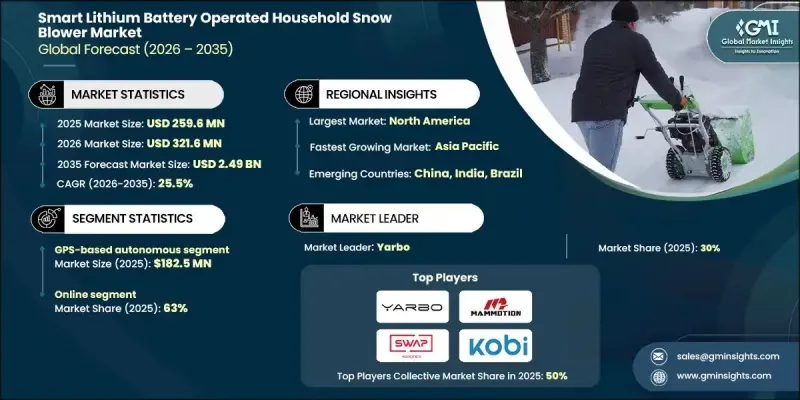
這一成長反映了家用設備偏好的更廣泛轉變,消費者正在尋求更清潔、更安靜、更易於使用的傳統除雪工具替代品。電池驅動的拋雪機符合人們日益增強的環保意識以及減少排放氣體、噪音和維護的需求。鋰電池系統在寒冷氣候下提供可靠的性能,同時無需燃料處理和機械維護。住宅越來越重視能夠減少體力勞動並有效適應不斷變化且難以預測的冬季條件的解決方案。這種偏好促使智慧自動拋雪機成為漫長冬季中可靠的家用工具,為住宅環境提供便利、高效和可靠的除雪性能。製造商透過整合先進的自動化技術和智慧功能來滿足這些期望,從而提高易用性和可靠性。互聯功能使用戶能夠遠端管理效能,智慧系統則根據環境條件調整運作。鋰離子電池技術的持續進步在這一市場擴張中發揮核心作用,與前幾代電池相比,它具有更長的運作時間、更高的耐用性和更強大的除雪能力。這些進步提高了電池供電系統的可靠性,即使在大雪天氣下也是如此,進一步加速了從汽油動力設備向電池供電設備的過渡。
| 市場覆蓋範圍 | |
|---|---|
| 開始年份 | 2025 |
| 預測年份 | 2026-2035 |
| 起始值 | 2.596億美元 |
| 預測金額 | 24.9億美元 |
| 複合年成長率 | 25.5% |
預計到2025年,基於GPS的自主系統市場將創造1.825億美元的收入。這些系統之所以引領市場,是因為它們擁有超越傳統感測器解決方案的功能,例如精確導航、持續覆蓋區域和完全自主駕駛。整合定位技術使機器能夠識別已繪製的區域、保持精確的行駛路徑,並在用戶干預極少的情況下提供可靠的性能,從而推動了對全自動除雪解決方案的需求。
預計到2025年,線上銷售將佔市場佔有率的63%。數位平台為消費者提供便利的購買管道、詳細的產品比較以及透明的用戶評價,這些都會影響他們的購買意願。消費者越來越依賴線上管道來評估產品的效能參數、電池續航力、維護需求以及真實使用者的回饋,然後再做出購買決定。
預計到2025年,美國智慧型鋰電池家用除雪機市場規模將達1.242億美元。區域需求成長的促進因素包括冬季持續時間延長、降雪頻率增加、郊區住宅面積擴大以及鋰電池工具的廣泛應用。尤其是在美國和加拿大,持續的寒冷天氣不斷推高了對高效住宅除雪解決方案的需求。
目錄
第1章調查方法和範圍
第2章執行摘要
第3章業界考察
- 生態系分析
- 供應商情況
- 利潤率
- 每個階段的附加價值
- 影響價值鏈的因素
- 產業影響因素
- 促進要素
- 智慧和自主家居設備的普及率不斷提高
- 人們越來越偏好選擇環保、更安靜的除雪方式
- 線上通路的拓展和電子商務市場的強勁成長
- 產業潛在風險與挑戰
- 電池壽命限制以及在極寒和雪地條件下的性能
- 與傳統模型相比,初始成本更高
- 機會
- 將先進的導航技術與人工智慧驅動的自動化相結合
- 拓展至新興雪區及亞太市場
- 促進要素
- 成長潛力分析
- 關鍵市場趨勢與顛覆性因素
- 未來市場趨勢
- 風險及緩解分析
- 科技與創新趨勢
- 當前技術趨勢
- 新興技術
- 價格趨勢
- 按地區
- 依產品
- 監管環境
- 北美洲
- 歐洲
- 亞太地區
- 中東和非洲
- 拉丁美洲
- 波特五力分析
- PESTEL 分析
- 消費行為分析
- 購買模式
- 偏好分析
- 消費行為的區域差異
- 電子商務對購買決策的影響
第4章 競爭情勢
- 介紹
- 公司市佔率分析
- 按地區
- 企業矩陣分析
- 主要市場公司的競爭分析
- 競爭定位矩陣
- 重大進展
- 併購
- 夥伴關係與合作
- 新產品發布
- 擴張計劃
第5章 2022-2035年按產品分類的市場估算與預測
- 基於GPS的自動駕駛
- 基於視覺的自動駕駛
- 混合多感測器
6. 依模組化程度分類的市場估算與預測,2022-2035 年
- 一次使用(僅限雪地)
- 多季節模組化平台
第7章 按物業規模分類的市場估計與預測,2022-2035年
- 袖珍的
- 標準郊區住宅
- 大型郊區型
- 房地產
第8章 按分銷管道分類的市場估算與預測,2022-2035年
- 線上
- 離線
第9章 2022-2035年各地區市場估算與預測
- 北美洲
- 美國
- 加拿大
- 歐洲
- 法國
- 奧地利
- 瑞典
- 芬蘭
- 瑞士
- 挪威
- 丹麥
- 愛沙尼亞
- 亞太地區
- 台灣
- 日本
- 韓國
- 蒙古
- 拉丁美洲
- 阿根廷
- 智利
- 哥倫比亞
- 中東和非洲
- 伊朗
- 摩洛哥
- 南非
第10章:公司簡介
- Yarbo
- Mammotion
- Kobi Company
- Swap Robotics
- Snowbot
- EGO Power+
- Greenworks
- Toro
- Milwaukee Tool
- Ryobi
- DeWalt
- Snow Joe
- Kobalt
- Craftsman
- Earthwise
The Global Smart Lithium Battery Operated Household Snow Blower Market was valued at USD 259.6 million in 2025 and is estimated to grow at a CAGR of 25.5% to reach USD 2.49 billion by 2035.
Growth reflects a broader transformation in household equipment preferences, with consumers seeking cleaner, quieter, and easier-to-use alternatives to conventional snow removal tools. Battery-powered snow blowers align well with rising environmental awareness and the growing desire to reduce emissions, noise, and maintenance demands. Lithium-battery systems deliver consistent performance in cold climates while eliminating fuel handling and mechanical upkeep. Homeowners increasingly value solutions that reduce physical effort and adapt effectively to changing and unpredictable winter conditions. These preferences position smart, automated snow blowers as reliable household tools capable of supporting long winters while delivering convenience, efficiency, and dependable clearing performance in residential environments. Manufacturers respond to these expectations by integrating advanced automation and smart functionality that improves usability and reliability. Connected features allow users to manage performance remotely while intelligent systems adjust operation based on environmental conditions. Continued improvements in lithium-ion battery technology play a central role in market expansion, offering longer operating times, improved durability, and stronger snow-clearing capabilities than earlier battery generations. These advances reinforce confidence in battery-powered systems, even during heavier snowfall, and further accelerate the shift away from gas-powered equipment.
| Market Scope | |
|---|---|
| Start Year | 2025 |
| Forecast Year | 2026-2035 |
| Start Value | $259.6 Million |
| Forecast Value | $2.49 Billion |
| CAGR | 25.5% |
The GPS-based autonomous systems segment generated USD 182.5 million in 2025. These systems lead adoption due to their ability to deliver accurate navigation, consistent area coverage, and fully automated operation beyond the capabilities of sensor-based solutions. Integrated positioning technology enables machines to recognize mapped areas, maintain precise movement paths, and deliver reliable performance with minimal user intervention, strengthening demand for fully autonomous snow-clearing solutions.
The online sales segment held 63% share in 2025. Digital platforms offer consumers convenient access, detailed product comparisons, and transparent reviews that influence purchasing confidence. Buyers increasingly rely on online channels to evaluate performance specifications, battery life, maintenance requirements, and real-world user feedback before committing to a purchase.
United States Smart Lithium Battery Operated Household Snow Blower Market generated USD 124.2 million in 2025. Regional demand is supported by extended winter seasons, frequent snowfall, large suburban housing areas, and widespread adoption of lithium-powered tools. Prolonged cold conditions consistently drive the need for efficient residential snow removal solutions, particularly across the US and Canada.
Key companies active in the Global Smart Lithium Battery Operated Household Snow Blower Market include Toro, EGO Power+, Greenworks, Yarbo, Ryobi, DeWalt, Snow Joe, Mammotion, Milwaukee Tool, Craftsman, Kobalt, Kobi Company, Swap Robotics, Earthwise, and Snowbot. Companies in the smart lithium-battery operated household snow blower market strengthen their position by focusing on innovation in automation, battery efficiency, and smart connectivity. Manufacturers prioritize improving runtime, power output, and durability to enhance cold-weather performance. Expanding direct-to-consumer and online retail strategies improves visibility and customer access. Many brands emphasize ease of use, safety, and low maintenance to appeal to residential buyers.
Table of Contents
Chapter 1 Methodology and Scope
- 1.1 Market scope and definition
- 1.2 Research design
- 1.2.1 Research approach
- 1.2.2 Data collection methods
- 1.3 Data mining sources
- 1.3.1 Global
- 1.3.2 Regional/Country
- 1.4 Base estimates and calculations
- 1.4.1 Base year calculation
- 1.4.2 Key trends for market estimation
- 1.5 Primary research and validation
- 1.5.1 Primary sources
- 1.6 Forecast model
- 1.7 Research assumptions and limitations
Chapter 2 Executive Summary
- 2.1 Industry 360° synopsis
- 2.2 Key market trends
- 2.2.1 By Regional
- 2.2.2 By Product
- 2.2.3 By Modularity
- 2.2.4 By Property size
- 2.2.5 By Distribution channel
- 2.3 CXO perspectives: Strategic imperatives
- 2.3.1 Key decision points for industry executives
- 2.3.2 Critical success factors for market players
- 2.4 Future outlook and strategic recommendations
Chapter 3 Industry Insights
- 3.1 Industry ecosystem analysis
- 3.1.1 Supplier landscape
- 3.1.2 Profit margin
- 3.1.3 Value addition at each stage
- 3.1.4 Factor affecting the value chain
- 3.2 Industry impact forces
- 3.2.1 Growth drivers
- 3.2.1.1 Rising Adoption of Smart and Autonomous Home Equipment
- 3.2.1.2 Growing Preference for Eco-Friendly and Low-Noise Snow Removal
- 3.2.1.3 Expanded Online Availability and Strong E-Commerce Growth
- 3.2.2 Industry pitfalls & challenges
- 3.2.2.1 Limited Battery Runtime and Performance in Extreme Snow Conditions
- 3.2.2.2 Higher Upfront Cost Compared to Conventional Models
- 3.2.3 Opportunities
- 3.2.3.1 Integration of Advanced Navigation and AI-Driven Automation
- 3.2.3.2 Expansion into Emerging Snowfall Regions and APAC Markets
- 3.2.1 Growth drivers
- 3.3 Growth potential analysis
- 3.4 Major market trends and Distruptions
- 3.5 Future market trends
- 3.6 Risk and mitigation Analysis
- 3.7 Technology and innovation landscape
- 3.7.1 Current technological trends
- 3.7.2 Emerging technologies
- 3.8 Price trends
- 3.8.1 By Region
- 3.8.2 By Product
- 3.9 Regulatory landscape
- 3.9.1 Noth America
- 3.9.2 Europe
- 3.9.3 Asia-Pacific
- 3.9.4 Middle East and Africa
- 3.9.5 Latin America
- 3.10 Porter's analysis
- 3.11 PESTEL analysis
- 3.12 Consumer behaviour analysis
- 3.12.1 Purchasing patterns
- 3.12.2 Preference analysis
- 3.12.3 Regional variations in consumer behavior
- 3.12.4 Impact of e-commerce on buying decisions
Chapter 4 Competitive Landscape, 2025
- 4.1 Introduction
- 4.2 Company market share analysis
- 4.2.1 By region
- 4.2.1.1 North America
- 4.2.1.2 Europe
- 4.2.1.3 Asia Pacific
- 4.2.1.4 Latin America
- 4.2.1.5 Middle East and Africa
- 4.2.1 By region
- 4.3 Company matrix analysis
- 4.4 Competitive analysis of major market players
- 4.5 Competitive positioning matrix
- 4.6 Key developments
- 4.6.1 Mergers & acquisitions
- 4.6.2 Partnerships & collaborations
- 4.6.3 New product launches
- 4.6.4 Expansion plans
Chapter 5 Market Estimates & Forecast, By Product, 2022-2035 (USD Million) (Thousand Units)
- 5.1 Key trends
- 5.2 Gps-based autonomous
- 5.3 Vision-based autonomous
- 5.4 Hybrid multi-sensor
Chapter 6 Market Estimates & Forecast, By Modularity, 2022-2035 (USD Million) (Thousand Units)
- 6.1 Key trends
- 6.2 Single-purpose snow-only
- 6.3 Multi-season modular platform
Chapter 7 Market Estimates & Forecast, By Property Size, 2022-2035 (USD Million) (Thousand Units)
- 7.1 Key trends
- 7.2 Compact
- 7.3 Standard Suburban
- 7.4 Large Suburban
- 7.5 Estate
Chapter 8 Market Estimates & Forecast, By Distribution Channel, 2022-2035 (USD Million) (Thousand Units)
- 8.1 Key trends
- 8.2 Online
- 8.3 Offline
Chapter 9 Market Estimates and Forecast, By Region, 2022 - 2035 (USD Million) (Thousand Units)
- 9.1 Key trends
- 9.2 North America
- 9.2.1 U.S.
- 9.2.2 Canada
- 9.3 Europe
- 9.3.1 France
- 9.3.2 Austria
- 9.3.3 Sweden
- 9.3.4 Finland
- 9.3.5 Switzerland
- 9.3.6 Norway
- 9.3.7 Denmark
- 9.3.8 Estonia
- 9.4 Asia Pacific
- 9.4.1 Taiwan
- 9.4.2 Japan
- 9.4.3 South Korea
- 9.4.4 Mongolia
- 9.5 Latin America
- 9.5.1 Argentina
- 9.5.2 Chile
- 9.5.3 Colombia
- 9.6 Middle East and Africa
- 9.6.1 Iran
- 9.6.2 Morocco
- 9.6.3 South Africa
Chapter 10 Company Profiles
- 10.1 Yarbo
- 10.2 Mammotion
- 10.3 Kobi Company
- 10.4 Swap Robotics
- 10.5 Snowbot
- 10.6 EGO Power+
- 10.7 Greenworks
- 10.8 Toro
- 10.9 Milwaukee Tool
- 10.10 Ryobi
- 10.11 DeWalt
- 10.12 Snow Joe
- 10.13 Kobalt
- 10.14 Craftsman
- 10.15 Earthwise

 機場除雪車輛及設備市場:2026-2032年全球市場預測(依設備類型、車輛類型、動力來源、應用及最終用戶分類)
 2034年全球除雪機器人市場預測:按機器人類型、移動方式、除雪機制、應用、銷售管道、最終用戶和地區分類的全球分析融雪融冰系統市場:2026年至2032年全球預測(依系統類型、組件、系統功能、安裝方式、應用及通路分類)除雪機市場:依產品類型、動力來源、引擎功率、應用和通路分類-2026-2032年全球預測除雪機市場:依產品類型、引擎類型、動力來源、最終用戶、應用和分銷管道分類,全球預測,2026-2032年天線式融雪除冰系統市場:依產品、類型、安裝方式、通路、應用領域分類,全球預測(2026-2032年)
 機場除雪車輛及設備市場:依產品類型、機場類型及地區分類(2026-2034 年)
 2026年全球推雪機市場報告
 機場除雪車輛設備市場-全球產業規模、佔有率、趨勢、機會、預測:依產品類型、機場類型、地區和競爭格局分類,2021-2031年
 除雪設備市場機會、成長要素、產業趨勢分析及2026年至2035年預測