


 |
市場調查報告書
商品編碼
1936502
醫用氧氣濃縮機市場機會、成長促進因素、產業趨勢分析及預測(2026-2035年)Medical Oxygen Concentrators Market Opportunity, Growth Drivers, Industry Trend Analysis, and Forecast 2026 - 2035 |
||||||

全球醫用氧氣濃縮機市場預計到 2025 年將達到 18 億美元,到 2035 年將達到 33 億美元,年複合成長率為 6.4%。
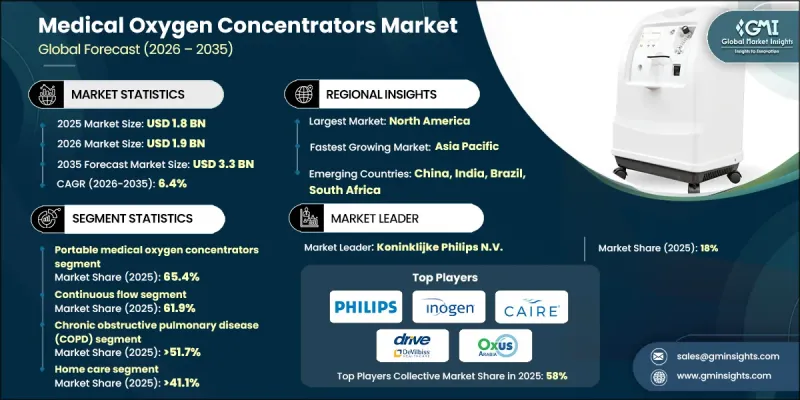
慢性呼吸系統疾病發生率上升、空氣污染加劇以及全球老年人口比例增加是推動氧氣濃縮器市場成長的主要因素。氧氣濃縮機在為慢性呼吸系統疾病導致呼吸困難的患者提供長期氧氣療法發揮關鍵作用。這些設備透過過濾環境空氣產生氧氣,並將高濃度氧氣直接輸送給患者,無需笨重的儲氧罐。醫療系統正擴大採用氧氣濃縮器,將其作為一種經濟高效、可靠且擴充性的呼吸解決方案。此外,居家醫療的明顯轉變也推動了市場成長,這得益於公共衛生措施、醫療設備取得途徑的改善以及病患對舒適照護的偏好。設備效率、噪音降低和能源效率的提升也促進了氧氣濃縮器的普及。人們對早期呼吸介入和長期疾病管理重要性的認知不斷提高,也增強了醫院、診所和居家照護機構對氧氣濃縮器的需求。
| 市場覆蓋範圍 | |
|---|---|
| 開始年份 | 2025 |
| 預測年份 | 2026-2035 |
| 起始金額 | 18億美元 |
| 預測金額 | 33億美元 |
| 複合年成長率 | 6.4% |
截至2025年,攜帶式醫用氧氣濃縮機市佔率達到65.4%。這些系統憑藉其緊湊輕巧的設計,為使用者提供行動性、便利性和持續供氧功能。患者越來越傾向於選擇攜帶式解決方案,以便保持獨立性,並在日常生活和旅行中不間斷地接受治療。更智慧的供氧系統、更長的電池續航時間和數位化連接等技術的不斷進步,持續推動著這個細分市場的擴張。
預計到2025年,連續流氧氣供應設備將佔據61.9%的市場。連續流氧氣供應設備能夠提供穩定的氧氣,因此對於需要在休息或睡眠期間持續接受治療的患者來說至關重要。其可靠性和滿足高氧氣需求的能力使其在臨床和居家醫療環境中廣泛應用。
預計到2025年,美國醫用氧氣濃縮機市場規模將達到6.352億美元。推動市場成長的因素包括:強大的醫療基礎設施、廣泛的保險覆蓋範圍以及居家醫療解決方案的日益普及。與數位健康平台和遠端監控系統的整合,進一步加速了醫用氧氣濃縮器在各種醫療環境中的應用。
目錄
第1章調查方法和範圍
第2章執行摘要
第3章業界考察
- 生態系分析
- 供應商情況
- 影響價值鏈的因素
- 產業影響因素
- 成長促進因素
- 全球老年人口基數不斷成長
- 慢性阻塞性肺病全球盛行率不斷上升
- 提高人們對居家醫療解決方案的認知
- 氧氣濃縮機創新
- 產業潛在風險與挑戰
- 嚴格的監管環境
- 設備高成本
- 市場機遇
- 與數位化居家醫療生態系統的整合
- 成長促進因素
- 成長潛力分析
- 監管環境
- 北美洲
- 歐洲
- 亞太地區
- 科技趨勢
- 當前技術趨勢
- 新興技術
- 未來市場趨勢
- 波特五力分析
- PESTEL 分析
第4章 競爭情勢
- 介紹
- 公司市佔率分析
- 世界
- 北美洲
- 歐洲
- 企業矩陣分析
- 主要市場公司的競爭分析
- 競爭定位矩陣
- 重大進展
- 併購
- 夥伴關係與合作
- 新產品發布
- 擴張計劃
第5章 2022-2035年按產品分類的市場估算與預測
- 攜帶式醫用氧氣濃縮機
- 固定式醫用氧氣濃縮機
第6章 按技術分類的市場估計與預測,2022-2035年
- 連續流
- 脈衝流
第7章 按應用領域分類的市場估算與預測,2022-2035年
- 慢性阻塞性肺病(COPD)
- 氣喘
- 呼吸窘迫症候群
- 其他用途
第8章 依最終用途分類的市場估算與預測,2022-2035年
- 醫院
- 診所
- 居家醫療
- 其他最終用戶
第9章 2022-2035年各地區市場估算與預測
- 北美洲
- 美國
- 加拿大
- 歐洲
- 德國
- 英國
- 法國
- 西班牙
- 義大利
- 荷蘭
- 亞太地區
- 中國
- 印度
- 日本
- 澳洲
- 韓國
- 拉丁美洲
- 巴西
- 墨西哥
- 阿根廷
- 中東和非洲
- 南非
- 沙烏地阿拉伯
- 阿拉伯聯合大公國
第10章:公司簡介
- BESCO Medical
- BPL Medical Technologies
- CAIRE
- Daikin Industries
- Drive DeVilbiss Healthcare
- ESAB Corporation
- Foshan Keyhub Electronic Industries
- Inogen
- Jiangsu Yuyue Medical Equipment &Supply(Yuwell)
- Koninklijke Philips NV
- O2 Concepts
- OXUS
- Precision Medical
- React Health
- Teijin Limited
The Global Medical Oxygen Concentrators Market was valued at USD 1.8 billion in 2025 and is estimated to grow at a CAGR of 6.4% to reach USD 3.3 billion by 2035.
Growth is driven by the rising incidence of chronic respiratory disorders, increasing air pollution exposure, and the growing proportion of elderly populations worldwide. Oxygen concentrators play a vital role in delivering long-term oxygen therapy for patients facing breathing difficulties caused by chronic respiratory conditions. These devices generate oxygen by filtering ambient air and supplying concentrated oxygen directly to patients, eliminating the need for bulky storage cylinders. Healthcare systems increasingly adopt oxygen concentrators as cost-effective, reliable, and scalable respiratory solutions. The market also benefits from a clear shift toward home-based healthcare, supported by public health initiatives, improved access to medical devices, and patient preference for comfort-driven care. Advances in device efficiency, noise reduction, and energy performance further enhance adoption. Growing awareness of early respiratory intervention and long-term disease management strengthens demand across hospitals, clinics, and home care environments.
| Market Scope | |
|---|---|
| Start Year | 2025 |
| Forecast Year | 2026-2035 |
| Start Value | $1.8 Billion |
| Forecast Value | $3.3 Billion |
| CAGR | 6.4% |
The portable medical oxygen concentrators segment held 65.4% share in 2025. These systems provide mobility, convenience, and continuous oxygen support in compact and lightweight designs. Patients increasingly prefer portable solutions that allow independence and uninterrupted therapy during daily activities or travel. Ongoing technological improvements, including smarter oxygen delivery systems, extended battery performance, and digital connectivity, continue to drive segment expansion.
The continuous flow segment held a 61.9% share in 2025. Continuous flow devices deliver a constant oxygen supply, making them essential for patients requiring stable therapy during rest or sleep. Their reliability and ability to support higher oxygen needs make them widely used in both clinical and homecare settings.
United States Medical Oxygen Concentrators Market reached USD 635.2 million in 2025. Strong healthcare infrastructure, broad insurance coverage, and rising adoption of home healthcare solutions support market leadership. Integration with digital health platforms and remote monitoring systems further accelerates usage across care settings.
Key companies operating in the Global Medical Oxygen Concentrators Market include Koninklijke Philips N.V., Inogen, CAIRE, Drive DeVilbiss Healthcare, Teijin Limited, React Health, Precision Medical, O2 Concepts, Daikin Industries, Jiangsu Yuyue Medical Equipment & Supply, BPL Medical Technologies, BESCO Medical, Foshan Keyhub Electronic Industries, ESAB Corporation, and OXUS. Companies in the medical oxygen concentrators market strengthen their market position by focusing on product innovation, portability, and energy efficiency. Manufacturers invest in lightweight designs, quieter operation, and longer battery life to enhance patient comfort and usability. Expansion into homecare and telehealth-integrated solutions supports wider adoption. Strategic partnerships with healthcare providers and distributors improve market access and service reach. Regulatory compliance, quality certifications, and patient safety remain core priorities.
Table of Contents
Chapter 1 Methodology and Scope
- 1.1 Market scope and definition
- 1.2 Research design
- 1.2.1 Research approach
- 1.2.2 Data collection methods
- 1.3 Data mining sources
- 1.3.1 Global
- 1.3.2 Regional/country
- 1.4 Base estimates and calculations
- 1.4.1 Base year calculation
- 1.4.2 Key trends for market estimation
- 1.5 Primary research and validation
- 1.5.1 Primary sources
- 1.6 Forecast model
- 1.7 Research assumptions and limitations
Chapter 2 Executive Summary
- 2.1 Industry 360° synopsis
- 2.2 Key market trends
- 2.2.1 Regional trends
- 2.2.2 Product trends
- 2.2.3 Technology trends
- 2.2.4 Application trends
- 2.2.5 End use trends
- 2.3 CXO perspectives: Strategic imperatives
- 2.3.1 Key decision points for industry executives
- 2.3.2 Critical success factors for market players
- 2.4 Future outlook and strategic recommendations
Chapter 3 Industry Insights
- 3.1 Industry ecosystem analysis
- 3.1.1 Supplier landscape
- 3.1.2 Factors affecting the value chain
- 3.2 Industry impact forces
- 3.2.1 Growth drivers
- 3.2.1.1 Globally increasing elderly population base
- 3.2.1.2 Rising COPD prevalence worldwide
- 3.2.1.3 Increasing awareness of home healthcare solutions
- 3.2.1.4 Technological innovations in oxygen concentrators
- 3.2.2 Industry pitfalls and challenges
- 3.2.2.1 Stringent regulatory landscape
- 3.2.2.2 High cost of the device
- 3.2.3 Market opportunities
- 3.2.3.1 Integration with digital home care ecosystems
- 3.2.1 Growth drivers
- 3.3 Growth potential analysis
- 3.4 Regulatory landscape
- 3.4.1 North America
- 3.4.2 Europe
- 3.4.3 Asia Pacific
- 3.5 Technology landscape
- 3.5.1 Current technological trends
- 3.5.2 Emerging technologies
- 3.6 Future market trends
- 3.7 Porter's analysis
- 3.8 PESTEL analysis
Chapter 4 Competitive Landscape, 2025
- 4.1 Introduction
- 4.2 Company market share analysis
- 4.2.1 Global
- 4.2.2 North America
- 4.2.3 Europe
- 4.3 Company matrix analysis
- 4.4 Competitive analysis of major market players
- 4.5 Competitive positioning matrix
- 4.6 Key developments
- 4.6.1 Merger and acquisition
- 4.6.2 Partnership and collaboration
- 4.6.3 New product launches
- 4.6.4 Expansion plans
Chapter 5 Market Estimates and Forecast, By Product, 2022 - 2035 ($ Mn)
- 5.1 Key trends
- 5.2 Portable medical oxygen concentrators
- 5.3 Stationary medical oxygen concentrators
Chapter 6 Market Estimates and Forecast, By Technology, 2022 - 2035 ($ Mn)
- 6.1 Key trends
- 6.2 Continuous flow
- 6.3 Pulse flow
Chapter 7 Market Estimates and Forecast, By Application, 2022 - 2035 ($ Mn)
- 7.1 Key trends
- 7.2 Chronic obstructive pulmonary disease (COPD)
- 7.3 Asthma
- 7.4 Respiratory distress syndrome
- 7.5 Other applications
Chapter 8 Market Estimates and Forecast, By End Use, 2022 - 2035 ($ Mn)
- 8.1 Key trends
- 8.2 Hospitals
- 8.3 Clinics
- 8.4 Home care
- 8.5 Other end users
Chapter 9 Market Estimates and Forecast, By Region, 2022 - 2035 ($ Mn)
- 9.1 Key trends
- 9.2 North America
- 9.2.1 U.S.
- 9.2.2 Canada
- 9.3 Europe
- 9.3.1 Germany
- 9.3.2 UK
- 9.3.3 France
- 9.3.4 Spain
- 9.3.5 Italy
- 9.3.6 Netherlands
- 9.4 Asia Pacific
- 9.4.1 China
- 9.4.2 India
- 9.4.3 Japan
- 9.4.4 Australia
- 9.4.5 South Korea
- 9.5 Latin America
- 9.5.1 Brazil
- 9.5.2 Mexico
- 9.5.3 Argentina
- 9.6 Middle East and Africa
- 9.6.1 South Africa
- 9.6.2 Saudi Arabia
- 9.6.3 UAE
Chapter 10 Company Profiles
- 10.1 BESCO Medical
- 10.2 BPL Medical Technologies
- 10.3 CAIRE
- 10.4 Daikin Industries
- 10.5 Drive DeVilbiss Healthcare
- 10.6 ESAB Corporation
- 10.7 Foshan Keyhub Electronic Industries
- 10.8 Inogen
- 10.9 Jiangsu Yuyue Medical Equipment & Supply (Yuwell)
- 10.10 Koninklijke Philips N.V.
- 10.11 O2 Concepts
- 10.12 OXUS
- 10.13 Precision Medical
- 10.14 React Health
- 10.15 Teijin Limited

 氧氣濃縮機市場:按電源、類型、輸送方式、流量、應用、最終用戶和分銷管道分類-2026-2032年全球市場預測VOC轉子濃縮器市場按過濾類型、濾材、技術、空氣流量、容塵量、應用、終端用戶產業和分銷管道分類,全球預測,2026-2032年
 固定式氧氣濃縮機市場規模、佔有率和成長分析:按產品類型、電源、便攜性、最終用戶和地區分類 - 2026-2033 年產業預測
 2026年全球氧氣濃縮機市場報告
 全球醫用氧氣濃縮機市場規模、佔有率、趨勢和成長分析報告(2026-2034年)
 日本氧氣濃縮機市場規模、佔有率、趨勢和預測:按類型、技術、應用、最終用戶和地區分類,2026-2034年
 氧氣濃縮機市場規模、佔有率和成長分析(按類型、技術、應用、最終用戶和地區分類)—產業預測(2026-2033 年)
 醫用氧氣濃縮機和氧氣瓶市場規模、佔有率和成長分析(按模式、技術、最終用戶和地區分類)—2026-2033年產業預測
 全球氧氣濃縮機市場:市場規模、佔有率、趨勢分析(按產品、應用、技術和地區分類)、細分市場預測(2025-2033 年)北美氧氣濃縮機市場:市場規模、佔有率、趨勢分析(按產品、應用、技術和國家分類)、細分市場預測(2025-2033 年)