


 |
市場調查報告書
商品編碼
1936489
工業能源儲存系統市場機會、成長要素、產業趨勢分析及2026年至2035年預測Industrial Energy Storage System Market Opportunity, Growth Drivers, Industry Trend Analysis, and Forecast 2026 - 2035 |
||||||

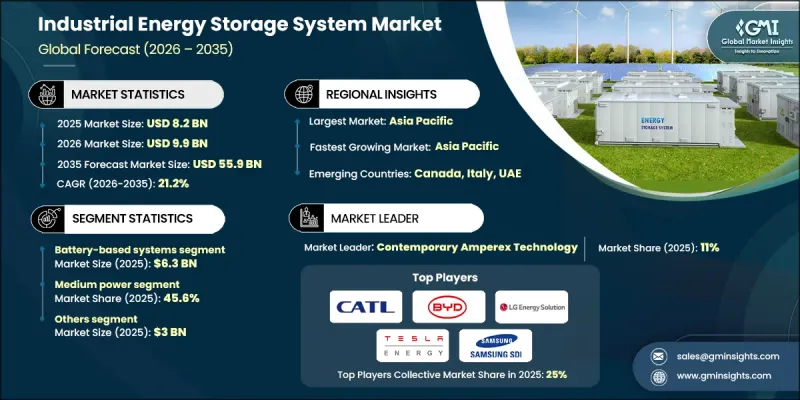
全球工業能源儲存系統市場預計到 2025 年將達到 82 億美元,到 2035 年將達到 559 億美元,年複合成長率為 21.2%。
市場成長受到工業企業日益成長的壓力,這些企業需要與全球氣候目標和內部永續性措施保持一致。世界各國政府都在收緊排放法規,而隨著碳定價機制和排放交易計畫的日益普及,長期依賴石化燃料的成本也不斷上升。隨著工業活動轉型為電氣化並更依賴可再生能源,能源儲存系統對於維持營運連續性和應對電力供應波動變得至關重要。工業儲能正日益被視為實現脫碳目標、增強能源安全和提高低碳經濟韌性的戰略基礎。隨著電力基礎設施、可再生能源發電和儲能解決方案的普及,工業能源儲存系統系統正日益被視為長期資產,而非輔助設備。
| 市場覆蓋範圍 | |
|---|---|
| 開始年份 | 2025 |
| 預測年份 | 2026-2035 |
| 起始值 | 82億美元 |
| 預測金額 | 559億美元 |
| 複合年成長率 | 21.2% |
除了監管合規之外,乾淨科技成本的下降也促使企業加快對永續能源解決方案的投資。工業企業採用能源儲存系統不僅是為了實現其環境目標,也是為了提升財務績效。這些系統被廣泛認為是能夠幫助穩定能源消耗、提高營運成本可預測性並降低整體能源相關成本的有效工具。因此,工業儲能的商業價值在眾多工業應用領域中持續增強。
預計2025年,電池技術市場規模將達到63億美元。這一主導地位反映了工業環境中對電池的依賴性日益增強,以平衡能源需求和生產要求。這些系統旨在儲存低需求時期或再生能源來源產生的多餘電力,並在需求增加時釋放。這種能力使企業能夠提高效率和柔軟性,同時在高成本時期減少對電網的依賴。電池解決方案還具有擴充性的架構,使其能夠部署在各種規模的設施中,同時支援穩定的效能和運作管理。
到2025年,中功率儲能系統將佔據45.6%的市場佔有率,成為最大的功率細分市場。這類系統尤其適用於需要在容量和基礎設施投資之間取得平衡的工業環境。中功率儲能解決方案能夠提供足夠的電力來應對尖峰時段能源需求、支援可再生能源併網並提高運作可靠性,同時避免了高容量儲能系統帶來的複雜性和高成本。這種平衡使得該細分市場對眾多尋求可靠高效儲能解決方案的工業用戶極具吸引力。
預計2025年,美國工業能源儲存系統市場規模將達到21億美元,佔79.7%的市佔率。推動美國市場擴張的主要因素包括:強勁的脫碳舉措、現場可再生能源的日益普及以及應對電力成本波動的需求。工業營運商正在加速採用能源儲存系統,以提高電力品質、控制能源成本並增強業務永續營運。社區能源系統的蓬勃發展也有助於提高系統韌性,同時降低停電風險。隨著法規結構的不斷完善,工業參與者正獲得新的市場機制,進而提升儲能資產的經濟價值。
目錄
第1章調查方法和範圍
第2章執行摘要
第3章業界考察
- 生態系分析
- 供應商情況
- 利潤率
- 每個階段的附加價值
- 影響價值鏈的因素
- 產業影響因素
- 促進要素
- 工業脫碳和淨零排放目標
- 可再生能源併網
- 數位化和智慧型能源管理
- 產業潛在風險與挑戰
- 高昂的初始投資成本
- 技術風險和性能不確定性
- 機會
- 長期儲能解決方案
- 數位平台和人工智慧最佳化
- 促進要素
- 成長潛力分析
- 未來市場趨勢
- 科技與創新趨勢
- 當前技術趨勢
- 新興技術
- 價格趨勢
- 按地區
- 透過儲存系統
- 監管環境
- 標準和合規要求
- 區域法規結構
- 認證標準
- 波特五力分析
- PESTEL 分析
第4章 競爭情勢
- 介紹
- 公司市佔率分析
- 按地區
- 企業矩陣分析
- 主要市場公司的競爭分析
- 競爭定位矩陣
- 重大進展
- 併購
- 夥伴關係與合作
- 新產品發布
- 擴張計劃
5. 2022-2035年按儲存系統分類的市場估算與預測
- 機械系統
- 壓縮空氣儲能
- 抽水蓄能水力發電
- 熱力系統
- 電池儲能系統
第6章 依產量範圍分類的市場估計與預測,2022-2035年
- 低功率(超過 200kW)
- 中功率(200千瓦至5兆瓦)
- 高功率(小於5兆瓦)
第7章 按應用領域分類的市場估算與預測,2022-2035年
- 能源套利和時間轉移
- 尖峰用電調節和負載平衡
- 可再生能源併網與穩定
- 電網穩定和電壓支撐
- 電力傳輸和分配的延誤
8. 2022-2035年按最終用途產業分類的市場估算與預測
- 礦業
- 石油和天然氣
- 食品/飲料
- 製藥
- 車
- 其他(資料中心等)
第9章 按分銷管道分類的市場估算與預測,2022-2035年
- 直銷
- 間接銷售
第10章 2022-2035年各地區市場估計與預測
- 北美洲
- 美國
- 加拿大
- 歐洲
- 德國
- 英國
- 法國
- 義大利
- 西班牙
- 亞太地區
- 中國
- 日本
- 印度
- 澳洲
- 韓國
- 拉丁美洲
- 巴西
- 墨西哥
- 阿根廷
- 中東和非洲
- 南非
- 沙烏地阿拉伯
- 阿拉伯聯合大公國
第11章 公司簡介
- Atlas Copco
- BYD
- Caterpillar
- Contemporary Amperex Technology
- Cummins
- ESS
- Fluence Energy
- LG Energy Solution
- Northvolt
- Powin Energy
- Samsung SDI
- Sumitomo Electric Industries
- Tesla Energy
- Wartsila Energy
The Global Industrial Energy Storage System Market was valued at USD 8.2 billion in 2025 and is estimated to grow at a CAGR of 21.2% to reach USD 55.9 billion by 2035.
Market growth is strongly influenced by mounting pressure on industrial organizations to align with global climate objectives and internal sustainability commitments. Governments worldwide are implementing stricter emissions regulations, while the long-term cost of fossil fuel dependence continues to rise as carbon pricing mechanisms and emissions trading programs gain traction. As industrial operations shift toward electrified processes and greater reliance on renewable energy, energy storage systems are becoming essential to maintain operational continuity and manage fluctuations in power supply. Industrial energy storage is increasingly viewed as a strategic enabler that supports decarbonization goals, strengthens energy security, and improves resilience in a low-carbon economy. The broader adoption of electric infrastructure, renewable power generation, and storage solutions is reinforcing the role of industrial energy storage systems as long-term assets rather than auxiliary equipment.
| Market Scope | |
|---|---|
| Start Year | 2025 |
| Forecast Year | 2026-2035 |
| Start Value | $8.2 Billion |
| Forecast Value | $55.9 Billion |
| CAGR | 21.2% |
Beyond regulatory compliance, declining costs of clean technologies are encouraging companies to accelerate investments in sustainable energy solutions. Industrial enterprises are adopting energy storage systems not only to support environmental targets but also to improve financial performance. These systems are widely recognized as tools that help stabilize energy consumption, improve predictability of operating expenses, and reduce overall energy-related costs. As a result, the business case for industrial energy storage continues to strengthen across a wide range of industrial applications.
The battery-based technologies segment generated USD 6.3 billion in 2025. Their leadership position reflects the growing reliance on batteries to balance energy demand with production requirements in industrial settings. These systems are designed to store excess electricity generated during low-demand periods or from renewable sources and release it when demand rises. This capability allows organizations to reduce dependence on grid electricity during high-cost periods while improving efficiency and flexibility. Battery-based solutions also benefit from scalable architectures, enabling deployment across facilities of varying sizes while supporting consistent performance and operational control.
The medium power category accounted for 45.6% share in 2025, making it the largest power segment. Systems within this range are particularly well-suited for industrial environments that require a balance between capacity and infrastructure investment. Medium power energy storage solutions offer sufficient output to manage peak energy requirements, support renewable integration, and enhance operational reliability without the complexity or cost associated with higher-capacity installations. This balance has made the segment highly attractive to a broad range of industrial users seeking dependable and efficient storage solutions.
United States Industrial Energy Storage System Market held 79.7% share in 2025, generating USD 2.1 billion. Market expansion in the country is driven by strong decarbonization initiatives, rising adoption of onsite renewable energy, and the need to address fluctuating electricity costs. Industrial operators are increasingly deploying energy storage systems to improve power quality, manage energy expenses, and strengthen operational continuity. The growing development of localized energy systems is also enhancing resilience while reducing exposure to power interruptions. As regulatory frameworks evolve, industrial participants are gaining access to new market mechanisms that enhance the economic value of energy storage assets.
Key companies active in the Global Industrial Energy Storage System Market include LG Energy Solution, Tesla Energy, Wartsila Energy, BYD, Fluence Energy, Caterpillar, Samsung SDI, Cummins, Northvolt, Atlas Copco, Contemporary Amperex Technology, ESS, Powin Energy, and Sumitomo Electric Industries. Companies operating in the industrial energy storage system market are strengthening their market position through a combination of technology innovation, strategic partnerships, and geographic expansion. Manufacturers are prioritizing investments in advanced battery chemistries, system efficiency improvements, and digital energy management capabilities to enhance performance and reliability. Many players are expanding their solution portfolios to address diverse industrial requirements while offering modular designs that support scalable deployment.
Table of Contents
Chapter 1 Methodology and Scope
- 1.1 Market scope and definition
- 1.2 Research design
- 1.2.1 Research approach
- 1.2.2 Data collection methods
- 1.3 Data mining sources
- 1.3.1 Global
- 1.3.2 Regional/Country
- 1.4 Base estimates and calculations
- 1.4.1 Base year calculation
- 1.4.2 Key trends for market estimation
- 1.5 Primary research and validation
- 1.5.1 Primary sources
- 1.6 Forecast model
- 1.7 Research assumptions and limitations
Chapter 2 Executive Summary
- 2.1 Industry 360° synopsis
- 2.2 Key market trends
- 2.2.1 Regional
- 2.2.2 Storage systems
- 2.2.3 Power range
- 2.2.4 Application
- 2.2.5 End use industry
- 2.2.6 Distribution channel
- 2.3 CXO perspectives: Strategic imperatives
- 2.3.1 Key decision points for industry executives
- 2.3.2 Critical success factors for market players
- 2.4 Future outlook and strategic recommendations
Chapter 3 Industry Insights
- 3.1 Industry ecosystem analysis
- 3.1.1 Supplier landscape
- 3.1.2 Profit margin
- 3.1.3 Value addition at each stage
- 3.1.4 Factor affecting the value chain
- 3.2 Industry impact forces
- 3.2.1 Growth drivers
- 3.2.1.1 Industrial decarbonization & net-zero targets
- 3.2.1.2 Renewable energy integration
- 3.2.1.3 Digitalization & smart energy management
- 3.2.2 Industry pitfalls & challenges
- 3.2.2.1 High upfront capex
- 3.2.2.2 Technology risk & performance uncertainty
- 3.2.3 Opportunities
- 3.2.3.1 Long-duration storage solutions
- 3.2.3.2 Digital platforms & AI optimization
- 3.2.1 Growth drivers
- 3.3 Growth potential analysis
- 3.4 Future market trends
- 3.5 Technology and innovation landscape
- 3.5.1 Current technological trends
- 3.5.2 Emerging technologies
- 3.6 Price trends
- 3.6.1 By region
- 3.6.2 By storage systems
- 3.7 Regulatory landscape
- 3.7.1 Standards and compliance requirements
- 3.7.2 Regional regulatory frameworks
- 3.7.3 Certification standards
- 3.8 Porter's analysis
- 3.9 PESTEL analysis
Chapter 4 Competitive Landscape, 2025
- 4.1 Introduction
- 4.2 Company market share analysis
- 4.2.1 By region
- 4.2.1.1 North America
- 4.2.1.2 Europe
- 4.2.1.3 Asia Pacific
- 4.2.1.4 Latin America
- 4.2.1.5 Middle East and Africa
- 4.2.1 By region
- 4.3 Company matrix analysis
- 4.4 Competitive analysis of major market players
- 4.5 Competitive positioning matrix
- 4.6 Key developments
- 4.6.1 Mergers & acquisitions
- 4.6.2 Partnerships & collaborations
- 4.6.3 New product launches
- 4.6.4 Expansion plans
Chapter 5 Market Estimates and Forecast, By Storage system, 2022 - 2035 (USD Billion) (Thousand Units)
- 5.1 Key trends
- 5.2 Mechanical systems
- 5.3 Compressed air energy storage
- 5.4 Pumped hydro power
- 5.5 Thermal systems
- 5.6 Battery-based systems
Chapter 6 Market Estimates and Forecast, By Power Range, 2022 - 2035 (USD Billion) (Thousand Units)
- 6.1 Key trends
- 6.2 Low power (>200kW)
- 6.3 Medium power (200kW-5MW)
- 6.4 High power (<5 MW)
Chapter 7 Market Estimates and Forecast, By Application, 2022 - 2035 (USD Billion) (Thousand Units)
- 7.1 Key trends
- 7.2 Energy arbitrage & time-shifting
- 7.3 Peak shaving & load leveling
- 7.4 Renewable integration & firming
- 7.5 Grid stability & voltage support
- 7.6 Transmission & distribution deferral
Chapter 8 Market Estimates and Forecast, By End Use Industry, 2022 - 2035 (USD Billion) (Thousand Units)
- 8.1 Key trends
- 8.2 Mining
- 8.3 Oil & gas
- 8.4 Food & beverage
- 8.5 Pharmaceutical
- 8.6 Automotive
- 8.7 Others (data center etc.)
Chapter 9 Market Estimates and Forecast, By Distribution Channel, 2022 - 2035 (USD Billion) (Thousand Units)
- 9.1 Key trends
- 9.2 Direct sales
- 9.3 Indirect sales
Chapter 10 Market Estimates and Forecast, By Region, 2022 - 2035 (USD Billion) (Thousand Units)
- 10.1 Key trends
- 10.2 North America
- 10.2.1 U.S.
- 10.2.2 Canada
- 10.3 Europe
- 10.3.1 Germany
- 10.3.2 UK
- 10.3.3 France
- 10.3.4 Italy
- 10.3.5 Spain
- 10.4 Asia Pacific
- 10.4.1 China
- 10.4.2 Japan
- 10.4.3 India
- 10.4.4 Australia
- 10.4.5 South Korea
- 10.5 Latin America
- 10.5.1 Brazil
- 10.5.2 Mexico
- 10.5.3 Argentina
- 10.6 Middle East and Africa
- 10.6.1 South Africa
- 10.6.2 Saudi Arabia
- 10.6.3 UAE
Chapter 11 Company Profiles
- 11.1 Atlas Copco
- 11.2 BYD
- 11.3 Caterpillar
- 11.4 Contemporary Amperex Technology
- 11.5 Cummins
- 11.6 ESS
- 11.7 Fluence Energy
- 11.8 LG Energy Solution
- 11.9 Northvolt
- 11.10 Powin Energy
- 11.11 Samsung SDI
- 11.12 Sumitomo Electric Industries
- 11.13 Tesla Energy
- 11.14 Wartsila Energy

 2026年全球能源儲存系統市場報告
 全球牽引能源儲存系統市場(按電池化學成分、車輛類型、電芯類型、電壓範圍、應用和最終用戶分類)預測(2026-2032年)微型太陽能能源儲存系統市場(按電池類型、容量範圍、最終用途和應用分類),全球預測(2026-2032)
 能源儲存系統市場規模、佔有率及成長分析(按技術、應用、最終用途、容量和地區分類)-2026-2033年產業預測
 日本儲能系統市場報告(按技術、應用、最終用戶和地區分類,2026-2034年)
 戶外液冷能源儲存系統:全球市佔率及排名、總銷售量及需求預測(2025-2031年)能源儲存系統(ESS)-全球市場佔有率和排名、總收入和需求預測(2025-2031年)
 全球智慧能源儲存系統系統市場全球電子機械能源儲存系統系統市場全球電化學能源儲存系統系統市場