


 |
市場調查報告書
商品編碼
1936488
魚類驅蟲藥市場機會、成長要素、產業趨勢分析及預測(2026年至2035年)Fish Anthelmintics Drugs Market Opportunity, Growth Drivers, Industry Trend Analysis, and Forecast 2026 - 2035 |
||||||

全球魚類驅蟲藥市場預計到 2025 年將達到 2.56 億美元,到 2035 年將達到 4.305 億美元,年複合成長率為 5.3%。
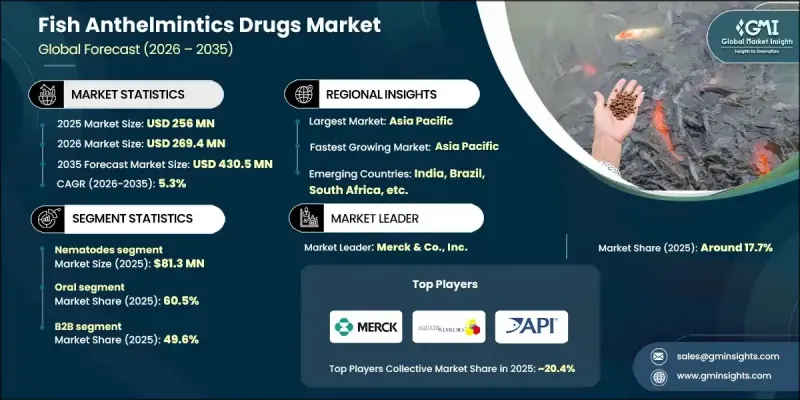
市場成長的促進因素包括水產養殖業的快速擴張、養殖魚類寄生蟲感染的日益增加以及對高品質水產品需求的不斷成長。驅蟲藥在控制線蟲、絛蟲和吸蟲等體內寄生蟲方面發揮關鍵作用,這些寄生蟲會對魚類的健康、生長和存活率產生負面影響。隨著水產養殖業為滿足全球蛋白質需求而不斷集約化,有效的寄生蟲控制對於最大限度地減少經濟損失和確保永續的水產養殖至關重要。對魚類健康管理和生物安全的日益重視,促使商業水產養殖設施中魚類驅蟲藥的使用量顯著增加。寄生蟲感染不僅會降低飼料轉換率和增重,還會增加死亡率,直接影響養殖場的盈利。因此,水產養殖生產者正加大對預防和治療方案的投資,以維護其養殖魚類的健康。一些國家的監管機構也建議控制獸藥的使用,以提高食品安全標準,這進一步促進了市場成長。此外,製劑技術的進步促成了更有針對性、殘留可控、環境安全的驅蟲藥的研發,提高了治療效果並符合監管標準。
| 市場覆蓋範圍 | |
|---|---|
| 開始年份 | 2025 |
| 預測年份 | 2026-2035 |
| 起始值 | 2.56億美元 |
| 預測金額 | 4.305億美元 |
| 複合年成長率 | 5.3% |
按藥物類別分類,市場可分為苯並咪唑酮、大環內酯類、吡喹酮類和其他類藥物,其中苯並咪唑酮類藥物預計在2025年將創造6550萬美元的銷售額。苯並咪唑酮因其對胃腸道線蟲和吸蟲具有廣譜療效、成本效益高且可透過飼料輕鬆給藥而廣受歡迎。這些藥物透過抑制寄生蟲的代謝和能量產生,在有效控制寄生蟲的同時,也能維持對魚類的可接受安全範圍。它們在淡水和海水養殖系統中的廣泛應用鞏固了主導地位。
2025年,B2B市場佔據49.6%的市場佔有率,這主要得益於商業養魚場、孵化場、綜合水產養殖生產商和大型水產品出口商的強勁需求。這些買家優先考慮可靠且有效率的驅蟲解決方案,以控制高密度養殖環境中的寄生蟲感染,因為這些環境的感染風險較高。 B2B客戶通常透過獸藥供應商、水產養殖經銷商或與生產商直接簽訂合約來批量採購魚類驅蟲藥,以確保穩定的供應和成本效益。
亞太地區魚類驅蟲藥市場預計到2025年將達到1.93億美元,主要促進因素包括該地區大規模水產養殖生產、水產品消費量的成長以及商業水產養殖業務的擴張。中國、印度、越南和印尼等國憑藉其廣泛的內陸和沿海水產養殖活動,成為該市場的主要貢獻者。現代魚類健康管理方法的日益普及,以及政府為提高水產養殖生產力和疾病控制而採取的舉措,正推動該地區動物用藥品使用量的顯著成長。
目錄
第1章調查方法和範圍
第2章執行摘要
第3章業界考察
- 生態系分析
- 產業影響因素
- 促進要素
- 水產養殖產量增加
- 寄生蟲病迅速增加
- 緩釋製劑與聯合治療的開發
- 嚴格的食品安全法規
- 產業潛在風險與挑戰
- 新動物用藥品的嚴格核准流程
- 人們對水體中藥物殘留的擔憂
- 機會
- 新興市場水產養殖的快速成長
- 整合智慧監測系統用於寄生蟲檢測和標靶藥物治療
- 促進要素
- 成長潛力分析
- 監管環境
- 北美洲
- 美國
- 加拿大
- 歐洲
- 亞太地區
- 北美洲
- 技術格局
- 當前技術趨勢
- 新興技術
- 投資環境
- 專利分析
- 定價分析
- 供應鏈分析
- 波特五力分析
- PESTEL 分析
- 未來市場趨勢
第4章 競爭情勢
- 介紹
- 企業矩陣分析
- 公司市佔率分析
- 主要市場公司的競爭分析
- 競爭定位矩陣
- 重大進展
- 併購
- 夥伴關係與合作
- 新產品發布
- 擴張計劃
5. 2022-2035年按藥物類別分類的市場估算與預測
- 奎諾酮
- 苯並咪唑酮
- 大環內酯
- 其他藥物類別
第6章 依目標寄生蟲分類的市場估算與預測,2022-2035年
- 線蟲
- 吸蟲
- 混合感染
- 絛蟲
7. 按配方分類的市場估計和預測,2022-2035 年
- 口服
- 浸沒
- 注射
第8章 按分銷管道分類的市場估算與預測,2022-2035年
- B2B
- 獸醫院藥房
- 零售店
- 電子商務
第9章 2022-2035年各地區市場估算與預測
- 北美洲
- 美國
- 加拿大
- 歐洲
- 挪威
- 土耳其
- 德國
- 英國
- 法國
- 西班牙
- 義大利
- 荷蘭
- 亞太地區
- 中國
- 印度
- 印尼
- 越南
- 日本
- 韓國
- 澳洲
- 拉丁美洲
- 巴西
- 墨西哥
- 阿根廷
- 中東和非洲
- 埃及
- 南非
- 沙烏地阿拉伯
- 阿拉伯聯合大公國
第10章:公司簡介
- API
- Aquarium Products India
- Aquatic Remedies
- Centurion HEALTHCARE
- Hikari
- KOI PHARMA
- Kyoritsu Seiyaku Corporation
- Merck &Co., Inc.
- NATIONAL FISH PHARMACEUTICALS USA
- Syndel
The Global Fish Anthelmintics Drugs Market was valued at USD 256 million in 2025 and is estimated to grow at a CAGR of 5.3% to reach USD 430.5 million by 2035.
Market growth is driven by the rapid expansion of aquaculture, the increasing prevalence of parasitic infestations in farmed fish, and rising demand for high-quality seafood. Anthelmintic drugs play a critical role in controlling internal parasitic worms such as nematodes, cestodes, and trematodes that negatively impact fish health, growth rates, and survival. As aquaculture operations intensify to meet global protein demand, effective parasite management has become essential to minimize economic losses and ensure sustainable fish farming practices. The growing emphasis on fish health management and biosecurity has significantly increased the adoption of fish anthelmintics across commercial aquaculture facilities. Parasitic infections not only reduce feed efficiency and weight gain but also increase mortality rates, directly affecting farm profitability. As a result, aquaculture producers are increasingly investing in preventive and therapeutic drug solutions to maintain stock health. Regulatory bodies in several countries are also encouraging the controlled use of veterinary pharmaceuticals to improve food safety standards, further supporting market growth. Additionally, advancements in formulation technologies have led to more targeted, residue-controlled, and environmentally safer anthelmintic drugs, improving treatment outcomes and compliance with regulatory norms.
| Market Scope | |
|---|---|
| Start Year | 2025 |
| Forecast Year | 2026-2035 |
| Start Value | $256 Million |
| Forecast Value | $430.5 Million |
| CAGR | 5.3% |
Based on drug class, the market is segmented into benzimidazoles, macrocyclic lactones, praziquantel, and others, with the benzimidazoles segment generating USD 65.5 million in 2025. Benzimidazoles are widely preferred due to their broad-spectrum efficacy against gastrointestinal nematodes and trematodes, cost-effectiveness, and ease of administration through medicated feed. These drugs interfere with parasite metabolism and energy production, leading to effective parasite elimination while maintaining acceptable safety margins for fish. Their extensive use in both freshwater and marine aquaculture systems has solidified their leading market position.
The B2B segment held 49.6% share in 2025, driven by strong demand from commercial aquaculture farms, hatcheries, integrated fish producers, and large-scale seafood exporters. These buyers prioritize reliable, high-efficacy anthelmintic solutions to manage parasite outbreaks in high-density farming environments where infection risks are elevated. B2B customers typically procure fish anthelmintics in bulk through veterinary suppliers, aquaculture input distributors, and direct manufacturer contracts, ensuring consistent supply and cost efficiency
Asia Pacific Fish Anthelmintics Drugs Market reached USD 193 million in 2025, supported by the region's large-scale aquaculture production, growing seafood consumption, and expanding commercial fish farming operations. Countries such as China, India, Vietnam, and Indonesia are major contributors, owing to their extensive inland and coastal aquaculture activities. The increasing adoption of modern fish health management practices, combined with government initiatives to improve aquaculture productivity and disease control, has significantly boosted the use of veterinary drugs in the region.
Key players operating in the Global Fish Anthelmintics Drugs Market include Zoetis Inc., Elanco Animal Health, Merck & Co. (MSD Animal Health), Virbac, Vetoquinol, Ceva Sante Animale, Huvepharma, and Phibro Animal Health Corporation. Companies operating in the Fish Anthelmintics Drugs Market are focusing on product innovation, strategic partnerships, and geographic expansion to strengthen their market presence. Leading players are investing heavily in research and development to introduce advanced formulations with improved efficacy, reduced environmental impact, and lower drug residue levels to meet stringent regulatory standards. Collaborations with aquaculture farms, feed manufacturers, and veterinary networks enable companies to expand distribution and improve farmer awareness. Many firms are also targeting emerging aquaculture markets in Asia Pacific and Latin America through localized manufacturing and pricing strategies. Additionally, companies are emphasizing sustainable parasite management solutions, including integrated health management programs, to build long-term customer relationships and reinforce their competitive positioning.
Table of Contents
Chapter 1 Methodology and Scope
- 1.1 Market scope and definition
- 1.2 Research design
- 1.2.1 Research approach
- 1.2.2 Data collection methods
- 1.3 Data mining sources
- 1.3.1 Global
- 1.3.2 Regional/Country
- 1.4 Base estimates and calculations
- 1.4.1 Base year calculation
- 1.4.2 Key trends for market estimation
- 1.5 Primary research and validation
- 1.5.1 Primary sources
- 1.6 Forecast model
- 1.7 Research assumptions and limitations
Chapter 2 Executive Summary
- 2.1 Industry 3600 synopsis
- 2.2 Key market trends
- 2.2.1 Regional trends
- 2.2.2 Drug class trends
- 2.2.3 Target parasite trends
- 2.2.4 Formulation trends
- 2.2.5 Distribution channel trends
- 2.3 CXO perspectives: Strategic imperatives
- 2.3.1 Key decision points for industry executives
- 2.3.2 Critical success factors for market players
- 2.4 Future outlook and strategic recommendations
Chapter 3 Industry Insights
- 3.1 Industry ecosystem analysis
- 3.2 Industry impact forces
- 3.2.1 Growth drivers
- 3.2.1.1 Rising production of aquaculture
- 3.2.1.2 Surging prevalence of parasitic diseases
- 3.2.1.3 Development of long-acting formulations and combination therapies
- 3.2.1.4 Stringent food safety regulations
- 3.2.2 Industry pitfalls and challenges
- 3.2.2.1 Strict approval processes for new veterinary drugs
- 3.2.2.2 Concerns regarding residual drugs in water bodies
- 3.2.3 Opportunities
- 3.2.3.1 Rapid aquaculture growth in emerging markets
- 3.2.3.2 Integration of smart monitoring systems for parasite detection and targeted drug use
- 3.2.1 Growth drivers
- 3.3 Growth potential analysis
- 3.4 Regulatory landscape
- 3.4.1 North America
- 3.4.1.1 U.S.
- 3.4.1.2 Canada
- 3.4.2 Europe
- 3.4.3 Asia Pacific
- 3.4.1 North America
- 3.5 Technological landscape
- 3.5.1 Current technological trends
- 3.5.2 Emerging technologies
- 3.6 Investment landscape
- 3.7 Patent analysis
- 3.8 Pricing analysis
- 3.9 Supply chain analysis
- 3.10 Porter's analysis
- 3.11 PESTEL analysis
- 3.12 Future market trends
Chapter 4 Competitive Landscape, 2025
- 4.1 Introduction
- 4.2 Company matrix analysis
- 4.3 Company market share analysis
- 4.4 Competitive analysis of major market players
- 4.5 Competitive positioning matrix
- 4.6 Key developments
- 4.6.1 Mergers & acquisitions
- 4.6.2 Partnerships & collaborations
- 4.6.3 New product launches
- 4.6.4 Expansion plans
Chapter 5 Market Estimates and Forecast, By Drug Class, 2022 - 2035 ($ Mn)
- 5.1 Key trends
- 5.2 Pyrazinoisoquinolones
- 5.3 Benzimidazoles
- 5.4 Macrocyclic lactones
- 5.5 Other drug classes
Chapter 6 Market Estimates and Forecast, By Target Parasite, 2022 - 2035 ($ Mn)
- 6.1 Key trends
- 6.2 Nematodes
- 6.3 Trematodes
- 6.4 Mixed infections
- 6.5 Cestodes
Chapter 7 Market Estimates and Forecast, By Formulation, 2022 - 2035 ($ Mn)
- 7.1 Key trends
- 7.2 Oral
- 7.3 Immersion
- 7.4 Injectable
Chapter 8 Market Estimates and Forecast, By Distribution Channel, 2022 - 2035 ($ Mn)
- 8.1 Key trends
- 8.2 B2B
- 8.3 Veterinary pharmacy
- 8.4 Retail stores
- 8.5 E-commerce
Chapter 9 Market Estimates and Forecast, By Region, 2022 - 2035 ($ Mn)
- 9.1 Key trends
- 9.2 North America
- 9.2.1 U.S.
- 9.2.2 Canada
- 9.3 Europe
- 9.3.1 Norway
- 9.3.2 Turkey
- 9.3.3 Germany
- 9.3.4 UK
- 9.3.5 France
- 9.3.6 Spain
- 9.3.7 Italy
- 9.3.8 Netherlands
- 9.4 Asia Pacific
- 9.4.1 China
- 9.4.2 India
- 9.4.3 Indonesia
- 9.4.4 Vietnam
- 9.4.5 Japan
- 9.4.6 South Korea
- 9.4.7 Australia
- 9.5 Latin America
- 9.5.1 Brazil
- 9.5.2 Mexico
- 9.5.3 Argentina
- 9.6 MEA
- 9.6.1 Egypt
- 9.6.2 South Africa
- 9.6.3 Saudi Arabia
- 9.6.4 UAE
Chapter 10 Company Profiles
- 10.1 API
- 10.2 Aquarium Products India
- 10.3 Aquatic Remedies
- 10.4 Centurion HEALTHCARE
- 10.5 Hikari
- 10.6 KOI PHARMA
- 10.7 Kyoritsu Seiyaku Corporation
- 10.8 Merck & Co., Inc.
- 10.9 NATIONAL FISH PHARMACEUTICALS U.S.A.
- 10.10 Syndel

 茴香腦三硫磷市場:依產品類型、給藥途徑、應用、最終用戶和分銷管道分類-2026-2032年全球預測顆粒狀沸石市場:依產品類型、包裝類型、應用、通路和最終用途分類-2026-2032年全球預測製藥破碎機市場:按機器類型、材料類型、銷售管道、應用、最終用戶分類,全球預測(2026-2032)
 製藥和生物技術領域的生產和供應協議(2021-2026)醫藥和生物技術產業分銷協議:2020-2026
 醫藥市場規模、佔有率和成長分析:按分子類型、產品類型、給藥途徑、疾病類型和地區分類-2026-2033年產業預測
 2035年醫藥市場分析及預測:類型、產品類型、服務、技術、應用、劑型、最終用戶、流程、實施方案、設備新斯的明甲硫酸鹽注射液市場分析及預測(至2035年):按類型、產品類型、應用、最終用戶、技術、實施類型、製程、組件和設備分類
 2026-2034年全球醫藥和生物技術領域人工智慧(AI)市場規模、佔有率、趨勢和成長分析報告硫酸卡那黴素注射劑市場按劑量、劑型、用途、最終用戶和分銷管道分類-全球預測(2026-2032 年)