


 |
市場調查報告書
商品編碼
1936484
阻燃劑市場機會、成長要素、產業趨勢分析及2026年至2035年預測Flame Retardants Market Opportunity, Growth Drivers, Industry Trend Analysis, and Forecast 2026 - 2035 |
||||||

全球阻燃劑市場預計到 2025 年將達到 98 億美元,到 2035 年將達到 177 億美元,年複合成長率為 6.1%。
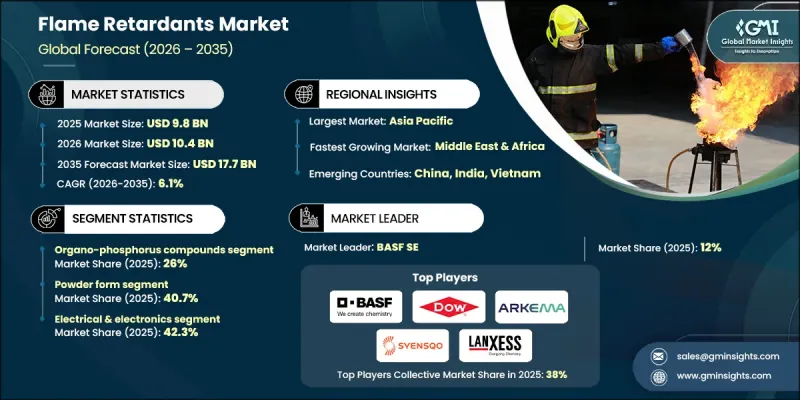
市場成長主要受嚴格的消防安全法規、快速的都市化以及建築、電氣電子和交通運輸行業日益成長的需求所驅動。阻燃劑在降低火災風險方面發揮關鍵作用,其作用機制包括延緩點燃、抑制火焰蔓延和減少煙霧產生,適用於包括塑膠、纖維、發泡體和塗料在內的多種材料。隨著基礎設施建設的不斷改進、電氣化程度的提高以及電子設備的廣泛應用,耐火材料的重要性顯著提升。同時,住宅、商業和工業設施公共標準的不斷提高也持續推動對先進阻燃解決方案的需求。
| 市場覆蓋範圍 | |
|---|---|
| 開始年份 | 2025 |
| 預測年份 | 2026-2035 |
| 起始值 | 98億美元 |
| 預測金額 | 177億美元 |
| 複合年成長率 | 6.1% |
隨著監管機構和終端用戶日益重視永續性、低毒性和可回收性,市場正經歷著向環保無鹵化阻燃劑的重大轉變。製造商正日益關注磷基、無機和聚合物結合型阻燃體系,這些體系既能滿足不斷發展的環境法規標準,又能提供有效的防火保護。封裝和分散技術的進步進一步提高了阻燃劑的性能穩定性及其與現代聚合物的兼容性。這些創新在電動車、可再生能源系統和智慧基礎設施等高成長產業尤其重要,因為在這些產業中,防火安全至關重要,對材料性能的要求也日益嚴格。
按類型分類,有機磷酸酯類化合物預計到2025年將佔據26%的市場。這些化合物因其優異的阻燃性能、在多種聚合物系統中的通用性以及相比傳統鹵代產品更高的合規性而被廣泛應用。有機磷酸酯類阻燃劑廣泛應用於工程塑膠、發泡體、塗料和電子元件等領域,這些領域對低煙和高熱穩定性要求極高。其在無鹵組合藥物中的日益普及符合全球永續性目標,進一步鞏固了其市場主導地位。
以最終用途分類,到2025年,電氣和電子設備產業將佔據42.3%的市場。這主要得益於家用電器機殼、電路基板、連接器以及電線電纜等部件中阻燃劑使用量的不斷成長,以滿足日益嚴格的防火安全和性能標準。家用電器、資料中心、智慧型設備和電力基礎設施的快速發展,推動了對能夠承受高溫、電應力和長期運作的高性能阻燃材料的需求。隨著電子元件變得越來越小巧、越來越複雜,對既能確保安全又不影響功能的先進阻燃解決方案的需求也日益成長。
預計2025年,美國阻燃劑市場規模將達20億美元。北美地區的成長主要由美國推動,美國成熟的電子製造業基礎支撐著穩定的需求,無鹵材料在佈線、絕緣和電路保護應用中的採用率不斷提高。強勁的建築活動持續推動耐火材料的使用,而汽車生產的持續成長也進一步支撐了消費。 UL-94和NFPA等消防安全標準的嚴格執行、先進磷基化合物技術的引入以及完善的合規體系,不斷鞏固美國的市場地位。陶氏化學、雅寶公司和科萊恩等主要製造商在保障供應安全和鞏固美國在區域市場的地位方面發揮核心作用。
目錄
第1章調查方法和範圍
第2章執行摘要
第3章業界考察
- 生態系分析
- 供應商情況
- 利潤率
- 每個階段的附加價值
- 影響價值鏈的因素
- 中斷
- 產業影響因素
- 促進要素
- 產業潛在風險與挑戰
- 市場機遇
- 成長潛力分析
- 監管環境
- 北美洲
- 歐洲
- 亞太地區
- 拉丁美洲
- 中東和非洲
- 波特五力分析
- PESTEL 分析
- 科技與創新趨勢
- 當前技術趨勢
- 新興技術
- 價格趨勢
- 按地區
- 按類型
- 未來市場趨勢
- 科技與創新趨勢
- 當前技術趨勢
- 新興技術
- 專利狀態
- 貿易統計(HS編碼)
- 主要進口國
- 主要出口國
- 永續性和環境方面
- 永續努力
- 減少廢棄物策略
- 生產中的能源效率
- 環保舉措
- 考慮到碳足跡
第4章 競爭情勢
- 介紹
- 公司市佔率分析
- 按地區
- 北美洲
- 歐洲
- 亞太地區
- 拉丁美洲
- 中東和非洲
- 按地區
- 企業矩陣分析
- 主要市場公司的競爭分析
- 競爭定位矩陣
- 重大進展
- 併購
- 夥伴關係與合作
- 新產品發布
- 擴張計劃
第5章 按類型分類的市場估算與預測,2022-2035年
- 溴化物
- 十溴二苯基醚(DecaBDE)
- 六溴環十二烷(HBCD)
- TBBPA(四溴雙酚A)
- DBDPE(十溴二苯乙烷)
- 其他溴化化合物
- 氯代化合物
- 氯化石蠟
- 德氯烷加
- 其他氯代化合物
- 銻化合物(ATO)
- 氫氧化鋁(ATH)
- ATH粉末
- ATH母粒
- 多種塗層ATH
- 有機磷化合物
- DOPO(9,10-二氫-9-氧雜-10-磷雜菲-10-氧化物)
- RDP(間苯二酚雙(二苯基磷酸酯))
- TPP(磷酸三苯酯)
- 多聚磷酸銨
- 其他磷化合物
- 硼酸鋅
- 技術級硼酸鋅(2ZnO,3B2O3,3.5H2O)
- 脫水硼酸鋅
- 錫酸鋅
- 標準級錫酸鋅
- 高純度
- 其他特種化學品
- 氫氧化鎂
- 三聚氰胺氰尿酸鹽
- 可膨脹石墨
- 新興特殊化合物
第6章 依產品類型分類的市場估算與預測,2022-2035年
- 粉狀
- 技術級粉末
- 微粉
- 表面塗層粉末
- 顆粒/丸劑
- 母粒顆粒
- 顆粒狀
- 液態
- 液態磷化合物
- 滷代液FRS
- 封裝形式
- 微膠囊化磷阻燃劑
- 先進分散技術
7. 依最終用途分類的市場估計與預測,2022-2035 年
- 建築材料
- 隔熱材料
- 建築板材
- 泡沫和密封劑
- 防火塗料
- 電氣和電子設備
- 家用電子電器機殼
- 電路基板和元件
- 連接器和開關
- 電線電纜
- 電源線
- 數據和通訊電纜
- 汽車線束
- 運輸
- 汽車應用
- 航太應用
- 鐵路和海運應用
- 紡織品和室內裝飾
- 商用家具
- 汽車內裝
- 防護紡織品
- 黏合劑和密封劑
- 結構性黏著劑
- 防火密封膠
- 其他用途
- 紙張/包裝
- 橡膠應用
- 新興應用
第8章 2022-2035年各地區市場估算與預測
- 北美洲
- 美國
- 加拿大
- 歐洲
- 德國
- 英國
- 法國
- 西班牙
- 義大利
- 其他歐洲地區
- 亞太地區
- 中國
- 印度
- 日本
- 澳洲
- 韓國
- 亞太其他地區
- 拉丁美洲
- 巴西
- 墨西哥
- 阿根廷
- 其他拉丁美洲地區
- 中東和非洲
- 沙烏地阿拉伯
- 南非
- 阿拉伯聯合大公國
- 其他中東和非洲地區
第9章:公司簡介
- Albemarle Corporation
- Dow Inc.
- Nouryon
- ICL Group Ltd.
- LANXESS AG
- BASF SE
- Clariant AG
- Tomiyama Pure Chemical
- Eti Maden
- Hangzhou JLS Flame Retardants Chemical Co., Ltd.
- Zhejiang Wansheng Co., Ltd.
- Nabaltec AG
- Valtris
- Rio Tinto
- Syensqo
- Huber Engineered Materials
- Tosoh Corporation
- Avient Corporation
- Daihachi Chemical
- Italmatch Chemicals
- William Blythe Ltd.
- Zibo Hengjin Chemical Co., Ltd.
- ADEKA Corporation
- Jiangsu Yoke Technology Co., Ltd.
- Arkema
The Global Flame Retardants Market was valued at USD 9.8 billion in 2025 and is estimated to grow at a CAGR of 6.1% to reach USD 17.7 billion by 2035.
Market growth is driven by stringent fire safety regulations, rapid urbanization, and rising demand from construction, electrical & electronics, and transportation industries. Flame retardants play a critical role in reducing fire-related risks by delaying ignition, slowing flame spread, and minimizing smoke generation across a wide range of materials, including plastics, textiles, foams, and coatings. Increasing infrastructure development, electrification, and the proliferation of electronic devices have significantly elevated the importance of fire-resistant materials. At the same time, regulatory pressure to improve public safety standards across residential, commercial, and industrial settings continues to support sustained demand for advanced flame-retardant solutions.
| Market Scope | |
|---|---|
| Start Year | 2025 |
| Forecast Year | 2026-2035 |
| Start Value | $9.8 Billion |
| Forecast Value | $17.7 Billion |
| CAGR | 6.1% |
The market is witnessing a pronounced shift toward environmentally friendly and halogen-free flame retardants, as regulatory agencies and end users prioritize sustainability, reduced toxicity, and recyclability. Manufacturers are increasingly focusing on phosphorus-based, inorganic, and polymer-bound flame-retardant systems that offer effective fire protection while meeting evolving environmental compliance norms. Technological advancements in encapsulation and dispersion technologies have further enhanced performance consistency and compatibility with modern polymers. These innovations are particularly relevant for high-growth applications such as electric vehicles, renewable energy systems, and smart infrastructure, where fire safety is critical and material performance requirements are increasingly stringent.
By type, the organo-phosphorus compounds segment held 26% share in 2025. These compounds are widely adopted due to their excellent flame-retardant efficiency, versatility across multiple polymer systems, and strong regulatory acceptance compared to traditional halogenated products. Organo-phosphorus flame retardants are extensively used in engineering plastics, foams, coatings, and electronic components, where low smoke emission and high thermal stability are essential. Their growing use in halogen-free formulations aligns well with global sustainability goals, further reinforcing their leadership position in the market.
In terms of end use, the electrical & electronics segment held 42.3% share in 2025, driven by the increasing use of flame retardants in consumer electronics housings, circuit boards, connectors, wires, and cables to meet strict fire safety and performance standards. Rapid growth in consumer electronics, data centers, smart devices, and power infrastructure has amplified demand for high-performance flame-retardant materials that can withstand heat, electrical stress, and long operational lifecycles. As electronic components become smaller and more powerful, the need for advanced flame-retardant solutions that ensure safety without compromising functionality continues to rise.
U.S. Flame Retardants Market generated USD 2 billion in 2025. Growth across North America is largely anchored in the United States, where steady demand is supported by a mature electronics manufacturing base that increasingly adopts halogen-free materials for wiring, insulation, and circuit protection. Strong activity in construction continues to drive the use of fire-resistant materials, while ongoing automotive production further reinforces consumption. Strict enforcement of fire safety regulations such as UL-94 and NFPA standards, along with the adoption of advanced phosphorus-based formulations and well-established compliance frameworks, continues to strengthen the country's market standing. Leading manufacturers including Dow Inc., Albemarle Corporation, and Clariant AG play a central role in maintaining supply stability and reinforcing the U.S. position within the regional market.
Key players operating in the Global Flame Retardants Market include BASF SE, Albemarle Corporation, ICL Group Ltd., LANXESS AG, Clariant AG, Avient Corporation, Arkema, Syensqo, Nabaltec AG, and Huber Engineered Materials. These companies maintain strong market positions through broad product portfolios, global manufacturing footprints, and deep technical expertise across multiple end-use industries. Companies in the Flame Retardants Market are strengthening their market foothold through product innovation, sustainability-focused R&D, and strategic partnerships with end-use industries. Leading players are investing in the development of halogen-free, low-smoke, and polymer-bound flame retardants to address tightening environmental regulations and customer sustainability goals. Expansion into high-growth regions, particularly Asia Pacific, through local manufacturing and distribution networks remains a key strategy. Firms are also enhancing application engineering support and regulatory compliance services to help customers meet complex fire safety standards.
Table of Contents
Chapter 1 Methodology & Scope
- 1.1 Market scope and definition
- 1.2 Research design
- 1.2.1 Research approach
- 1.2.2 Data collection methods
- 1.3 Data mining sources
- 1.3.1 Global
- 1.3.2 Regional/Country
- 1.4 Base estimates and calculations
- 1.4.1 Base year calculation
- 1.4.2 Key trends for market estimation
- 1.5 Primary research and validation
- 1.5.1 Primary sources
- 1.6 Forecast model
- 1.7 Research assumptions and limitations
Chapter 2 Executive Summary
- 2.1 Industry 360° synopsis
- 2.2 Key market trends
- 2.2.1 Product
- 2.2.2 Material type
- 2.2.3 Application
- 2.2.4 Regional
- 2.3 TAM Analysis, 2026-2035
- 2.4 CXO perspectives: Strategic imperatives
- 2.4.1 Executive decision points
- 2.4.2 Critical success factors
- 2.5 Future outlook and strategic recommendations
Chapter 3 Industry Insights
- 3.1 Industry ecosystem analysis
- 3.1.1 Supplier landscape
- 3.1.2 Profit margin
- 3.1.3 Value addition at each stage
- 3.1.4 Factor affecting the value chain
- 3.1.5 Disruptions
- 3.2 Industry impact forces
- 3.2.1 Growth drivers
- 3.2.2 Industry pitfalls and challenges
- 3.2.3 Market opportunities
- 3.3 Growth potential analysis
- 3.4 Regulatory landscape
- 3.4.1 North America
- 3.4.2 Europe
- 3.4.3 Asia Pacific
- 3.4.4 Latin America
- 3.4.5 Middle East & Africa
- 3.5 Porter's analysis
- 3.6 PESTEL analysis
- 3.7 Technology and innovation landscape
- 3.7.1 Current technological trends
- 3.7.2 Emerging technologies
- 3.8 Price trends
- 3.8.1 By region
- 3.8.2 By type
- 3.9 Future market trends
- 3.10 Technology and innovation landscape
- 3.10.1 Current technological trends
- 3.10.2 Emerging technologies
- 3.11 Patent landscape
- 3.12 Trade statistics (HS code)
- 3.12.1 Major importing countries
- 3.12.2 Major exporting countries
- 3.13 Sustainability and environmental aspects
- 3.13.1 Sustainable practices
- 3.13.2 Waste reduction strategies
- 3.13.3 Energy efficiency in production
- 3.13.4 Eco-friendly initiatives
- 3.14 Carbon footprint consideration
Chapter 4 Competitive Landscape, 2025
- 4.1 Introduction
- 4.2 Company market share analysis
- 4.2.1 By region
- 4.2.1.1 North America
- 4.2.1.2 Europe
- 4.2.1.3 Asia Pacific
- 4.2.1.4 LATAM
- 4.2.1.5 MEA
- 4.2.1 By region
- 4.3 Company matrix analysis
- 4.4 Competitive analysis of major market players
- 4.5 Competitive positioning matrix
- 4.6 Key developments
- 4.6.1 Mergers & acquisitions
- 4.6.2 Partnerships & collaborations
- 4.6.3 New product launches
- 4.6.4 Expansion plans
Chapter 5 Market Estimates and Forecast, By Type, 2022-2035 (USD Million) (Kilo Tons)
- 5.1 Key trends
- 5.2 Brominated compounds
- 5.2.1 DecaBDE (decabromodiphenyl ether)
- 5.2.2 HBCD (hexabromocyclododecane)
- 5.2.3 TBBPA (tetrabromobisphenol A)
- 5.2.4 DBDPE (decabromodiphenyl ethane)
- 5.2.5 Other brominated compounds
- 5.3 Chlorinated compounds
- 5.3.1 Chlorinated paraffins
- 5.3.2 Dechlorane plus
- 5.3.3 Other chlorinated compounds
- 5.4 Antimony compounds (ATO)
- 5.5 Aluminum trihydroxide (ATH)
- 5.5.1 ATH powder
- 5.5.2 ATH masterbatch
- 5.5.3 Coated ATH variants
- 5.6 Organo-phosphorus compounds
- 5.6.1 DOPO (9,10-dihydro-9-oxa-10-phosphaphenanthrene-10-oxide)
- 5.6.2 RDP (resorcinol bis(diphenylphosphate))
- 5.6.3 TPP (triphenyl phosphate)
- 5.6.4 Ammonium polyphosphate
- 5.6.5 Other phosphorus compounds
- 5.7 Zinc borate
- 5.7.1 Technical grade zinc borate (2ZnO·3B2O3·3.5H2O)
- 5.7.2 Dehydrated zinc borate
- 5.8 Zinc stannate
- 5.8.1 Standard grade zinc stannate
- 5.8.2 High-purity grades
- 5.9 Other specialty chemicals
- 5.9.1 Magnesium hydroxide
- 5.9.2 Melamine cyanurate
- 5.9.3 Expandable graphite
- 5.9.4 Emerging specialty compounds
Chapter 6 Market Estimates and Forecast, By Product Form, 2022-2035 (USD Million) (Kilo Tons)
- 6.1 Key trends
- 6.2 Powder form
- 6.2.1 Technical-grade powder
- 6.2.2 Micronized powder
- 6.2.3 Surface-coated powder
- 6.3 Granules/pellets
- 6.3.1 Masterbatch granules
- 6.3.2 Pelletized forms
- 6.4 Liquid form
- 6.4.1 Liquid phosphorus compounds
- 6.4.2 Halogenated liquid FRS
- 6.5 Encapsulated form
- 6.5.1 Microencapsulated FRS
- 6.5.2 Advanced dispersion technologies
Chapter 7 Market Estimates and Forecast, By End Use, 2022-2035 (USD Million) (Kilo Tons)
- 7.1 Construction materials
- 7.1.1 Insulation materials
- 7.1.2 Building panels and boards
- 7.1.3 Foams and sealants
- 7.1.4 Fire-rated paints and coatings
- 7.2 Electrical & electronics
- 7.2.1 Consumer electronics housings
- 7.2.2 Circuit boards and components
- 7.2.3 Connectors and switches
- 7.3 Wires & cables
- 7.3.1 Power cables
- 7.3.2 Data and telecom cables
- 7.3.3 Automotive wiring
- 7.4 Transportation
- 7.4.1 Automotive end uses
- 7.4.2 Aerospace end uses
- 7.4.3 Rail and marine end uses
- 7.5 Textiles & upholstery
- 7.5.1 Contract furnishings
- 7.5.2 Automotive interiors
- 7.5.3 Protective textiles
- 7.6 Adhesives & sealants
- 7.6.1 Structural adhesives
- 7.6.2 Fire-rated sealants
- 7.7 Other end uses
- 7.7.1 Paper and packaging
- 7.7.2 Rubber end uses
- 7.7.3 Emerging end uses
Chapter 8 Market Estimates and Forecast, By Region, 2022-2035 (USD Million) (Kilo Tons)
- 8.1 Key trends
- 8.2 North America
- 8.2.1 U.S.
- 8.2.2 Canada
- 8.3 Europe
- 8.3.1 Germany
- 8.3.2 UK
- 8.3.3 France
- 8.3.4 Spain
- 8.3.5 Italy
- 8.3.6 Rest of Europe
- 8.4 Asia Pacific
- 8.4.1 China
- 8.4.2 India
- 8.4.3 Japan
- 8.4.4 Australia
- 8.4.5 South Korea
- 8.4.6 Rest of Asia Pacific
- 8.5 Latin America
- 8.5.1 Brazil
- 8.5.2 Mexico
- 8.5.3 Argentina
- 8.5.4 Rest of Latin America
- 8.6 Middle East and Africa
- 8.6.1 Saudi Arabia
- 8.6.2 South Africa
- 8.6.3 UAE
- 8.6.4 Rest of Middle East and Africa
Chapter 9 Company Profiles
- 9.1 Albemarle Corporation
- 9.2 Dow Inc.
- 9.3 Nouryon
- 9.4 ICL Group Ltd.
- 9.5 LANXESS AG
- 9.6 BASF SE
- 9.7 Clariant AG
- 9.8 Tomiyama Pure Chemical
- 9.9 Eti Maden
- 9.10 Hangzhou JLS Flame Retardants Chemical Co., Ltd.
- 9.11 Zhejiang Wansheng Co., Ltd.
- 9.12 Nabaltec AG
- 9.13 Valtris
- 9.14 Rio Tinto
- 9.15 Syensqo
- 9.16 Huber Engineered Materials
- 9.17 Tosoh Corporation
- 9.18 Avient Corporation
- 9.19 Daihachi Chemical
- 9.20 Italmatch Chemicals
- 9.21 William Blythe Ltd.
- 9.22 Zibo Hengjin Chemical Co., Ltd.
- 9.23 ADEKA Corporation
- 9.24 Jiangsu Yoke Technology Co., Ltd.
- 9.25 Arkema

 航太塑膠阻燃劑市場:規模、佔有率和成長分析(按產品類型、樹脂相容性、形態、飛機類型、應用、最終用途和地區分類)—2026-2033年產業預測
 阻燃劑市場:依形態、類型、最終用途產業和應用分類-2026-2032年全球市場預測
 阻燃劑市場規模、佔有率、趨勢和預測:按類型、應用、最終用戶行業和地區分類,2026-2034年
 溴化阻燃劑:市場機會、成長要素、產業趨勢分析及2026-2035年預測阻燃熱塑性塑膠市場:2026-2032年全球市場預測(依聚合物類型、終端用途產業、阻燃類型、增強類型、製造流程和形狀分類)
 下一代阻燃劑市場預測至2034年:按類型、應用、最終用戶和地區分類的全球分析現場阻燃處理服務市場:依服務類型、阻燃劑類型、應用領域及最終用戶產業分類-2026-2032年全球市場預測矽基阻燃劑市場:按類型、形態、通路、應用和最終用途分類-2026年至2032年全球預測
 2026-2034年全球銻酸鈉市場規模、佔有率、趨勢和成長分析報告
 2026年全球阻燃劑市場報告