

 |
市場調查報告書
商品編碼
1936482
運動照明市場機會、成長要素、產業趨勢分析及2026年至2035年預測Sports Lighting Market Opportunity, Growth Drivers, Industry Trend Analysis, and Forecast 2026 - 2035 |
||||||

全球體育照明市場預計到 2025 年將達到 8.831 億美元,到 2035 年將達到 18.7 億美元,年複合成長率為 7.9%。
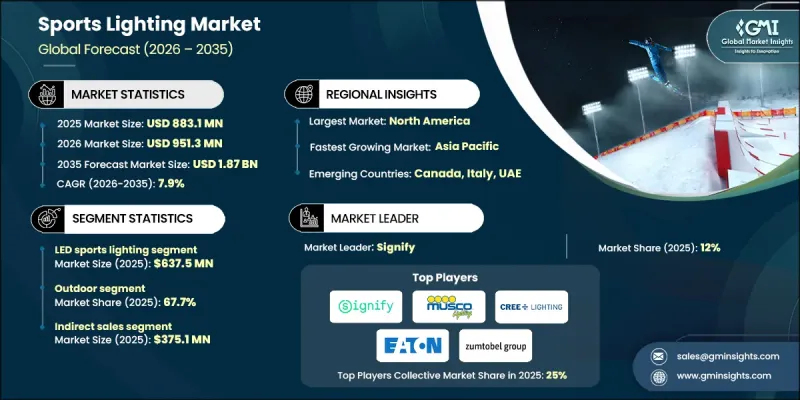
市場成長主要得益於體育場館照明系統從傳統技術向先進LED系統的大規模轉型。現代體育場館越來越重視能源效率、長壽命和卓越的照明質量,加速了LED照明在全球的普及。與傳統照明相比,LED解決方案顯著降低了電力消耗量和維護需求,使營運商能夠在保持穩定照明品質的同時降低長期營運成本。更長的使用壽命(通常超過50,000小時)減少了停機時間和更換成本,尤其在大型場館中,具有顯著的價值。更高的色彩精度和更均勻的亮度提升了運動員和觀眾的可見度,並滿足了更高的性能標準和轉播要求。此外,更低的發熱量也有助於降低冷卻需求,從而實現整體節能,使照明昇級與永續性和碳減排目標相契合。
| 市場覆蓋範圍 | |
|---|---|
| 開始年份 | 2025 |
| 預測年份 | 2026-2035 |
| 起始值 | 8.831億美元 |
| 預測金額 | 18.7億美元 |
| 複合年成長率 | 7.9% |
LED 體育照明領域反映了其主導的市場地位,預計到 2025 年將達到 6.375 億美元。這些系統具有高效、即時啟動和出色的視覺效果,使其成為尋求可靠和柔軟性照明解決方案的體育場、競技場和休閒場所的完美選擇。
到 2025 年,戶外應用領域將佔 67.7% 的市場佔有率。由於 LED 系統在惡劣環境條件下的耐用性、較長的使用壽命以及改進的光控制(可確保均勻照明並最大限度地減少設施周界外的光線洩漏),市場需求將保持強勁。
預計到 2025 年,美國體育照明市場將佔據 79.7% 的市場佔有率,價值 2.438 億美元。推動市場成長的因素包括體育設施的持續維修、嚴格的能源效率要求、永續性目標,以及對能夠滿足現代廣播技術和數位互動需求的先進照明系統日益成長的需求。
目錄
第1章調查方法和範圍
第2章執行摘要
第3章業界考察
- 生態系分析
- 供應商情況
- 利潤率
- 每個階段的附加價值
- 影響價值鏈的因素
- 產業影響因素
- 促進要素
- LED穿透力和能源效率
- 高清廣播要求
- 節能法規
- 產業潛在風險與挑戰
- 前期成本高
- 供應鏈風險
- 機會
- 智慧照明整合
- 永續性和ESG相容性
- 促進要素
- 成長潛力分析
- 未來市場趨勢
- 科技與創新趨勢
- 當前技術趨勢
- 新興技術
- 價格趨勢
- 按地區
- 按類型
- 監管環境
- 標準和合規要求
- 區域法規結構
- 認證標準
- 波特五力分析
- PESTEL 分析
第4章 競爭情勢
- 介紹
- 公司市佔率分析
- 按地區
- 企業矩陣分析
- 主要市場公司的競爭分析
- 競爭定位矩陣
- 重大進展
- 併購
- 夥伴關係與合作
- 新產品發布
- 擴張計劃
第5章 按類型分類的市場估算與預測,2022-2035年
- LED運動照明
- 傳統照明系統
- 太陽能運動照明
6. 2022-2035年按家電類型分類的市場估算與預測
- 泛光燈
- 工礦燈
第7章 按類別分類的市場估計與預測,2022-2035年
- 戶外
- 室內的
第8章 2022-2035年按價格分類的市場估算與預測
- 低價位
- 中價位
- 高的
第9章 按功率類型分類的市場估算與預測,2022-2035年
- 50瓦或以下
- 50-100W
- 100-200W
- 150-200W
- 超過200瓦
第10章 依應用領域分類的市場估計與預測,2022-2035年
- 籃球
- 排球
- 網球和球拍運動
- 足球
- 蟋蟀
- 羽毛球
- 其他(橄欖球、棒球、冰上曲棍球等)
第11章 依最終用戶分類的市場估算與預測,2022-2035年
- 專業體育場館
- 教育機構
- 市政/休閒設施
- 體育中心
- 培訓學院
第12章 按分銷管道分類的市場估算與預測,2022-2035年
- 直銷
- 間接銷售
第13章 2022-2035年各地區市場估算與預測
- 北美洲
- 美國
- 加拿大
- 歐洲
- 德國
- 英國
- 法國
- 義大利
- 西班牙
- 亞太地區
- 中國
- 日本
- 印度
- 澳洲
- 韓國
- 拉丁美洲
- 巴西
- 墨西哥
- 阿根廷
- 中東和非洲
- 南非
- 沙烏地阿拉伯
- 阿拉伯聯合大公國
第14章:公司簡介
- Acuity Brands
- AEON LED
- Bajaj Illumination
- Cooper Lighting Solutions
- Cree Lighting
- Eaton
- GE
- Havells India Limited
- Musco Lighting
- Schreder
- Signify NV
- SITECO
- Thorn Lighting
- Transrail
- Zumtobel Group
The Global Sports Lighting Market was valued at USD 883.1 million in 2025 and is estimated to grow at a CAGR of 7.9% to reach USD 1.87 billion by 2035.
Market growth is driven by a large-scale transition from conventional lighting technologies to advanced LED systems across sports infrastructure. Modern sports facilities are increasingly prioritizing energy efficiency, long operational life, and superior lighting quality, which has accelerated LED adoption worldwide. Compared to traditional lighting, LED solutions significantly reduce electricity consumption and maintenance requirements, allowing operators to lower long-term operating costs while maintaining consistent illumination quality. Extended service life, often exceeding 50,000 hours, reduces downtime and replacement expenses, which is especially valuable for large venues. Improved color accuracy and uniform brightness enhance visibility for athletes and audiences, supporting higher performance standards and broadcast requirements. Reduced heat generation also contributes to overall energy savings by lowering cooling needs, aligning lighting upgrades with sustainability and carbon reduction targets.
| Market Scope | |
|---|---|
| Start Year | 2025 |
| Forecast Year | 2026-2035 |
| Start Value | $883.1 Million |
| Forecast Value | $1.87 Billion |
| CAGR | 7.9% |
The LED sports lighting segment generated USD 637.5 million in 2025, reflecting its leadership position in the market. These systems deliver high efficiency, instant operation, and superior visual performance, making them the preferred choice for stadiums, arenas, and recreational facilities seeking reliable and flexible lighting solutions.
The outdoor applications segment accounted for 67.7% share in 2025. Demand remains strong due to the durability of LED systems in harsh environmental conditions, longer operational life, and improved light control that ensures even coverage while minimizing spillover beyond facility boundaries.
United States Sports Lighting Market held a 79.7% share and generated USD 243.8 million in 2025. Growth is supported by ongoing upgrades of sports venues, stricter energy efficiency requirements, sustainability targets, and increasing demand for advanced lighting systems capable of supporting modern broadcast and digital engagement needs.
Key players in the Global Sports Lighting Market include Signify N.V., Musco Lighting, Acuity Brands, Eaton, Cree Lighting, GE, Cooper Lighting Solutions, Zumtobel Group, Schreder, Thorn Lighting, SITECO, AEON LED, Bajaj Illumination, Havells India Limited, and Transrail. Companies in the sports lighting market are strengthening their position by investing in high-efficiency LED technologies, smart lighting controls, and connected systems that enable remote management and dynamic lighting effects. Manufacturers are expanding portfolios with modular and customizable solutions to address varied facility sizes and performance requirements. Strategic partnerships with stadium developers and sports organizations help secure long-term contracts, while continued R&D improves optical performance, durability, and energy savings. Sustainability-focused product development and compliance with evolving energy regulations further enhance competitiveness, while global expansion into emerging sports infrastructure markets supports long-term growth.
Table of Contents
Chapter 1 Methodology and Scope
- 1.1 Market scope and definition
- 1.2 Research design
- 1.2.1 Research approach
- 1.2.2 Data collection methods
- 1.3 Data mining sources
- 1.3.1 Global
- 1.3.2 Regional/Country
- 1.4 Base estimates and calculations
- 1.4.1 Base year calculation
- 1.4.2 Key trends for market estimation
- 1.5 Primary research and validation
- 1.5.1 Primary sources
- 1.6 Forecast model
- 1.7 Research assumptions and limitations
Chapter 2 Executive Summary
- 2.1 Industry 360° synopsis
- 2.2 Key market trends
- 2.2.1 Regional
- 2.2.2 Product type
- 2.2.3 Technology type
- 2.2.4 End user
- 2.2.5 Distribution channel
- 2.3 CXO perspectives: Strategic imperatives
- 2.3.1 Key decision points for industry executives
- 2.3.2 Critical success factors for market players
- 2.4 Future outlook and strategic recommendations
Chapter 3 Industry Insights
- 3.1 Industry ecosystem analysis
- 3.1.1 Supplier landscape
- 3.1.2 Profit margin
- 3.1.3 Value addition at each stage
- 3.1.4 Factor affecting the value chain
- 3.2 Industry impact forces
- 3.2.1 Growth drivers
- 3.2.1.1 LED adoption & energy efficiency
- 3.2.1.2 High-definition broadcast requirements
- 3.2.1.3 Energy efficiency mandates
- 3.2.2 Industry pitfalls & challenges
- 3.2.2.1 High initial cost
- 3.2.2.2 Supply chain risks
- 3.2.3 Opportunities
- 3.2.3.1 Smart lighting integration
- 3.2.3.2 Sustainability & ESG alignment
- 3.2.1 Growth drivers
- 3.3 Growth potential analysis
- 3.4 Future market trends
- 3.5 Technology and innovation landscape
- 3.5.1 Current technological trends
- 3.5.2 Emerging technologies
- 3.6 Price trends
- 3.6.1 By region
- 3.6.2 By type
- 3.7 Regulatory landscape
- 3.7.1 Standards and compliance requirements
- 3.7.2 Regional regulatory frameworks
- 3.7.3 Certification standards
- 3.8 Porter's analysis
- 3.9 PESTEL analysis
Chapter 4 Competitive Landscape, 2025
- 4.1 Introduction
- 4.2 Company market share analysis
- 4.2.1 By region
- 4.2.1.1 North America
- 4.2.1.2 Europe
- 4.2.1.3 Asia Pacific
- 4.2.1.4 Latin America
- 4.2.1.5 Middle East and Africa
- 4.2.1 By region
- 4.3 Company matrix analysis
- 4.4 Competitive analysis of major market players
- 4.5 Competitive positioning matrix
- 4.6 Key developments
- 4.6.1 Mergers & acquisitions
- 4.6.2 Partnerships & collaborations
- 4.6.3 New product launches
- 4.6.4 Expansion plans
Chapter 5 Market Estimates and Forecast, By Type, 2022 - 2035 (USD Million) (Thousand Units)
- 5.1 Key trends
- 5.2 LED sports lighting
- 5.3 Traditional lighting systems
- 5.4 Solar sports lighting
Chapter 6 Market Estimates and Forecast, By Fixture Type, 2022 - 2035 (USD Million) (Thousand Units)
- 6.1 Key trends
- 6.2 Floodlights
- 6.3 High-bay lights
Chapter 7 Market Estimates and Forecast, By Category, 2022 - 2035 (USD Million) (Thousand Units)
- 7.1 Key trends
- 7.2 Outdoor
- 7.3 Indoor
Chapter 8 Market Estimates and Forecast, By Price, 2022 - 2035 (USD Million) (Thousand Units)
- 8.1 Key trends
- 8.2 Low
- 8.3 Medium
- 8.4 High
Chapter 9 Market Estimates and Forecast, By Power Type, 2022 - 2035 (USD Million) (Thousand Units)
- 9.1 Key trends
- 9.2 Upto 50W
- 9.3 50-100W
- 9.4 100-200W
- 9.5 150-200W
- 9.6 Above 200W
Chapter 10 Market Estimates and Forecast, By Application, 2022 - 2035 (USD Million) (Thousand Units)
- 10.1 Key trends
- 10.2 Basketball
- 10.3 Volleyball
- 10.4 Tennis & Racquet Sports
- 10.5 Football/Soccer
- 10.6 Cricket
- 10.7 Badminton
- 10.8 Others (Rugby, baseball, ice hockey, etc.)
Chapter 11 Market Estimates and Forecast, By End User, 2022 - 2035 (USD Million) (Thousand Units)
- 11.1 Key trends
- 11.2 Professional sports arenas
- 11.3 Educational institutions
- 11.4 Municipalities/recreational facilities
- 11.5 Sports complex
- 11.6 Training academies
Chapter 12 Market Estimates and Forecast, By Distribution Channel, 2022 - 2035 (USD Million) (Thousand Units)
- 12.1 Key trends
- 12.2 Direct sales
- 12.3 Indirect Sales
Chapter 13 Market Estimates and Forecast, By Region, 2022 - 2035 (USD Million) (Thousand Units)
- 13.1 Key trends
- 13.2 North America
- 13.2.1 U.S.
- 13.2.2 Canada
- 13.3 Europe
- 13.3.1 Germany
- 13.3.2 UK
- 13.3.3 France
- 13.3.4 Italy
- 13.3.5 Spain
- 13.4 Asia Pacific
- 13.4.1 China
- 13.4.2 Japan
- 13.4.3 India
- 13.4.4 Australia
- 13.4.5 South Korea
- 13.5 Latin America
- 13.5.1 Brazil
- 13.5.2 Mexico
- 13.5.3 Argentina
- 13.6 Middle East and Africa
- 13.6.1 South Africa
- 13.6.2 Saudi Arabia
- 13.6.3 UAE
Chapter 14 Company Profiles
- 14.1 Acuity Brands
- 14.2 AEON LED
- 14.3 Bajaj Illumination
- 14.4 Cooper Lighting Solutions
- 14.5 Cree Lighting
- 14.6 Eaton
- 14.7 GE
- 14.8 Havells India Limited
- 14.9 Musco Lighting
- 14.10 Schreder
- 14.11 Signify N.V.
- 14.12 SITECO
- 14.13 Thorn Lighting
- 14.14 Transrail
- 14.15 Zumtobel Group


