

 |
市場調查報告書
商品編碼
1928984
運動襪市場機會、成長要素、產業趨勢分析及2026年至2035年預測Athletic Socks Market Opportunity, Growth Drivers, Industry Trend Analysis, and Forecast 2026 - 2035 |
||||||

全球運動襪市場預計到 2025 年將達到 63 億美元,到 2035 年將達到 109 億美元,年複合成長率為 5.5%。
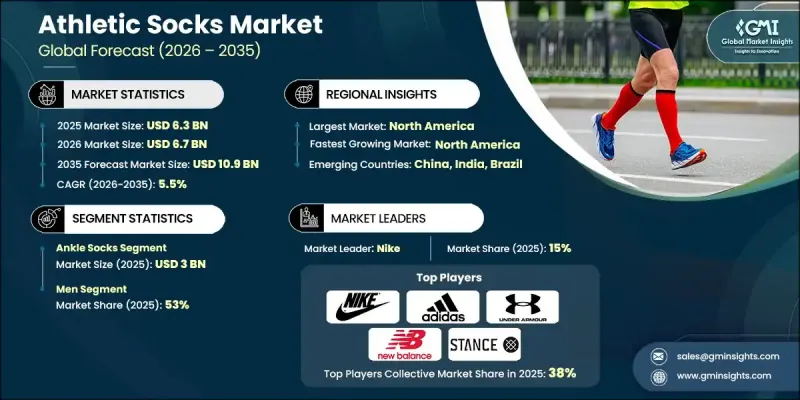
隨著消費者在時尚、健身和日常舒適度方面的習慣不斷變化,市場也持續發展。隨著休閒的興起,運動襪不再侷限於運動場合,而是成為日常穿搭的必備單品,適用於各種運動和休閒場合。不斷變化的風格偏好和數位化主導的潮流趨勢,使運動服飾成為日常生活的一部分。同時,人們參與體育活動和戶外休閒的積極性日益提高,促使品牌更加重視性能導向的設計。舒適性、耐用性和功能性不再是可選項,而是基本要求。吸濕排汗、緩衝和防臭已成為產品開發的關鍵要素,這顯示消費者越來越重視健康和舒適度。雖然電子商務的發展讓消費者能夠更方便地獲取種類繁多的產品,但對於那些喜歡在購買前觸摸和感受產品的消費者來說,實體零售的價值仍然不容忽視。環保意識也影響消費者的購買行為,永續性正日益影響各行各業的材料選擇和生產方式。
| 市場覆蓋範圍 | |
|---|---|
| 開始年份 | 2025 |
| 預測年份 | 2026-2035 |
| 起始值 | 63億美元 |
| 預測金額 | 109億美元 |
| 複合年成長率 | 5.5% |
截至2025年,男士襪子市佔率達53%。這一主導地位主要得益於男性消費者更多地參與運動、健身和休閒活動,他們將性能卓越、經久耐用的襪子視為必備品。
截至2025年,線下銷售管道通路仍佔據最大的市場佔有率。實體零售仍具有強大的影響力,因為顧客可以直接試穿、體驗布料質感、厚度和舒適度。在許多地區,實體商店購物仍然深深植根於消費者的習慣中,並透過親身體驗持續提供強大的信任感。
預計到 2025 年,美國運動襪市場將佔據 78% 的佔有率,並創造 17 億美元的收入。人們對體育和健身活動的高度參與、完善的零售基礎設施以及對休閒產品的強勁需求,都支撐著該地區的主導地位和持續創新。
目錄
第1章調查方法和範圍
第2章執行摘要
第3章業界考察
- 生態系分析
- 供應商情況
- 利潤率
- 每個階段的附加價值
- 影響價值鏈的因素
- 產業影響因素
- 促進要素
- 參與運動和健身的人數增加
- 休閒風潮日益盛行
- 材料技術的進步
- 產業潛在風險與挑戰
- 激烈的競爭與產品飽和
- 人們對永續性的期望日益提高
- 機會
- 電子商務與數位個人化的發展
- 對天然環保纖維的需求日益成長
- 促進要素
- 成長潛力分析
- 關鍵市場趨勢與顛覆性因素
- 未來市場趨勢
- 風險及緩解分析
- 科技與創新趨勢
- 當前技術趨勢
- 新興技術
- 價格趨勢
- 按地區
- 依產品類型
- 監管環境
- 北美洲
- 歐洲
- 亞太地區
- 中東和非洲
- 拉丁美洲
- 波特分析
- PESTEL 分析
第4章 競爭情勢
- 介紹
- 公司市佔率分析
- 按地區
- 企業矩陣分析
- 主要市場公司的競爭分析
- 競爭定位矩陣
- 重大進展
- 併購
- 夥伴關係與合作
- 新產品發布
- 擴張計劃
第5章 依產品類型分類的市場估算與預測,2022-2035年
- 短襪
- 船襪
- 及膝襪
第6章 按材料分類的市場估算與預測,2022-2035年
- 棉布
- 羊毛
- 羊毛
- 合成材料
- 其他
第7章 2022-2035年按價格分類的市場估計與預測
- 低價位
- 中號
- 高價位範圍
8. 2022-2035年按消費群組分類的市場估計與預測
- 男性
- 女士
- 適合兒童
9. 2022-2035年按分銷管道分類的市場估算與預測
- 線上
- 離線
第10章 2022-2035年各地區市場估計與預測
- 北美洲
- 美國
- 加拿大
- 歐洲
- 德國
- 英國
- 法國
- 義大利
- 西班牙
- 土耳其
- 亞太地區
- 中國
- 日本
- 印度
- 澳洲
- 韓國
- 拉丁美洲
- 巴西
- 墨西哥
- 阿根廷
- 中東和非洲
- 南非
- 沙烏地阿拉伯
- 阿拉伯聯合大公國
第11章 公司簡介
- Adidas AG
- ASICS Corporation
- Balega International
- Darn Tough Vermont
- Feetures, LLC
- New Balance Athletics, Inc.
- Nike, Inc.
- PUMA SE
- Reebok International Limited
- SockGuy, Inc.
- Stance Inc.
- Swiftwick LLC
- Thorlos, Inc.
- Under Armour, Inc.
- Wigwam Mills Inc.
The Global Athletic Socks Market was valued at USD 6.3 billion in 2025 and is estimated to grow at a CAGR of 5.5% to reach USD 10.9 billion by 2035.
The market is evolving as consumer habits related to fashion, fitness, and daily comfort continue to shift. Athletic socks are no longer limited to sports use, as the widespread acceptance of athleisure has positioned them as a regular wardrobe item suitable for both active and casual settings. Changing style preferences and digitally driven trends have normalized sporty apparel in everyday life. At the same time, growing participation in physical activities and outdoor recreation is encouraging brands to prioritize performance-focused designs. Comfort, durability, and functional benefits have become standard requirements rather than optional features. Moisture management, cushioning, and odor control are now integral to product development, highlighting a stronger emphasis on health and comfort. E-commerce growth has expanded consumer access to a wide assortment of products, while physical retail continues to hold value for shoppers who prefer tactile evaluation before purchase. Environmental awareness is also influencing purchasing behavior, with sustainability increasingly shaping material choices and production practices across the industry.
| Market Scope | |
|---|---|
| Start Year | 2025 |
| Forecast Year | 2026-2035 |
| Start Value | $6.3 Billion |
| Forecast Value | $10.9 Billion |
| CAGR | 5.5% |
The men's category accounted for 53% share in 2025. This dominance is supported by strong participation rates in sports, fitness routines, and recreational activities among male consumers, where performance-oriented and long-lasting socks are considered essential.
The offline sales channels segment held the highest market share in 2025. Physical retail remains influential because it allows customers to directly assess fit, fabric quality, thickness, and comfort. In many regions, in-store shopping remains deeply rooted in consumer habits and continues to provide confidence through hands-on purchasing experiences.
United States Athletic Socks Market held 78% share, generating USD 1.7 billion in 2025. High engagement in sports and fitness activities, well-established retail infrastructure, and strong demand for athleisure products support regional leadership and ongoing innovation.
Key companies active in the Global Athletic Socks Market include Nike, Inc., Adidas AG, Under Armour, Inc., PUMA SE, ASICS Corporation, New Balance Athletics, Inc., Stance Inc., Thorlos, Inc., Balega International, Feetures, LLC, Swiftwick LLC, Darn Tough Vermont, Wigwam Mills Inc., Reebok International Limited, and SockGuy, Inc. Companies operating in the Athletic Socks Market are strengthening their market position by focusing on product innovation, material advancement, and brand differentiation. Many players invest in performance fabrics that improve comfort, durability, and moisture management while addressing sustainability goals through recycled or eco-friendly materials. Expanding product portfolios across multiple price points helps brands reach diverse consumer segments. Strategic partnerships with retailers and direct-to-consumer channels enhance visibility and customer engagement. Marketing strategies increasingly emphasize lifestyle positioning and performance benefits to build brand loyalty. Continuous design updates, customization options, and investments in supply chain efficiency further support competitive advantage and long-term market presence.
Table of Contents
Chapter 1 Methodology and Scope
- 1.1 Market scope and definition
- 1.2 Research design
- 1.2.1 Research approach
- 1.2.2 Data collection methods
- 1.3 Data mining sources
- 1.3.1 Global
- 1.3.2 Regional/Country
- 1.4 Base estimates and calculations
- 1.4.1 Base year calculation
- 1.4.2 Key trends for market estimation
- 1.5 Primary research and validation
- 1.5.1 Primary sources
- 1.6 Forecast model
- 1.7 Research assumptions and limitations
Chapter 2 Executive Summary
- 2.1 Industry 360° synopsis
- 2.2 Key market trends
- 2.2.1 By Regional
- 2.2.2 By Product type
- 2.2.3 By Material
- 2.2.4 By Price
- 2.2.5 By Consumer group
- 2.2.6 By Distribution channel
- 2.3 CXO perspectives: Strategic imperatives
- 2.3.1 Key decision points for industry executives
- 2.3.2 Critical success factors for market players
- 2.4 Future outlook and strategic recommendations
Chapter 3 Industry Insights
- 3.1 Industry ecosystem analysis
- 3.1.1 Supplier landscape
- 3.1.2 Profit margin
- 3.1.3 Value addition at each stage
- 3.1.4 Factor affecting the value chain
- 3.2 Industry impact forces
- 3.2.1 Growth drivers
- 3.2.1.1 Rising Sports and Fitness Participation
- 3.2.1.2 Expansion of the Athleisure Trend
- 3.2.1.3 Advancements in Material Technology
- 3.2.2 Industry pitfalls & challenges
- 3.2.2.1 Intense Competition and Product Saturation
- 3.2.2.2 Rising Expectations for Sustainability
- 3.2.3 Opportunities
- 3.2.3.1 Growth of e-commerce and digital personalization
- 3.2.3.2 Increasing demand for natural and eco-friendly fibers
- 3.2.1 Growth drivers
- 3.3 Growth potential analysis
- 3.4 Major market trends and Disruption
- 3.5 Future market trends
- 3.6 Risk and mitigation Analysis
- 3.7 Technology and innovation landscape
- 3.7.1 Current technological trends
- 3.7.2 Emerging technologies
- 3.8 Price trends
- 3.8.1 By Region
- 3.8.2 By Product type
- 3.9 Regulatory landscape
- 3.9.1 North America
- 3.9.2 Europe
- 3.9.3 Asia-Pacific
- 3.9.4 Middle East and Africa
- 3.9.5 Latin America
- 3.10 Porter';s analysis
- 3.11 PESTEL analysis
Chapter 4 Competitive Landscape, 2025
- 4.1 Introduction
- 4.2 Company market share analysis
- 4.2.1 By region
- 4.2.1.1 North America
- 4.2.1.2 Europe
- 4.2.1.3 Asia Pacific
- 4.2.1.4 Latin America
- 4.2.1.5 Middle East and Africa
- 4.2.1 By region
- 4.3 Company matrix analysis
- 4.4 Competitive analysis of major market players
- 4.5 Competitive positioning matrix
- 4.6 Key developments
- 4.6.1 Mergers & acquisitions
- 4.6.2 Partnerships & collaborations
- 4.6.3 New product launches
- 4.6.4 Expansion plans
Chapter 5 Market Estimates & Forecast, By Product Type, 2022-2035 (USD Billion) (Thousand Units)
- 5.1 Key trends
- 5.2 Ankle socks
- 5.3 Crew socks
- 5.4 Knee-high socks
Chapter 6 Market Estimates & Forecast, By Material, 2022-2035 (USD Billion) (Thousand Units)
- 6.1 Key trends
- 6.2 Cotton
- 6.3 Fleece
- 6.4 Wool
- 6.5 Synthetic
- 6.6 Others
Chapter 7 Market Estimates & Forecast, By Price, 2022-2035 (USD Billion) (Thousand Units)
- 7.1 Key trends
- 7.2 Low
- 7.3 Medium
- 7.4 High
Chapter 8 Market Estimates & Forecast, By Consumer Group, 2022-2035 (USD Billion) (Thousand Units)
- 8.1 Key trends
- 8.2 Men
- 8.3 Women
- 8.4 Kids
Chapter 9 Market Estimates & Forecast, By Distribution Channel, 2022-2035 (USD Billion) (Thousand Units)
- 9.1 Key trends
- 9.2 Online
- 9.3 Offline
Chapter 10 Market Estimates and Forecast, By Region, 2022 - 2035 (USD Billion) (Thousand Units)
- 10.1 Key trends
- 10.2 North America
- 10.2.1 U.S.
- 10.2.2 Canada
- 10.3 Europe
- 10.3.1 Germany
- 10.3.2 UK
- 10.3.3 France
- 10.3.4 Italy
- 10.3.5 Spain
- 10.3.6 Turkey
- 10.4 Asia Pacific
- 10.4.1 China
- 10.4.2 Japan
- 10.4.3 India
- 10.4.4 Australia
- 10.4.5 South Korea
- 10.5 Latin America
- 10.5.1 Brazil
- 10.5.2 Mexico
- 10.5.3 Argentina
- 10.6 Middle East and Africa
- 10.6.1 South Africa
- 10.6.2 Saudi Arabia
- 10.6.3 UAE
Chapter 11 Company Profiles
- 11.1 Adidas AG
- 11.2 ASICS Corporation
- 11.3 Balega International
- 11.4 Darn Tough Vermont
- 11.5 Feetures, LLC
- 11.6 New Balance Athletics, Inc.
- 11.7 Nike, Inc.
- 11.8 PUMA SE
- 11.9 Reebok International Limited
- 11.10 SockGuy, Inc.
- 11.11 Stance Inc.
- 11.12 Swiftwick LLC
- 11.13 Thorlos, Inc.
- 11.14 Under Armour, Inc.
- 11.15 Wigwam Mills Inc.

 襪子市場分析及預測(至2035年):依類型、產品類型、材料、最終用戶、技術、應用、製造流程、功能、安裝類型分類襪子市場分析及預測(至2035年):類型、材料類型、應用、最終用戶、技術、功能、產品類型及產品介紹足部保濕襪市場分析與預測(至2035年):按類型、產品類型、技術、應用、材料類型、最終用戶、功能、部署類型和解決方案分類
 全球保濕襪市場規模、佔有率、趨勢和成長分析報告:2026-2034年
 日本襪類市場規模、佔有率、趨勢和預測:按類型、最終用途和地區分類,2026-2034年
 襪子市場機會、成長要素、產業趨勢分析及2026年至2035年預測
 多趾襪市場 - 全球產業規模、佔有率、趨勢、機會及預測(按產品類型、材料類型、分銷管道、地區和競爭格局分類,2021-2031年)襪子市場-全球產業規模、佔有率、趨勢、機會、預測:按類型、類別、銷售管道、地區和競爭格局分類,2021-2031年運動襪市場-全球產業規模、佔有率、趨勢、機會、預測:按產品、材料、通路、地區和競爭格局分類,2021-2031年
 除臭襪市場:2026-2032年全球預測(按產品類型、材料、技術、分銷管道和最終用戶分類)