


 |
市場調查報告書
商品編碼
1928971
氟界面活性劑市場機會、成長要素、產業趨勢分析及2026年至2035年預測Fluorosurfactants Market Opportunity, Growth Drivers, Industry Trend Analysis, and Forecast 2026 - 2035 |
||||||

全球氟界面活性劑市場預計到 2025 年將達到 15 億美元,到 2035 年將達到 19.1 億美元,年複合成長率為 2.4%。
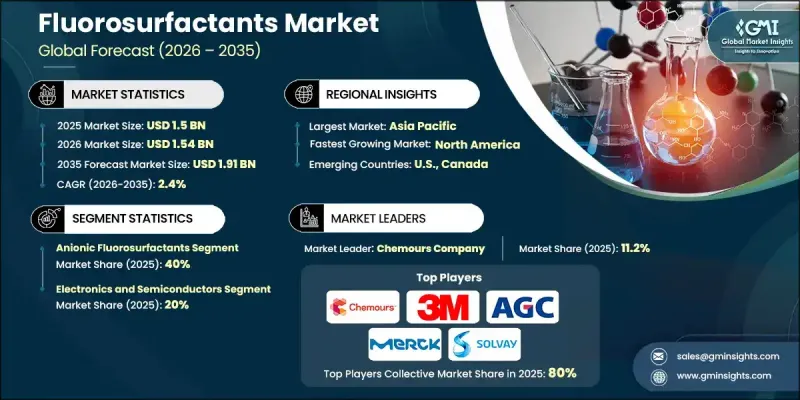
氟界面活性劑在市場穩定中扮演著至關重要的角色,尤其是在對精度、可靠性和性能要求極高的先進製造環境中。儘管監管審查日益嚴格,供應商趨勢也在不斷變化,但這些材料仍深度融入高階工業流程。對 PFAS 化合物的審查力度加大、遵循成本不斷攀升以及部分生產商的策略性退出,正在加速籌資策略的重組和替代化學品的認證工作。然而,採用替代品仍然是一項長期挑戰,尤其是在微電子領域,該領域的製程可靠性依賴於精確的表面性能和超潔淨的環境。隨著製造公差的日益嚴格,對一致的潤濕控制和缺陷預防的需求仍然至關重要。買家正擴大尋求多元化的採購模式以降低供應風險。同時,供應商則專注於研發兼具高性能和更佳環保特性的複雜配方。市場前景反映了監管壓力和持續的結構性需求的雙重影響,尤其是在替代品技術複雜、認證週期長達數年的行業。
| 市場覆蓋範圍 | |
|---|---|
| 開始年份 | 2025 |
| 預測年份 | 2026-2035 |
| 起始值 | 15億美元 |
| 預測金額 | 19.1億美元 |
| 複合年成長率 | 2.4% |
至2025年,陰離子氟界面活性劑市佔率將達到40%。這一分佈反映了應用領域對化學穩定性、相容性和在嚴苛加工條件下性能的要求。這些化學物質因其能夠在極低濃度下實現極低的表面張力,同時在惡劣環境中保持可靠性而備受青睞。陰離子活性劑透過改善流動性和分散穩定性,在塗料和聚合物加工領域繼續發揮重要作用。
預計到2025年,電子和半導體應用領域將佔據20%的市場。該領域高度依賴氟表面活性劑,以在對缺陷接受度極低的複雜製造過程中維持精確的表面相互作用。漫長的認證週期和嚴格的純度要求持續支撐著先進製造環境中對氟表面活性劑的旺盛需求。
到2025年,美國將引領北美氟界面活性劑市場,佔26%的市場。在美國,氟界面活性劑廣泛應用於半導體製造、航太生產和特種化學品加工等眾多領域。不斷完善的法規結構增加了合規義務,影響採購決策和風險管理方法。對先進製造能力的持續投資,也持續支撐著對高純度配方產品的需求。加拿大憑藉其工業基礎,在與不斷發展的環境監管體系接軌的同時,也為市場做出了貢獻。
目錄
第1章調查方法和範圍
第2章執行摘要
第3章業界考察
- 生態系分析
- 供應商情況
- 利潤率
- 每個階段的附加價值
- 影響價值鏈的因素
- 中斷
- 產業影響因素
- 促進要素
- 產業潛在風險與挑戰
- 市場機遇
- 成長潛力分析
- 監管環境
- 北美洲
- 歐洲
- 亞太地區
- 拉丁美洲
- 中東和非洲
- 波特分析
- PESTEL 分析
- 價格趨勢
- 按地區
- 未來市場趨勢
- 科技與創新趨勢
- 當前技術趨勢
- 新興技術
- 專利狀態
- 貿易統計(HS編碼)(註:僅提供主要國家的貿易統計)
- 主要進口國
- 主要出口國
- 永續性和環境方面
- 永續努力
- 減少廢棄物策略
- 生產中的能源效率
- 環保舉措
- 碳足跡考量
第4章 競爭情勢
- 介紹
- 公司市佔率分析
- 按地區
- 北美洲
- 歐洲
- 亞太地區
- 拉丁美洲
- 中東和非洲
- 按地區
- 企業矩陣分析
- 主要市場公司的競爭分析
- 競爭定位矩陣
- 重大進展
- 併購
- 夥伴關係與合作
- 新產品發布
- 擴張計劃
5. 依產品類型分類的市場,2022-2035 年
- 陰離子界面活性劑
- 非離子型氟界面活性劑
- 陽離子氟表面活性劑
- 兩性氟表面活性劑
第6章 市場:依應用領域分類,2022-2035年
- 油漆和塗料
- 黏合劑和密封劑
- 滅火泡沫
- 聚合物分散體
- 工業和商用清潔劑
- 電子裝置和半導體
- 石油和天然氣
- 紡織品和皮革
- 其他
7. 按分銷管道分類的市場,2022-2035 年
- 直銷
- 批發商和批發公司
- 線上/電子商務平台
- 其他
第8章 2022-2035年各地區市場規模及預測
- 北美洲
- 美國
- 加拿大
- 歐洲
- 英國
- 德國
- 法國
- 義大利
- 西班牙
- 其他歐洲地區
- 亞太地區
- 中國
- 印度
- 日本
- 韓國
- 澳洲
- 亞太其他地區
- 拉丁美洲
- 巴西
- 墨西哥
- 阿根廷
- 其他拉丁美洲地區
- 中東和非洲
- 南非
- 沙烏地阿拉伯
- 阿拉伯聯合大公國
- 其他中東和非洲地區
第9章:公司簡介
- 3M
- The Chemours Company
- The Dow Chemical Company
- AGC
- Asahi Glass
- Daikin Industries
- Merck KGaA
- Solvay
- Shamrock Technologies
- Mitsubishi Chemical Corporation
- DIC Corporation
- OMNOVA Solutions
- Advanced Polymer
- Innovative Chemical Technologies
- Pilot Chemical Company
The Global Fluorosurfactants Market was valued at USD 1.5 billion in 2025 and is estimated to grow at a CAGR of 2.4% to reach USD 1.91 billion by 2035.
Market stability is supported by the critical role fluorosurfactants play in advanced manufacturing environments, particularly where precision, reliability, and performance cannot be compromised. These materials remain deeply embedded in high-end industrial processes despite increasing regulatory oversight and shifting supplier dynamics. Heightened scrutiny around PFAS compounds, rising compliance expenses, and strategic exits by select producers are reshaping procurement strategies and accelerating efforts to qualify alternative chemistries. However, replacement timelines remain lengthy, especially in microelectronics, where process reliability depends on exact surface behavior and ultra-clean conditions. As manufacturing tolerances tighten, demand for consistent wetting control and defect prevention remains essential. Buyers increasingly pursue diversified sourcing models to mitigate supply risks, while suppliers focus on refined formulations that balance performance with improved environmental profiles. The market outlook reflects a combination of regulatory pressure and structural demand durability, particularly where substitution is technically complex and qualification cycles extend over many years.
| Market Scope | |
|---|---|
| Start Year | 2025 |
| Forecast Year | 2026-2035 |
| Start Value | $1.5 Billion |
| Forecast Value | $1.91 Billion |
| CAGR | 2.4% |
The anionic fluorosurfactants segment held 40% share in 2025. This distribution reflects application requirements for chemical stability, compatibility, and performance under extreme processing conditions. These chemistries are valued for their ability to achieve extremely low surface tension at minimal concentrations while maintaining reliability in harsh environments. Anionic variants continue to play a key role in coatings and polymer processing by enhancing flow characteristics and dispersion stability.
The electronics and semiconductor applications segment accounted for 20% share in 2025. This segment relies heavily on fluorosurfactants to maintain precise surface interactions during complex manufacturing stages where defect tolerance is minimal. Long qualification cycles and stringent purity requirements continue to reinforce sustained demand across advanced fabrication environments.
North America Fluorosurfactants Market held 26% share in 2025, led by the United States, where fluorosurfactants are used across semiconductor manufacturing, aerospace production, and specialty chemical processing. Expanding regulatory frameworks have increased compliance obligations, influencing sourcing decisions and risk management practices. Ongoing investment in advanced manufacturing capacity continues to support demand for high-purity formulations. Canada contributes through its industrial base while aligning with evolving environmental oversight structures.
Key participants active in the Global Fluorosurfactants Market include Solvay, Daikin Industries, The Chemours Company, AGC, Mitsubishi Chemical Corporation, Merck KGaA, Asahi Glass, DIC Corporation, Shamrock Technologies, The Dow Chemical Company, Pilot Chemical Company, OMNOVA Solutions, Innovative Chemical Technologies, Advanced Polymer, and 3M. Companies operating in the Global Fluorosurfactants Market focus on reinforcing their competitive position through formulation innovation, regulatory alignment, and customer collaboration. Significant investment is directed toward developing short-chain and alternative chemistries that preserve performance while addressing environmental concerns. Suppliers emphasize ultra-high-purity manufacturing, contamination control, and technical support to meet demanding customer specifications. Strategic portfolio optimization and selective capacity investment help manage regulatory exposure and cost pressures. Long-term partnerships with critical end users support early-stage qualification and application-specific customization.
Table of Contents
Chapter 1 Methodology & Scope
- 1.1 Market scope and definition
- 1.2 Research design
- 1.2.1 Research approach
- 1.2.2 Data collection methods
- 1.3 Data mining sources
- 1.3.1 Global
- 1.3.2 Regional/Country
- 1.4 Base estimates and calculations
- 1.4.1 Base year calculation
- 1.4.2 Key trends for market estimation
- 1.5 Primary research and validation
- 1.5.1 Primary sources
- 1.6 Forecast model
- 1.7 Research assumptions and limitations
Chapter 2 Executive Summary
- 2.1 Industry 360° synopsis
- 2.2 Key market trends
- 2.2.1 Product type
- 2.2.2 Application
- 2.2.3 Distribution channel
- 2.3 TAM analysis, 2025-2034
- 2.4 CXO perspectives: Strategic imperatives
- 2.4.1 Executive decision points
- 2.4.2 Critical success factors
- 2.5 Outlook and strategic recommendations
Chapter 3 Industry Insights
- 3.1 Industry ecosystem analysis
- 3.1.1 Supplier landscape
- 3.1.2 Profit margin
- 3.1.3 Value addition at each stage
- 3.1.4 Factor affecting the value chain
- 3.1.5 Disruptions
- 3.2 Industry impact forces
- 3.2.1 Growth drivers
- 3.2.2 Industry pitfalls and challenges
- 3.2.3 Market opportunities
- 3.3 Growth potential analysis
- 3.4 Regulatory landscape
- 3.4.1 North America
- 3.4.2 Europe
- 3.4.3 Asia Pacific
- 3.4.4 Latin America
- 3.4.5 Middle East & Africa
- 3.5 Porter';s analysis
- 3.6 PESTEL analysis
- 3.7 Price trends
- 3.7.1 By region
- 3.8 Future market trends
- 3.9 Technology and innovation landscape
- 3.9.1 Current technological trends
- 3.9.2 Emerging technologies
- 3.10 Patent landscape
- 3.11 Trade statistics (HS code) (Note: the trade statistics will be provided for key countries only)
- 3.11.1 Major importing countries
- 3.11.2 Major exporting countries
- 3.12 Sustainability and environmental aspects
- 3.12.1 Sustainable practices
- 3.12.2 Waste reduction strategies
- 3.12.3 Energy efficiency in production
- 3.12.4 Eco-friendly initiatives
- 3.13 Carbon footprint considerations
Chapter 4 Competitive Landscape, 2025
- 4.1 Introduction
- 4.2 Company market share analysis
- 4.2.1 By region
- 4.2.1.1 North America
- 4.2.1.2 Europe
- 4.2.1.3 Asia Pacific
- 4.2.1.4 Latin America
- 4.2.1.5 Middle East & Africa
- 4.2.1 By region
- 4.3 Company matrix analysis
- 4.4 Competitive analysis of major market players
- 4.5 Competitive positioning matrix
- 4.6 Key developments
- 4.6.1 Mergers & acquisitions
- 4.6.2 Partnerships & collaborations
- 4.6.3 New product launches
- 4.6.4 Expansion plans
Chapter 5 Market, By Product Type, 2022-2035 (USD Billion, Kilo Tons)
- 5.1 Key trends
- 5.2 Anionic fluorosurfactant
- 5.3 Non-ionic fluorosurfactant
- 5.4 Cationic fluorosurfactant
- 5.5 Amphoteric fluorosurfactant
Chapter 6 Market, By Application, 2022-2035 (USD Billion, Kilo Tons)
- 6.1 Key trends
- 6.2 Paints & coatings
- 6.3 Adhesives & sealants
- 6.4 Firefighting foams
- 6.5 Polymer dispersion
- 6.6 Industrial & institutional cleaners
- 6.7 Electronics & semiconductors
- 6.8 Oil & gas
- 6.9 Textiles & leather
- 6.10 Others
Chapter 7 Market, By Distribution Channel, 2022-2035 (USD Billion, Kilo Tons)
- 7.1 Key trends
- 7.2 Direct sales
- 7.3 Distributors & wholesalers
- 7.4 Online/e-commerce platforms
- 7.5 Others
Chapter 8 Market Size and Forecast, By Region, 2022-2035 (USD Billion, Kilo Tons)
- 8.1 Key trends
- 8.2 North America
- 8.2.1 U.S.
- 8.2.2 Canada
- 8.3 Europe
- 8.3.1 UK
- 8.3.2 Germany
- 8.3.3 France
- 8.3.4 Italy
- 8.3.5 Spain
- 8.3.6 Rest of Europe
- 8.4 Asia Pacific
- 8.4.1 China
- 8.4.2 India
- 8.4.3 Japan
- 8.4.4 South Korea
- 8.4.5 Australia
- 8.4.6 Rest of Asia Pacific
- 8.5 Latin America
- 8.5.1 Brazil
- 8.5.2 Mexico
- 8.5.3 Argentina
- 8.5.4 Rest of Latin America
- 8.6 Middle East & Africa
- 8.6.1 South Africa
- 8.6.2 Saudi Arabia
- 8.6.3 UAE
- 8.6.4 Rest of Middle East & Africa
Chapter 9 Company Profiles
- 9.1 3M
- 9.2 The Chemours Company
- 9.3 The Dow Chemical Company
- 9.4 AGC
- 9.5 Asahi Glass
- 9.6 Daikin Industries
- 9.7 Merck KGaA
- 9.8 Solvay
- 9.9 Shamrock Technologies
- 9.10 Mitsubishi Chemical Corporation
- 9.11 DIC Corporation
- 9.12 OMNOVA Solutions
- 9.13 Advanced Polymer
- 9.14 Innovative Chemical Technologies
- 9.15 Pilot Chemical Company

 氟表面活性劑市場規模、佔有率、成長及全球產業分析:依類型、應用和地區劃分的洞察,預測(2026-2034 年)
 氟界面活性劑市場規模、佔有率及成長分析(按類型、應用和地區分類)-2026-2033年產業預測
 氟表面活性劑:全球市場佔有率和排名、總收入和需求預測(2025-2031年)
 氟界面活性劑市場-全球產業規模、佔有率、趨勢、機會及預測(按類型、應用、地區和競爭細分,2020-2030 年)全球氟表面活性劑市場規模(按類型、應用、地區、範圍和預測)
 含氟界面活性劑市場規模、佔有率、趨勢分析報告:按類型、應用、地區、細分市場預測,2024-2030