


 |
市場調查報告書
商品編碼
1928970
燃料電池電動車市場機會、成長要素、產業趨勢分析及2026年至2035年預測Fuel Cell Electric Vehicle Market Opportunity, Growth Drivers, Industry Trend Analysis, and Forecast 2026 - 2035 |
||||||

全球燃料電池電動車市場預計到 2025 年將價值 60 億美元,到 2035 年將達到 576 億美元,年複合成長率為 26.6%。
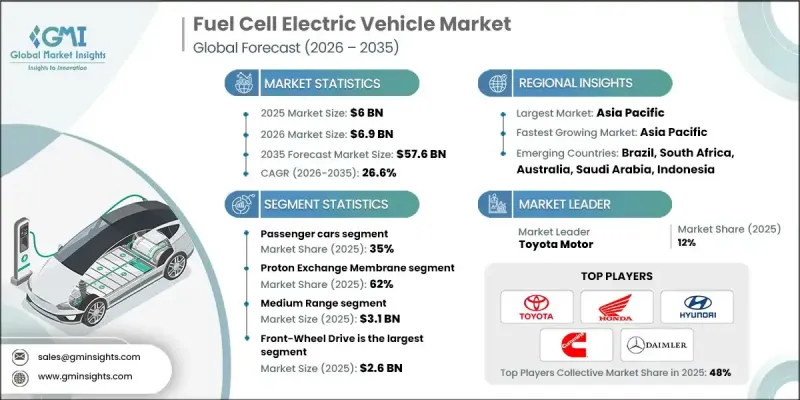
燃料電池電動車(FCEV)的成長主要得益於其長續航里程和快速加氫能力,在公共運輸、物流和乘用車領域中得到越來越廣泛的應用。政府旨在推廣清潔能源的政策、補貼和稅收優惠鼓勵了投資者的參與,並開拓了新的市場,進一步加速了該產業的擴張。儘管供應鏈中斷影響了FCEV的銷售量,但汽車製造商正以前所未有的速度加快氫燃料電池平台的研發。各公司正在展示下一代燃料電池技術,並準備量產車型投入商業部署,這反映了他們對交通運輸產業脫碳的堅定承諾。日益增強的環保意識和永續性目標正促使消費者和政府優先考慮零排放出行,隨著各國努力減少溫室氣體排放,FCEV的吸引力也日益增強。
| 市場覆蓋範圍 | |
|---|---|
| 開始年份 | 2025 |
| 預測年份 | 2026-2035 |
| 起始值 | 60億美元 |
| 預測金額 | 576億美元 |
| 複合年成長率 | 26.6% |
預計到2025年,乘用車市佔率將達到35%,並在2026年至2035年間以27.8%的複合年成長率成長。隨著汽車製造商不斷改進動力傳動系統設計並最佳化日常使用整合,搭乘用燃料電池汽車(FCEV)正在快速發展。消費者對永續性和低排放出行的日益關注正在加速動力來源乘用車的普及。製造商正致力於延長續航里程、縮短加氫時間並提高車輛整體效率,以達到甚至超越傳統內燃機汽車和電池式電動車的性能。此外,先進的資訊娛樂系統、安全功能和互聯選項也被融入其中,以滿足現代消費者的需求。
預計到2025年,質子交換膜(PEM)燃料電池將佔據62%的市場佔有率,並在2035年之前以28.9%的複合年成長率成長。 PEM燃料電池的工作溫度低於傳統燃料電池,因此啟動速度更快,更能適應頻繁啟動的駕駛環境,對溫度控管的要求也更低。技術進步提高了PEM燃料電池的效率和耐久性,並降低了鉑金的使用量,使其在保持商業應用性能的同時,也具備了成本競爭力。
預計到 2025 年,中國燃料電池電動車 (FCEV) 市場規模將達到 17.9 億美元。政府計畫和私人投資正在推動 FCEV 的快速普及,國家層級的措施旨在引進數萬輛燃料電池汽車,同時一些省份正在擴大加氫基礎設施。
目錄
第1章調查方法和範圍
第2章執行摘要
第3章業界考察
- 生態系分析
- 供應商情況
- 原物料供應商
- 零件供應商
- 製造商
- 技術提供者
- 分銷管道
- 最終用途
- 成本結構
- 利潤率
- 每個階段的附加價值
- 垂直整合趨勢
- 顛覆者
- 供應商情況
- 影響因素
- 促進要素
- 脫碳義務和排放法規
- 氫能基礎設施的擴張
- 物流和公共運輸領域商業車隊的引入
- 清潔車輛獎勵和補貼
- 產業潛在風險與挑戰
- 缺乏氫氣加註基礎設施
- 燃料電池系統耐久性與維護
- 市場機遇
- 電池混合動力和燃料電池整合
- 氫供應鏈和綠氫能應用
- 區域氫能政策與產業合作
- 將業務拓展至物料搬運和利基工業車輛領域
- 促進要素
- 成長潛力分析
- 監管環境
- 北美洲
- 美國國家公路交通安全管理局低速車輛(LSV)標準(FMVSS 500)
- 美國各州有關合法上路低速車輛(LSV)的法規
- 加拿大運輸部輕型商用車法規
- 歐洲
- 歐盟四輪輕型車輛類別 L6e/L7e
- 聯合國歐洲經濟委員會(UNECE)車輛安全法規
- 歐盟電池法規
- 歐盟報廢車輛指令
- 亞太地區
- 中國新能源車與低速車GB標準
- 印度電動車CMVR法規
- 日本國土運輸省微型交通工具管理條例
- 拉丁美洲
- 巴西 CONTRAN 標準
- 阿根廷 IRAM 標準
- 墨西哥NOM車輛標準
- 中東和非洲
- 沙烏地阿拉伯 SASO 標準
- 阿拉伯聯合大公國證券及市場管理局 (ESMA) 法規
- GSO海灣國家電動車標準
- 南非SANS標準
- 北美洲
- 波特分析
- PESTEL 分析
- 技術趨勢與創新生態系統
- 目前技術
- 新興技術
- 價格趨勢
- 按地區
- 依產品
- 專利分析
- 生產統計
- 生產基地
- 消費基礎
- 進出口
- 永續性和環境方面
- 永續實踐
- 減少廢棄物策略
- 生產中的能源效率
- 環保舉措
- 碳足跡考量
- 低速車輛可行性及實施評估
- 總擁有成本 (TCO) 基準
- 電池、充電系統和動力傳動系統實用性
- 道路合法性和合規經濟學
- 應用層級的投資收益報酬率 (ROI) 與投資回收期
- 基礎設施發展現狀與營運風險
第4章 競爭情勢
- 介紹
- 公司市佔率分析
- 北美洲
- 歐洲
- 亞太地區
- 拉丁美洲
- 中東和非洲
- 競爭定位矩陣
- 戰略展望矩陣
- 重大進展
- 併購
- 夥伴關係與合作
- 新產品發布
- 企業擴張計畫和資金籌措
第5章 依車輛類型分類的市場估計與預測,2022-2035年
- 搭乘用車
- 轎車
- 掀背車車
- SUV
- 商用車輛
- 輕型商用車(LCV)
- 中型商用車(MCV)
- 重型商用車(HCV)
- 二輪車和三輪車
第6章 燃料電池市場估算與預測(2022-2035年)
- 質子交換膜
- 磷酸燃料電池
- 固體氧化物燃料電池
第7章 2022-2035年各地區市場估算與預測
- 短距離(不到250英里)
- 中程(250-500英里)
- 長途(超過500英里)
第8章 按驅動類型分類的市場估算與預測,2022-2035年
- 前輪驅動(FWD)
- 後輪驅動(RWD)
- 全輪驅動(AWD)
第9章 按應用領域分類的市場估算與預測,2022-2035年
- 個人使用
- 商用車輛
- 最後一公里配送
- 物流/貨運
- 共乘和共用出行
- 公共運輸
- 工業和物料搬運
- 政府和基礎設施計劃
第10章 2022-2035年各地區市場估計與預測
- 北美洲
- 美國
- 加拿大
- 歐洲
- 英國
- 德國
- 法國
- 義大利
- 西班牙
- 比利時
- 荷蘭
- 瑞典
- 俄羅斯
- 亞太地區
- 中國
- 印度
- 日本
- 澳洲
- 新加坡
- 韓國
- 越南
- 印尼
- 拉丁美洲
- 巴西
- 墨西哥
- 阿根廷
- 中東和非洲
- 南非
- 沙烏地阿拉伯
- 阿拉伯聯合大公國
第11章:公司簡介
- 世界公司
- Toyota Motor
- Hyundai Motor Company
- Honda Motor
- General Motors Company
- Daimler/Daimler Truck
- BMW
- Audi/Volkswagen
- Bosch
- Ballard Power Systems
- PowerCell Sweden
- Nikola
- Plug Power
- Hino Motors
- 本地製造商
- SAIC Motor
- Tata Motors
- Renault
- Nissan Motor
- First Automotive Works(FAW)
- Changan Automobile
- Yutong
- Foton
- Higer Bus
- 新興企業
- Riversimple
- REV
The Global Fuel Cell Electric Vehicle Market was valued at USD 6 billion in 2025 and is estimated to grow at a CAGR of 26.6% to reach USD 57.6 billion by 2035.
Growth is driven by rising adoption of fuel cell electric vehicles in public transportation, logistics, and passenger vehicle segments due to their long-range performance and fast refueling capabilities. Government policies, subsidies, and tax incentives aimed at promoting clean energy are encouraging investor participation and opening new markets, further fueling industry expansion. Supply chain disruptions have affected FCEV sales, but automakers are accelerating the development of hydrogen platforms faster than ever before. Companies are showcasing next-generation fuel cell technologies and preparing production-level vehicles for commercial deployment, signaling a strong commitment to decarbonizing transportation. Growing environmental awareness and sustainability goals are motivating both consumers and governments to prioritize zero-emission mobility, making FCEVs increasingly appealing as countries strive to reduce greenhouse gas emissions.
| Market Scope | |
|---|---|
| Start Year | 2025 |
| Forecast Year | 2026-2035 |
| Start Value | $6 Billion |
| Forecast Value | $57.6 Billion |
| CAGR | 26.6% |
The passenger car segment held 35% share in 2025 and is expected to grow at a CAGR of 27.8% from 2026 to 2035. Passenger FCEVs are rapidly evolving as automakers refine powertrain designs and optimize integration for daily use. Increasing consumer awareness about sustainability and low-emission mobility is accelerating adoption of hydrogen-powered passenger cars. Manufacturers are focusing on enhancing driving range, reducing refueling times, and improving overall vehicle efficiency to match or exceed the performance of traditional internal combustion and battery electric vehicles. Advanced infotainment, safety features, and connectivity options are being incorporated to meet modern consumer expectations.
The proton exchange membrane (PEM) fuel cells segment held 62% share in 2025 and is projected to grow at a CAGR of 28.9% through 2035. PEM fuel cells operate at lower temperatures than conventional fuel cells, enabling quick start-ups, better adaptation to frequent stop-and-go driving, and reduced thermal management requirements. Advances are achieving high efficiencies, longer durability, and reduced platinum use, improving cost competitiveness while sustaining performance for commercial applications.
China Fuel Cell Electric Vehicle Market generated USD 1.79 billion in 2025. Government programs and private investments are driving rapid FCEV adoption, with national initiatives aiming to deploy tens of thousands of fuel cell vehicles while expanding hydrogen refueling infrastructure across multiple provinces.
Key players in the Global Fuel Cell Electric Vehicle Market include Bosch, Honda Motor, Ballard Power Systems, General Motors Company, Daimler, BMW, Toyota Motor, Volkswagen, Hyundai Motor Company, and PowerCell Sweden. Companies in the Global Fuel Cell Electric Vehicle Market are strengthening their position by investing heavily in R&D to enhance fuel cell efficiency, durability, and cost-effectiveness. They are forming strategic alliances with automotive manufacturers, technology providers, and infrastructure developers to accelerate vehicle deployment and expand global reach. Firms are actively developing hydrogen refueling networks, offering integrated mobility solutions, and standardizing vehicle platforms to improve interoperability. Additional strategies include optimizing supply chains, localizing production, launching pilot programs, and leveraging government incentives to build market credibility and drive adoption across public and commercial transportation sectors.
Table of Contents
Chapter 1 Methodology & Scope
- 1.1 Market scope and definition
- 1.2 Research design
- 1.2.1 Research approach
- 1.2.2 Data collection methods
- 1.3 Data mining sources
- 1.3.1 Global
- 1.3.2 Regional/Country
- 1.4 Base estimates and calculations
- 1.4.1 Base year calculation
- 1.4.2 Key trends for market estimation
- 1.5 Primary research and validation
- 1.5.1 Primary sources
- 1.6 Forecast model
- 1.7 Research assumptions and limitations
Chapter 2 Executive Summary
- 2.1 Industry 360° synopsis
- 2.2 Key market trends
- 2.2.1 Regional
- 2.2.2 Vehicle
- 2.2.3 Fuel Cell
- 2.2.4 Range
- 2.2.5 Drive
- 2.2.6 Application
- 2.3 TAM Analysis, 2026-2035
- 2.4 CXO perspectives: Strategic imperatives
- 2.4.1 Key decision points for industry executives
- 2.4.2 Critical success factors for market players
- 2.5 Future outlook and strategic recommendations
Chapter 3 Industry Insights
- 3.1 Industry ecosystem analysis
- 3.1.1 Supplier landscape
- 3.1.1.1 Raw material suppliers
- 3.1.1.2 Component suppliers
- 3.1.1.3 Manufacturers
- 3.1.1.4 Technology providers
- 3.1.1.5 Distribution channel
- 3.1.1.6 End Use
- 3.1.2 Cost structure
- 3.1.3 Profit margin
- 3.1.4 Value addition at each stage
- 3.1.5 Vertical integration trends
- 3.1.6 Disruptors
- 3.1.1 Supplier landscape
- 3.2 Impact on forces
- 3.2.1 Growth drivers
- 3.2.1.1 Decarbonization mandates & emissions regulations
- 3.2.1.2 Hydrogen infrastructure expansion
- 3.2.1.3 Commercial fleet adoption in logistics & public transport
- 3.2.1.4 Incentives & subsidies for clean vehicles
- 3.2.2 Industry pitfalls & challenges
- 3.2.2.1 Hydrogen refueling infrastructure scarcity
- 3.2.2.2 Fuel cell system durability & maintenance
- 3.2.3 Market opportunities
- 3.2.3.1 Battery-hybrid & fuel cell integration
- 3.2.3.2 Hydrogen supply chain & green hydrogen adoption
- 3.2.3.3 Regional hydrogen policies & industrial partnerships
- 3.2.3.4 Expansion into material handling and niche industrial vehicles
- 3.2.1 Growth drivers
- 3.3 Growth potential analysis
- 3.4 Regulatory landscape
- 3.4.1 North America
- 3.4.1.1 U.S. NHTSA Low-Speed Vehicle (LSV) Standards (FMVSS 500)
- 3.4.1.2 U.S. State-Level Street-Legal LSV Rules
- 3.4.1.3 Canada Transport Canada LSV Regulations
- 3.4.2 Europe
- 3.4.2.1 EU Quadricycle Category L6e / L7e
- 3.4.2.2 UNECE Vehicle Safety Regulations
- 3.4.2.3 EU Battery Regulation
- 3.4.2.4 EU End-of-Life Vehicle Directive
- 3.4.3 Asia-Pacific
- 3.4.3.1 China GB Standards for NEVs and LSVs
- 3.4.3.2 India CMVR Rules for Electric Vehicles
- 3.4.3.3 Japan MLIT Micro-Mobility Regulations
- 3.4.4 Latin America
- 3.4.4.1 Brazil CONTRAN Standards
- 3.4.4.2 Argentina IRAM Standards
- 3.4.4.3 Mexico NOM Vehicle Standards
- 3.4.5 Middle East & Africa
- 3.4.5.1 Saudi Arabia SASO Standards
- 3.4.5.2 UAE ESMA Regulations
- 3.4.5.3 GSO Gulf Standards for Electric Vehicles
- 3.4.5.4 South Africa SANS Regulations
- 3.4.1 North America
- 3.5 Porter';s analysis
- 3.6 PESTEL analysis
- 3.7 Technology trends & innovation ecosystem
- 3.7.1 Current technologies
- 3.7.2 Emerging technologies
- 3.8 Price trends
- 3.8.1 By region
- 3.8.2 By product
- 3.9 Patent analysis
- 3.10 Production statistics
- 3.10.1 Production hubs
- 3.10.2 Consumption hubs
- 3.10.3 Export and import
- 3.11 Sustainability and environmental aspects
- 3.11.1 Sustainable practices
- 3.11.2 Waste reduction strategies
- 3.11.3 Energy efficiency in production
- 3.11.4 Eco-friendly initiatives
- 3.11.5 Carbon footprint considerations
- 3.12 Feasibility & adoption of low-speed vehicles assessment
- 3.12.1 Total Cost of Ownership (TCO) benchmarking
- 3.12.2 Battery, charging & powertrain viability
- 3.12.3 Street-legality & compliance economics
- 3.12.4 Application-level ROI & payback
- 3.12.5 Infrastructure readiness & operating risk
Chapter 4 Competitive Landscape, 2025
- 4.1 Introduction
- 4.2 Company market share analysis
- 4.2.1 North America
- 4.2.2 Europe
- 4.2.3 Asia-Pacific
- 4.2.4 Latin America
- 4.2.5 Middle East & Africa
- 4.3 Competitive positioning matrix
- 4.4 Strategic outlook matrix
- 4.5 Key developments
- 4.5.1 Mergers & acquisitions
- 4.5.2 Partnerships & collaborations
- 4.5.3 New product launches
- 4.5.4 Expansion plans and funding
Chapter 5 Market Estimates & Forecast, By Vehicle, 2022 - 2035 ($Bn, Units)
- 5.1 Key trends
- 5.2 Passenger Cars
- 5.2.1 Sedans
- 5.2.2 Hatchbacks
- 5.2.3 SUVs
- 5.3 Commercial Vehicles
- 5.3.1 Light commercial vehicles (LCV)
- 5.3.2 Medium commercial vehicles (MCV)
- 5.3.3 Heavy commercial vehicles (HCV)
- 5.4 Two & Three Wheelers
Chapter 6 Market Estimates & Forecast, By Fuel Cell, 2022 - 2035 ($Bn, units)
- 6.1 Key trends
- 6.2 Proton Exchange Membrane
- 6.3 Phosphoric Acid Fuel Cell
- 6.4 Solid Oxide Fuel Cell
Chapter 7 Market Estimates & Forecast, By Range, 2022 - 2035 ($Bn, Units)
- 7.1 Key trends
- 7.2 Short Range (Below 250 Miles)
- 7.3 Medium Range (250 - 500 Miles)
- 7.4 Long Range (Above 500 Miles)
Chapter 8 Market Estimates & Forecast, By Drive, 2022 - 2035 ($Bn, Units)
- 8.1 Key trends
- 8.2 Front-Wheel Drive (FWD)
- 8.3 Rear-Wheel Drive (RWD)
- 8.4 All-Wheel Drive (AWD)
Chapter 9 Market Estimates & Forecast, By Application, 2022 - 2035 ($Bn, Units)
- 9.1 Key trends
- 9.2 Personal use
- 9.3 Commercial fleet
- 9.3.1 Last-mile delivery
- 9.3.2 Logistics & freight
- 9.3.3 Ride-hailing & shared mobility
- 9.4 Public transportation
- 9.5 Industrial & material handling
- 9.6 Government & infrastructure projects
Chapter 10 Market Estimates & Forecast, By Region, 2022 - 2035 ($Bn, Units)
- 10.1 North America
- 10.1.1 US
- 10.1.2 Canada
- 10.2 Europe
- 10.2.1 UK
- 10.2.2 Germany
- 10.2.3 France
- 10.2.4 Italy
- 10.2.5 Spain
- 10.2.6 Belgium
- 10.2.7 Netherlands
- 10.2.8 Sweden
- 10.2.9 Russia
- 10.3 Asia Pacific
- 10.3.1 China
- 10.3.2 India
- 10.3.3 Japan
- 10.3.4 Australia
- 10.3.5 Singapore
- 10.3.6 South Korea
- 10.3.7 Vietnam
- 10.3.8 Indonesia
- 10.4 Latin America
- 10.4.1 Brazil
- 10.4.2 Mexico
- 10.4.3 Argentina
- 10.5 MEA
- 10.5.1 South Africa
- 10.5.2 Saudi Arabia
- 10.5.3 UAE
Chapter 11 Company Profiles
- 11.1 Global players
- 11.1.1 Toyota Motor
- 11.1.2 Hyundai Motor Company
- 11.1.3 Honda Motor
- 11.1.4 General Motors Company
- 11.1.5 Daimler / Daimler Truck
- 11.1.6 BMW
- 11.1.7 Audi / Volkswagen
- 11.1.8 Bosch
- 11.1.9 Ballard Power Systems
- 11.1.10 PowerCell Sweden
- 11.1.11 Nikola
- 11.1.12 Plug Power
- 11.1.13 Hino Motors
- 11.2 Regional players
- 11.2.1 SAIC Motor
- 11.2.2 Tata Motors
- 11.2.3 Renault
- 11.2.4 Nissan Motor
- 11.2.5 First Automotive Works (FAW)
- 11.2.6 Changan Automobile
- 11.2.7 Yutong
- 11.2.8 Foton
- 11.2.9 Higer Bus
- 11.3 Emerging players
- 11.3.1 Riversimple
- 11.3.2 REV

 燃料電池汽車市場:2026-2032年全球市場預測(按車輛類型、燃料電池類型、功率輸出、應用和最終用戶分類)
 2026年全球燃料電池汽車市場報告2026年全球燃料電池電動車市場報告2026年燃料電池V2G(車輛到電網)全球市場報告全球車輛電網整合 (VGI)、車網互動 (V2G) 和電網整合車輛 (GIV) 市場報告及車輛電網整合展望 2026燃料電池商用車市場:按技術、功率輸出、組件類型、車輛類型和應用分類,全球預測(2026-2032)全球燃料電池電動車市場:機會與策略展望(至2034年)
 燃料電池汽車全球市場規模、佔有率、趨勢和成長分析報告(2026-2034)
 燃料電池汽車市場規模、佔有率和趨勢分析報告:按車輛類型、地區、消費者趨勢、競爭分析和細分市場預測(2025-2033 年)
 燃料電池商用車市場-全球產業規模、佔有率、趨勢、機會及預測,依車輛類型(卡車、巴士)、功率範圍(低於100千瓦、100千瓦至200千瓦、高於200千瓦)、地區及競爭格局分類,2021-2031年預測