


 |
市場調查報告書
商品編碼
1928967
乾式船舶洗滌器系統市場機會、成長要素、產業趨勢分析及2026年至2035年預測Dry Marine Scrubber Systems Market Opportunity, Growth Drivers, Industry Trend Analysis, and Forecast 2026 - 2035 |
||||||

全球乾式海洋洗滌器系統市場預計到 2025 年將達到 12 億美元,到 2035 年將達到 29 億美元,年複合成長率為 8.7%。
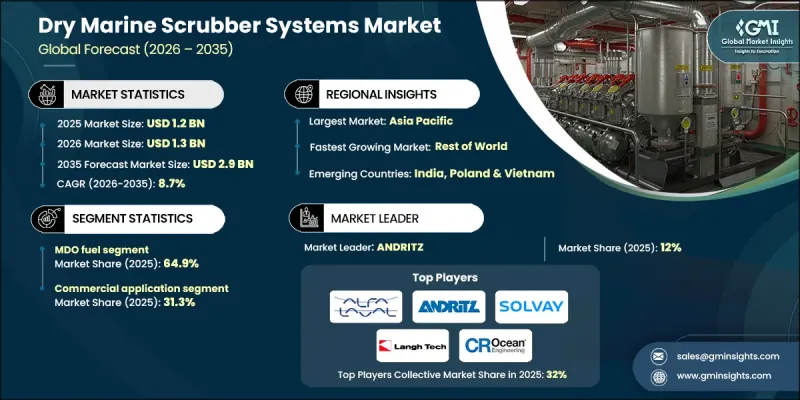
這一成長是由日益嚴格的排放法規推動的,這些法規正在重塑整個航運業的合規策略。船舶營運商正在採用乾式洗滌器系統,以滿足硫氧化物和氮氧化物的排放限制,同時控制營運成本並避免監管處罰。這些系統無需對引擎進行大規模改造即可實現合規,使其成為一種高效且具有商業性可行性的選擇。乾式洗滌器透過在有害廢氣成分排放到大氣之前將其捕獲,在減少空氣污染物方面發揮關鍵作用。它們的使用有助於更清潔的航空營運業,改善港口周圍的空氣質量,並符合日益成長的永續性期望。對技術開發的持續投資正在提高所有船舶類型系統的效率、可靠性和適應性。專注於降低生命週期成本和簡化操作的改進措施正被擴大採用。隨著營運商在履行環境義務和盈利之間尋求平衡,乾式洗滌器系統正成為現代船隊戰略中不可或缺的解決方案。
| 市場覆蓋範圍 | |
|---|---|
| 開始年份 | 2025 |
| 預測年份 | 2026-2035 |
| 起始值 | 12億美元 |
| 預測金額 | 29億美元 |
| 複合年成長率 | 8.7% |
預計到 2025 年,船用柴油市場佔有率將達到 64.9%,到 2035 年將以 8.5% 的複合年成長率成長。日益嚴格的硫排放法規以及燃料與乾式洗滌器技術的兼容性支撐了市場需求,使得企業無需進行重大技術變革即可符合排放標準。
預計到 2035 年,休閒船舶領域將以 8.5% 的複合年成長率成長。推動這一成長的因素是,船東加大了對緊湊型排放氣體控制解決方案的投資,這些解決方案能夠幫助他們在滿足監管標準的同時,保持空間效率和船舶設計。
預計到 2025 年,美國乾式船舶洗滌器系統市場將佔據 71.9% 的市場佔有率,到 2035 年將創造超過 4.7 億美元的收入。強而有力的監管執法和零排放要求正在加速乾式洗滌器的普及,使其成為首選的合規解決方案。
目錄
第1章調查方法和範圍
第2章執行摘要
第3章業界考察
- 產業生態系統
- 原物料供應及採購分析
- 製造能力評估
- 供應鏈韌性與風險因素
- 配電網路分析
- 監管環境
- 產業影響因素
- 促進要素
- 產業潛在風險與挑戰
- 成長潛力分析
- 成本結構分析
- 波特分析
- 供應商的議價能力
- 買方的議價能力
- 新進入者的威脅
- 替代品的威脅
- PESTEL 分析
- 新的機會與趨勢
- 數位化和物聯網整合
- 拓展新興市場
- 投資分析及未來展望
第4章 競爭情勢
- 介紹
- 按地區分類的公司市佔率分析
- 北美洲
- 歐洲
- 亞太地區
- 世界其他地區
- 戰略儀錶板
- 策略舉措
- 企業標竿管理
- 創新與科技趨勢
第5章 依燃料類型分類的市場規模及預測(2022-2035年)
- MDO
- MGO
- 混合
- 其他
第6章 依應用領域分類的市場規模及預測(2022-2035年)
- 商業的
- 離岸
- 休閒
- 海軍
- 其他
第7章 2022-2035年各地區市場規模及預測
- 北美洲
- 美國
- 加拿大
- 歐洲
- 希臘
- 挪威
- 德國
- 英國
- 法國
- 荷蘭
- 義大利
- 亞太地區
- 中國
- 韓國
- 日本
- 越南
- 印度
- 澳洲
- 世界其他地區
第8章 公司簡介
- ANDRITZ
- Aarco Engineering Projects Pvt. Ltd.
- Albion Marine Solutions
- Alfa Laval
- 布倫塔格亞太有限公司
- Clean Marine
- CR Ocean Engineering
- DuPont Clean Technologies
- Ecospray Technologies
- Fuji Electric
- Langh Tech
- ME Production
- Nicro
- SAACKE
- Solvay
- VDL AEC Maritime
- Yara Marine Technologies
The Global Dry Marine Scrubber Systems Market was valued at USD 1.2 billion in 2025 and is estimated to grow at a CAGR of 8.7% to reach USD 2.9 billion by 2035.
Growth is driven by increasingly strict emission regulations that are reshaping compliance strategies across the maritime industry. Ship operators are adopting dry scrubber systems to meet sulfur and nitrogen oxide limits while managing operating costs and avoiding regulatory penalties. These systems enable compliance without extensive engine modifications, making them an efficient and commercially viable option. Dry marine scrubbers play a vital role in lowering atmospheric pollutants by capturing harmful exhaust components before release. Their use supports cleaner maritime operations, improves air quality around ports, and aligns with rising sustainability expectations. Continuous investment in technology development is enhancing system efficiency, reliability, and adaptability across vessel categories. Improvements focused on lowering lifecycle costs and simplifying operations are increasingly adopted. As operators balance environmental obligations with profitability, dry scrubber systems are becoming an essential solution within modern fleet strategies.
| Market Scope | |
|---|---|
| Start Year | 2025 |
| Forecast Year | 2026-2035 |
| Start Value | $1.2 Billion |
| Forecast Value | $2.9 Billion |
| CAGR | 8.7% |
The marine diesel oil segment accounted for 64.9% share in 2025 and is expected to grow at a CAGR of 8.5% through 2035. Demand is supported by tighter sulfur regulations and the fuel's compatibility with dry scrubber technology, allowing compliance without major technical changes.
The recreational vessel segment is projected to grow at a CAGR of 8.5% by 2035. Adoption is rising as owners invest in compact emission control solutions that meet regulatory standards while preserving space efficiency and vessel design.
U.S. Dry Marine Scrubber Systems Market held 71.9% share in 2025 and is expected to generate more than USD 470 million in revenue by 2035. Strong regulatory enforcement and zero-discharge requirements are accelerating adoption, positioning dry scrubbers as a preferred compliance solution.
Key companies operating in the Global Dry Marine Scrubber Systems Market include Alfa Laval, ANDRITZ, Yara Marine Technologies, Ecospray Technologies, DuPont Clean Technologies, Solvay, Fuji Electric, Langh Tech, Clean Marine, SAACKE, VDL AEC Maritime, Nicro, CR Ocean Engineering, ME Production, Brenntag Asia Pacific Pte Ltd, Albion Marine Solutions, and Aarco Engineering Projects Pvt. Ltd. Companies in the Global Dry Marine Scrubber Systems Market are strengthening their positions through technological innovation, strategic partnerships, and global service expansion. Manufacturers are investing in compact, high-efficiency designs that reduce installation complexity and operating costs. Many players are focusing on modular systems to support retrofitting across diverse vessel types. Expanding after-sales services, including maintenance and performance optimization, is helping improve long-term customer retention. Firms are also enhancing compliance support by aligning product offerings with evolving environmental regulations.
Table of Contents
Chapter 1 Methodology & Scope
- 1.1 Research design
- 1.1.1 Research approach
- 1.1.2 Data collection methods
- 1.2 Base estimates and calculations
- 1.2.1 Base year calculation
- 1.2.2 Market estimates & forecast parameters
- 1.3 Forecast
- 1.3.1 Key trends for market estimates
- 1.3.1.1 Quantified market impact analysis
- 1.3.2 Mathematical impact of growth parameters on forecast
- 1.3.3 Scenario analysis framework
- 1.3.1 Key trends for market estimates
- 1.4 Primary research and validation
- 1.4.1 Some of the primary sources (but not limited to)
- 1.5 Data mining sources
- 1.5.1 Paid Sources
- 1.5.2 Sources, by region
- 1.6 Research trail & scoring components
- 1.6.1 Research trail components
- 1.6.2 Scoring components
- 1.7 Research transparency addendum
- 1.7.1 Source attribution framework
- 1.7.2 Quality assurance metrics
- 1.7.3 Our commitment to trust
- 1.8 Market definitions
Chapter 2 Executive Summary
- 2.1 Industry synopsis, 2022 - 2035
- 2.2 Business trends
- 2.3 Fuel trends
- 2.4 Application trends
- 2.5 Regional trends
Chapter 3 Industry Insights
- 3.1 Industry ecosystem
- 3.1.1 Raw material availability & sourcing analysis
- 3.1.2 Manufacturing capacity assessment
- 3.1.3 Supply chain resilience & risk factors
- 3.1.4 Distribution network analysis
- 3.2 Regulatory landscape
- 3.3 Industry impact forces
- 3.3.1 Growth drivers
- 3.3.2 Industry pitfalls & challenges
- 3.4 Growth potential analysis
- 3.5 Cost structure analysis
- 3.6 Porter';s analysis
- 3.6.1 Bargaining power of suppliers
- 3.6.2 Bargaining power of buyers
- 3.6.3 Threat of new entrants
- 3.6.4 Threat of substitutes
- 3.7 PESTEL analysis
- 3.7.1 Political factors
- 3.7.2 Economic factors
- 3.7.3 Social factors
- 3.7.4 Technological factors
- 3.7.5 Legal factors
- 3.7.6 Environmental factors
- 3.8 Emerging opportunities & trends
- 3.8.1 Digitalization & IoT integration
- 3.8.2 Emerging market penetration
- 3.9 Investment analysis and future outlook
Chapter 4 Competitive landscape, 2025
- 4.1 Introduction
- 4.2 Company market share analysis, by region, 2025
- 4.2.1 North America
- 4.2.2 Europe
- 4.2.3 Asia Pacific
- 4.2.4 Rest of World
- 4.3 Strategic dashboard
- 4.4 Strategic initiatives
- 4.5 Company benchmarking
- 4.6 Innovation & technology landscape
Chapter 5 Market Size and Forecast, By Fuel, 2022 - 2035 (USD Million & Units)
- 5.1 Key trends
- 5.2 MDO
- 5.3 MGO
- 5.4 Hybrid
- 5.5 Others
Chapter 6 Market Size and Forecast, By Application, 2022 - 2035 (USD Million & Units)
- 6.1 Key trends
- 6.2 Commercial
- 6.3 Offshore
- 6.4 Recreational
- 6.5 Navy
- 6.6 Others
Chapter 7 Market Size and Forecast, By Region, 2022 - 2035 (USD Million & Units)
- 7.1 Key trends
- 7.2 North America
- 7.2.1 U.S.
- 7.2.2 Canada
- 7.3 Europe
- 7.3.1 Greece
- 7.3.2 Norway
- 7.3.3 Germany
- 7.3.4 UK
- 7.3.5 France
- 7.3.6 Netherlands
- 7.3.7 Italy
- 7.4 Asia Pacific
- 7.4.1 China
- 7.4.2 South Korea
- 7.4.3 Japan
- 7.4.4 Vietnam
- 7.4.5 India
- 7.4.6 Australia
- 7.5 Rest of World
Chapter 8 Company Profiles
- 8.1 ANDRITZ
- 8.2 Aarco Engineering Projects Pvt. Ltd.
- 8.3 Albion Marine Solutions
- 8.4 Alfa Laval
- 8.5 Brenntag Asia Pacific Pte Ltd
- 8.6 Clean Marine
- 8.7 CR Ocean Engineering
- 8.8 DuPont Clean Technologies
- 8.9 Ecospray Technologies
- 8.10 Fuji Electric
- 8.11 Langh Tech
- 8.12 ME Production
- 8.13 Nicro
- 8.14 SAACKE
- 8.15 Solvay
- 8.16 VDL AEC Maritime
- 8.17 Yara Marine Technologies

 2026年全球船舶洗滌器系統市場報告
 船舶洗滌器市場規模、佔有率及成長分析(按技術、應用、安裝方式、最終用戶和地區分類)-2026-2033年產業預測
 船舶洗滌器系統市場規模、佔有率及成長分析(按技術、燃料、應用和地區分類)-產業預測(2026-2033 年)
 按系統配置、船舶類型、安裝類型和洗滌器技術分類的船舶洗滌器系統市場-全球預測,2025年至2032年
 船舶洗滌器系統市場機會、成長動力、產業趨勢分析及 2025 - 2034 年預測
 船用洗滌器市場規模、佔有率、趨勢分析報告:按類型、安裝類型、應用、地區、細分市場預測,2025-2030 年濕式船舶洗滌器系統市場機會、成長動力、產業趨勢分析及 2025 - 2034 年預測商用乾式船用洗滌器系統市場機會、成長促進因素、產業趨勢分析與預測 2024 - 2032 年2024 - 2032 年海上濕式船舶洗滌器系統市場機會、成長動力、產業趨勢分析與預測商用濕式船用洗滌器系統市場機會、成長動力、產業趨勢分析與預測 2024 - 2032 年