


 |
市場調查報告書
商品編碼
1928959
工業鍋爐市場機會、成長要素、產業趨勢分析及預測(2026年至2035年)Industrial Boiler Market Opportunity, Growth Drivers, Industry Trend Analysis, and Forecast 2026 - 2035 |
||||||

全球工業鍋爐市場預計到 2025 年將達到 121 億美元,到 2035 年將達到 207 億美元,年複合成長率為 5.4%。
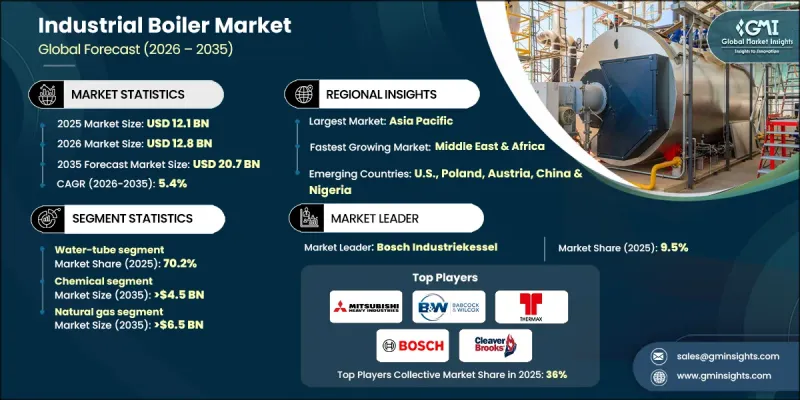
這一成長主要受化工、食品飲料、紙漿造紙和金屬等行業工藝熱需求的不斷成長以及連續工藝流程中不斷提高的產能目標所驅動。各公司正投資於配備數位化燃燒控制和氧氣微調系統的現代化高效能燃氣鍋爐,以提高能源管理和運作可靠性。工業鍋爐是大型封閉容器,用於加熱水以產生蒸氣或熱水,廣泛應用於製造業、發電業和化學工業。以緊湊型水管鍋爐和混合式鍋爐取代老舊的火管鍋爐,並輔以以可靠性為中心的維護(RCM),正在加速市場普及。日益嚴格的硫氧化物(SOx)、氮氧化物(NOx)、顆粒物(PM)和二氧化碳(CO2)排放法規,以及更嚴格的許可要求,正在推動對先進燃燒器、選擇性催化還原(SCR)系統、煙氣再循環(FGR)和高耐灰設計的需求。燃料價格波動和天然氣供應的不確定性正在推動採用多燃料機組和快速燃料切換系統,以最佳化生命週期成本和營運風險。
| 市場覆蓋範圍 | |
|---|---|
| 開始年份 | 2025 |
| 預測年份 | 2026-2035 |
| 起始值 | 121億美元 |
| 預測金額 | 207億美元 |
| 複合年成長率 | 5.4% |
到 2025 年,水管工業鍋爐市佔率佔 70.2%。成長的驅動力是化學、石化和金屬加工行業對高壓蒸氣的需求不斷成長,同時,採用先進的過熱器、節能裝置和自動燃燒控制系統對現有水管系統進行升級改造的趨勢,進一步加速了水管鍋爐的普及。
預計到2035年,食品加工用工業鍋爐市場將以5.5%的複合年成長率成長。加工食品和包裝食品消費量的成長以及日益嚴格的衛生標準是推動這一成長的主要因素。此外,為減少碳排放和實現永續性目標,天然氣和生質鍋爐的日益普及也促進了市場擴張。
預計到2025年,北美工業鍋爐市場將佔據82.4%的市場佔有率,市場規模達18億美元。節能排放技術和數位化監控系統的投資是推動市場成長的主要動力。對永續性的持續關注以及對嚴格排放標準的遵守,正在推動對先進燃燒解決方案和高效運行鍋爐系統的需求。
目錄
第1章調查方法和範圍
資訊來源完整性通訊協定
- 調查過程和信度評分
- 研究路徑的組成部分
- 評分要素
- 數據收集
- 主要資訊的部分列表
- 資料探勘資訊來源
- 付費資訊來源
- 區域資訊來源
- 付費資訊來源
- 基本估計值與計算
- 兩種方法的基準年計算均適用。
- 市場估計和預測參數
- 預測模型
- 量化市場影響分析
- 生長參數對預測值的數學影響
- 量化市場影響分析
- 研究透明度附錄
- 資訊來源歸屬框架
- 品質保證指標
- 對信任的承諾
- 市場定義
第2章執行摘要
第3章業界考察
- 生態系分析
- 原物料供應及採購分析
- 製造能力評估
- 供應鏈韌性與風險因素
- 配電網路分析
- 監管環境
- 產業影響因素
- 促進要素
- 產業潛在風險與挑戰
- 成長潛力分析
- 波特分析
- 供應商的議價能力
- 買方的議價能力
- 新進入者的威脅
- 替代品的威脅
- PESTEL 分析
- 工業鍋爐成本結構分析
- 價格趨勢分析
- 依產品
- 按地區
- 新的機會與趨勢
- 數位化和物聯網整合
- 投資分析及未來展望
第4章 競爭情勢
- 介紹
- 按地區分類的公司市佔率分析
- 北美洲
- 歐洲
- 亞太地區
- 中東和非洲
- 拉丁美洲
- 戰略儀錶板
- Key partnerships &collaborations
- Major M&A activities
- Product innovations &launches
- Market expansion strategies
- 策略舉措
- 競爭標竿分析
- 創新與科技趨勢
第5章 2022-2035年依產品分類的市場規模及預測
- 火管式
- 按產能
- <10 MMBTU/hr
- 10-25 MMBTU/小時
- 25-50 MMBTU/小時
- 50-75 MMBTU/小時
- 75-100 MMBTU/小時
- 100-175 百萬英熱單位/小時
- 175-250 MMBTU/小時
- >250 MMBTU/hr
- 透過使用
- 食品加工
- 紙漿和造紙
- 化學
- 煉油廠
- 初級金屬
- 其他
- 透過技術
- 冷凝式
- 非冷凝式
- 燃料類型:天然氣/石油/煤炭/其他
- 天然氣
- 油
- 煤炭
- 其他
- 按產能
- 水管式
- 按產能
- <10 MMBTU/hr
- 10-25 MMBTU/小時
- 25-50 MMBTU/小時
- 50~75 MMBTU/hr
- 75-100 MMBTU/小時
- 100-175 MMBTU/小時
- 175-250 MMBTU/小時
- >250 MMBTU/hr
- 透過使用
- 食品加工
- 紙漿和造紙
- 化學
- 煉油廠
- 初級金屬
- 其他
- 透過技術
- 冷凝式
- 非冷凝式
- 燃料類型:天然氣/石油/煤炭/其他
- 天然氣
- 油
- 煤炭
- 其他
- 按產能
第6章 依產能分類的市場規模及預測(2022-2035年)
- 低於 10 MMBTU/小時
- 1000萬至2500萬英熱單位/小時
- 2500萬至5000萬英熱單位/小時
- 5000萬至7500萬英熱單位/小時
- 7500萬至1億英熱單位/小時
- 1億至1.75億英熱單位/小時
- 1.75億至2.5億英熱單位/小時
- 超過2.5億英熱單位/小時
第7章 依應用領域分類的市場規模及預測(2022-2035年)
- 食品加工
- 紙漿和造紙
- 化學
- 煉油廠
- 初級金屬
- 其他
第8章 依技術分類的市場規模及預測(2022-2035年)
- 冷凝式
- 非冷凝式
第9章 依燃料類型分類的市場規模及預測(2022-2035年)
- 天然氣
- 油
- 煤炭
- 其他
第10章 2022-2035年各地區市場規模及預測
- 北美洲
- 美國
- 加拿大
- 墨西哥
- 歐洲
- 法國
- 英國
- 波蘭
- 義大利
- 西班牙
- 奧地利
- 德國
- 瑞典
- 俄羅斯
- 亞太地區
- 中國
- 印度
- 菲律賓
- 日本
- 韓國
- 澳洲
- 印尼
- 中東和非洲
- 沙烏地阿拉伯
- 伊朗
- 阿拉伯聯合大公國
- 奈及利亞
- 南非
- 拉丁美洲
- 巴西
- 阿根廷
- 智利
第11章:公司簡介
- Babcock &Wilcox Enterprises
- Bharat Heavy Electricals
- Bosch Industriekessel
- California Boiler
- Clayton Industries
- Cleaver-Brooks
- Cochran
- Doosan Enerbility
- FERROLI
- Fonderie Sime
- FONDITAL
- Forbes Marshall
- Fulton
- Groupe Atlantic
- HME Boilers
- Hoval
- Hurst Boiler &Welding
- John Cockerill
- John Wood Group
- Mitsubishi Heavy Industries
- Miura America
- Rentech Boiler Systems
- Sofinter
- Thermax
- Thermodyne Engineering Systems
- Victory Energy Operations
- Viessmann Climate Solutions
- Walchandnagar Industries
The Global Industrial Boiler Market was valued at USD 12.1 billion in 2025 and is estimated to grow at a CAGR of 5.4% to reach USD 20.7 billion by 2035.
Growth is fueled by rising demand for process heat across industries such as chemicals, food & beverage, pulp & paper, and metals, along with increasing throughput targets in continuous-process operations. Companies are investing in modern, high-efficiency fired boilers with digitized combustion control and O2 trim systems, which are enhancing energy management and operational reliability. Industrial boilers are large, enclosed vessels designed to produce steam or hot water by applying heat to water, commonly used for manufacturing, power generation, and chemical processing. Replacing aging fire-tube units with compact water-tube and hybrid designs, supported by reliability-centered maintenance, is accelerating market adoption. Stricter emissions regulations for SOx, NOx, PM, and CO2, coupled with permitting scrutiny, are driving demand for advanced burners, selective catalytic reduction systems, flue-gas recirculation, and high-ash-tolerant designs. Volatile fuel prices and gas supply uncertainty are encouraging the adoption of multi-fuel capable units and rapid fuel-switching systems to optimize lifecycle cost and operational risk.
| Market Scope | |
|---|---|
| Start Year | 2025 |
| Forecast Year | 2026-2035 |
| Start Value | $12.1 Billion |
| Forecast Value | $20.7 Billion |
| CAGR | 5.4% |
The water-tube industrial boiler segment accounted for 70.2% share in 2025. Rising demand for high-pressure steam in chemical, petrochemical, and metal processing industries is propelling growth, while upgrading existing water-tube systems with advanced superheaters, economizers, and automated combustion controls is further accelerating adoption.
The food processing industrial boiler market is expected to grow at a CAGR of 5.5% by 2035. Growth is driven by increasing consumption of processed and packaged foods alongside strict hygiene standards. The rising adoption of natural gas and biomass-fired boilers, aimed at reducing carbon footprints and meeting sustainability objectives, is also supporting market expansion.
North America Industrial Boiler Market held an 82.4% share in 2025, generating USD 1.8 billion. Growth is driven by investments in energy-efficient, low-emission technologies and digital monitoring systems. Ongoing emphasis on sustainability and adherence to stringent emission standards is reinforcing demand for advanced combustion solutions and operationally efficient boiler systems.
Leading companies operating in the Global Industrial Boiler Market include Bosch Industriekessel, Viessmann Climate Solutions, Babcock & Wilcox Enterprises, California Boiler, Clayton Industries, Doosan Enerbility, Cleaver-Brooks, Hoval, Miura America, Walchandnagar Industries, John Cockerill, Bharat Heavy Electricals, Thermodyne Engineering Systems, FONDITAL, Rentech Boiler Systems, John Wood Group, Sofinter, Hurst Boiler & Welding, FERROLI, Fonderie Sime, Fulton, Groupe Atlantic, HME Boilers, Thermmax, Cochran, and Victory Energy Operations. Companies in the Global Industrial Boiler Market are employing multiple strategies to strengthen their foothold and expand market presence. They are investing heavily in research and development to enhance energy efficiency, emissions control, and digital integration. Strategic partnerships with industrial users, EPC contractors, and energy service companies help expand customer access. Firms are introducing multi-fuel, hybrid, and compact boiler designs to meet evolving regulatory requirements and operational challenges. Geographic expansion into emerging regions with high industrial growth potential is a key focus.
Table of Contents
Chapter 1 Methodology & Scope
- 1.1 Research approach
- 1.2 Quality commitments
- 1.2.1 GMI AI policy & data integrity commitment
Source consistency protocol
- 1.3 Research trail & confidence scoring
- 1.3.1 Research trail components
- 1.3.2 Scoring components
- 1.4 Data collection
- 1.4.1 Partial list of primary sources
- 1.5 Data mining sources
- 1.5.1 Paid sources
- 1.5.1.1 Sources, by region
- 1.5.1 Paid sources
- 1.6 Base estimates and calculations
- 1.6.1 Base year calculation for any one approach
- 1.7 Market estimates & forecasts parameters
- 1.8 Forecast model
- 1.8.1 Quantified market impact analysis
- 1.8.1.1 Mathematical impact of growth parameters on forecast
- 1.8.1 Quantified market impact analysis
- 1.9 Research transparency addendum
- 1.9.1 Source attribution framework
- 1.9.2 Quality assurance metrics
- 1.9.3 Our commitment to trust
- 1.10 Market definitions
Chapter 2 Executive Summary
- 2.1 Industry synopsis, 2022 - 2035
- 2.2 Business trends
- 2.3 Product trends
- 2.4 Capacity trends
- 2.5 Application trends
- 2.6 Technology trends
- 2.7 Fuel trends
- 2.8 Regional trends
Chapter 3 Industry Insights
- 3.1 Industry ecosystem analysis
- 3.1.1 Raw material availability & sourcing analysis
- 3.1.2 Manufacturing capacity assessment
- 3.1.3 Supply chain resilience & risk factors
- 3.1.4 Distribution network analysis
- 3.2 Regulatory landscape
- 3.3 Industry impact forces
- 3.3.1 Growth drivers
- 3.3.2 Industry pitfalls & challenges
- 3.4 Growth potential analysis
- 3.5 Porter';s analysis
- 3.5.1 Bargaining power of suppliers
- 3.5.2 Bargaining power of buyers
- 3.5.3 Threat of new entrants
- 3.5.4 Threat of substitutes
- 3.6 PESTEL analysis
- 3.6.1 Political factors
- 3.6.2 Economic factors
- 3.6.3 Social factors
- 3.6.4 Technological factors
- 3.6.5 Legal factors
- 3.6.6 Environmental factors
- 3.7 Cost structure analysis of industrial boiler
- 3.8 Price trend analysis
- 3.8.1 By product
- 3.8.2 By region
- 3.9 Emerging opportunities & trends
- 3.10 Digitalization and IoT integration
- 3.11 Investment analysis & future outlook
Chapter 4 Competitive Landscape, 2025
- 4.1 Introduction
- 4.2 Company market share analysis, by region, 2025
- 4.2.1 North America
- 4.2.2 Europe
- 4.2.3 Asia Pacific
- 4.2.4 Middle East & Africa
- 4.2.5 Latin America
- 4.3 Strategic dashboard
- 4.3.1 Key partnerships & collaborations
- 4.3.2 Major M&A activities
- 4.3.3 Product innovations & launches
- 4.3.4 Market expansion strategies
- 4.4 Strategic initiatives
- 4.5 Competitive benchmarking
- 4.6 Innovation & technology landscape
Chapter 5 Market Size and Forecast, By Product, 2022 - 2035 (USD Million, MMBTU/hr & Units)
- 5.1 Key trends
- 5.2 Fire-tube
- 5.2.1 By capacity
- 5.2.1.1 < 10 MMBTU/hr
- 5.2.1.2 10 - 25 MMBTU/hr
- 5.2.1.3 25 - 50 MMBTU/hr
- 5.2.1.4 50 - 75 MMBTU/hr
- 5.2.1.5 75 - 100 MMBTU/hr
- 5.2.1.6 100 - 175 MMBTU/hr
- 5.2.1.7 175 - 250 MMBTU/hr
- 5.2.1.8 > 250 MMBTU/hr
- 5.2.2 By application
- 5.2.2.1 Food processing
- 5.2.2.2 Pulp & paper
- 5.2.2.3 Chemical
- 5.2.2.4 Refinery
- 5.2.2.5 Primary metal
- 5.2.2.6 Others
- 5.2.3 By technology
- 5.2.3.1 Condensing
- 5.2.3.2 Non-condensing
- 5.2.4 By fuel
- 5.2.4.1 Natural gas
- 5.2.4.2 Oil
- 5.2.4.3 Coal
- 5.2.4.4 Others
- 5.2.1 By capacity
- 5.3 Water-tube
- 5.3.1 By capacity
- 5.3.1.1 < 10 MMBTU/hr
- 5.3.1.2 10 - 25 MMBTU/hr
- 5.3.1.3 25 - 50 MMBTU/hr
- 5.3.1.4 50 - 75 MMBTU/hr
- 5.3.1.5 75 - 100 MMBTU/hr
- 5.3.1.6 100 - 175 MMBTU/hr
- 5.3.1.7 175 - 250 MMBTU/hr
- 5.3.1.8 > 250 MMBTU/hr
- 5.3.2 By application
- 5.3.2.1 Food processing
- 5.3.2.2 Pulp & paper
- 5.3.2.3 Chemical
- 5.3.2.4 Refinery
- 5.3.2.5 Primary metal
- 5.3.2.6 Others
- 5.3.3 By technology
- 5.3.3.1 Condensing
- 5.3.3.2 Non-condensing
- 5.3.4 By fuel
- 5.3.4.1 Natural gas
- 5.3.4.2 Oil
- 5.3.4.3 Coal
- 5.3.4.4 Others
- 5.3.1 By capacity
Chapter 6 Market Size and Forecast, By Capacity, 2022 - 2035 (USD Million, MMBTU/hr & Units)
- 6.1 Key trends
- 6.2 < 10 MMBTU/hr
- 6.3 10 - 25 MMBTU/hr
- 6.4 25 - 50 MMBTU/hr
- 6.5 50 - 75 MMBTU/hr
- 6.6 75 - 100 MMBTU/hr
- 6.7 100 - 175 MMBTU/hr
- 6.8 175 - 250 MMBTU/hr
- 6.9 > 250 MMBTU/hr
Chapter 7 Market Size and Forecast, By Application, 2022 - 2035 (USD Million, MMBTU/hr & Units)
- 7.1 Key trends
- 7.2 Food processing
- 7.3 Pulp & paper
- 7.4 Chemical
- 7.5 Refinery
- 7.6 Primary metal
- 7.7 Others
Chapter 8 Market Size and Forecast, By Technology, 2022 - 2035 (USD Million, MMBTU/hr & Units)
- 8.1 Key trends
- 8.2 Condensing
- 8.3 Non-condensing
Chapter 9 Market Size and Forecast, By Fuel, 2022 - 2035 (USD Million, MMBTU/hr & Units)
- 9.1 Key trends
- 9.2 Natural gas
- 9.3 Oil
- 9.4 Coal
- 9.5 Others
Chapter 10 Market Size and Forecast, By Region, 2022 - 2035 (USD Million, MMBTU/hr & Units)
- 10.1 Key trends
- 10.2 North America
- 10.2.1 U.S.
- 10.2.2 Canada
- 10.2.3 Mexico
- 10.3 Europe
- 10.3.1 France
- 10.3.2 UK
- 10.3.3 Poland
- 10.3.4 Italy
- 10.3.5 Spain
- 10.3.6 Austria
- 10.3.7 Germany
- 10.3.8 Sweden
- 10.3.9 Russia
- 10.4 Asia Pacific
- 10.4.1 China
- 10.4.2 India
- 10.4.3 Philippines
- 10.4.4 Japan
- 10.4.5 South Korea
- 10.4.6 Australia
- 10.4.7 Indonesia
- 10.5 Middle East & Africa
- 10.5.1 Saudi Arabia
- 10.5.2 Iran
- 10.5.3 UAE
- 10.5.4 Nigeria
- 10.5.5 South Africa
- 10.6 Latin America
- 10.6.1 Brazil
- 10.6.2 Argentina
- 10.6.3 Chile
Chapter 11 Company Profiles
- 11.1 Babcock & Wilcox Enterprises
- 11.2 Bharat Heavy Electricals
- 11.3 Bosch Industriekessel
- 11.4 California Boiler
- 11.5 Clayton Industries
- 11.6 Cleaver-Brooks
- 11.7 Cochran
- 11.8 Doosan Enerbility
- 11.9 FERROLI
- 11.10 Fonderie Sime
- 11.11 FONDITAL
- 11.12 Forbes Marshall
- 11.13 Fulton
- 11.14 Groupe Atlantic
- 11.15 HME Boilers
- 11.16 Hoval
- 11.17 Hurst Boiler & Welding
- 11.18 John Cockerill
- 11.19 John Wood Group
- 11.20 Mitsubishi Heavy Industries
- 11.21 Miura America
- 11.22 Rentech Boiler Systems
- 11.23 Sofinter
- 11.24 Thermax
- 11.25 Thermodyne Engineering Systems
- 11.26 Victory Energy Operations
- 11.27 Viessmann Climate Solutions
- 11.28 Walchandnagar Industries

 工業鍋爐市場-2026-2032年全球市場預測
 工業鍋爐市場規模、佔有率和成長分析:按鍋爐類型、燃料類型、容量、壓力、技術、最終用途產業和地區分類-2026-2033年產業預測
 2026-2030年全球工業鍋爐市場
 2026年全球瓦斯-水管工業鍋爐市場報告
 工業鍋爐市場 - 全球產業規模、佔有率、趨勢、機會、預測:按類型、功能、燃料類型、最終用戶、地區和競爭格局分類,2021-2031年
 全球燃氣-水-管式工業鍋爐市場規模、佔有率、趨勢和成長分析報告:2026-2034年
 日本工業鍋爐市場規模、佔有率、趨勢和預測:按燃料、應用和地區分類,2026-2034年2026年全球工業鍋爐市場報告2026年全球水管工業鍋爐市場報告自動給水鍋爐市場按類型、加熱技術、容量、材料、最終用途和分銷管道分類,全球預測(2026-2032年)