

 |
市場調查報告書
商品編碼
1928939
液體洗手劑市場機會、成長要素、產業趨勢分析及2026年至2035年預測Liquid Hand Soap Market Opportunity, Growth Drivers, Industry Trend Analysis, and Forecast 2026 - 2035 |
||||||

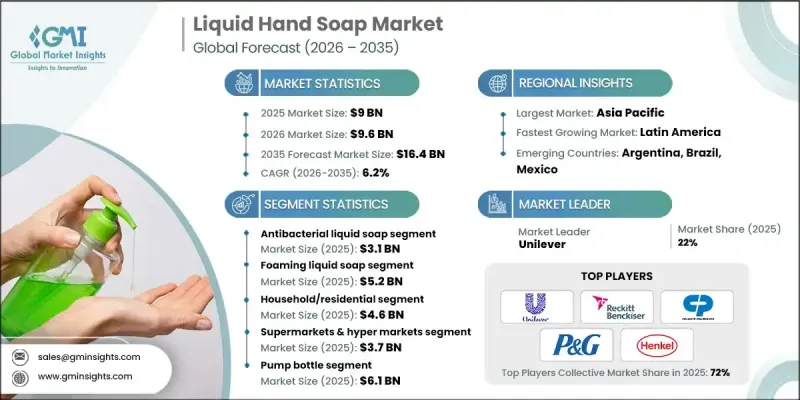
全球液體洗手劑市場預計到 2025 年價值 90 億美元,到 2035 年將達到 164 億美元,年複合成長率為 6.2%。
市場擴張主要受個人衛生意識提升的推動,尤其是在新冠疫情爆發後,勤洗手已成為家庭和機構的日常習慣。衛生標準的強化監管和持續進行的公共衛生宣傳活動鞏固了洗手劑液作為全球必備衛生用品的地位。消費者偏好正轉向天然、植物和環保配方,許多新產品都採用有機和植物成分。各公司正加速研發使用蘆薈、草本萃取物和精油的產品,以吸引注重健康和環保的消費者。新興國家可支配收入的成長進一步推動了對具有卓越護膚功效、怡人香氛和環保包裝的高階洗手劑的需求。高階趨勢、永續配方以及家用和商用領域的科技創新,都推動著市場持續發展。
| 市場覆蓋範圍 | |
|---|---|
| 開始年份 | 2025 |
| 預測年份 | 2026-2035 |
| 起始值 | 90億美元 |
| 預測金額 | 164億美元 |
| 複合年成長率 | 6.2% |
預計2025年,抗菌液體肥皂市場規模將達31億美元。其主導地位主要得益於家庭、醫療保健和商業環境中對殺菌防護的強勁需求。監管合規性、頻繁使用和品牌忠誠度也為其強大的市場地位做出了貢獻。
預計到2025年,泡沫液體肥皂市場規模將達到52億美元,成為以配方分類的最大細分市場。其受歡迎程度主要得益於便捷的按壓式包裝、可控的用量、良好的衛生印像以及經濟實惠的價格。醫療保健、商業和酒店業的廣泛應用進一步鞏固了其穩定的需求和高階市場定位。
預計到2025年,北美液體洗手劑市場規模將達到25億美元,佔全球市場佔有率的28%。美國憑藉其大規模的消費群以及醫療機構、辦公室、學校和餐飲服務業等機構的強勁需求,引領著該地區市場。消費者對液體和泡沫洗手液的需求逐漸超過固態洗手液,抗菌和低致敏產品的普及也推動了市場的快速成長。此外,消費者對經皮膚科醫生測試、無香精和植物來源產品的需求不斷成長,進一步推動了美國和加拿大市場的優質化趨勢。
目錄
第1章調查方法和範圍
第2章執行摘要
第3章業界考察
- 生態系分析
- 供應商情況
- 利潤率
- 每個階段的附加價值
- 影響價值鏈的因素
- 中斷
- 產業影響因素
- 促進要素
- 新冠感染疾病後,人們對衛生的意識有所提升。
- 對有機和天然個人保健產品的需求不斷成長
- 可支配所得增加和高級產品消費成長
- 產業潛在風險與挑戰
- 抗菌效果和皮膚安全性
- 實現有機和天然配方的成本效益
- 市場機遇
- 開發環境永續配方
- 可重複填充和零浪費包裝的創新
- 促進要素
- 成長潛力分析
- 監管環境
- 北美洲
- 歐洲
- 亞太地區
- 拉丁美洲
- 中東和非洲
- 波特分析
- PESTEL 分析
- 價格趨勢
- 按地區
- 產品類型
- 未來市場趨勢
- 科技與創新趨勢
- 當前技術趨勢
- 新興技術
- 專利狀態
- 貿易統計(HS編碼)(註:僅提供主要國家的貿易統計)
- 主要進口國
- 主要出口國
- 永續性和環境方面
- 永續努力
- 減少廢棄物策略
- 生產中的能源效率
- 環保舉措
- 碳足跡考量
第4章 競爭情勢
- 介紹
- 公司市佔率分析
- 按地區
- 北美洲
- 歐洲
- 亞太地區
- 拉丁美洲
- 中東和非洲
- 按地區
- 企業矩陣分析
- 主要市場公司的競爭分析
- 競爭定位矩陣
- 重大進展
- 併購
- 夥伴關係與合作
- 新產品發布
- 擴張計劃
第5章 依產品類型分類的市場估算與預測,2022-2035年
- 抗菌液體肥皂
- 含有保濕滋養成分的液體肥皂
- 無香型液體肥皂,適合敏感肌膚
- 有機/草本液體肥皂
- 其他
第6章 依配方分類的市場估計與預測,2022-2035年
- 泡沫液體肥皂
- 普通液體肥皂(非泡沫型)
7. 依最終用途分類的市場估計與預測,2022-2035 年
- 家庭/住宅
- 商業和公共設施
- 飯店及餐飲業
- 醫療設施
- 辦公室/企業空間
- 教育機構
- 工業/製造業
第8章 按分銷管道分類的市場估算與預測,2022-2035年
- 超級市場和大賣場
- 便利商店
- 藥房和藥品商店
- 電子商務/線上零售
- 專賣店
第9章 按包裝類型分類的市場估算與預測,2022-2035年
- 泵浦瓶
- 填充用裝
- 旅行尺寸/便攜尺寸
- 自動分配器
第10章 2022-2035年各地區市場估計與預測
- 北美洲
- 美國
- 加拿大
- 歐洲
- 德國
- 英國
- 法國
- 西班牙
- 義大利
- 其他歐洲地區
- 亞太地區
- 中國
- 印度
- 日本
- 澳洲
- 韓國
- 亞太其他地區
- 拉丁美洲
- 巴西
- 墨西哥
- 阿根廷
- 其他拉丁美洲地區
- 中東和非洲
- 沙烏地阿拉伯
- 南非
- 阿拉伯聯合大公國
- 其他中東和非洲地區
第11章 公司簡介
- Henkel Corporation
- Sigma Industries
- ANUSPA HERITAGE PRODUCTS PVT LTD
- Vanguard Soap
- Vermont Soap
- Colgate-Palmolive
- Procter &Gamble
- Unilever
- 3M
- Reckitt Benckiser
- Johnson &Johnson
- Medline Industries
- Wipro Consumer Care &Lighting, ITC Ltd
- Gojo Industries
- JR Watkins &Co
The Global Liquid Hand Soap Market was valued at USD 9 billion in 2025 and is estimated to grow at a CAGR of 6.2% to reach USD 16.4 billion by 2035.
The market expansion is driven by heightened hygiene awareness, particularly following the COVID-19 pandemic, which has reinforced frequent handwashing as a daily habit across households and institutions. Regulatory emphasis on sanitation standards and ongoing public health campaigns have strengthened liquid hand soap's position as an essential hygiene product worldwide. Consumer preferences are shifting toward natural, plant-based, and eco-friendly formulations, with a significant portion of new product launches featuring organic or botanical ingredients. Companies are increasingly innovating with aloe vera, herbal extracts, and essential oils to appeal to health-conscious and environmentally aware consumers. Rising disposable incomes in emerging economies are further driving demand for premium liquid hand soaps that offer enhanced skincare benefits, appealing fragrances, and environmentally responsible packaging. The market continues to evolve with premiumization trends, sustainable formulations, and innovation in both household and institutional segments.
| Market Scope | |
|---|---|
| Start Year | 2025 |
| Forecast Year | 2026-2035 |
| Start Value | $9 Billion |
| Forecast Value | $16.4 Billion |
| CAGR | 6.2% |
The antibacterial liquid soap segment reached USD 3.1 billion in 2025. Its leadership is supported by high demand for germ protection in households, medical, and commercial settings. Regulatory compliance, frequent use, and brand loyalty sustain its strong market presence.
The foaming liquid soap segment accounted for USD 5.2 billion in 2025, making it the largest segment in terms of formulation. Its popularity is driven by convenient dispensing, controlled usage, hygiene perception, and cost efficiency. High adoption across healthcare, commercial, and hospitality sectors reinforces consistent demand and premium positioning.
North America Liquid Hand Soap Market contributed USD 2.5 billion in 2025, representing 28% share. The United States dominates the regional market due to a large consumer base and a robust institutional presence in healthcare, offices, schools, and foodservice establishments. The adoption of liquid and foaming soaps over bar formulations, along with antibacterial and skin-sensitive variants, supports rapid growth. Rising demand for dermatologist-tested, fragrance-free, and plant-based products further drives premiumization trends in the U.S. and Canada.
Major players in the Global Liquid Hand Soap Market include Henkel Corporation, Colgate-Palmolive, Unilever, Johnson & Johnson, 3M, Procter & Gamble, Medline Industries, Sigma Industries, Gojo Industries, JR Watkins & Co, ANUSPA Heritage Products Pvt Ltd, Wipro Consumer Care & Lighting, ITC Ltd, Vermont Soap, and Vanguard Soap. Companies in the Global Liquid Hand Soap Market are strengthening their positions through product innovation, focusing on natural, organic, and eco-friendly formulations to meet evolving consumer preferences. Strategic partnerships, mergers, and acquisitions allow firms to expand their geographic reach and broaden product portfolios. Premiumization strategies, including the introduction of fragrance-free, dermatologist-tested, and plant-based options, enhance brand positioning. Firms are also investing in sustainable packaging, marketing campaigns emphasizing hygiene and wellness, and tailored institutional solutions to capture B2B demand.
Table of Contents
Chapter 1 Methodology & Scope
- 1.1 Market scope and definition
- 1.2 Research design
- 1.2.1 Research approach
- 1.2.2 Data collection methods
- 1.3 Data mining sources
- 1.3.1 Global
- 1.3.2 Regional/Country
- 1.4 Base estimates and calculations
- 1.4.1 Base year calculation
- 1.4.2 Key trends for market estimation
- 1.5 Primary research and validation
- 1.5.1 Primary sources
- 1.6 Forecast model
- 1.7 Research assumptions and limitations
Chapter 2 Executive Summary
- 2.1 Industry 360° synopsis
- 2.2 Key market trends
- 2.2.1 Regional
- 2.2.2 Product type
- 2.2.3 Formulation
- 2.2.4 End Use
- 2.2.5 Distribution channel
- 2.2.6 Packaging
- 2.3 TAM Analysis, 2026-2035
- 2.4 CXO perspectives: Strategic imperatives
- 2.4.1 Executive decision points
- 2.4.2 Critical success factors
- 2.5 Future Outlook and Strategic Recommendations
Chapter 3 Industry Insights
- 3.1 Industry ecosystem analysis
- 3.1.1 Supplier Landscape
- 3.1.2 Profit Margin
- 3.1.3 Value addition at each stage
- 3.1.4 Factor affecting the value chain
- 3.1.5 Disruptions
- 3.2 Industry impact forces
- 3.2.1 Growth drivers
- 3.2.1.1 Heightened hygiene awareness post-covid-19 pandemic
- 3.2.1.2 Growing demand for organic & natural personal care products
- 3.2.1.3 Rising disposable income & premium product adoption
- 3.2.2 Industry pitfalls and challenges
- 3.2.2.1 Balancing antimicrobial efficacy with skin safety
- 3.2.2.2 Achieving cost-effectiveness in organic/natural formulations
- 3.2.3 Market opportunities
- 3.2.3.1 Development of eco-friendly & sustainable formulations
- 3.2.3.2 Innovation in refillable & zero-waste packaging
- 3.2.1 Growth drivers
- 3.3 Growth potential analysis
- 3.4 Regulatory landscape
- 3.4.1 North America
- 3.4.2 Europe
- 3.4.3 Asia Pacific
- 3.4.4 Latin America
- 3.4.5 Middle East & Africa
- 3.5 Porter';s analysis
- 3.6 PESTEL analysis
- 3.7 Price trends
- 3.7.1 By region
- 3.7.2 Product type
- 3.8 Future market trends
- 3.9 Technology and Innovation Landscape
- 3.9.1 Current technological trends
- 3.9.2 Emerging technologies
- 3.10 Patent Landscape
- 3.11 Trade statistics (HS code) (Note: the trade statistics will be provided for key countries only)
- 3.11.1 Major importing countries
- 3.11.2 Major exporting countries
- 3.12 Sustainability and environmental aspects
- 3.12.1 Sustainable practices
- 3.12.2 Waste reduction strategies
- 3.12.3 Energy efficiency in production
- 3.12.4 Eco-friendly initiatives
- 3.13 Carbon footprint considerations
Chapter 4 Competitive Landscape, 2025
- 4.1 Introduction
- 4.2 Company market share analysis
- 4.2.1 By region
- 4.2.1.1 North America
- 4.2.1.2 Europe
- 4.2.1.3 Asia Pacific
- 4.2.1.4 LATAM
- 4.2.1.5 MEA
- 4.2.1 By region
- 4.3 Company matrix analysis
- 4.4 Competitive analysis of major market players
- 4.5 Competitive positioning matrix
- 4.6 Key developments
- 4.6.1 Mergers & acquisitions
- 4.6.2 Partnerships & collaborations
- 4.6.3 New product launches
- 4.6.4 Expansion plans
Chapter 5 Market Estimates and Forecast, By Product Type, 2022 - 2035 (USD Million) (Kilo Ton)
- 5.1 Key trends
- 5.2 Antibacterial liquid soap
- 5.3 Moisturizing/nourishing liquid soap
- 5.4 Fragrance-free/sensitive skin liquid soap
- 5.5 Organic/herbal liquid soap
- 5.6 Others
Chapter 6 Market Estimates and Forecast, By Formulation, 2022 - 2035 (USD Million) (Kilo Ton)
- 6.1 Key trends
- 6.2 Foaming liquid soap
- 6.3 Regular liquid soap (non-foaming)
Chapter 7 Market Estimates and Forecast, By End Use, 2022 - 2035 (USD Million) (Kilo Ton)
- 7.1 Key trends
- 7.2 Household/residential
- 7.3 Commercial/institutional
- 7.3.1 Hotels & hospitality
- 7.3.2 Healthcare facilities
- 7.3.3 Offices & corporate spaces
- 7.3.4 Educational institutions
- 7.4 Industrial/manufacturing
Chapter 8 Market Estimates and Forecast, By Distribution Channel, 2022 - 2035 (USD Million) (Kilo Ton)
- 8.1 Key trends
- 8.2 Supermarkets & hypermarkets
- 8.3 Convenience stores
- 8.4 Pharmacies & drug stores
- 8.5 E-commerce/online retail
- 8.6 Specialty stores
Chapter 9 Market Estimates and Forecast, By Packaging, 2022 - 2035 (USD Million) (Kilo Ton)
- 9.1 Key trends
- 9.2 Pump bottle
- 9.3 Refill pouch
- 9.4 Travel/portable size
- 9.5 Automatic dispenser
Chapter 10 Market Estimates and Forecast, By Region, 2022 - 2035 (USD Million) (Kilo Ton)
- 10.1 Key trends
- 10.2 North America
- 10.2.1 U.S.
- 10.2.2 Canada
- 10.3 Europe
- 10.3.1 Germany
- 10.3.2 UK
- 10.3.3 France
- 10.3.4 Spain
- 10.3.5 Italy
- 10.3.6 Rest of Europe
- 10.4 Asia Pacific
- 10.4.1 China
- 10.4.2 India
- 10.4.3 Japan
- 10.4.4 Australia
- 10.4.5 South Korea
- 10.4.6 Rest of Asia Pacific
- 10.5 Latin America
- 10.5.1 Brazil
- 10.5.2 Mexico
- 10.5.3 Argentina
- 10.5.3 Rest of Latin America
- 10.6 Middle East and Africa
- 10.6.1 Saudi Arabia
- 10.6.2 South Africa
- 10.6.3 UAE
- 10.6.4 Rest of Middle East and Africa
Chapter 11 Company Profiles
- 11.1 Henkel Corporation
- 11.2 Sigma Industries
- 11.3 ANUSPA HERITAGE PRODUCTS PVT LTD
- 11.4 Vanguard Soap
- 11.5 Vermont Soap
- 11.6 Colgate-Palmolive
- 11.7 Procter & Gamble
- 11.8 Unilever
- 11.9 3M
- 11.10 Reckitt Benckiser
- 11.11 Johnson & Johnson
- 11.12 Medline Industries
- 11.13 Wipro Consumer Care & Lighting, ITC Ltd
- 11.14 Gojo Industries
- 11.15 JR Watkins & Co

 全球抗菌產品市場規模、佔有率、趨勢和成長分析報告(2026-2034年)
 2026-2030年全球液體洗手劑市場
 液體洗手劑市場 - 全球產業規模、佔有率、趨勢、機會、預測:按性質、包裝類型、銷售管道、地區和競爭格局分類,2021-2031年抗菌產品市場-全球產業規模、佔有率、趨勢、機會及預測(依產品、銷售管道、地區及競爭格局分類,2021-2031年)抗菌皂市場-全球產業規模、佔有率、趨勢、機會及預測(按類型、通路、地區及競爭格局分類,2021-2031年)
 全球液體洗手劑市場全球抗菌產品市場
 液體洗手劑市場規模、佔有率及成長分析(按產品類型、包裝類型、應用、分銷管道和地區)-2025-2032 年產業預測