

 |
市場調查報告書
商品編碼
1928932
個人護理電器市場機會、成長要素、產業趨勢分析及2026年至2035年預測Personal Care Appliances Market Opportunity, Growth Drivers, Industry Trend Analysis, and Forecast 2026 - 2035 |
||||||

全球個人護理電器市場預計到 2025 年將達到 249 億美元,到 2035 年將達到 438 億美元,年複合成長率為 5.9%。
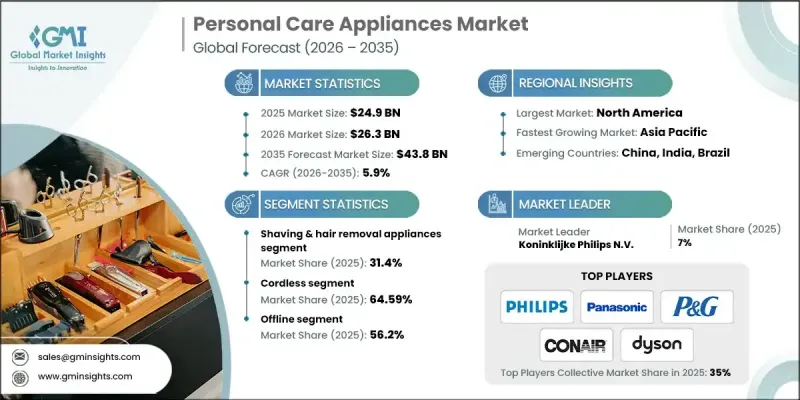
這一成長主要得益於人們健康意識的提升和對營運效率的日益重視,從而刺激了對先進的個人護理和自我護理設備的需求。主要企業間的併購整合加速了創新,拓展了產品線,並增強了市場影響。傳統的手動個人護理工具,例如刮鬍刀和手動刷子,越來越被認為效率低且不符合人體工學,這使得高科技產品更具吸引力。現代個人護理系統中使用的節能馬達、長壽命鋰離子電池和永續材料減少了對環境的影響,並引起了尋求環保替代方案的消費者的共鳴。此外,電子商務的日益普及、中產階級消費群體的不斷壯大以及北美、歐洲和亞太地區消費者對智慧互聯設備的偏好日益增強,也為這一成長提供了支持,這些地區的商業性可行性也在不斷提高。
| 市場覆蓋範圍 | |
|---|---|
| 開始年份 | 2025 |
| 預測年份 | 2026-2035 |
| 起始值 | 249億美元 |
| 預測金額 | 438億美元 |
| 複合年成長率 | 5.9% |
預計到2025年,剃鬍和除毛設備市佔率將達到31.4%。這一細分市場受益於人們對精準修容日益成長的興趣以及男性體毛管理的日益普及。這些設備因其日常個人使用需求而備受青睞,反映出消費者對高性能、高可靠性且能在家中提供專業級效果的系統的強勁需求。
預計到2025年,無線家電市場將佔據64.59%的市場佔有率,並創造161億美元的市場規模。其受歡迎程度主要歸功於其帶來的移動性、便利性和生產力的提升。鋰離子電池和無線充電技術的融合進一步增強了產品的易用性和可靠性。消費者越來越傾向於在旅行和外出時使用無線家電,凸顯了消費者對攜帶式智慧型裝置的偏好轉變,這類設備能夠最大限度地減少雜亂,提高效率。
預計到2025年,北美個人護理電器市場規模將達到91億美元,到2035年將以6.7%的複合年成長率持續成長。美國憑藉其成熟的市場、對高階個人護理產品的強勁需求以及對智慧家居技術的投資,正引領區域市場的成長。具備物聯網功能的個人護理設備,憑藉其個人化的追蹤功能和專業級的護理效果,正逐漸成為現代家庭的標配,並推動著市場向前發展。
目錄
第1章調查方法和範圍
第2章執行摘要
第3章業界考察
- 生態系分析
- 供應商情況
- 利潤率
- 每個階段的附加價值
- 影響價值鏈的因素
- 產業影響因素
- 促進要素
- 男性對儀容和自我護理的需求日益成長
- 一個智慧互聯的生態系統
- 永續性和生態設計
- 產業潛在風險與挑戰
- 高階設備高成本
- 仿冒品的氾濫
- 機會
- 人工智慧驅動的個人化
- 無線設計,便攜性極佳
- 促進要素
- 成長潛力分析
- 未來市場趨勢
- 科技與創新趨勢
- 當前技術趨勢
- 新興技術
- 價格趨勢
- 按地區
- 按類型
- 監管環境
- 標準和合規要求
- 區域法規結構
- 認證標準
- 波特分析
- PESTEL 分析
第4章 競爭情勢
- 介紹
- 公司市佔率分析
- 按地區
- 企業矩陣分析
- 主要市場公司的競爭分析
- 競爭定位矩陣
- 重大進展
- 併購
- 夥伴關係與合作
- 新產品發布
- 擴張計劃
第5章 依產品類型分類的市場估算與預測,2022-2035年
- 刮鬍和除毛設備
- 電動剃刀
- 修剪器和除毛器
- IPL除毛儀
- 其他(鼻毛/耳毛修剪器)
- 美髮造型設備
- 吹風機
- 直髮器
- 直髮器和捲髮器
- 理髮器和修剪器
- 口腔清潔用品設備
- 電動牙刷
- 水牙線
- 美白設備
- 護膚儀器
- 抗衰老設備
- 微電流
- LED光療
- 高頻治療設備
- 臉部清潔工具
- 臉部按摩器
- 其他(超音波孔隙提取設備)
- 抗衰老設備
- 按摩和放鬆設備
- 促進頭髮生長
- 足部和腿部按摩器
- 電動按摩器
- 肌肉按摩槍
- 其他
6. 2022-2035年按消費群組分類的市場估計與預測
- 男性
- 女士
- 男女通用的
第7章 依能源類型分類的市場估計與預測,2022-2035年
- 有線
- 無線
第8章 依最終用途分類的市場估算與預測,2022-2035年
- 住宅
- 商業的
9. 2022-2035年按分銷管道分類的市場估算與預測
- 線上管道
- 電子商務平台
- 公司網站
- 離線頻道
- 專賣店
- 超級市場和大賣場
- 百貨公司
第10章 2022-2035年各地區市場估計與預測
- 北美洲
- 美國
- 加拿大
- 歐洲
- 德國
- 英國
- 法國
- 義大利
- 西班牙
- 亞太地區
- 中國
- 日本
- 印度
- 澳洲
- 韓國
- 拉丁美洲
- 巴西
- 墨西哥
- 阿根廷
- 中東和非洲
- 南非
- 沙烏地阿拉伯
- 阿拉伯聯合大公國
第11章:公司簡介
- Andis Company
- Colgate-Palmolive Company
- Conair Corporation
- Dyson Limited
- Flyco
- Groupe SEB
- Havells India
- Helen of Troy
- Koninklijke Philips NV
- Lion Corporation
- Panasonic Corporation
- Procter &Gamble Co.
- Shiseido Company
- Spectrum Brands, Inc.
- Wahl Clipper Corporation
The Global Personal Care Appliances Market was valued at USD 24.9 billion in 2025 and is estimated to grow at a CAGR of 5.9% to reach USD 43.8 billion by 2035.
The growth is fueled by increasing consumer awareness of wellness and a strong emphasis on operational efficiency, prompting demand for advanced grooming and self-care devices. Consolidation through mergers and acquisitions among major players has accelerated innovation, expanded product lines, and strengthened market presence. Traditional manual grooming tools such as razors and hand-held brushes are increasingly seen as less effective and ergonomically outdated, making high-tech appliances more appealing. Energy-efficient motors, long-lasting lithium-ion batteries, and sustainable materials in modern personal care systems reduce environmental impact and resonate with consumers seeking eco-conscious alternatives. Growth is further supported by rising e-commerce adoption, expansion of the middle-class consumer base, and a growing preference for smart, connected devices in North America, Europe, and the Asia-Pacific region, where commercial viability continues to improve.
| Market Scope | |
|---|---|
| Start Year | 2025 |
| Forecast Year | 2026-2035 |
| Start Value | $24.9 Billion |
| Forecast Value | $43.8 Billion |
| CAGR | 5.9% |
The shaving & hair removal appliances segment accounted for 31.4% share in 2025. The segment benefits from increasing interest in precision grooming and the rising popularity of body hair management among men. These appliances are favored for daily personal use, reflecting a strong demand for high-capacity, reliable systems capable of providing professional-grade results at home.
The cordless devices segment captured 64.59% share in 2025, generating USD 16.1 billion. Their popularity stems from enhanced mobility, convenience, and productivity. The integration of lithium-ion batteries and wireless charging has further improved usability and reliability. Consumers increasingly prefer cordless appliances for travel and on-the-go grooming, underscoring a shift toward portable, smart devices that minimize clutter and maximize efficiency.
North America Personal Care Appliances Market reached USD 9.1 billion in 2025 and is projected to grow at a CAGR of 6.7% through 2035. The United States drives regional growth through its mature market, strong adoption of premium grooming products, and investments in smart home technologies. IoT-enabled personal care devices providing personalized tracking and professional-quality results have become a standard for modern households, driving the market forward.
Leading companies in the Global Personal Care Appliances Market include Dyson Limited, Conair Corporation, Philips, Procter & Gamble Co., Panasonic Corporation, Andis Company, Shiseido Company, Spectrum Brands, Inc., Wahl Clipper Corporation, Lion Corporation, Havells India, Helen of Troy, Flyco, Colgate-Palmolive Company, and Groupe SEB. Companies in the Global Personal Care Appliances Market strengthen their foothold through multiple strategies. They focus on product innovation, integrating smart features, IoT capabilities, and energy-efficient technologies to enhance user experience. Strategic mergers, acquisitions, and partnerships expand geographic reach and diversify product portfolios. Premiumization and targeted marketing campaigns highlight advanced performance and design.
Table of Contents
Chapter 1 Methodology and Scope
- 1.1 Market scope and definition
- 1.2 Research design
- 1.2.1 Research approach
- 1.2.2 Data collection methods
- 1.3 Data mining sources
- 1.3.1 Global
- 1.3.2 Regional/Country
- 1.4 Base estimates and calculations
- 1.4.1 Base year calculation
- 1.4.2 Key trends for market estimation
- 1.5 Primary research and validation
- 1.5.1 Primary sources
- 1.6 Forecast model
- 1.7 Research assumptions and limitations
Chapter 2 Executive Summary
- 2.1 Industry 360° synopsis
- 2.2 Key market trends
- 2.2.1 Regional
- 2.2.2 Product type
- 2.2.3 Consumer group
- 2.2.4 Power supply
- 2.2.5 End-use
- 2.2.6 Distribution channel
- 2.3 CXO perspectives: Strategic imperatives
- 2.3.1 Key decision points for industry executives
- 2.3.2 Critical success factors for market players
- 2.4 Future outlook and strategic recommendations
Chapter 3 Industry Insights
- 3.1 Industry ecosystem analysis
- 3.1.1 Supplier landscape
- 3.1.2 Profit margin
- 3.1.3 Value addition at each stage
- 3.1.4 Factor affecting the value chain
- 3.2 Industry impact forces
- 3.2.1 Growth drivers
- 3.2.1.1 Rise in male grooming & self-care
- 3.2.1.2 Smart & connected ecosystems
- 3.2.1.3 Sustainability & eco-design
- 3.2.2 Industry pitfalls & challenges
- 3.2.2.1 High cost of premium devices
- 3.2.2.2 Proliferation of counterfeit products
- 3.2.3 Opportunities
- 3.2.3.1 AI-driven personalization
- 3.2.3.2 Travel-friendly & cordless designs
- 3.2.1 Growth drivers
- 3.3 Growth potential analysis
- 3.4 Future market trends
- 3.5 Technology and innovation landscape
- 3.5.1 Current technological trends
- 3.5.2 Emerging technologies
- 3.6 Price trends
- 3.6.1 By region
- 3.6.2 By type
- 3.7 Regulatory landscape
- 3.7.1 Standards and compliance requirements
- 3.7.2 Regional regulatory frameworks
- 3.7.3 Certification standards
- 3.8 Porter';s analysis
- 3.9 PESTEL analysis
Chapter 4 Competitive Landscape, 2025
- 4.1 Introduction
- 4.2 Company market share analysis
- 4.2.1 By region
- 4.2.1.1 North America
- 4.2.1.2 Europe
- 4.2.1.3 Asia Pacific
- 4.2.1.4 Latin America
- 4.2.1.5 Middle East and Africa
- 4.2.1 By region
- 4.3 Company matrix analysis
- 4.4 Competitive analysis of major market players
- 4.5 Competitive positioning matrix
- 4.6 Key developments
- 4.6.1 Mergers & acquisitions
- 4.6.2 Partnerships & collaborations
- 4.6.3 New product launches
- 4.6.4 Expansion plans
Chapter 5 Market Estimates & Forecast, By Product Type, 2022 - 2035, (USD Billion) (Million Units)
- 5.1 Key trends
- 5.2 Shaving & hair removal appliances
- 5.2.1 Electric shavers
- 5.2.2 Trimmers & epilators
- 5.2.3 IPL hair removal devices
- 5.2.4 Other (nose & ear trimmers)
- 5.3 Hair styling appliances
- 5.3.1 Hair dryers
- 5.3.2 Hair straighteners
- 5.3.3 Curling irons and wands
- 5.3.4 Hair clippers and trimmers
- 5.4 Oral care appliances
- 5.4.1 Electric toothbrushes
- 5.4.2 Water flossers
- 5.4.3 Whitening devices
- 5.5 Skin care appliances
- 5.5.1 Anti-aging devices
- 5.5.1.1 Microcurrent
- 5.5.1.2 LED light therapy
- 5.5.1.3 Radiofrequency treatment devices
- 5.5.2 Facial cleansing tools
- 5.5.3 Facial massagers
- 5.5.4 Other (ultrasonic pore extractors)
- 5.5.1 Anti-aging devices
- 5.6 Massage & relaxation appliances
- 5.6.1 Hair growth stimulation
- 5.6.2 Foot and leg massagers
- 5.6.3 Electric body massagers
- 5.6.4 Muscle massage guns
- 5.7 Others
Chapter 6 Market Estimates & Forecast, By Consumer Group, 2022 - 2035, (USD Billion) (Million Units)
- 6.1 Key trends
- 6.2 Men
- 6.3 Women
- 6.4 Unisex
Chapter 7 Market Estimates & Forecast, By Power Supply, 2022 - 2035, (USD Billion) (Million Units)
- 7.1 Key trends
- 7.2 Corded
- 7.3 Cordless
Chapter 8 Market Estimates & Forecast, By End Use, 2022 - 2035, (USD Billion) (Million Units)
- 8.1 Key trends
- 8.2 Residential
- 8.3 Commercial
Chapter 9 Market Estimates & Forecast, By Distribution Channel, 2022 - 2035, (USD Billion) (Million Units)
- 9.1 Key trends
- 9.2 Online channels
- 9.2.1 E-commerce platforms
- 9.2.2 Company websites
- 9.3 Offline channels
- 9.3.1 Specialty stores
- 9.3.2 Supermarkets and hypermarkets
- 9.3.3 Department stores
Chapter 10 Market Estimates and Forecast, By Region, 2022 - 2035 (USD Billion) (Million Units)
- 10.1 Key trends
- 10.2 North America
- 10.2.1 U.S.
- 10.2.2 Canada
- 10.3 Europe
- 10.3.1 Germany
- 10.3.2 UK
- 10.3.3 France
- 10.3.4 Italy
- 10.3.5 Spain
- 10.4 Asia Pacific
- 10.4.1 China
- 10.4.2 Japan
- 10.4.3 India
- 10.4.4 Australia
- 10.4.5 South Korea
- 10.5 Latin America
- 10.5.1 Brazil
- 10.5.2 Mexico
- 10.5.3 Argentina
- 10.6 Middle East and Africa
- 10.6.1 South Africa
- 10.6.2 Saudi Arabia
- 10.6.3 UAE
Chapter 11 Company Profiles
- 11.1 Andis Company
- 11.2 Colgate-Palmolive Company
- 11.3 Conair Corporation
- 11.4 Dyson Limited
- 11.5 Flyco
- 11.6 Groupe SEB
- 11.7 Havells India
- 11.8 Helen of Troy
- 11.9 Koninklijke Philips N.V.
- 11.10 Lion Corporation
- 11.11 Panasonic Corporation
- 11.12 Procter & Gamble Co.
- 11.13 Shiseido Company
- 11.14 Spectrum Brands, Inc.
- 11.15 Wahl Clipper Corporation

 2026-2030年全球個人護理電器市場
 人體烘乾機市場:2026-2032年全球市場預測(依產品類型、烘乾技術、控制方法、最終用戶及通路分類)
 人體烘乾機市場規模、佔有率和成長分析:按產品類型、技術、應用、操作模式、分銷管道、最終用戶和地區分類-2026-2033年產業預測
 個人護理電器市場報告:趨勢、預測和競爭分析(至2035年)
 烘乾器市場規模、佔有率、趨勢和預測:按產品類型、分銷管道、應用和地區分類,2026-2034年
 個人護理電子產品市場-全球產業規模、佔有率、趨勢、機會與預測:按類型、性別、銷售管道、地區和競爭格局分類,2021-2031年烘體器市場 - 全球產業規模、佔有率、趨勢、機會及預測(依產品類型、最終用戶、應用、銷售管道、地區及競爭格局分類,2021-2031)
 個人護理電器市場規模、佔有率和成長分析(按產品類型、消費群組、電源、價格分佈、分銷管道、最終用途和地區分類)—產業預測,2026-2033年
 全球身體烘乾機市場