

 |
市場調查報告書
商品編碼
1928931
水瓶市場機會、成長要素、產業趨勢分析及2026年至2035年預測Water Bottle Market Opportunity, Growth Drivers, Industry Trend Analysis, and Forecast 2026 - 2035 |
||||||

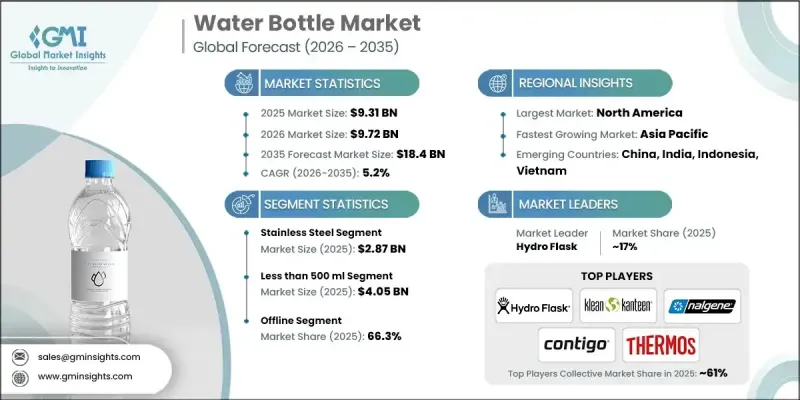
全球水瓶市場預計到 2025 年價值 93.1 億美元,到 2035 年達到 184 億美元,年複合成長率為 5.2%。
市場成長的驅動力在於消費者對可重複使用產品的廣泛需求,而這種需求的驅動力又源自於意識提升對環境影響和長期減少廢棄物的不斷增強。人們對塑膠污染日益成長的擔憂促使他們用符合永續生活方式的可重複填充容器取代一次性容器。公共意識宣傳活動和有組織的永續性項目正在強化重複填充的習慣,並推動對耐用水瓶的穩定需求。消費者越來越傾向選擇兼具環保責任和長期經濟價值的產品。這種轉變也影響零售策略,經銷商正在擴大可重複使用水瓶的供應範圍,以滿足不斷變化的偏好。同時,積極生活方式的普及也促進了攜帶式飲水解決方案需求的成長。消費者優先考慮耐用、便利、保溫和防漏的水瓶。專注於材料性能、保溫性和設計的產品創新持續增強日常和外出旅行市場的活力。
| 市場覆蓋範圍 | |
|---|---|
| 開始年份 | 2025 |
| 預測年份 | 2026-2035 |
| 起始值 | 93.1億美元 |
| 預測金額 | 184億美元 |
| 複合年成長率 | 5.2% |
預計到 2025 年,不銹鋼市場規模將達到 28.7 億美元,2026 年至 2035 年的複合年成長率將達到 6.3%。這種材料的需求源自於其強度高、耐腐蝕、隔熱性能優異,使其適用於各種環境下的重複使用。
預計到 2025 年,容量小於 500 毫升的水瓶市場規模將達到 40.5 億美元,到 2035 年將以 4.6% 的複合年成長率成長。由於其體積小巧、便於攜帶,並且適合快速補水,尤其是在都市區,因此這一細分市場仍然很受歡迎。
預計到 2025 年,美國水瓶市場規模將達到 20.2 億美元,2026 年至 2035 年的複合年成長率將達到 4.3%。健康意識的增強、對永續性的追求以及對高品質隔熱產品的需求,將繼續推動美國市場的擴張。
目錄
第1章調查方法和範圍
第2章執行摘要
第3章業界考察
- 生態系分析
- 供應商情況
- 利潤率
- 每個階段的附加價值
- 影響價值鏈的因素
- 產業影響因素
- 促進要素
- 推廣使用可重複使用產品,以減少一次性塑膠廢棄物。
- 拓展健身、運動和戶外休閒活動
- 公司和機構擴大使用品牌水瓶
- 挑戰與困難
- 激烈的競爭和產品同質化
- 耐用性問題(低成本塑膠和金屬瓶)
- 機會
- 具備飲水追蹤功能的智慧水瓶需求上升
- 擴大永續材料的應用,例如再生塑膠和生物基聚合物
- 促進要素
- 成長潛力分析
- 未來市場趨勢
- 科技與創新趨勢
- 當前技術趨勢
- 新興技術
- 價格趨勢
- 按地區
- 依產品
- 監管環境
- 標準和合規要求
- 區域法規結構
- 認證標準
- 波特分析
- PESTEL 分析
第4章 競爭情勢
- 介紹
- 公司市佔率分析
- 按地區
- 北美洲
- 歐洲
- 亞太地區
- 拉丁美洲
- 中東和非洲
- 按地區
- 企業矩陣分析
- 主要市場公司的競爭分析
- 競爭定位矩陣
- 重大進展
- 併購
- 夥伴關係與合作
- 新產品發布
- 擴張計劃
第5章 按材料分類的市場估算與預測,2022-2035年
- 塑膠
- 不銹鋼
- 玻璃
- 其他
第6章 依產能分類的市場估計與預測,2022-2035年
- 少於500毫升
- 500毫升等於1升
- 1公升或更多
7. 2022-2035年按分銷管道分類的市場估算與預測
- 線上
- 離線
第8章 2022-2035年各地區市場估算與預測
- 北美洲
- 美國
- 加拿大
- 歐洲
- 德國
- 英國
- 法國
- 義大利
- 西班牙
- 亞太地區
- 中國
- 印度
- 日本
- 韓國
- 澳洲
- 拉丁美洲
- 巴西
- 墨西哥
- 阿根廷
- 中東和非洲
- 沙烏地阿拉伯
- 阿拉伯聯合大公國
- 南非
第9章:公司簡介
- Aquasana
- CamelBak Products
- Chilly's Bottles
- Contigo
- GobiLab
- HydraPak
- Hydro Flask
- Klean Kanteen, Inc.
- Nalgene
- Pacific Market International
- S'well
- SIGG Switzerland
- Thermos
- Tupperware Brands Corporation
- YETI Holdings
The Global Water Bottle Market was valued at USD 9.31 billion in 2025 and is estimated to grow at a CAGR of 5.2% to reach USD 18.4 billion by 2035.
Market growth is supported by a broad shift toward reusable products as consumers become more conscious of environmental impact and long-term waste reduction. Rising concern over plastic pollution is encouraging people to replace disposable containers with refillable alternatives that align with sustainable living practices. Public awareness campaigns and institutional sustainability programs are reinforcing refill habits and driving consistent demand for durable bottles. Consumers are increasingly drawn to products that combine environmental responsibility with long-term economic value. This shift is also influencing retail strategies, as sellers expand reusable bottle assortments to meet evolving preferences. In parallel, growing participation in active lifestyles is contributing to higher demand for portable hydration solutions. Consumers are prioritizing bottles that offer durability, convenience, temperature retention, and leak resistance. Product innovation focused on material performance, insulation, and design continues to strengthen market momentum across both everyday and on-the-go usage.
| Market Scope | |
|---|---|
| Start Year | 2025 |
| Forecast Year | 2026-2035 |
| Start Value | $9.31 Billion |
| Forecast Value | $18.4 Billion |
| CAGR | 5.2% |
The stainless steel category generated USD 2.87 billion in 2025 and is expected to grow at a CAGR of 6.3% from 2026 to 2035. Demand for this material is driven by its strength, corrosion resistance, and superior thermal insulation, making it suitable for repeated use across diverse environments.
The bottles with a capacity of less than 500 milliliters accounted for USD 4.05 billion in 2025 and are projected to grow at a CAGR of 4.6% through 2035. This segment remains popular due to its compact form, ease of transport, and suitability for short-duration hydration needs, particularly in urban settings.
United States Water Bottle Market reached USD 2.02 billion in 2025 and is forecast to grow at a CAGR of 4.3% between 2026 and 2035. Rising health awareness, sustainability preferences, and demand for high-quality insulated products continue to support market expansion in the country.
Key companies operating in the Global Water Bottle Market include Hydro Flask, YETI Holdings, Thermos, CamelBak Products, Klean Kanteen, Inc., S'well, SIGG Switzerland, Nalgene, Contigo, Pacific Market International, Tupperware Brands Corporation, Aquasana, HydraPak, Chilly's Bottles, and GobiLab. Companies in the Global Water Bottle Market are strengthening their market position by focusing on material innovation, product differentiation, and sustainability messaging. Many brands are investing in advanced insulation technologies, lightweight designs, and long-lasting materials to improve user experience. Expanding product lines across multiple sizes and price segments helps capture a wider consumer base. Firms are also increasing visibility through digital platforms and direct-to-consumer channels to build stronger brand engagement. Strategic collaborations, limited-edition designs, and emphasis on eco-friendly credentials support customer loyalty and long-term market competitiveness.
Table of Contents
Chapter 1 Methodology & Scope
- 1.1 Market scope and definition
- 1.2 Research design
- 1.2.1 Research approach
- 1.2.2 Data collection methods
- 1.3 Data mining sources
- 1.3.1 Global
- 1.3.2 Regional/Country
- 1.4 Base estimates and calculations
- 1.4.1 Base year calculation
- 1.4.2 Key trends for market estimation
- 1.5 Primary research and validation
- 1.5.1 Primary sources
- 1.6 Forecast model
- 1.7 Research assumptions and limitations
Chapter 2 Executive Summary
- 2.1 Industry 360° synopsis
- 2.2 Key market trends
- 2.2.1 Regional
- 2.2.2 Material
- 2.2.3 Capacity
- 2.2.4 Distribution channel
- 2.3 CXO perspectives: Strategic imperatives
- 2.3.1 Key decision points for industry executives
- 2.3.2 Critical success factors for market players
- 2.4 Future outlook and strategic recommendations
Chapter 3 Industry Insights
- 3.1 Industry ecosystem analysis
- 3.1.1 Supplier landscape
- 3.1.2 Profit margin
- 3.1.3 Value addition at each stage
- 3.1.4 Factor affecting the value chain
- 3.2 Industry impact forces
- 3.2.1 Growth drivers
- 3.2.1.1 Growing adoption of reusable products to reduce single-use plastic waste
- 3.2.1.2 Expansion of fitness, sports, and outdoor recreation activities
- 3.2.1.3 Increasing corporate and institutional use of branded water bottles
- 3.2.2 Pitfalls & Challenges
- 3.2.2.1 Intense price competition and product commoditization
- 3.2.2.2 Durability concerns low-cost plastic and metal bottles
- 3.2.3 Opportunities
- 3.2.3.1 Rising demand for smart water bottles with hydration tracking
- 3.2.3.2 Expansion of sustainable materials such as recycled plastics and bio-based polymers
- 3.2.1 Growth drivers
- 3.3 Growth potential analysis
- 3.4 Future market trends
- 3.5 Technology and innovation landscape
- 3.5.1 Current technological trends
- 3.5.2 Emerging technologies
- 3.6 Price trends
- 3.6.1 By region
- 3.6.2 By product
- 3.7 Regulatory landscape
- 3.7.1 Standards and compliance requirements
- 3.7.2 Regional regulatory frameworks
- 3.7.3 Certification standards
- 3.8 Porter';s analysis
- 3.9 PESTEL analysis
Chapter 4 Competitive Landscape, 2025
- 4.1 Introduction
- 4.2 Company market share analysis
- 4.2.1 By Region
- 4.2.1.1 North America
- 4.2.1.2 Europe
- 4.2.1.3 Asia Pacific
- 4.2.1.4 Latin America
- 4.2.1.5 Middle East & Africa
- 4.2.1 By Region
- 4.3 Company matrix analysis
- 4.4 Competitive analysis of major market players
- 4.5 Competitive positioning matrix
- 4.6 Key developments
- 4.6.1 Mergers & acquisitions
- 4.6.2 Partnerships & collaborations
- 4.6.3 New product launches
- 4.6.4 Expansion plans
Chapter 5 Market Estimates & Forecast, By Material, 2022 - 2035, (USD Billion) (Thousand Units)
- 5.1 Key trends
- 5.2 Plastic
- 5.3 Stainless steel
- 5.4 Glass
- 5.5 Others
Chapter 6 Market Estimates & Forecast, By Capacity, 2022 - 2035, (USD Billion) (Thousand Units)
- 6.1 Key trends
- 6.2 Less than 500 ml
- 6.3 500 ml - 1 L
- 6.4 More than 1 L
Chapter 7 Market Estimates & Forecast, By Distribution Channel, 2022 - 2035, (USD Billion) (Thousand Units)
- 7.1 Key trends
- 7.2 Online
- 7.3 Offline
Chapter 8 Market Estimates & Forecast, By Region, 2022 - 2035, (USD Billion) (Thousand Units)
- 8.1 Key trends
- 8.2 North America
- 8.2.1 U.S.
- 8.2.2 Canada
- 8.3 Europe
- 8.3.1 Germany
- 8.3.2 UK
- 8.3.3 France
- 8.3.4 Italy
- 8.3.5 Spain
- 8.4 Asia Pacific
- 8.4.1 China
- 8.4.2 India
- 8.4.3 Japan
- 8.4.4 South Korea
- 8.4.5 Australia
- 8.5 Latin America
- 8.5.1 Brazil
- 8.5.2 Mexico
- 8.5.3 Argentina
- 8.6 MEA
- 8.6.1 Saudi Arabia
- 8.6.2 UAE
- 8.6.3 South Africa
Chapter 9 Company Profiles
- 9.1 Aquasana
- 9.2 CamelBak Products
- 9.3 Chilly’s Bottles
- 9.4 Contigo
- 9.5 GobiLab
- 9.6 HydraPak
- 9.7 Hydro Flask
- 9.8 Klean Kanteen, Inc.
- 9.9 Nalgene
- 9.10 Pacific Market International
- 9.11 S’well
- 9.12 SIGG Switzerland
- 9.13 Thermos
- 9.14 Tupperware Brands Corporation
- 9.15 YETI Holdings

 2026年全球折疊水瓶市場報告
 2026-2030年全球保溫水瓶市場
 水瓶市場:依產品類型、材質類型、容量、通路和地區分類
 生態碗市場分析及至2034年的預測:類型、產品、材料類型、應用、最終用戶、技術、功能、流程、組件、部署
 保溫水瓶市場(按隔熱材料類型、材料、容量、銷售管道和應用)—2025-2032 年全球預測可重複使用水瓶市場按材料類型、產品類型、容量範圍、應用類型、分銷管道和最終用戶分類-2025-2032 年全球預測環保瓶市場按材質、產品類型、分銷管道、最終用途、價格分佈、數量和年齡層別分類-全球預測 2025-2032
 2032 年可重複使用瓶生態系統市場預測:按材料、數量、價格分佈、分銷管道、最終用戶和地區進行的全球分析金屬水瓶市場按產品類型、材料、容量、分銷管道和最終用戶分類-2025-2030 年全球預測
 全球注入式水瓶市場