

 |
市場調查報告書
商品編碼
1928927
韓國美妝產品市場機會、成長要素、產業趨勢分析及2026年至2035年預測K-Beauty Products Market Opportunity, Growth Drivers, Industry Trend Analysis, and Forecast 2026 - 2035 |
||||||

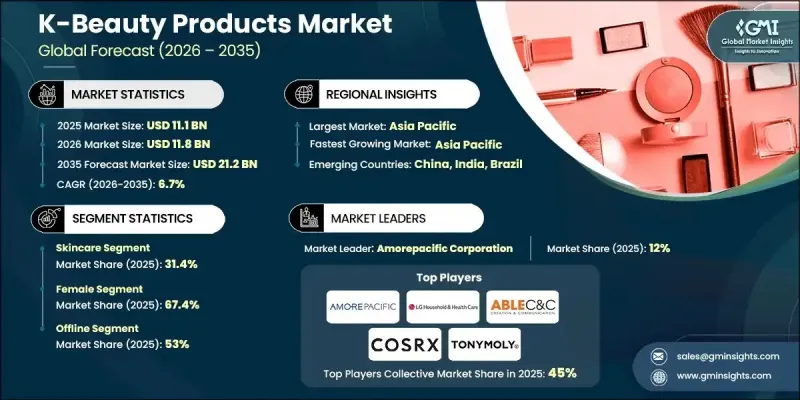
全球韓妝產品市場預計到 2025 年將達到 111 億美元,到 2035 年將達到 212 億美元,年複合成長率為 6.7%。
隨著品牌日益重視創新、產品線拓展和全球佈局,市場正經歷一場意義深遠的變革時期。策略整合活動正被廣泛用於加速產品研發,並增強其在國際市場的競爭力。同時,消費者的偏好也轉向了更注重環保和長期肌膚健康的配方。依賴刺激性化學成分的傳統方法正逐漸被更乾淨、更永續的替代方案所取代。這種轉變正在重塑產品研發策略,並推動對先進護膚解決方案的需求。全球消費者越來越傾向於以預防和維護為主的美容護膚方案,這些方案強調肌膚屏障的維護和整體健康。消費者對高效護膚和專業級解決方案日益成長的興趣,進一步推動了其在成熟市場和新興市場的普及。這些因素共同促成了韓妝(K-beauty)成為全球美容產業中一個充滿活力、創新主導的細分市場。
| 市場覆蓋範圍 | |
|---|---|
| 開始年份 | 2025 |
| 預測期 | 2026-2035 |
| 起始值 | 111億美元 |
| 預測金額 | 212億美元 |
| 複合年成長率 | 6.7% |
到 2025 年,護膚類將成為全球最大的細分市場,佔 31.4% 的市佔率。其主導地位的驅動力在於消費者對先進的護膚流程、創新質地和以科學為依據的配方有著濃厚的興趣,這些產品專注於長期改善膚質和外觀。
2024年,女性消費者群體將佔市場佔有率的67.4%,創造75億美元的收入。這群人體現了對結構化美容程序的高度重視以及對高階、專業韓妝產品的持續需求。
預計到2025年,北美韓妝產品市場規模將達到31億美元,到2035年將以7.2%的複合年成長率成長。美國約佔該地區收入的85%,這得益於不斷擴大的零售分銷網路以及消費者對溫和、預防性護膚方案日益成長的偏好。
目錄
第1章調查方法和範圍
第2章執行摘要
第3章業界考察
- 生態系分析
- 供應商情況
- 利潤率
- 每個階段的附加價值
- 影響價值鏈的因素
- 產業影響因素
- 促進要素
- 男性對儀容和自我護理的需求日益成長
- 智慧互聯生態系統
- 永續性和生態設計
- 產業潛在風險與挑戰
- 高階設備高成本
- 仿冒品的氾濫
- 機會
- 人工智慧驅動的個人化
- 方便攜帶且易於使用的「隨時隨地」設計
- 促進要素
- 成長潛力分析
- 未來市場趨勢
- 科技與創新趨勢
- 當前技術趨勢
- 新興技術
- 價格趨勢
- 按地區
- 按類型
- 監管環境
- 標準和合規要求
- 區域法規結構
- 認證標準
- 波特分析
- PESTEL 分析
第4章 競爭情勢
- 介紹
- 公司市佔率分析
- 按地區
- 企業矩陣分析
- 主要市場公司的競爭分析
- 競爭定位矩陣
- 重大進展
- 併購
- 夥伴關係與合作
- 新產品發布
- 擴張計劃
第5章 依產品類型分類的市場估算與預測,2022-2035年
- 護膚
- 洗面乳
- 爽膚水
- 美容精華液
- 保濕霜
- 面具
- 防曬油
- 化妝品
- 臉
- 唇
- 眼科
- 身體保養
- 身體乳液
- 沐浴露
- 去角質劑
- 護髮
- 其他
6. 依最終用途分類的市場估計與預測,2022-2035 年
- 男性
- 女士
7. 2022-2035年按分銷管道分類的市場估算與預測
- 線上管道
- 離線頻道
第8章 2022-2035年各地區市場估算與預測
- 北美洲
- 美國
- 加拿大
- 歐洲
- 德國
- 英國
- 法國
- 義大利
- 西班牙
- 亞太地區
- 中國
- 日本
- 印度
- 澳洲
- 韓國
- 拉丁美洲
- 巴西
- 墨西哥
- 阿根廷
- 中東和非洲
- 南非
- 沙烏地阿拉伯
- 阿拉伯聯合大公國
第9章:公司簡介
- Able C&C Co.Ltd.
- Amorepacific Corporation
- LG Household &Health Care
- APR Corp(Medicube)
- COSRX
- Dr. Jart+(Estee Lauder)
- Clio Cosmetics
- Beauty of Joseon
- Innisfree
- Tony Moly
- Nature Republic
- Neogen Corporation
- Banila Co
- Missha(Able C&C)
- Kolmar Korea(ODM/OEM)
The Global K-Beauty Products Market was valued at USD 11.1 billion in 2025 and is estimated to grow at a CAGR of 6.7% to reach USD 21.2 billion by 2035.
The market is undergoing a strong transformation as brands increasingly prioritize innovation, portfolio expansion, and global reach. Strategic consolidation activity is being used to accelerate product development and strengthen competitive positioning across international markets. At the same time, consumer preferences are shifting toward formulations that align with environmental responsibility and long-term skin health. Traditional approaches that rely heavily on harsh chemical inputs are gradually being replaced by cleaner and more sustainable alternatives. This shift is reshaping product development strategies and elevating demand for advanced skincare solutions. Global consumers are increasingly drawn to preventative and maintenance-focused beauty routines that emphasize skin barrier support and overall wellness. Rising interest in high-performance skincare and professional-grade solutions is further supporting adoption across mature and emerging markets. These factors collectively position K-beauty as a resilient and innovation-driven segment within the global beauty industry.
| Market Scope | |
|---|---|
| Start Year | 2025 |
| Forecast Year | 2026-2035 |
| Start Value | $11.1 Billion |
| Forecast Value | $21.2 Billion |
| CAGR | 6.7% |
The skincare category accounted for 31.4% share in 2025, making it the largest segment globally. Its leadership is supported by strong consumer interest in advanced routines, innovative textures, and science-backed formulations that focus on long-term skin quality and appearance.
The female consumer segment held a 67.4% share in 2024, generating USD 7.5 billion. This segment reflects higher engagement with structured beauty routines and consistent demand for premium and specialized K-beauty offerings.
North America K-Beauty Products Market reached USD 3.1 billion in 2025 and is expected to grow at a CAGR of 7.2% through 2035. The United States accounted for nearly 85% of regional revenue, supported by expanding retail availability and growing consumer preference for gentle, preventative skincare solutions.
Key companies active in the Global K-Beauty Products Market include Amorepacific Corporation, LG Household & Health Care, COSRX, Innisfree, Tony Moly, Dr. Jart+, Beauty of Joseon, Nature Republic, Clio Cosmetics, Banila Co, Neogen Corporation, APR Corp, Able C&C Co., Ltd., Missha, and Kolmar Korea. Companies in the Global K-Beauty Products Market are strengthening their market position through continuous formulation innovation and global brand expansion. Many players are investing in research focused on skin-friendly and sustainability-oriented ingredients to align with evolving consumer expectations. Strategic partnerships, acquisitions, and contract manufacturing support faster product launches and market entry. Brands are also leveraging digital marketing and social media to build global awareness and educate consumers on skincare routines.
Table of Contents
Chapter 1 Methodology and Scope
- 1.1 Market scope and definition
- 1.2 Research design
- 1.2.1 Research approach
- 1.2.2 Data collection methods
- 1.3 Data mining sources
- 1.3.1 Global
- 1.3.2 Regional/Country
- 1.4 Base estimates and calculations
- 1.4.1 Base year calculation
- 1.4.2 Key trends for market estimation
- 1.5 Primary research and validation
- 1.5.1 Primary sources
- 1.6 Forecast model
- 1.7 Research assumptions and limitations
Chapter 2 Executive Summary
- 2.1 Industry 360° synopsis
- 2.2 Key market trends
- 2.2.1 Regional
- 2.2.2 Product type
- 2.2.3 End Use
- 2.2.4 Distribution channel
- 2.3 CXO perspectives: Strategic imperatives
- 2.3.1 Key decision points for industry executives
- 2.3.2 Critical success factors for market players
- 2.4 Future outlook and strategic recommendations
Chapter 3 Industry Insights
- 3.1 Industry ecosystem analysis
- 3.1.1 Supplier landscape
- 3.1.2 Profit margin
- 3.1.3 Value addition at each stage
- 3.1.4 Factor affecting the value chain
- 3.2 Industry impact forces
- 3.2.1 Growth drivers
- 3.2.1.1 Rise in Male Grooming & Self-Care
- 3.2.1.2 Smart & Connected Ecosystems
- 3.2.1.3 Sustainability & Eco-Design
- 3.2.2 Industry pitfalls & challenges
- 3.2.2.1 High Cost of Premium Devices
- 3.2.2.2 Proliferation of Counterfeit Products
- 3.2.3 Opportunities
- 3.2.3.1 AI-Driven Personalization
- 3.2.3.2 Travel-friendly & "On-the-go" designs
- 3.2.1 Growth drivers
- 3.3 Growth potential analysis
- 3.4 Future market trends
- 3.5 Technology and innovation landscape
- 3.5.1 Current technological trends
- 3.5.2 Emerging technologies
- 3.6 Price trends
- 3.6.1 By region
- 3.6.2 By type
- 3.7 Regulatory landscape
- 3.7.1 Standards and compliance requirements
- 3.7.2 Regional regulatory frameworks
- 3.7.3 Certification standards
- 3.8 Porter';s analysis
- 3.9 PESTEL analysis
Chapter 4 Competitive Landscape, 2025
- 4.1 Introduction
- 4.2 Company market share analysis
- 4.2.1 By region
- 4.2.1.1 North America
- 4.2.1.2 Europe
- 4.2.1.3 Asia Pacific
- 4.2.1.4 Latin America
- 4.2.1.5 Middle East and Africa
- 4.2.1 By region
- 4.3 Company matrix analysis
- 4.4 Competitive analysis of major market players
- 4.5 Competitive positioning matrix
- 4.6 Key developments
- 4.6.1 Mergers & acquisitions
- 4.6.2 Partnerships & collaborations
- 4.6.3 New product launches
- 4.6.4 Expansion plans
Chapter 5 Market Estimates & Forecast, By Product Type, 2022 - 2035, (USD Billion) (Million Units)
- 5.1 Key trends
- 5.2 Skincare
- 5.2.1 Cleansers
- 5.2.2 Toners
- 5.2.3 Serums
- 5.2.4 Moisturizers
- 5.2.5 Masks
- 5.2.6 Sunscreens
- 5.3 Makeup
- 5.3.1 Face
- 5.3.2 Lip
- 5.3.3 Eye
- 5.4 Bodycare
- 5.4.1 Body lotions
- 5.4.2 Body wash
- 5.4.3 Exfoliants
- 5.5 Haircare
- 5.6 Others
Chapter 6 Market Estimates & Forecast, By End Use, 2022 - 2035, (USD Billion) (Million Units)
- 6.1 Key trends
- 6.2 Male
- 6.3 Female
Chapter 7 Market Estimates & Forecast, By Distribution Channel, 2022 - 2035, (USD Billion) (Million Units)
- 7.1 Key trends
- 7.2 Online channels
- 7.3 Offline channels
Chapter 8 Market Estimates and Forecast, By Region, 2022 - 2035 (USD Billion) (Million Units)
- 8.1 Key trends
- 8.2 North America
- 8.2.1 U.S.
- 8.2.2 Canada
- 8.3 Europe
- 8.3.1 Germany
- 8.3.2 UK
- 8.3.3 France
- 8.3.4 Italy
- 8.3.5 Spain
- 8.4 Asia Pacific
- 8.4.1 China
- 8.4.2 Japan
- 8.4.3 India
- 8.4.4 Australia
- 8.4.5 South Korea
- 8.5 Latin America
- 8.5.1 Brazil
- 8.5.2 Mexico
- 8.5.3 Argentina
- 8.6 Middle East and Africa
- 8.6.1 South Africa
- 8.6.2 Saudi Arabia
- 8.6.3 UAE
Chapter 9 Company Profiles
- 9.1 Able C&C Co.Ltd.
- 9.2 Amorepacific Corporation
- 9.3 LG Household & Health Care
- 9.4 APR Corp (Medicube)
- 9.5 COSRX
- 9.6 Dr. Jart+ (Estee Lauder)
- 9.7 Clio Cosmetics
- 9.8 Beauty of Joseon
- 9.9 Innisfree
- 9.10 Tony Moly
- 9.11 Nature Republic
- 9.12 Neogen Corporation
- 9.13 Banila Co
- 9.14 Missha (Able C&C)
- 9.15 Kolmar Korea (ODM/OEM)


