


 |
市場調查報告書
商品編碼
1928922
先進輪胎市場機會、成長要素、產業趨勢分析及2026年至2035年預測Advanced Tires Market Opportunity, Growth Drivers, Industry Trend Analysis, and Forecast 2026 - 2035 |
||||||

預計到 2024 年,全球先進輪胎市場規模將達到 18 億美元,並預計從 2025 年到 2034 年將以 8.8% 的複合年成長率成長,這主要得益於汽車技術的快速發展和對高性能輪胎需求的不斷成長。
隨著汽車產業向電動車轉型,製造商正致力於研發新一代輪胎,以提升車輛的效率、安全性和耐用性。先進輪胎融合了智慧監控系統、預測性維護技術和低滾動阻力設計,旨在最佳化車輛性能和能源效率。這些創新對於電動車和自動駕駛汽車至關重要,能夠延長電池壽命、確保卓越的道路安全並最大限度地減少維護需求。在對永續且技術先進的交通解決方案日益成長的需求驅動下,汽車製造商和輪胎製造商正攜手合作,開發符合未來出行需求的尖端輪胎。
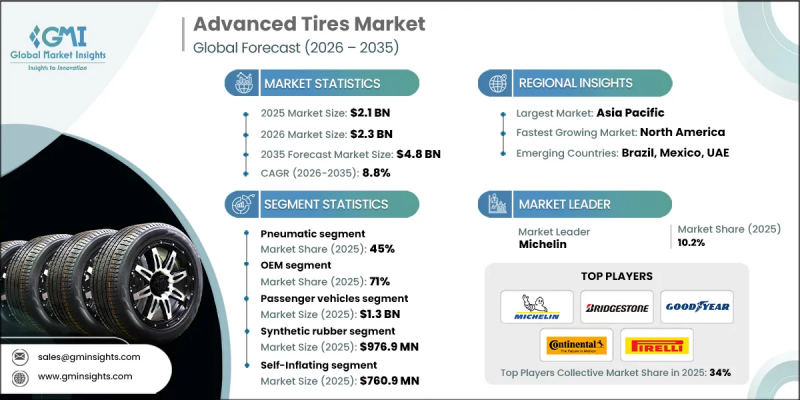
內建感測器的智慧輪胎在商用車和乘用車領域正日益普及。這些感測器能夠即時提供輪胎壓力、溫度和胎面磨損等關鍵性能指標數據,從而實現預測性維護並降低爆胎風險。更高的安全性和燃油效率使智慧輪胎成為車隊營運商和個人消費者的首選。隨著遠端資訊處理和車輛診斷技術與輪胎技術的日益融合,製造商不斷開發能夠提升車輛運轉率和駕駛性能的解決方案,進一步推動了市場成長。
| 市場覆蓋範圍 | |
|---|---|
| 開始年份 | 2025 |
| 預測年份 | 2026-2035 |
| 起始值 | 21億美元 |
| 預測金額 | 48億美元 |
| 複合年成長率 | 8.8% |
按車輛類型分類,輕型車輛佔據了大部分收入佔有率。截至2024年,該細分市場的規模預計為8億美元,隨著電動車(EV)的日益普及,預計將顯著成長。專為電動車設計的先進輪胎專注於降低滾動阻力,這直接影響能源效率和續航里程。整合式智慧監控系統可以即時追蹤輪胎狀況,幫助駕駛員保持最佳性能和安全性。汽車製造商正優先投資於能夠滿足不斷變化的消費者偏好和監管要求的高效輪胎解決方案。
按銷售管道,先進輪胎市場可分為原廠配套(OEM)市場和售後市場,預計到2024年,OEM市場將佔據71%的市場佔有率。汽車製造商正日益將智慧輪胎技術應用於新車,這些技術具備即時胎壓監測、自動診斷和預測性維護等功能。這些先進功能不僅提升了車輛的整體性能,也協助了聯網汽車和自動駕駛的發展。對車輛自動化的日益重視正在加速智慧輪胎系統的普及,這些系統能夠在最大限度地提高安全性和效率的同時,最大限度地減少維護需求。利用這些創新技術,汽車製造商能夠提升使用者體驗並最佳化車輛性能策略。
在基礎建設和汽車產業大規模發展的推動下,亞太地區預計到2024年將佔全球先進輪胎市場40%的佔有率。中國已成為主要貢獻者,創造了2.5億美元的區域收入。建築業的快速擴張、交通網路投資的增加以及強大的生產能力,都在推動對耐用、高性能輪胎的需求。隨著技術進步不斷重塑產業格局,汽車製造商和輪胎製造商之間的合作預計將在未來幾年持續推動市場成長。
目錄
第1章調查方法和範圍
第2章執行摘要
第3章業界考察
- 生態系分析
- 供應商情況
- 利潤率
- 成本結構
- 每個階段的附加價值
- 影響價值鏈的因素
- 中斷
- 產業影響因素
- 促進要素
- 電動車和混合動力汽車越來越受歡迎
- 對安全性和車輛性能的要求日益提高
- 輪胎設計的技術進步
- 全球汽車生產與旅遊服務的擴張
- 產業潛在風險與挑戰
- 高昂的研發和製造成本
- 消費者意識和基礎設施不足
- 市場機遇
- 智慧連網汽車生態系的發展
- 對永續和環保輪胎的需求不斷成長
- 材料和設計方面的技術進步
- OEM協作和基於平台的部署
- 促進要素
- 成長潛力分析
- 監管環境
- 北美洲
- 聯邦機動車輛安全標準(FMVSS)
- 加拿大機動車輛安全標準(CMVSS)
- 歐洲
- 符合德國TUV和BaFin標準
- 法國DGITM指南
- 英國車輛認證機構(VCA)規章
- 遵守義大利運輸部規定
- 亞太地區
- 中國工業和資訊化部(工信部)指南
- 日本國土交通省標準
- 韓國國土交通部(MOLIT)法規
- 印度公路運輸和公路部 (MoRTH) 和印度標準協會 (BIS) 指南
- 拉丁美洲
- 巴西 DENATRAN 和 ANFAVEA 法規
- 墨西哥SCT和NOM標準
- 中東和非洲
- 阿拉伯聯合大公國道路和交通管理局 (RTA) 指南
- 沙烏地阿拉伯運輸總局(GAT)規章
- 北美洲
- 波特分析
- PESTEL 分析
- 科技與創新趨勢
- 當前技術趨勢
- 新興技術
- 價格趨勢
- 按地區
- 依產品
- 成本細分分析
- 專利分析
- 永續性和環境方面
- 永續努力
- 減少廢棄物策略
- 生產中的能源效率
- 環保舉措
- 碳足跡考量
- 使用案例場景
- OEM整合與汽車平臺完整性
- OEM聯合開發與認證策略
- 電動車和自動駕駛汽車的輪胎規格
- 電動車專用輪胎的經濟性和性能之間的權衡
- 車隊和商用車採用分析
- 製造程序創新
第4章 競爭情勢
- 介紹
- 公司市佔率分析
- 北美洲
- 歐洲
- 亞太地區
- 拉丁美洲
- 中東和非洲
- 主要市場公司的競爭分析
- 競爭定位矩陣
- 戰略展望矩陣
- 重大進展
- 併購
- 夥伴關係與合作
- 新產品發布
- 企業擴張計畫和資金籌措
第5章 依輪胎類型分類的市場估計與預測,2022-2035年
- 充氣輪胎
- 無氣
- 防爆輪胎
- 其他
第6章 依車輛類型分類的市場估計與預測,2022-2035年
- 搭乘用車
- 掀背車車
- 轎車
- SUV
- 商用車輛
- 輕型商用車(LCV)
- 中型商用車(MCV)
- 重型商用車(HCV)
第7章 按材料分類的市場估算與預測,2022-2035年
- 合成橡膠
- 天然橡膠
- 彈性體
- 其他
第8章 按技術分類的市場估算與預測,2022-2035年
- 自充氣
- 晶片嵌入式類型
- 自密封
- 多重腔體
- 一體式
第9章 依銷售管道分類的市場估計與預測,2022-2035年
- OEM
- 售後市場
第10章 2022-2035年各地區市場估計與預測
- 北美洲
- 美國
- 加拿大
- 歐洲
- 英國
- 德國
- 法國
- 義大利
- 西班牙
- 比利時
- 荷蘭
- 瑞典
- 亞太地區
- 中國
- 印度
- 日本
- 澳洲
- 新加坡
- 韓國
- 越南
- 印尼
- 馬來西亞
- 拉丁美洲
- 巴西
- 墨西哥
- 阿根廷
- 中東和非洲
- 阿拉伯聯合大公國
- 南非
- 沙烏地阿拉伯
第11章:公司簡介
- Global Player
- Bridgestone
- Continental
- Cooper-Standard
- Goodyear
- Michelin
- Pirelli
- Sumitomo
- Tenneco(DRiV)
- Vibracoustic
- Yokohama
- Regional Player
- Apollo Tyres
- Giti Tire
- Hankook Tire
- Jinyu Tire
- Kumho Tire
- Linglong Tire
- MRF
- Nexen Tire
- Sailun Tire
- Triangle Tire
- 新興製造商
- Aeolus Tyre
- CEAT
- Double Coin
- Ovation Tyres
- Tigar Tyres
The global advanced tires market was valued at USD 1.8 billion in 2024 and is projected to grow at a CAGR of 8.8% between 2025 and 2034, driven by rapid advancements in automotive technology and the increasing demand for high-performance tires. As the automotive sector transitions toward electric vehicles (EVs), manufacturers are focusing on next-generation tires that enhance vehicle efficiency, safety, and durability. Advanced tires incorporate intelligent monitoring systems, predictive maintenance technologies, and low rolling resistance designs to optimize vehicle performance and energy efficiency. These innovations are crucial for electric and autonomous vehicles, ensuring extended battery life, superior road safety, and minimal maintenance. The rising demand for sustainable and technologically advanced transportation solutions is driving automakers and tire manufacturers to collaborate on cutting-edge tire developments that align with the future of mobility.
Smart tires equipped with embedded sensors are gaining traction across commercial and personal vehicle fleets. These sensors provide real-time data on critical performance metrics such as tire pressure, temperature, and tread wear, enabling predictive maintenance and reducing the risk of blowouts. Enhanced safety features and improved fuel efficiency make smart tires a preferred choice among fleet operators and individual consumers. The increasing integration of telematics and vehicle diagnostics into tire technology further supports market growth as manufacturers continue to develop solutions that improve vehicle uptime and on-road performance.
| Market Scope | |
|---|---|
| Start Year | 2025 |
| Forecast Year | 2026-2035 |
| Start Value | $2.1 Billion |
| Forecast Value | $4.8 Billion |
| CAGR | 8.8% |
Segmented by vehicle type, the market sees light-duty vehicles holding a major revenue share. In 2024, this segment was valued at USD 800 million, with expectations of substantial growth due to the rising adoption of EVs. Advanced tires specifically designed for electric models focus on reducing rolling resistance, which directly impacts energy efficiency and driving range. By integrating intelligent monitoring systems, these tires offer real-time tracking of tire conditions, helping drivers maintain optimal performance and safety. Automakers are prioritizing investments in high-efficiency tire solutions that cater to evolving consumer preferences and regulatory requirements.
Based on sales channels, the advanced tires market is divided into OEM and aftermarket, with OEMs dominating at a 71% share in 2024. Automakers are increasingly integrating smart tire technologies into new vehicle models, equipping them with real-time pressure monitoring, automated diagnostics, and predictive maintenance capabilities. These advanced features enhance overall vehicle performance while supporting the push toward connected and autonomous driving. The growing emphasis on vehicle automation is accelerating the adoption of intelligent tire systems that require minimal maintenance while maximizing safety and efficiency. By leveraging these innovations, automakers can offer enhanced user experiences and refine their vehicle performance strategies.
The Asia Pacific region accounted for 40% of the global advanced tires market in 2024, driven by large-scale infrastructure developments and the booming automotive industry. China emerged as the leading contributor, generating USD 250 million in regional revenue. The rapid expansion of the construction sector, increasing investments in transportation networks, and strong production capabilities are fueling demand for durable, high-performance tires. As technological advancements continue to shape the industry, growing collaborations between automakers and tire manufacturers are expected to drive sustained market growth in the coming years.
Table of Contents
Chapter 1 Methodology & Scope
- 1.1 Market scope and definition
- 1.2 Research design
- 1.2.1 Research approach
- 1.2.2 Data collection methods
- 1.3 Data mining sources
- 1.3.1 Global
- 1.3.2 Regional/Country
- 1.4 Base estimates and calculations
- 1.4.1 Base year calculation
- 1.4.2 Key trends for market estimation
- 1.5 Primary research and validation
- 1.5.1 Primary sources
- 1.6 Forecast
- 1.7 Research assumptions and limitations
Chapter 2 Executive Summary
- 2.1 Industry 360° synopsis, 2022 - 2035
- 2.2 Key market trends
- 2.2.1 Regional
- 2.2.2 Tire
- 2.2.3 Vehicle
- 2.2.4 Material
- 2.2.5 Technology
- 2.2.6 Sales Channel
- 2.3 TAM Analysis, 2026-2035
- 2.4 CXO perspectives: Strategic imperatives
- 2.4.1 Executive decision points
- 2.4.2 Critical success factors
- 2.5 Future outlook and strategic recommendations
Chapter 3 Industry Insights
- 3.1 Industry ecosystem analysis
- 3.1.1 Supplier Landscape
- 3.1.2 Profit Margin
- 3.1.3 Cost structure
- 3.1.4 Value addition at each stage
- 3.1.5 Factor affecting the value chain
- 3.1.6 Disruptions
- 3.2 Industry impact forces
- 3.2.1 Growth drivers
- 3.2.1.1 Rising electric & hybrid vehicle adoption
- 3.2.1.2 Growing demand for safety & vehicle performance
- 3.2.1.3 Technological advancements in tire design
- 3.2.1.4 Expansion of global vehicle production & mobility services
- 3.2.2 Industry pitfalls and challenges
- 3.2.2.1 High development & manufacturing costs
- 3.2.2.2 Limited consumer awareness & infrastructure readiness
- 3.2.3 Market opportunities
- 3.2.3.1 Growth of Smart & Connected Vehicle Ecosystems
- 3.2.3.2 Rising Demand for Sustainable & Eco-Friendly Tires
- 3.2.3.3 Technological Advancements in Materials and Design
- 3.2.3.4 OEM Collaborations and Platform-Based Deployments
- 3.2.1 Growth drivers
- 3.3 Growth potential analysis
- 3.4 Regulatory landscape
- 3.4.1 North America
- 3.4.1.1 U.S. Federal Motor Vehicle Safety Standards (FMVSS)
- 3.4.1.2 Canada Motor Vehicle Safety Standards (CMVSS)
- 3.4.2 Europe
- 3.4.2.1 Germany TUV & BaFin Compliance
- 3.4.2.2 France DGITM Guidelines
- 3.4.2.3 UK Vehicle Certification Agency (VCA) Regulations
- 3.4.2.4 Italy Ministry of Infrastructure & Transport Compliance
- 3.4.3 Asia Pacific
- 3.4.3.1 China MIIT Guidelines
- 3.4.3.2 Japan MLIT Standards
- 3.4.3.3 South Korea MOLIT Regulations
- 3.4.3.4 India Ministry of MoRTH & BIS Guidelines
- 3.4.4 Latin America
- 3.4.4.1 Brazil DENATRAN & ANFAVEA Regulations
- 3.4.4.2 Mexico SCT & NOM Standards
- 3.4.5 Middle East and Africa
- 3.4.5.1 UAE Roads & Transport Authority (RTA) Guidelines
- 3.4.5.2 Saudi Arabia General Authority for Transport (GAT) Regulations
- 3.4.1 North America
- 3.5 Porter';s analysis
- 3.6 PESTEL analysis
- 3.7 Technology and Innovation Landscape
- 3.7.1 Current technological trends
- 3.7.2 Emerging technologies
- 3.8 Price trends
- 3.8.1 By region
- 3.8.2 By product
- 3.9 Cost breakdown analysis
- 3.10 Patent analysis
- 3.11 Sustainability and Environmental Aspects
- 3.11.1 Sustainable practices
- 3.11.2 Waste reduction strategies
- 3.11.3 Energy efficiency in production
- 3.11.4 Eco-friendly initiatives
- 3.11.5 Carbon footprint considerations
- 3.12 Use case scenarios
- 3.13 OEM Integration & Vehicle Platform Alignment
- 3.13.1 OEM co-development & homologation strategy
- 3.13.2 EV & autonomous vehicle tire specifications
- 3.14 EV-Specific Tire Economics & Performance Trade-offs
- 3.15 Fleet & Commercial Adoption Analysis
- 3.16 Manufacturing Process Innovation
Chapter 4 Competitive Landscape, 2025
- 4.1 Introduction
- 4.2 Company market share analysis
- 4.2.1 North America
- 4.2.2 Europe
- 4.2.3 Asia Pacific
- 4.2.4 Latin America
- 4.2.5 Middle East & Africa
- 4.3 Competitive analysis of major market players
- 4.4 Competitive positioning matrix
- 4.5 Strategic outlook matrix
- 4.6 Key developments
- 4.6.1 Mergers & acquisitions
- 4.6.2 Partnerships & collaborations
- 4.6.3 New product launches
- 4.6.4 Expansion plans and funding
Chapter 5 Market Estimates & Forecast, By Tire, 2022 - 2035 ($ Bn, Units)
- 5.1 Key trends
- 5.2 Pneumatic
- 5.3 Airless
- 5.4 Run-flat
- 5.5 Others
Chapter 6 Market Estimates & Forecast, By Vehicle, 2022 - 2035 ($ Bn, Units)
- 6.1 Key trends
- 6.2 Passenger vehicles
- 6.2.1 Hatchbacks
- 6.2.2 Sedans
- 6.2.3 SUV
- 6.3 Commercial vehicles
- 6.3.1 Light commercial vehicles (LCV)
- 6.3.2 Medium commercial vehicles (MCV)
- 6.3.3 Heavy commercial vehicles (HCV)
Chapter 7 Market Estimates & Forecast, By Material, 2022 - 2035 ($ Bn, Units)
- 7.1 Key trends
- 7.2 Synthetic rubber
- 7.3 Natural rubber
- 7.4 Elastomers
- 7.5 Others
Chapter 8 Market Estimates & Forecast, By Technology, 2022 - 2035 ($ Bn, Units)
- 8.1 Key trends
- 8.2 Self-Inflating
- 8.3 Chip-Embedded
- 8.4 Self-Sealing
- 8.5 Multi-chamber
- 8.6 All-In-One
Chapter 9 Market Estimates & Forecast, By Sales Channel, 2022 - 2035 ($ Bn, Units)
- 9.1 Key trends
- 9.2 OEM
- 9.3 Aftermarket
Chapter 10 Market Estimates & Forecast, By Region, 2022 - 2035 ($ Bn, Units)
- 10.1 Key trends
- 10.2 North America
- 10.2.1 US
- 10.2.2 Canada
- 10.3 Europe
- 10.3.1 UK
- 10.3.2 Germany
- 10.3.3 France
- 10.3.4 Italy
- 10.3.5 Spain
- 10.3.6 Belgium
- 10.3.7 Netherlands
- 10.3.8 Sweden
- 10.4 Asia Pacific
- 10.4.1 China
- 10.4.2 India
- 10.4.3 Japan
- 10.4.4 Australia
- 10.4.5 Singapore
- 10.4.6 South Korea
- 10.4.7 Vietnam
- 10.4.8 Indonesia
- 10.4.9 Malaysia
- 10.5 Latin America
- 10.5.1 Brazil
- 10.5.2 Mexico
- 10.5.3 Argentina
- 10.6 MEA
- 10.6.1 UAE
- 10.6.2 South Africa
- 10.6.3 Saudi Arabia
Chapter 11 Company Profiles
- 11.1 Global Player
- 11.1.1 Bridgestone
- 11.1.2 Continental
- 11.1.3 Cooper-Standard
- 11.1.4 Goodyear
- 11.1.5 Michelin
- 11.1.6 Pirelli
- 11.1.7 Sumitomo
- 11.1.8 Tenneco (DRiV)
- 11.1.9 Vibracoustic
- 11.1.10 Yokohama
- 11.2 Regional Player
- 11.2.1 Apollo Tyres
- 11.2.2 Giti Tire
- 11.2.3 Hankook Tire
- 11.2.4 Jinyu Tire
- 11.2.5 Kumho Tire
- 11.2.6 Linglong Tire
- 11.2.7 MRF
- 11.2.8 Nexen Tire
- 11.2.9 Sailun Tire
- 11.2.10 Triangle Tire
- 11.3 Emerging Players
- 11.3.1 Aeolus Tyre
- 11.3.2 CEAT
- 11.3.3 Double Coin
- 11.3.4 Ovation Tyres
- 11.3.5 Tigar Tyres


