


 |
市場調查報告書
商品編碼
1928915
一氯乙酸市場機會、成長要素、產業趨勢分析及預測(2026年至2035年)Monochloroacetic Acid Market Opportunity, Growth Drivers, Industry Trend Analysis, and Forecast 2026 - 2035 |
||||||

全球一氯乙酸市場預計到 2025 年將達到 9.852 億美元,到 2035 年將達到 15 億美元,年複合成長率為 4.2%。
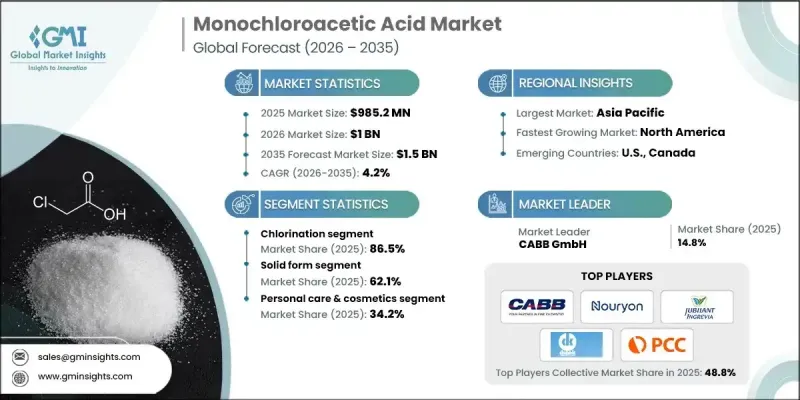
由於其在多個領域的應用不斷擴展,該行業正經歷著穩步成長。一氯乙酸是生產藥品、界面活性劑、染料和殺蟲劑的關鍵中間體。它作為羧甲基纖維素和除草劑等特殊化學品的組成單元,凸顯了其在化學品製造中的重要性。該化合物的高反應活性、成本效益和多功能性使其成為化學合成的理想選擇。農業領域對作物保護解決方案的需求不斷成長、藥品生產規模擴大以及藥物研發投資的增加,進一步推動了市場成長。然而,該產業也面臨許多挑戰,例如原料成本波動、氯代化合物帶來的環境問題以及嚴格的法規結構。對安全性和永續生產方式的日益重視,正迫使製造商採用更環保的做法,間接影響市場趨勢。
| 市場覆蓋範圍 | |
|---|---|
| 開始年份 | 2025 |
| 預測年份 | 2026-2035 |
| 起始值 | 9.852億美元 |
| 預測金額 | 15億美元 |
| 複合年成長率 | 4.2% |
預計到2025年,氯化法將佔86.5%的市場佔有率,並在2035年之前保持4.2%的複合年成長率。市場持續受益於生產技術的進步,包括節能環保的氯化工藝,這些工藝在提高產量的同時,最大限度地減少了副產物的產生。醫藥、個人保健產品和農業領域對高純度一氯乙酸的需求不斷成長,推動了生產流程的最佳化。
依產品形態分類,預計2025年,固體一氯乙酸市佔率將達到62.1%,並在2026年至2035年間以4.2%的複合年成長率成長。固體形態的產品因其劑量控制精準、穩定性好、易於操作等優勢,在製藥、特殊化學品和農產品領域備受青睞。固體加工技術和儲存解決方案的進步,進一步幫助生產商延長產品保存期限、簡化運輸流程並提高營運效率。
預計到2025年,北美一氯乙酸市佔率將達到28.2%。這一成長主要得益於技術的進步、日益嚴格的環境法規以及完善的化學基礎設施。製藥、個人護理和農業等領域的應用不斷拓展,以及向永續生產的轉型,都推動了市場需求。該地區的企業正在採用更清潔的生產方法,以提高效率和生產力,同時滿足環境標準。
目錄
第1章調查方法和範圍
第2章執行摘要
第3章業界考察
- 生態系分析
- 供應商情況
- 利潤率
- 每個階段的附加價值
- 影響價值鏈的因素
- 中斷
- 產業影響因素
- 促進要素
- 產業潛在風險與挑戰
- 市場機遇
- 成長潛力分析
- 監管環境
- 北美洲
- 歐洲
- 亞太地區
- 拉丁美洲
- 中東和非洲
- 波特分析
- PESTEL 分析
- 價格趨勢
- 按地區
- 一氯乙酸的分類
- 未來市場趨勢
- 科技與創新趨勢
- 當前技術趨勢
- 新興技術
- 專利狀態
- 貿易統計(HS編碼)(註:僅提供主要國家的貿易統計)
- 主要進口國
- 主要出口國
- 永續性和環境方面
- 永續努力
- 減少廢棄物策略
- 生產中的能源效率
- 環保舉措
- 碳足跡考量
第4章 競爭情勢
- 介紹
- 公司市佔率分析
- 按地區
- 北美洲
- 歐洲
- 亞太地區
- 拉丁美洲
- 中東和非洲
- 按地區
- 企業矩陣分析
- 主要市場公司的競爭分析
- 競爭定位矩陣
- 重大進展
- 併購
- 夥伴關係與合作
- 新產品發布
- 業務拓展計劃
第5章 依製造流程分類的市場估算與預測,2022-2035年
- 氯化工藝
- 水解過程
第6章 依產品類型分類的市場估算與預測,2022-2035年
- 固態形式
- 液態
7. 2022-2035年按最終用途產業分類的市場估算與預測
- 個人護理及化妝品
- 護髮產品
- 護膚品
- 農業/作物保護
- 除草劑生產
- 農藥合成
- 植物生長調節劑
- 食品/飲料
- 食品增稠劑及穩定劑
- 食品包裝塗層
- 製藥和醫療保健
- 原料藥
- 藥用輔料
- 醫療設備黏合劑
- 石油和天然氣
- 鑽井液和泥漿添加劑
- 提高石油採收率技術
- 紡織品和紙製品
- 紡織品印染
- 造紙和塗佈
- 紡織加工
- 建材
- 水泥添加劑/緩凝劑
- 磁磚黏合劑和填縫劑
- 石膏板製造
- 清潔劑和清潔用品
- 液體清潔劑
- 工業用清潔劑
- 家用清潔劑和清潔用品
- 水處理
- 離子交換樹脂
- 螯合劑
- 油漆、塗料和油墨
- 汽車塗料
- 印刷油墨
- 工業塗料
第8章 2022-2035年各地區市場估算與預測
- 北美洲
- 美國
- 加拿大
- 歐洲
- 德國
- 英國
- 法國
- 西班牙
- 義大利
- 其他歐洲地區
- 亞太地區
- 中國
- 印度
- 日本
- 澳洲
- 韓國
- 亞太其他地區
- 拉丁美洲
- 巴西
- 墨西哥
- 阿根廷
- 其他拉丁美洲地區
- 中東和非洲
- 沙烏地阿拉伯
- 南非
- 阿拉伯聯合大公國
- 其他中東和非洲地區
第9章:公司簡介
- CABB GmbH
- Denak Co., Ltd.
- Jubilant Ingrevia Limited
- Merck KGaA
- Niacet Corporation
- Nouryon
- PCC Group
- Puyang Tiancheng Chemical Co. Ltd
- Shandong Minji Chemical Co., Ltd.
- Shiv Chem Industries
- Xuchang Dongfang Chemical Co. Ltd.
The Global Monochloroacetic Acid Market was valued at USD 985.2 million in 2025 and is estimated to grow at a CAGR of 4.2% to reach USD 1.5 billion by 2035.
The industry is experiencing steady growth due to its increasing utility across multiple sectors. Monochloroacetic acid serves as a critical intermediate in the production of pharmaceuticals, surfactants, dyes, and agrochemicals. Its role as a building block for specialty chemicals, including carboxymethyl cellulose and herbicides, highlights its significance in chemical manufacturing. The compound's high reactivity, cost-effectiveness, and versatility make it an ideal choice for chemical synthesis. Rising demand in agriculture for crop protection solutions, coupled with expansion in pharmaceutical production and investment in drug development, further supports market growth. However, the industry faces challenges such as fluctuating raw material costs, environmental concerns linked to chlorinated compounds, and strict regulatory frameworks. Increasing emphasis on safety and sustainable production methods is influencing manufacturers to adopt greener practices, indirectly shaping market trends.
| Market Scope | |
|---|---|
| Start Year | 2025 |
| Forecast Year | 2026-2035 |
| Start Value | $985.2 Million |
| Forecast Value | $1.5 Billion |
| CAGR | 4.2% |
The chlorination segment accounted for 86.5% share in 2025 and is expected to maintain a CAGR of 4.2% through 2035. The market continues to benefit from improvements in production techniques, including energy-efficient and eco-friendly chlorination processes that minimize by-product formation while enhancing yield. Growing demand for high-purity monochloroacetic acid in pharmaceuticals, personal care products, and agricultural applications is driving this shift toward optimized manufacturing processes.
In terms of product form, the solid monochloroacetic acid segment held 62.1% share in 2025 and is anticipated to grow at a CAGR of 4.2% between 2026 and 2035. Solid forms offer advantages such as precise dosing, stability, and ease of handling, making them preferred for pharmaceuticals, specialty chemicals, and agricultural products. Advances in solid-state processing and storage solutions are further supporting longer shelf life, simplified transportation, and better operational efficiency for manufacturers.
North America Monochloroacetic Acid Market held 28.2% share in 2025. This growth is fueled by evolving technologies, stringent environmental regulations, and a well-developed chemical infrastructure. Increasing applications in pharmaceuticals, personal care, and agriculture, along with a shift toward sustainable production, are driving demand. Companies in the region are adopting cleaner manufacturing practices to comply with environmental standards while enhancing efficiency and output.
Leading players in the Global Monochloroacetic Acid Market include CABB GmbH, Jubilant Ingrevia Limited, PCC Group, Merck KGaA, Denak Co., Ltd., Nouryon, Shandong Minji Chemical Co., Ltd., Xuchang Dongfang Chemical Co., Ltd., Shiv Chem Industries, Niacet Corporation, and Puyang Tiancheng Chemical Co., Ltd. Companies in the Monochloroacetic Acid Market are employing several key strategies to strengthen their position. These include expanding production capacities, adopting advanced and eco-friendly manufacturing technologies, forming strategic partnerships, and investing in R&D for high-purity products. Firms are also focusing on improving supply chain efficiency, exploring new geographic markets, and enhancing their product portfolios to meet growing demand across industries. By prioritizing sustainability, technological innovation, and strategic alliances, market players are solidifying their foothold and driving long-term growth.
Table of Contents
Chapter 1 Methodology & Scope
- 1.1 Market scope and definition
- 1.2 Research design
- 1.2.1 Research approach
- 1.2.2 Data collection methods
- 1.3 Data mining sources
- 1.3.1 Global
- 1.3.2 Regional/Country
- 1.4 Base estimates and calculations
- 1.4.1 Base year calculation
- 1.4.2 Key trends for market estimation
- 1.5 Primary research and validation
- 1.5.1 Primary sources
- 1.6 Forecast model
- 1.7 Research assumptions and limitations
Chapter 2 Executive Summary
- 2.1 Industry 3600 synopsis
- 2.2 Key market trends
- 2.2.1 Regional
- 2.2.2 Manufacturing process
- 2.2.3 Product form
- 2.2.4 End Use Industry
- 2.3 TAM Analysis, 2026-2035
- 2.4 CXO perspectives: Strategic imperatives
- 2.4.1 Executive decision points
- 2.4.2 Critical success factors
- 2.5 Future Outlook and Strategic Recommendations
Chapter 3 Industry Insights
- 3.1 Industry ecosystem analysis
- 3.1.1 Supplier landscape
- 3.1.2 Profit margin
- 3.1.3 Value addition at each stage
- 3.1.4 Factor affecting the value chain
- 3.1.5 Disruptions
- 3.2 Industry impact forces
- 3.2.1 Growth drivers
- 3.2.2 Industry pitfalls and challenges
- 3.2.3 Market opportunities
- 3.3 Growth potential analysis
- 3.4 Regulatory landscape
- 3.4.1 North America
- 3.4.2 Europe
- 3.4.3 Asia Pacific
- 3.4.4 Latin America
- 3.4.5 Middle East & Africa
- 3.5 Porter';s analysis
- 3.6 PESTEL analysis
- 3.7 Price trends
- 3.7.1 By region
- 3.7.2 By monochloroacetic acid class
- 3.8 Future market trends
- 3.9 Technology and Innovation landscape
- 3.9.1 Current technological trends
- 3.9.2 Emerging technologies
- 3.10 Patent Landscape
- 3.11 Trade statistics (HS code) ( Note: the trade statistics will be provided for key countries only)
- 3.11.1 Major importing countries
- 3.11.2 Major exporting countries
- 3.12 Sustainability and environmental aspects
- 3.12.1 Sustainable practices
- 3.12.2 Waste reduction strategies
- 3.12.3 Energy efficiency in production
- 3.12.4 Eco-friendly initiatives
- 3.13 Carbon footprint consideration
Chapter 4 Competitive Landscape, 2025
- 4.1 Introduction
- 4.2 Company market share analysis
- 4.2.1 By region
- 4.2.1.1 North America
- 4.2.1.2 Europe
- 4.2.1.3 Asia Pacific
- 4.2.1.4 LATAM
- 4.2.1.5 MEA
- 4.2.1 By region
- 4.3 Company matrix analysis
- 4.4 Competitive analysis of major market players
- 4.5 Competitive positioning matrix
- 4.6 Key developments
- 4.6.1 Mergers & acquisitions
- 4.6.2 Partnerships & collaborations
- 4.6.3 New Product Launches
- 4.6.4 Expansion Plans
Chapter 5 Market Estimates and Forecast, By Manufacturing Process, 2022-2035 (USD Million) (Kilo Tons)
- 5.1 Key trends
- 5.2 Chlorination process
- 5.3 Hydrolysis process
Chapter 6 Market Estimates and Forecast, By Product Form, 2022-2035 (USD Million) (Kilo Tons)
- 6.1 Key trends
- 6.2 Solid forms
- 6.3 Liquid forms
Chapter 7 Market Estimates and Forecast, By End Use Industry, 2022-2035 (USD Million) (Kilo Tons)
- 7.1 Key trends
- 7.2 Personal care & cosmetics
- 7.2.1 Hair care products
- 7.2.2 Skin care formulations
- 7.3 Agriculture & crop protection
- 7.3.1 Herbicide manufacturing
- 7.3.2 Pesticide synthesis
- 7.3.3 Plant growth regulators
- 7.4 Food & beverage
- 7.4.1 Food thickeners & stabilizers
- 7.4.2 Food packaging coatings
- 7.5 Pharmaceuticals & healthcare
- 7.5.1 Active pharmaceutical ingredients
- 7.5.2 Pharmaceutical excipients
- 7.5.3 Medical device adhesives
- 7.6 Oil & gas
- 7.6.1 Drilling fluids & mud additives
- 7.6.2 Enhanced oil recovery
- 7.7 Textiles & paper
- 7.7.1 Textile printing & dyeing
- 7.7.2 Paper manufacturing & coating
- 7.7.3 Textile finishing
- 7.8 Construction & building materials
- 7.8.1 Cement additives & retarders
- 7.8.2 Tile adhesives & grouts
- 7.8.3 Gypsum board production
- 7.9 Detergents & cleaning products
- 7.9.1 Liquid detergents
- 7.9.2 Industrial cleaners
- 7.9.3 Household cleaning products
- 7.10 Water treatment
- 7.10.1 Ion-exchange resins
- 7.10.2 Chelating agents
- 7.11 Paints, coatings & inks
- 7.11.1 Automotive coatings
- 7.11.2 Printing inks
- 7.11.3 Industrial coatings
Chapter 8 Market Estimates and Forecast, By Region, 2022-2035 (USD Million) (Kilo Tons)
- 8.1 Key trends
- 8.2 North America
- 8.2.1 U.S.
- 8.2.2 Canada
- 8.3 Europe
- 8.3.1 Germany
- 8.3.2 UK
- 8.3.3 France
- 8.3.4 Spain
- 8.3.5 Italy
- 8.3.6 Rest of Europe
- 8.4 Asia Pacific
- 8.4.1 China
- 8.4.2 India
- 8.4.3 Japan
- 8.4.4 Australia
- 8.4.5 South Korea
- 8.4.6 Rest of Asia Pacific
- 8.5 Latin America
- 8.5.1 Brazil
- 8.5.2 Mexico
- 8.5.3 Argentina
- 8.5.4 Rest of Latin America
- 8.6 Middle East and Africa
- 8.6.1 Saudi Arabia
- 8.6.2 South Africa
- 8.6.3 UAE
- 8.6.4 Rest of Middle East and Africa
Chapter 9 Company Profiles
- 9.1 CABB GmbH
- 9.2 Denak Co., Ltd.
- 9.3 Jubilant Ingrevia Limited
- 9.4 Merck KGaA
- 9.5 Niacet Corporation
- 9.6 Nouryon
- 9.7 PCC Group
- 9.8 Puyang Tiancheng Chemical Co. Ltd
- 9.9 Shandong Minji Chemical Co., Ltd.
- 9.10 Shiv Chem Industries
- 9.11 Xuchang Dongfang Chemical Co. Ltd.

 氯乙醯氯市場:按純度等級、最終用途產業、應用和通路管道分類 - 全球預測(2026-2032年)
 一氯乙酸市場規模、佔有率和成長分析(按產品形式、應用、最終用途、純度水準、生產方法和地區分類)-2026-2033年產業預測
 一氯乙酸市場-全球產業規模、佔有率、趨勢、機會和預測,按形式、按應用(羧甲基纖維素、農業化學品、界面活性劑、巰基乙酸等)、按地區和競爭情況細分,2020 年至 2030 年
 一氯乙酸市場-全球產業分析、規模、佔有率、成長、趨勢及預測(2025-2035)
 一氯乙酸市場按類型、應用和地區分類
 一氯乙酸 -市場佔有率分析、產業趨勢/統計、成長預測(2025-2030)
 全球一氯乙酸市場(2024-2028)
 氯乙醯氯市場報告:2030 年趨勢、預測與競爭分析
 一氯乙酸市場:全球產業分析、規模、佔有率、成長、趨勢、預測,2024-2033
 一氯乙酸市場依應用、最終用戶產業、通路和地區劃分,2024年至2031年