


 |
市場調查報告書
商品編碼
1928909
生物香蘭素市場機會、成長要素、產業趨勢分析及2026年至2035年預測Bio Vanillin Market Opportunity, Growth Drivers, Industry Trend Analysis, and Forecast 2026 - 2035 |
||||||

全球生物香草醛市場預計到 2025 年將達到 1.198 億美元,到 2035 年將達到 2.17 億美元,年複合成長率為 5.9%。
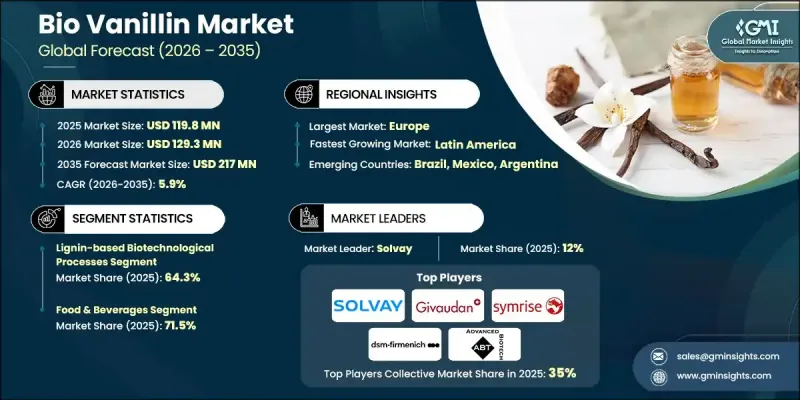
生物香蘭素因其採用永續天然資源生產而備受關注,成為合成香草醛的理想環保替代品。其先進的生物技術工藝使其符合全球永續性舉措,致力於減少對環境的影響。食品、飲料和個人護理行業對天然、潔淨標示產品的需求日益成長,推動了生物香蘭素的廣泛應用。各產業正優先發展綠色化學,並加速減少對石油化學衍生原料的依賴。生物香草素用途廣泛,既可作為優質有機食品的高級調味劑,也可用於天然香料配方。全球對永續性、真實風味和環保實踐的日益關注,並持續推動生物香草素在多個行業的應用,使其成為現代環保產品系列中的關鍵成分。
| 市場覆蓋範圍 | |
|---|---|
| 開始年份 | 2025 |
| 預測年份 | 2026-2035 |
| 起始值 | 1.198億美元 |
| 預測金額 | 2.17億美元 |
| 複合年成長率 | 5.9% |
基於木質素的生物技術製程佔據了64.3%的市場佔有率,預計到2035年將以5.5%的複合年成長率成長。這些製程利用可再生木質纖維素原料,符合循環經濟原則。由於其高效性和能夠生產高純度香草醛,微生物發酵轉化阿魏酸仍然是主要途徑。天然來源的丁香酚和異丁香酚等替代原料也為生產者提供了生產的柔軟性和永續性。
預計到2025年,食品飲料產業將佔據71.5%的市場佔有率,並在2026年至2035年間以5.7%的複合年成長率成長。生物香草素作為優質香料成分,廣泛應用於潔淨標示天然產品中,滿足消費者對純正口味和環保原料的需求。其獨特的芳香特性使其成為香精香料的理想原料,並支持綠色化學的發展。
預計到2025年,北美生物香草醛市佔率將達到27.5%。該地區市場擴張的驅動力主要來自強大的生產能力、永續的生產實踐以及消費者對潔淨標示和天然產品日益成長的需求。美國憑藉其在可再生原料和環保產品配方方面的支持性政策,在北美生物香草市場中處於領先地位。
目錄
第1章調查方法和範圍
第2章執行摘要
第3章業界考察
- 生態系分析
- 供應商情況
- 利潤率
- 每個階段的附加價值
- 影響價值鏈的因素
- 中斷
- 產業影響因素
- 促進要素
- 消費者對天然和潔淨標示成分的需求日益成長。
- 對合成香蘭素的監管壓力
- 主要食品和飲料公司的永續發展舉措
- 產業潛在風險與挑戰
- 香草醛對微生物宿主的毒性
- 生產高成本與合成香草醛的比較
- 市場機遇
- 新興市場的地域擴張
- 利用新型底物(廢棄生質能)
- 促進要素
- 成長潛力分析
- 監管環境
- 北美洲
- 歐洲
- 亞太地區
- 拉丁美洲
- 中東和非洲
- 波特分析
- PESTEL 分析
- 價格趨勢
- 按地區
- 透過生產技術
- 未來市場趨勢
- 科技與創新趨勢
- 當前技術趨勢
- 新興技術
- 專利狀態
- 貿易統計(HS編碼)
(註:貿易統計數據僅涵蓋主要國家。)
- 主要進口國
- 主要出口國
- 永續性和環境方面
- 永續努力
- 減少廢棄物策略
- 生產中的能源效率
- 環保舉措
- 考慮到碳足跡
第4章 競爭情勢
- 介紹
- 公司市佔率分析
- 按地區
- 北美洲
- 歐洲
- 亞太地區
- 拉丁美洲
- 中東和非洲
- 按地區
- 企業矩陣分析
- 主要市場公司的競爭分析
- 競爭定位矩陣
- 重大進展
- 併購
- 夥伴關係與合作
- 新產品發布
- 業務拓展計劃
第5章 依製造技術分類的市場估算與預測,2022-2035年
- 基於木質素的生物技術工藝
- 阿魏酸生物轉化
- 丁香酚生物轉化
- 異丁香酚的生物轉化
- 其他生產技術
- 咖啡酸的生物轉化
- 葡萄糖發酵
- 藜蘆醛的生物轉化
第6章 按應用領域分類的市場估算與預測,2022-2035年
- 食品/飲料
- 冰淇淋和冷凍甜點
- 巧克力和可可製品
- 糖果甜點和烘焙產品
- 飲料
- 乳製品(優格、風味牛奶)
- 其他(穀物、零食、醬料)
- 香水/香氛
- 奢華香水
- 個人保健產品
- 家居用品
- 製藥
- 口服藥物
- 外用藥物
- 營養保健品和膳食補充劑
- 化妝品和個人護理
- 護膚品
- 護髮產品
- 彩妝品
- 其他
- 工業用途
- 飼料添加劑
第7章 2022-2035年各地區市場估算與預測
- 北美洲
- 美國
- 加拿大
- 歐洲
- 德國
- 英國
- 法國
- 西班牙
- 義大利
- 其他歐洲地區
- 亞太地區
- 中國
- 印度
- 日本
- 澳洲
- 韓國
- 亞太其他地區
- 拉丁美洲
- 巴西
- 墨西哥
- 阿根廷
- 其他拉丁美洲地區
- 中東和非洲
- 沙烏地阿拉伯
- 南非
- 阿拉伯聯合大公國
- 其他中東和非洲地區
第8章 公司簡介
- Solvay
- Givaudan
- Symrise AG
- DSM Firmenich
- Advanced Biotech
- Evolva
- Ennolys
- Comax Flavors
- Omega Ingredients Ltd
- Beijing LYS Chemicals Co., Ltd
- Aurochemicals
- Borregaard
- Alfrebro, LLC
- IFF(International Flavors &Fragrances)
- Lesaffre
The Global Bio Vanillin Market was valued at USD 119.8 million in 2025 and is estimated to grow at a CAGR of 5.9% to reach USD 217 million by 2035.
Bio vanillin is gaining traction due to its production from sustainable, natural sources, making it a preferred eco-friendly alternative to synthetic vanillin. With advanced biotechnological processes, bio vanillin aligns with global sustainability initiatives focused on reducing environmental footprints. Rising consumer demand for natural and clean-label products across food, beverages, and personal care is boosting adoption. Industries increasingly prioritize green chemistry and reduced reliance on petrochemical-based ingredients. Bio vanillin's versatility allows its use as a premium flavoring agent in high-quality, organic food products, while also contributing to natural fragrance formulations. The growing global emphasis on sustainability, authentic taste profiles, and environmentally conscious practices continues to drive its adoption across multiple sectors, positioning bio vanillin as a key ingredient in modern, eco-focused product portfolios.
| Market Scope | |
|---|---|
| Start Year | 2025 |
| Forecast Year | 2026-2035 |
| Start Value | $119.8 Million |
| Forecast Value | $217 Million |
| CAGR | 5.9% |
The lignin-based biotechnological processes segment held 64.3% share and is expected to grow at a CAGR of 5.5% through 2035. These processes utilize renewable lignocellulosic materials and support circular economy principles. Ferulic acid conversion through microbial fermentation remains the primary pathway due to its efficiency and ability to produce high-purity vanillin. Alternative feedstocks such as eugenol and isoeugenol, naturally derived, also offer manufacturers flexibility in production and sustainability.
The food & beverages held 71.5% share in 2025 and is anticipated to grow at a CAGR of 5.7% between 2026 and 2035. Bio vanillin is used as a premium flavoring ingredient in clean-label and natural formulations, meeting consumer expectations for authentic taste and environmentally friendly sourcing. Its aromatic qualities also make it a preferred component in fragrance and perfumery applications, supporting green chemistry initiatives.
North America Bio Vanillin Market accounted for 27.5% share in 2025. The region's expansion is driven by strong manufacturing capabilities, sustainable production frameworks, and growing consumer demand for clean-label and natural products. The United States leads the region due to supportive renewable raw material policies and the adoption of environmentally conscious product formulations.
Key players in the Global Bio Vanillin Market include Symrise AG, Solvay, Givaudan, DSM Firmenich, Evolva, Advanced Biotech, Ennolys, Comax Flavors, IFF (International Flavors & Fragrances), Borregaard, Omega Ingredients Ltd, Beijing LYS Chemicals Co., Ltd, Alfrebro, LLC, Lesaffre, and Aurochemicals. Companies in the Global Bio Vanillin Market are enhancing their position by focusing on sustainable production, innovation, and strategic partnerships. Manufacturers are investing in advanced microbial fermentation and lignin-based technologies to improve yield, purity, and eco-efficiency. Expanding global distribution networks and forming collaborations with food, beverage, and personal care brands ensures wider market reach. Firms are also emphasizing R&D to develop alternative feedstocks, maintain cost competitiveness, and meet rising consumer demand for natural and clean-label products. Marketing strategies highlight sustainability, premium quality, and regulatory compliance to strengthen brand recognition and market penetration.
Table of Contents
Chapter 1 Methodology & Scope
- 1.1 Market scope and definition
- 1.2 Research design
- 1.2.1 Research approach
- 1.2.2 Data collection methods
- 1.3 Data mining sources
- 1.3.1 Global
- 1.3.2 Regional/Country
- 1.4 Base estimates and calculations
- 1.4.1 Base year calculation
- 1.4.2 Key trends for market estimation
- 1.5 Primary research and validation
- 1.5.1 Primary sources
- 1.6 Forecast model
- 1.7 Research assumptions and limitations
Chapter 2 Executive Summary
- 2.1 Industry 360° synopsis
- 2.2 Key market trends
- 2.2.1 Regional
- 2.2.2 Production technology
- 2.2.3 Application
- 2.3 TAM Analysis, 2026-2035
- 2.4 CXO perspectives: Strategic imperatives
- 2.4.1 Executive decision points
- 2.4.2 Critical success factors
- 2.5 Future Outlook and Strategic Recommendations
Chapter 3 Industry Insights
- 3.1 Industry ecosystem analysis
- 3.1.1 Supplier landscape
- 3.1.2 Profit margin
- 3.1.3 Value addition at each stage
- 3.1.4 Factor affecting the value chain
- 3.1.5 Disruptions
- 3.2 Industry impact forces
- 3.2.1 Growth drivers
- 3.2.1.1 Rising consumer demand for natural & clean-label ingredients
- 3.2.1.2 Regulatory pressure on synthetic vanillin
- 3.2.1.3 Sustainability commitments by F&B giants
- 3.2.2 Industry pitfalls and challenges
- 3.2.2.1 Vanillin toxicity to microbial hosts
- 3.2.2.2 High production costs vs synthetic vanillin
- 3.2.3 Market opportunities
- 3.2.3.1 Geographic expansion in emerging markets
- 3.2.3.2 Novel substrate utilization (waste biomass)
- 3.2.1 Growth drivers
- 3.3 Growth potential analysis
- 3.4 Regulatory landscape
- 3.4.1 North America
- 3.4.2 Europe
- 3.4.3 Asia Pacific
- 3.4.4 Latin America
- 3.4.5 Middle East & Africa
- 3.5 Porter';s analysis
- 3.6 PESTEL analysis
- 3.7 Price trends
- 3.7.1 By region
- 3.7.2 By production technology
- 3.8 Future market trends
- 3.9 Technology and Innovation landscape
- 3.9.1 Current technological trends
- 3.9.2 Emerging technologies
- 3.10 Patent Landscape
- 3.11 Trade statistics (HS code)
( Note: the trade statistics will be provided for key countries only)
- 3.11.1 Major importing countries
- 3.11.2 Major exporting countries
- 3.12 Sustainability and environmental aspects
- 3.12.1 Sustainable practices
- 3.12.2 Waste reduction strategies
- 3.12.3 Energy efficiency in production
- 3.12.4 Eco-friendly initiatives
- 3.13 Carbon footprint consideration
Chapter 4 Competitive Landscape, 2025
- 4.1 Introduction
- 4.2 Company market share analysis
- 4.2.1 By region
- 4.2.1.1 North America
- 4.2.1.2 Europe
- 4.2.1.3 Asia Pacific
- 4.2.1.4 LATAM
- 4.2.1.5 MEA
- 4.2.1 By region
- 4.3 Company matrix analysis
- 4.4 Competitive analysis of major market players
- 4.5 Competitive positioning matrix
- 4.6 Key developments
- 4.6.1 Mergers & acquisitions
- 4.6.2 Partnerships & collaborations
- 4.6.3 New Product Launches
- 4.6.4 Expansion Plans
Chapter 5 Market Estimates and Forecast, By Production Technology, 2022-2035 (USD Million) (Kilo Tons)
- 5.1 Key trends
- 5.2 Lignin-based biotechnological processes
- 5.3 Ferulic acid bioconversion
- 5.4 Eugenol bioconversion
- 5.5 Isoeugenol bioconversion
- 5.6 Other production technologies
- 5.6.1 Caffeic acid bioconversion
- 5.6.2 Glucose fermentation
- 5.6.3 Veratraldehyde biotransformation
Chapter 6 Market Estimates and Forecast, By Application, 2022-2035 (USD Million) (Kilo Tons)
- 6.1 Key trends
- 6.2 Food & beverages
- 6.2.1 Ice cream & frozen desserts
- 6.2.2 Chocolate & cocoa products
- 6.2.3 Confectioneries & baked goods
- 6.2.4 Beverages
- 6.2.5 Dairy products (yogurt, flavored milk)
- 6.2.6 Others (cereals, snacks, sauces)
- 6.3 Fragrances & perfumery
- 6.3.1 Fine fragrances
- 6.3.2 Personal care products
- 6.3.3 Household products
- 6.4 Pharmaceuticals
- 6.4.1 Oral medications
- 6.4.2 Topical formulations
- 6.4.3 Nutraceuticals & dietary supplements
- 6.5 Cosmetics & personal care
- 6.5.1 Skincare products
- 6.5.2 Haircare products
- 6.5.3 Color cosmetics
- 6.6 Others
- 6.6.1 Industrial applications
- 6.6.2 Animal feed additives
Chapter 7 Market Estimates and Forecast, By Region, 2022-2035 (USD Million) (Kilo Tons)
- 7.1 Key trends
- 7.2 North America
- 7.2.1 U.S.
- 7.2.2 Canada
- 7.3 Europe
- 7.3.1 Germany
- 7.3.2 UK
- 7.3.3 France
- 7.3.4 Spain
- 7.3.5 Italy
- 7.3.6 Rest of Europe
- 7.4 Asia Pacific
- 7.4.1 China
- 7.4.2 India
- 7.4.3 Japan
- 7.4.4 Australia
- 7.4.5 South Korea
- 7.4.6 Rest of Asia Pacific
- 7.5 Latin America
- 7.5.1 Brazil
- 7.5.2 Mexico
- 7.5.3 Argentina
- 7.5.4 Rest of Latin America
- 7.6 Middle East and Africa
- 7.6.1 Saudi Arabia
- 7.6.2 South Africa
- 7.6.3 UAE
- 7.6.4 Rest of Middle East and Africa
Chapter 8 Company Profiles
- 8.1 Solvay
- 8.2 Givaudan
- 8.3 Symrise AG
- 8.4 DSM Firmenich
- 8.5 Advanced Biotech
- 8.6 Evolva
- 8.7 Ennolys
- 8.8 Comax Flavors
- 8.9 Omega Ingredients Ltd
- 8.10 Beijing LYS Chemicals Co., Ltd
- 8.11 Aurochemicals
- 8.12 Borregaard
- 8.13 Alfrebro, LLC
- 8.14 IFF (International Flavors & Fragrances)
- 8.15 Lesaffre

 生物香草醛市場:依原料、形態、純度等級及應用分類-2026-2032年全球市場預測
 生物香草醛:市場佔有率分析、產業趨勢與統計、成長預測(2026-2031)
 生物香草醛市場-全球產業規模、佔有率、趨勢、機會、預測:按應用、地區和競爭格局分類,2021-2031年
 生物香草醛市場報告:按原料、應用和地區分類(2026-2034 年)
 2026-2034年全球生物香草醛市場規模、佔有率、趨勢和成長分析報告
 生物香草醛市場規模、佔有率及成長分析(按來源、應用及地區分類)-2026-2033年產業預測
 生物香草素市場規模、佔有率和趨勢分析報告:按最終用途、按地區、細分市場預測,2025-2030 年
 生物香草素市場報告:2030 年趨勢、預測與競爭分析