


 |
市場調查報告書
商品編碼
1928902
金屬加工液市場機會、成長要素、產業趨勢分析及2026年至2035年預測Metalworking Fluids Market Opportunity, Growth Drivers, Industry Trend Analysis, and Forecast 2026 - 2035 |
||||||

全球金屬加工液市場預計到 2025 年將達到 136 億美元,到 2035 年將達到 257 億美元,年複合成長率為 6.7%。
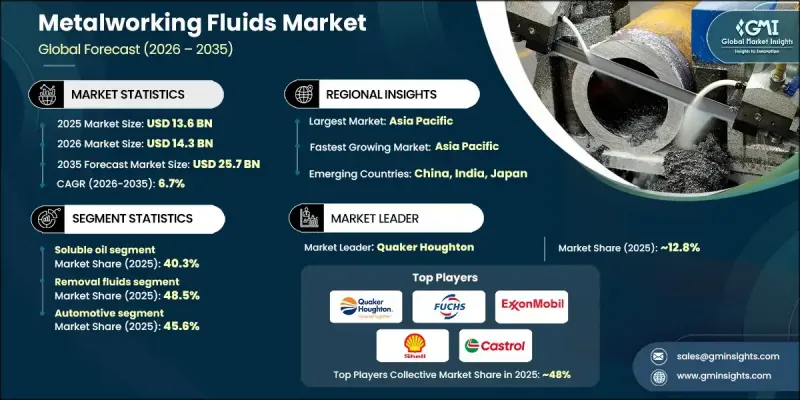
金屬加工液是指用於機械加工、研磨、成形和表面處理等製程的專用潤滑劑和冷卻劑。這些產品包括純油、水溶性油、半合成油和全合成油,它們發揮重要的功能,例如減少摩擦、散熱、排屑、防止腐蝕和延長刀具壽命。水溶性加工液因其成本效益高、乳化穩定性好以及適用於各種加工製作流程優點而被廣泛採用,因此佔據市場主導。汽車和航太製造業的擴張、對高精度零件需求的不斷成長以及加工技術的進步是推動市場成長的主要因素。此外,人們對生物基和永續配方的日益關注,以及對高速、複雜金屬加工應用性能的改進,也推動了全球市場的需求。在熱穩定性、潤滑性和表面光潔度方面的持續創新,確保了金屬加工液在現代製造業中始終扮演著不可或缺的角色。
| 市場覆蓋範圍 | |
|---|---|
| 開始年份 | 2025 |
| 預測年份 | 2026-2035 |
| 起始值 | 136億美元 |
| 預測金額 | 257億美元 |
| 複合年成長率 | 6.7% |
2025年,可溶性油市佔率達到40.3%,預計2026年至2035年將以6.5%的複合年成長率成長。可溶性油因其在冷卻效率、潤滑性能和成本效益方面的均衡表現而備受青睞。這些油液具有優異的乳化穩定性和多功能性,可滿足銑削、鑽孔、車削和研磨等多種應用需求。水基配方在提供高效散熱的同時,也能為中等負載作業提供足夠的潤滑,因此是通用機械加工的首選。
2025年,切削液市佔率佔比達48.5%,預計2026年至2035年將以7.2%的複合年成長率成長。其市場主導地位主要源自於汽車、航太和通用工程等產業對切削、研磨、銑削、鑽孔和車削等加工操作的根本性需求。切削液在金屬去除過程中提供關鍵的潤滑、冷卻、切屑管理和刀具保護,確保穩定的生產效率。由於其對各種金屬和工況的廣泛適用性,切削液將繼續作為機械加工的基礎發揮至關重要的作用。
預計到2025年,美國金屬加工液市場規模將達26億美元。北美地區,尤其是美國市場的成長,得益於其強大的工業基礎,包括汽車製造、航太零件製造和機械生產。引擎、變速箱和結構件製造對精度、效率和可靠性的需求,持續推動高性能加工液(例如切削油、半合成油和成型油)的需求。先進的基礎設施、完善的生產設施和嚴格的品質標準,也持續推動該地區市場對這些產品的採用。
目錄
第1章調查方法和範圍
第2章執行摘要
第3章業界考察
- 生態系分析
- 供應商情況
- 利潤率
- 每個階段的附加價值
- 影響價值鏈的因素
- 中斷
- 產業影響因素
- 促進要素
- 產業潛在風險與挑戰
- 市場機遇
- 成長潛力分析
- 監管環境
- 北美洲
- 歐洲
- 亞太地區
- 拉丁美洲
- 中東和非洲
- 波特分析
- PESTEL 分析
- 科技與創新趨勢
- 當前技術趨勢
- 新興技術
- 價格趨勢
- 按地區
- 依產品
- 未來市場趨勢
- 科技與創新趨勢
- 當前技術趨勢
- 新興技術
- 專利狀態
- 貿易統計(HS編碼)
(註:貿易統計數據僅涵蓋主要國家。)
- 主要進口國
- 主要出口國
- 永續性和環境方面
- 永續努力
- 減少廢棄物策略
- 生產中的能源效率
- 環保舉措
- 考慮到碳足跡
第4章 競爭情勢
- 介紹
- 公司市佔率分析
- 按地區
- 北美洲
- 歐洲
- 亞太地區
- 拉丁美洲
- 中東和非洲
- 按地區
- 企業矩陣分析
- 主要市場公司的競爭分析
- 競爭定位矩陣
- 重大進展
- 併購
- 夥伴關係與合作
- 新產品發布
- 擴張計劃
第5章 2022-2035年按產品分類的市場估算與預測
- 純油
- 可溶性油
- 半合成流體
- 合成流體
第6章 按應用領域分類的市場估算與預測,2022-2035年
- 液體
- 成型液
- 保護液
- 加工液
7. 依最終用途分類的市場估計與預測,2022-2035 年
- 車
- 航太
- 建造
- 電
- 農業
- 船
- 衛生保健
- 其他
第8章 2022-2035年各地區市場估算與預測
- 北美洲
- 美國
- 加拿大
- 歐洲
- 德國
- 英國
- 法國
- 西班牙
- 義大利
- 其他歐洲地區
- 亞太地區
- 中國
- 印度
- 日本
- 澳洲
- 韓國
- 亞太其他地區
- 拉丁美洲
- 巴西
- 墨西哥
- 阿根廷
- 其他拉丁美洲地區
- 中東和非洲
- 沙烏地阿拉伯
- 南非
- 阿拉伯聯合大公國
- 其他中東和非洲地區
第9章:公司簡介
- Quaker Houghton
- FUCHS Petrolub SE
- ExxonMobil
- Shell(Shell Lubricants)
- BP Castrol
- Chevron(Caltex)
- TotalEnergies
- Idemitsu Kosan
- Yushiro Chemical
- Blaser Swisslube
- Master Fluid Solutions
- Milacron(Cimcool)
- Oemeta Chemische Werke
- Petron Corporation
- Phoenix Petroleum Philippines
The Global Metalworking Fluids Market was valued at USD 13.6 billion in 2025 and is estimated to grow at a CAGR of 6.7% to reach USD 25.7 billion by 2035.
Metalworking fluids are described as specialized lubricants and coolants essential for machining, grinding, forming, and surface treatment processes. These products, available as neat oils, soluble oils, semi-synthetic, and fully synthetic fluids, provide vital functions such as friction reduction, heat dissipation, chip removal, corrosion protection, and tool life enhancement. Soluble oils dominate the market with broad adoption due to their cost-effectiveness, emulsion stability, and suitability across diverse machining operations. Market growth is propelled by expanding automotive and aerospace manufacturing, rising demand for high-precision components, and advances in machining technologies. Increasing focus on bio-based and sustainable formulations, along with enhanced performance characteristics for high-speed and complex metalworking, is further driving global demand. Continuous innovation in thermal stability, lubricity, and surface finish quality ensures that metalworking fluids remain indispensable in modern manufacturing.
| Market Scope | |
|---|---|
| Start Year | 2025 |
| Forecast Year | 2026-2035 |
| Start Value | $13.6 billion |
| Forecast Value | $25.7 billion |
| CAGR | 6.7% |
The soluble oil segment accounted for 40.3% share in 2025 and is expected to grow at a CAGR of 6.5% from 2026 to 2035. Soluble oils are favored due to their ability to provide a balanced combination of cooling efficiency, lubrication performance, and cost-effectiveness. These fluids offer excellent emulsion stability and versatility, supporting applications like milling, drilling, turning, and grinding. Their water-based formulation ensures efficient heat dissipation while maintaining sufficient lubrication for moderate-duty operations, making them a preferred choice for general machining requirements.
The removal fluids segment held a 48.5% share in 2025 and is projected to grow at a CAGR of 7.2% from 2026 to 2035. Their dominance is driven by the fundamental need for cutting, grinding, milling, drilling, and turning operations across automotive, aerospace, and general engineering sectors. Removal fluids provide critical lubrication, cooling, chip management, and tool protection, ensuring consistent productivity in metal removal processes. They remain the backbone of machining operations due to their wide applicability across various metals and operational conditions.
U.S. Metalworking Fluids Market generated USD 2.6 billion in 2025. Growth in North America, particularly in the United States, is supported by a strong industrial base encompassing automotive manufacturing, aerospace component fabrication, and machinery production. The demand for high-performance fluids, including removal, semi-synthetic, and forming fluids, is sustained by the requirement for precision, efficiency, and reliability in engine, transmission, and structural component manufacturing. Advanced infrastructure, established production facilities, and stringent quality standards continue to drive regional market adoption.
Key players operating in the Global Metalworking Fluids Market include Quaker Houghton, ExxonMobil, FUCHS Petrolub SE, Blaser Swisslube, Chevron (Caltex), TotalEnergies, Idemitsu Kosan, Shell (Shell Lubricants), Milacron (Cimcool), Master Fluid Solutions, Yushiro Chemical, Petron Corporation, Oemeta Chemische Werke, Phoenix Petroleum Philippines, and BP Castrol. Companies in the Global Metalworking Fluids Market are strengthening their positions by focusing on product innovation, sustainability, and technical support. Leading manufacturers are developing high-performance synthetic and semi-synthetic fluids with improved thermal stability, lubricity, and emulsion life to meet the demands of modern machining operations. Strategic collaborations with OEMs and industrial partners enable customized solutions tailored to specific metalworking processes. Expansion into emerging regions, coupled with efficient supply chain management, allows companies to widen their global footprint.
Table of Contents
Chapter 1 Methodology & Scope
- 1.1 Market scope and definition
- 1.2 Research design
- 1.2.1 Research approach
- 1.2.2 Data collection methods
- 1.3 Data mining sources
- 1.3.1 Global
- 1.3.2 Regional/Country
- 1.4 Base estimates and calculations
- 1.4.1 Base year calculation
- 1.4.2 Key trends for market estimation
- 1.5 Primary research and validation
- 1.5.1 Primary sources
- 1.6 Forecast model
- 1.7 Research assumptions and limitations
Chapter 2 Executive Summary
- 2.1 Industry 360° synopsis
- 2.2 Key market trends
- 2.2.1 Product
- 2.2.2 Application
- 2.2.3 End Use
- 2.2.4 Regional
- 2.3 TAM Analysis, 2025-2035
- 2.4 CXO perspectives: Strategic imperatives
- 2.4.1 Executive decision points
- 2.4.2 Critical success factors
- 2.5 Future outlook and strategic recommendations
Chapter 3 Industry Insights
- 3.1 Industry ecosystem analysis
- 3.1.1 Supplier landscape
- 3.1.2 Profit margin
- 3.1.3 Value addition at each stage
- 3.1.4 Factor affecting the value chain
- 3.1.5 Disruptions
- 3.2 Industry impact forces
- 3.2.1 Growth drivers
- 3.2.2 Industry pitfalls and challenges
- 3.2.3 Market opportunities
- 3.3 Growth potential analysis
- 3.4 Regulatory landscape
- 3.4.1 North America
- 3.4.2 Europe
- 3.4.3 Asia Pacific
- 3.4.4 Latin America
- 3.4.5 Middle East & Africa
- 3.5 Porter';s analysis
- 3.6 PESTEL analysis
- 3.7 Technology and innovation landscape
- 3.7.1 Current technological trends
- 3.7.2 Emerging technologies
- 3.8 Price trends
- 3.8.1 By region
- 3.8.2 By product
- 3.9 Future market trends
- 3.10 Technology and innovation landscape
- 3.10.1 Current technological trends
- 3.10.2 Emerging technologies
- 3.11 Patent landscape
- 3.12 Trade statistics (HS code)
( Note: the trade statistics will be provided for key countries only)
- 3.12.1 Major importing countries
- 3.12.2 Major exporting countries
- 3.13 Sustainability and environmental aspects
- 3.13.1 Sustainable practices
- 3.13.2 Waste reduction strategies
- 3.13.3 Energy efficiency in production
- 3.13.4 Eco-friendly initiatives
- 3.14 Carbon footprint consideration
Chapter 4 Competitive Landscape, 2025
- 4.1 Introduction
- 4.2 Company market share analysis
- 4.2.1 By region
- 4.2.1.1 North America
- 4.2.1.2 Europe
- 4.2.1.3 Asia Pacific
- 4.2.1.4 LATAM
- 4.2.1.5 MEA
- 4.2.1 By region
- 4.3 Company matrix analysis
- 4.4 Competitive analysis of major market players
- 4.5 Competitive positioning matrix
- 4.6 Key developments
- 4.6.1 Mergers & acquisitions
- 4.6.2 Partnerships & collaborations
- 4.6.3 New product launches
- 4.6.4 Expansion plans
Chapter 5 Market Estimates and Forecast, By Product, 2022-2035 (USD Million) (Kilo Tons)
- 5.1 Key trends
- 5.2 Neat oil
- 5.3 Soluble oil
- 5.4 Semi-synthetic fluid
- 5.5 Synthetic fluid
Chapter 6 Market Estimates and Forecast, By Application, 2022-2035 (USD Million) (Kilo Tons)
- 6.1 Key trends
- 6.2 Removal fluids
- 6.3 Forming fluids
- 6.4 Protecting fluids
- 6.5 Treating fluids
Chapter 7 Market Estimates and Forecast, By End Use, 2022-2035 (USD Million) (Kilo Tons)
- 7.1 Key trends
- 7.2 Automotive
- 7.3 Aerospace
- 7.4 Construction
- 7.5 Electrical & power
- 7.6 Agriculture
- 7.7 Marine
- 7.8 Healthcare
- 7.9 Others
Chapter 8 Market Estimates and Forecast, By Region, 2022-2035 (USD Million) (Kilo Tons)
- 8.1 Key trends
- 8.2 North America
- 8.2.1 U.S.
- 8.2.2 Canada
- 8.3 Europe
- 8.3.1 Germany
- 8.3.2 UK
- 8.3.3 France
- 8.3.4 Spain
- 8.3.5 Italy
- 8.3.6 Rest of Europe
- 8.4 Asia Pacific
- 8.4.1 China
- 8.4.2 India
- 8.4.3 Japan
- 8.4.4 Australia
- 8.4.5 South Korea
- 8.4.6 Rest of Asia Pacific
- 8.5 Latin America
- 8.5.1 Brazil
- 8.5.2 Mexico
- 8.5.3 Argentina
- 8.5.4 Rest of Latin America
- 8.6 Middle East and Africa
- 8.6.1 Saudi Arabia
- 8.6.2 South Africa
- 8.6.3 UAE
- 8.6.4 Rest of Middle East and Africa
Chapter 9 Company Profiles
- 9.1 Quaker Houghton
- 9.2 FUCHS Petrolub SE
- 9.3 ExxonMobil
- 9.4 Shell (Shell Lubricants)
- 9.5 BP Castrol
- 9.6 Chevron (Caltex)
- 9.7 TotalEnergies
- 9.8 Idemitsu Kosan
- 9.9 Yushiro Chemical
- 9.10 Blaser Swisslube
- 9.11 Master Fluid Solutions
- 9.12 Milacron (Cimcool)
- 9.13 Oemeta Chemische Werke
- 9.14 Petron Corporation
- 9.15 Phoenix Petroleum Philippines

 金屬加工液市場報告:按產品類型、原料、最終用途、潤滑劑類型、產業和地區分類(2026-2034 年)
 金屬加工液市場規模及預測(2021-2034年),全球及區域佔有率、趨勢及成長機會分析報告:依產品類型、類型及應用分類
 金屬加工液市場:2026-2032年全球市場預測(依產品類型、最終用途產業、製程、原料及銷售管道)
 全球金屬加工液市場:市場規模、佔有率和趨勢分析(按產品、應用、最終用途、最終用途產業和地區分類),細分市場預測(2026-2033 年)
 金屬加工液全球市場報告(2026 年)
 2026-2030年全球金屬加工液市場日本金屬加工液市場報告:按產品類型、原料、最終用途、流體類型、產業和地區分類(2026-2034年)
 全球金屬加工液市場(至 2030 年):按類型(直餾油、水溶性油、半合成油、合成油)、產品類型(除油、防銹油、成型油、加工油)、最終用戶產業和地區分類
 全球金屬加工液市場預測(截至 2030 年):按產品、功能、最終用戶和地區進行分析
 全球金屬加工液市場規模、產品類型、最終用戶產業、地區、範圍和預測