

 |
市場調查報告書
商品編碼
1928901
化妝品防腐劑市場機會、成長要素、產業趨勢分析及2026年至2035年預測Cosmetic Preservatives Market Opportunity, Growth Drivers, Industry Trend Analysis, and Forecast 2026 - 2035 |
||||||

全球化妝品防腐劑市場預計到 2025 年將達到 16 億美元,到 2035 年將達到 26 億美元,年複合成長率為 4.6%。
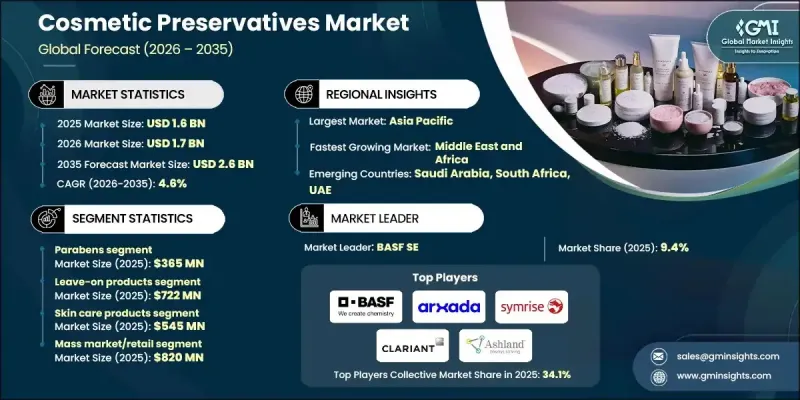
化妝品防腐劑市場的成長主要源自於消費者對安全、持久的化妝品配方日益成長的需求,以及意識提升不斷提高。化妝品防腐劑是配方中不可或缺的成分,能夠抑制微生物生長,並在生產、儲存和使用過程中保護產品免受污染。它們在維持產品的完整性、安全性和長期功效方面發揮著至關重要的作用。化妝品配方中水性體系的日益普及進一步凸顯了有效防腐的重要性。監管審查也影響市場動態,迫使製造商在滿足消費者期望的同時,遵守嚴格的安全標準。配方科學的進步推動了向更安全、更通用的防腐體系的過渡。包裝和成分技術的創新進一步加強了對污染的預防。所有這些因素共同強化了防腐劑作為現代化妝品開發核心要素的重要性。
| 市場覆蓋範圍 | |
|---|---|
| 開始年份 | 2025 |
| 預測年份 | 2026-2035 |
| 起始值 | 16億美元 |
| 預測金額 | 26億美元 |
| 複合年成長率 | 4.6% |
2025年,對羥基苯甲酸酯類防腐劑市場規模預計將達3.65億美元。與其他廣泛使用的合成防腐劑系統一樣,由於其可靠的抗菌性能,該類產品持續獲得市場認可。同時,隨著消費者尋求更親膚、更環保的選擇,對替代防腐劑的需求也不斷增加。為了滿足不同的配方需求,同時確保符合安全法規,各種防腐劑被廣泛應用。
預計到2025年,護膚品市場收入將達到5.45億美元。此品類的成長主要得益於消費者對個人健康、日常照護習慣、產品持續創新的日益關注。此外,消費者對其他個人護理品類的需求不斷成長,也推動了防腐劑需求的成長。
預計到 2025 年,美國化妝品防腐劑市場規模將達到 4.188 億美元。北美地區消費者對美容產品的強勁支出、持續的配方創新以及對潔淨標示和負責任配方化妝品的日益偏好,都支撐了該地區的成長。
目錄
第1章調查方法和範圍
第2章執行摘要
第3章業界考察
- 生態系分析
- 供應商情況
- 利潤率
- 每個階段的附加價值
- 影響價值鏈的因素
- 中斷
- 產業影響因素
- 促進要素
- 個人保健產品需求不斷成長
- 擴大水性配方的使用
- 全球化妝品產業的擴張
- 產業潛在風險與挑戰
- 皮膚刺激過敏風險
- 天然防腐劑的有效性有限。
- 市場機遇
- 消費者對天然和潔淨標示的化妝品的需求日益成長
- 保存系統技術進步
- 採用先進的包裝技術
- 促進要素
- 成長潛力分析
- 監管環境
- 北美洲
- 歐洲
- 亞太地區
- 拉丁美洲
- 中東和非洲
- 波特分析
- PESTEL 分析
- 科技與創新趨勢
- 當前技術趨勢
- 新興技術
- 價格趨勢
- 按地區
- 按防腐劑類型
- 未來市場趨勢
- 科技與創新趨勢
- 當前技術趨勢
- 新興技術
- 專利狀態
- 貿易統計(HS編碼)(註:僅提供主要國家的貿易統計)
- 主要進口國
- 主要出口國
- 永續性和環境方面
- 永續努力
- 減少廢棄物策略
- 生產中的能源效率
- 環保舉措
- 考慮到碳足跡
第4章 競爭情勢
- 介紹
- 公司市佔率分析
- 按地區
- 北美洲
- 歐洲
- 亞太地區
- 拉丁美洲
- 中東和非洲
- 按地區
- 企業矩陣分析
- 主要市場公司的競爭分析
- 競爭定位矩陣
- 重大進展
- 併購
- 夥伴關係與合作
- 新產品發布
- 擴張計劃
5. 2022-2035年按防腐劑類型分類的市場估算與預測
- 對羥基苯甲酸酯
- 對羥基苯甲酸甲酯
- 對羥基苯甲酸乙酯
- 對羥基苯甲酸丙酯
- 對羥基苯甲酸丁酯
- 對羥基苯甲酸酯混合物
- 苯氧乙醇和醇類
- 苯氧乙醇
- 苯甲醇
- 氯丁醇
- 變性酒精
- 甲醛釋放劑
- DMDM乙內醯脲
- 咪唑烷基脲
- 二唑烷基脲
- 季銨鹽-15
- 溴硝醇
- 有機酸
- 苯甲酸和苯甲酸鈉
- 山梨酸和山梨酸鉀
- 水楊酸
- 脫氫乙酸
- 檸檬酸和檸檬酸銀
- 異噻唑啉酮
- 甲基異噻唑啉酮(MIT)
- 甲基氯異噻唑啉酮(MCI/MIT混合物)
- 苯並異噻唑啉酮(BIT)
- 季銨化合物
- 苯扎氯銨
- 十六烷基三甲基氯化銨
- 聚氨丙基雙胍(PAPB)
- 氯己定及其鹽類
- 天然和植物來源的防腐劑
- 精油和植物萃取物
- 發酵原料
- 天然存在的有機酸
- Ecocert/COSMOS認證的防腐劑
- 多功能防腐劑
- 辛甘醇
- 戊二醇
- 乙基己基甘油
- 辛酸甘油酯
- 1,2-二醇和多元醇
- 其他
- Zinc pyrithione
- 三氯生(在某些地區使用受限)
- 銀化合物
- 碘丙炔氨基甲酸酯
第6章 依產品類型分類的市場估算與預測,2022-2035年
- 免洗商品
- 清洗產品
- 水性產品
- 乳液(油包水型和水包油型)
- 凝膠和水溶液
- 無水產品
- 油性製劑
- 粉末和固態形式
第7章 按應用領域分類的市場估算與預測,2022-2035年
- 護膚
- 乳霜和乳液
- 保濕霜
- 抗衰老產品
- 防曬油和防曬護理
- 洗面乳
- 美容精華/高濃度精華液
- 身體乳和潤膚霜
- 護髮
- 洗髮精
- 護髮素
- 美髮造型產品(啫咖哩、摩絲、噴霧)
- 染髮劑
- 髮膜和護理
- 頭皮護理產品
- 彩妝品(化妝品)
- 粉底液和BB/CC霜
- 唇膏/唇蜜
- 眼妝(睫毛膏、眼影、眼線)
- 指甲保養(指甲油、卸甲水)
- 腮紅和修容粉
- 化妝品
- 除臭劑和止汗劑
- 沐浴乳和沐浴凝膠
- 沐浴添加物(浴鹽、泡泡浴)
- 敏感部位衛生用品
- 乾洗手劑
- 香水
- 香水
- 冒號
- 身體噴霧
- 嬰兒護理產品
- 嬰兒潤膚露和乳霜
- 嬰兒洗髮精浴露
- 嬰兒擦拭巾
- 尿布疹膏
- 其他
- 化妝濕紙巾
- 口腔清潔用品(非藥用漱口水)
- 男士護理產品
- 曬黑產品
第8章 依最終用途分類的市場估算與預測,2022-2035年
- 大眾市場/零售
- 高階/豪華
- 專業/沙龍
- 契約製造/B2B
第9章 2022-2035年各地區市場估算與預測
- 北美洲
- 美國
- 加拿大
- 墨西哥
- 歐洲
- 德國
- 英國
- 法國
- 西班牙
- 義大利
- 其他歐洲地區
- 亞太地區
- 中國
- 印度
- 日本
- 澳洲
- 韓國
- 亞太其他地區
- 拉丁美洲
- 巴西
- 墨西哥
- 阿根廷
- 其他拉丁美洲地區
- 中東和非洲
- 沙烏地阿拉伯
- 南非
- 阿拉伯聯合大公國
- 其他中東和非洲地區
第10章:公司簡介
- Akema Srl
- Arkema SA
- Ashland Global Holdings Inc
- BASF SE
- Brenntag SE
- Clariant International Ltd
- Dadia Chemical Industries
- Evonik Industries AG
- Galaxy Surfactants Ltd
- Inolex Chemical Company
- Kumar Organic Products Ltd
- Lanxess Corporation
- Lonza Group AG
- Micro Science Tech
- Minasolve
- Naturex(Givaudan)
- Salicylates and Chemicals Pvt Ltd
- Sharon Personal Care
- Spec-Chem Industry Inc.
- Stepan Company
- Symrise AG
- Thor Group(Part of Arxada)
- Troy Corporation
The Global Cosmetic Preservatives Market was valued at USD 1.6 billion in 2025 and is estimated to grow at a CAGR of 4.6% to reach USD 2.6 billion by 2035.
Growth is supported by rising demand for safe, long-lasting cosmetic formulations and increasing consumer awareness around product hygiene and shelf stability. Cosmetic preservatives are described as essential formulation components that inhibit microbial growth and protect products from contamination during production, storage, and use. Their role is critical in maintaining product integrity, safety, and performance over time. As cosmetic formulations increasingly incorporate water-based systems, the need for effective preservation continues to rise. Regulatory oversight is also shaping market dynamics, as manufacturers must comply with strict safety standards while meeting consumer expectations. Advances in formulation science are supporting the transition toward safer and multifunctional preservation systems. Innovation in packaging and ingredient technology is further enhancing protection against contamination. Together, these factors are reinforcing the importance of preservatives as a core element in modern cosmetic product development.
| Market Scope | |
|---|---|
| Start Year | 2025 |
| Forecast Year | 2026-2035 |
| Start Value | $1.6 Billion |
| Forecast Value | $2.6 Billion |
| CAGR | 4.6% |
The parabens segment accounted for USD 365 million in 2025. This category, along with other widely used synthetic preservation systems, continues to be adopted due to reliable antimicrobial performance. At the same time, demand for alternative preservation solutions is increasing as consumers seek gentler and environmentally aligned options. A range of preservation chemistries is being used to meet diverse formulation requirements while ensuring compliance with safety regulations.
The skin care products segment generated USD 545 million in 2025. Growth in this category is being driven by heightened focus on personal wellness, daily care routines, and ongoing product innovation. Rising interest across other personal care categories is also contributing to broader preservative demand.
U.S. Cosmetic Preservatives Market reached USD 418.8 million in 2025. Regional growth is supported by strong consumer spending on beauty products, continued formulation innovation, and rising preference for clean-label and responsibly formulated cosmetics across North America.
Key companies operating in the Cosmetic Preservatives Market include BASF SE, Evonik Industries AG, Clariant International Ltd, Symrise AG, Lanxess Corporation, Ashland, Lonza Group AG, Arkema S.A., Stepan Company, Troy Corporation, Inolex Chemical Company, Galaxy Surfactants Ltd, Sharon Personal Care, Brenntag SE, Naturex (Givaudan), Akema S.r.l, Thor Group (part of Arxada), Kumar Organic Products Ltd, Minasolve, Micro Science Tech, Spec-Chem Industry Inc., Dadia Chemical Industries, Salicylates and Chemicals Pvt Ltd.Companies in the Cosmetic Preservatives Market are strengthening their market positions through innovation, regulatory alignment, and portfolio diversification. Manufacturers are investing in research to develop safer, multifunctional preservation systems that align with clean beauty trends. Expansion of natural and mild preservative solutions is helping brands meet changing consumer preferences. Strategic collaborations with cosmetic formulators are supporting customized solutions and long-term supply agreements.
Table of Contents
Chapter 1 Methodology & Scope
- 1.1 Market scope and definition
- 1.2 Research design
- 1.2.1 Research approach
- 1.2.2 Data collection methods
- 1.3 Data mining sources
- 1.3.1 Global
- 1.3.2 Regional/Country
- 1.4 Base estimates and calculations
- 1.4.1 Base year calculation
- 1.4.2 Key trends for market estimation
- 1.5 Primary research and validation
- 1.5.1 Primary sources
- 1.6 Forecast model
- 1.7 Research assumptions and limitations
Chapter 2 Executive Summary
- 2.1 Industry 360° synopsis
- 2.2 Key market trends
- 2.2.1 Preservative Type
- 2.2.2 Product Form
- 2.2.3 Application
- 2.2.4 End Use
- 2.2.5 Regional
- 2.3 TAM Analysis, 2025-2035
- 2.4 CXO perspectives: Strategic imperatives
- 2.4.1 Executive decision points
- 2.4.2 Critical success factors
- 2.5 Future outlook and strategic recommendations
Chapter 3 Industry Insights
- 3.1 Industry ecosystem analysis
- 3.1.1 Supplier landscape
- 3.1.2 Profit margin
- 3.1.3 Value addition at each stage
- 3.1.4 Factor affecting the value chain
- 3.1.5 Disruptions
- 3.2 Industry impact forces
- 3.2.1 Growth drivers
- 3.2.1.1 Rising demand for personal care products
- 3.2.1.2 Rising popularity of water-based formulations
- 3.2.1.3 Expansion of the global cosmetic industry
- 3.2.2 Industry pitfalls and challenges
- 3.2.2.1 Risk of skin irritation and allergies
- 3.2.2.2 Limited efficacy of natural preservatives
- 3.2.3 Market opportunities
- 3.2.3.1 Growing demand for natural and clean-label cosmetics
- 3.2.3.2 Technological advancements in preservation systems
- 3.2.3.3 Adoption of advanced packaging technologies
- 3.2.1 Growth drivers
- 3.3 Growth potential analysis
- 3.4 Regulatory landscape
- 3.4.1 North America
- 3.4.2 Europe
- 3.4.3 Asia Pacific
- 3.4.4 Latin America
- 3.4.5 Middle East & Africa
- 3.5 Porter';s analysis
- 3.6 PESTEL analysis
- 3.7 Technology and innovation landscape
- 3.7.1 Current technological trends
- 3.7.2 Emerging technologies
- 3.8 Price trends
- 3.8.1 By region
- 3.8.2 By preservative type
- 3.9 Future market trends
- 3.10 Technology and innovation landscape
- 3.10.1 Current technological trends
- 3.10.2 Emerging technologies
- 3.11 Patent landscape
- 3.12 Trade statistics (HS code) ( Note: the trade statistics will be provided for key countries only)
- 3.12.1 Major importing countries
- 3.12.2 Major exporting countries
- 3.13 Sustainability and environmental aspects
- 3.13.1 Sustainable practices
- 3.13.2 Waste reduction strategies
- 3.13.3 Energy efficiency in production
- 3.13.4 Eco-friendly initiatives
- 3.14 Carbon footprint consideration
Chapter 4 Competitive Landscape, 2025
- 4.1 Introduction
- 4.2 Company market share analysis
- 4.2.1 By region
- 4.2.1.1 North America
- 4.2.1.2 Europe
- 4.2.1.3 Asia Pacific
- 4.2.1.4 LATAM
- 4.2.1.5 MEA
- 4.2.1 By region
- 4.3 Company matrix analysis
- 4.4 Competitive analysis of major market players
- 4.5 Competitive positioning matrix
- 4.6 Key developments
- 4.6.1 Mergers & acquisitions
- 4.6.2 Partnerships & collaborations
- 4.6.3 New product launches
- 4.6.4 Expansion plans
Chapter 5 Market Estimates and Forecast, By Preservative Type, 2022-2035 (USD Million) (Kilo Tons)
- 5.1 Key trends
- 5.2 Parabens
- 5.2.1 Methylparaben
- 5.2.2 Ethylparaben
- 5.2.3 Propylparaben
- 5.2.4 Butylparaben
- 5.2.5 Paraben blends
- 5.3 Phenoxyethanol & alcohols
- 5.3.1 Phenoxyethanol
- 5.3.2 Benzyl alcohol
- 5.3.3 Chlorobutanol
- 5.3.4 Denatured alcohol
- 5.4 Formaldehyde-releasing agents
- 5.4.1 DMDM hydantoin
- 5.4.2 Imidazolidinyl urea
- 5.4.3 Diazolidinyl urea
- 5.4.4 Quaternium-15
- 5.4.5 Bronopol
- 5.5 Organic acids
- 5.5.1 Benzoic acid & sodium benzoate
- 5.5.2 Sorbic acid & potassium sorbate
- 5.5.3 Salicylic acid
- 5.5.4 Dehydroacetic acid
- 5.5.5 Citric acid & silver citrate
- 5.6 Isothiazolinones
- 5.6.1 Methylisothiazolinone (MIT)
- 5.6.2 Methylchloroisothiazolinone (MCI/MIT blends)
- 5.6.3 Benzisothiazolinone (BIT)
- 5.7 Quaternary ammonium compounds
- 5.7.1 Benzalkonium chloride
- 5.7.2 Cetrimonium chloride
- 5.7.3 Polyaminopropyl biguanide (PAPB)
- 5.7.4 Chlorhexidine & salts
- 5.8 Natural & botanical preservatives
- 5.8.1 Essential oils & plant extracts
- 5.8.2 Fermented ingredients
- 5.8.3 Organic acids from natural sources
- 5.8.4 Ecocert/COSMOS approved preservatives
- 5.9 Multifunctional preservatives
- 5.9.1 Caprylyl glycol
- 5.9.2 Pentylene glycol
- 5.9.3 Ethylhexylglycerin
- 5.9.4 Glyceryl caprylate
- 5.9.5 1,2-diols & polyols
- 5.10 Others
- 5.10.1 Zinc pyrithione
- 5.10.2 Triclosan (restricted markets)
- 5.10.3 Silver compounds
- 5.10.4 Iodopropynyl butylcarbamate
Chapter 6 Market Estimates and Forecast, By Product Form, 2022-2035 (USD Million) (Kilo Tons)
- 6.1 Key trends
- 6.2 Leave-on products
- 6.3 Rinse-off products
- 6.4 Water-based products
- 6.4.1 Emulsions (O/W & W/O)
- 6.4.2 Gels & aqueous solutions
- 6.5 Anhydrous products
- 6.5.1 Oil-based formulations
- 6.5.2 Powders & solid forms
Chapter 7 Market Estimates and Forecast, By Application, 2022-2035 (USD Million) (Kilo Tons)
- 7.1 Key trends
- 7.2 Skin care
- 7.2.1 Face creams & lotions
- 7.2.2 Moisturizers
- 7.2.3 Anti-aging products
- 7.2.4 Sunscreens & sun care
- 7.2.5 Facial cleansers
- 7.2.6 Serums & concentrates
- 7.2.7 Body lotions & butters
- 7.3 Hair care
- 7.3.1 Shampoos
- 7.3.2 Conditioners
- 7.3.3 Hair styling products (gels, mousses, sprays)
- 7.3.4 Hair dyes & colorants
- 7.3.5 Hair masks & treatments
- 7.3.6 Scalp care products
- 7.4 Color cosmetics (makeup)
- 7.4.1 Foundations & BB/CC creams
- 7.4.2 Lipsticks & lip glosses
- 7.4.3 Eye makeup (mascara, eye shadow, eyeliner)
- 7.4.4 Nail care (nail polish, removers)
- 7.4.5 Blush & bronzers
- 7.5 Toiletries
- 7.5.1 Deodorants & antiperspirants
- 7.5.2 Body washes & shower gels
- 7.5.3 Bath products (bath salts, bubble bath)
- 7.5.4 Intimate hygiene products
- 7.5.5 Hand sanitizers
- 7.6 Fragrances & perfumes
- 7.6.1 Perfumes
- 7.6.2 Colognes
- 7.6.3 Body mists
- 7.7 Baby care products
- 7.7.1 Baby lotions & creams
- 7.7.2 Baby shampoos & body wash
- 7.7.3 Baby wipes
- 7.7.4 Diaper rash creams
- 7.8 Others
- 7.8.1 Wet wipes (cosmetic use)
- 7.8.2 Oral care (non-medicinal mouthwash)
- 7.8.3 Men's grooming products
- 7.8.4 Tanning products
Chapter 8 Market Estimates and Forecast, By End Use, 2022-2035 (USD Million) (Kilo Tons)
- 8.1 Key trends
- 8.2 Mass Market/Retail
- 8.3 Premium/Luxury
- 8.4 Professional/Salon
- 8.5 Contract Manufacturing/B2B
Chapter 9 Market Estimates and Forecast, By Region, 2022-2035 (USD Million) (Kilo Tons)
- 9.1 Key trends
- 9.2 North America
- 9.2.1 U.S.
- 9.2.2 Canada
- 9.2.3 Mexico
- 9.3 Europe
- 9.3.1 Germany
- 9.3.2 UK
- 9.3.3 France
- 9.3.4 Spain
- 9.3.5 Italy
- 9.3.6 Rest of Europe
- 9.4 Asia Pacific
- 9.4.1 China
- 9.4.2 India
- 9.4.3 Japan
- 9.4.4 Australia
- 9.4.5 South Korea
- 9.4.6 Rest of Asia Pacific
- 9.5 Latin America
- 9.5.1 Brazil
- 9.5.2 Mexico
- 9.5.3 Argentina
- 9.5.4 Rest of Latin America
- 9.6 Middle East and Africa
- 9.6.1 Saudi Arabia
- 9.6.2 South Africa
- 9.6.3 UAE
- 9.6.4 Rest of Middle East and Africa
Chapter 10 Company Profiles
- 10.1 Akema S.r.l
- 10.2 Arkema S.A.
- 10.3 Ashland Global Holdings Inc
- 10.4 BASF SE
- 10.5 Brenntag SE
- 10.6 Clariant International Ltd
- 10.7 Dadia Chemical Industries
- 10.8 Evonik Industries AG
- 10.9 Galaxy Surfactants Ltd
- 10.10 Inolex Chemical Company
- 10.11 Kumar Organic Products Ltd
- 10.12 Lanxess Corporation
- 10.13 Lonza Group AG
- 10.14 Micro Science Tech
- 10.15 Minasolve
- 10.16 Naturex (Givaudan)
- 10.17 Salicylates and Chemicals Pvt Ltd
- 10.18 Sharon Personal Care
- 10.19 Spec-Chem Industry Inc.
- 10.20 Stepan Company
- 10.21 Symrise AG
- 10.22 Thor Group (Part of Arxada)
- 10.23 Troy Corporation

 化妝品防腐劑市場-2026-2032年全球市場預測
 全球化妝品防腐劑市場(至2031年):按類型、應用(護膚、護髮、淋浴設備產品、彩妝品、口腔護理)和地區分類
 化妝品防腐劑市場分析:按類型、產品、應用和地區分類(2026-2034 年)
 全球化妝品防腐劑市場規模、佔有率、趨勢和成長分析報告(2026-2034年)
 對羥基苯甲酸酯市場:依對羥基苯甲酸酯種類、應用、終端用戶產業及地區分類
 化妝品防腐劑市場規模、佔有率和成長分析(按產品類型、化學成分、功能、應用和地區分類)—2026-2033年產業預測全球化妝品防腐劑市場規模(按類型、應用、來源、地區、範圍和預測)
 化妝品防腐劑市場規模和預測、全球和地區佔有率、趨勢和成長機會分析報告範圍:按來源、產品類型、應用和地理位置
 全球化妝品防腐劑市場(2024-2028)