


 |
市場調查報告書
商品編碼
1928883
低菸無鹵阻燃聚丙烯市場機會、成長要素、產業趨勢分析及預測(2026-2035年)Low Smoke Halogen Free Flame Retardant Polypropylene (PP) Market Opportunity, Growth Drivers, Industry Trend Analysis, and Forecast 2026 - 2035 |
||||||

全球低菸、無鹵水、阻燃聚丙烯(PP)市場預計到 2025 年將達到 8.307 億美元,到 2035 年將達到 13 億美元,年複合成長率為 4.9%。
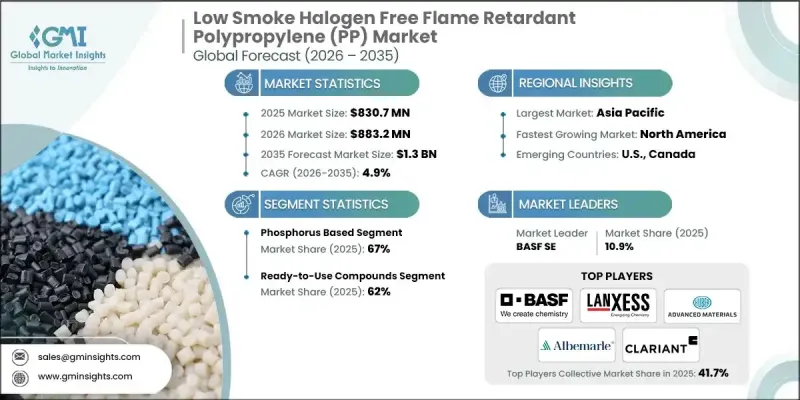
市場成長的驅動力在於,鹵代阻燃劑正被更安全的材料解決方案所取代,這些方案能夠減少燃燒過程中的煙霧和有毒氣體排放。這些聚丙烯配方旨在避免使用溴化和氯化添加劑,使其能夠滿足廣泛應用於電氣系統、車輛、電子產品和基礎設施等許多領域的國際安全和毒性標準。隨著材料標準強調減少煙霧、降低毒性和提高防火性能,世界各地的法規結構持續推動此類材料的普及。日益嚴格的環境和安全法規使得無鹵聚丙烯成為尋求長期合規性的製造商的首選。此外,在電氣化推進應用中,材料的熱應力可靠性至關重要,而無鹵聚丙烯的廣泛應用也推動了市場成長。阻燃劑化學領域的持續創新使製造商能夠平衡耐火性、機械強度、流動性和長期穩定性,使這些材料適用於要求嚴苛、安全至關重要的終端應用。
| 市場覆蓋範圍 | |
|---|---|
| 開始年份 | 2025 |
| 預測年份 | 2026-2035 |
| 起始值 | 8.307億美元 |
| 預測金額 | 13億美元 |
| 複合年成長率 | 4.9% |
截至2025年,磷基阻燃解決方案佔了67%的市場。這些系統因其在提供有效阻燃性能的同時,也能保持良好的加工性能和機械性能而被廣泛採用。協同配方技術的進步擴大了設計的柔軟性,從而在不影響耐久性的前提下,提高了抑煙性能並降低了毒性。
預計到2025年,即用型複合材料市佔率將達到62%。這些材料因其品質穩定、檢驗安全標準以及可簡化認證流程的技術支援而備受青睞。製造商可受益於更短的開發週期以及在多種厚度和應用需求下可預測的效能。
預計到2025年,北美低菸無鹵阻燃聚丙烯(PP)市佔率將達到16%。該地區的成長得益於電動交通、能源儲存系統和安全關鍵型建築應用領域對該產品日益成長的需求。監管政策的一致性和對消防安全標準的嚴格把控,也持續推動美國和加拿大市場的擴張。
目錄
第1章調查方法和範圍
第2章執行摘要
第3章業界考察
- 生態系分析
- 供應商情況
- 利潤率
- 每個階段的附加價值
- 影響價值鏈的因素
- 中斷
- 產業影響因素
- 促進要素
- 產業潛在風險與挑戰
- 市場機遇
- 成長潛力分析
- 監管環境
- 北美洲
- 歐洲
- 亞太地區
- 拉丁美洲
- 中東和非洲
- 波特分析
- PESTEL 分析
- 價格趨勢
- 按地區
- 未來市場趨勢
- 科技與創新趨勢
- 當前技術趨勢
- 新興技術
- 專利狀態
- 貿易統計(HS編碼)(註:僅提供主要國家的貿易統計)
- 主要進口國
- 主要出口國
- 永續性和環境方面
- 永續努力
- 減少廢棄物策略
- 生產中的能源效率
- 環保舉措
- 碳足跡考量
第4章 競爭情勢
- 介紹
- 公司市佔率分析
- 按地區
- 北美洲
- 歐洲
- 亞太地區
- 拉丁美洲
- 中東和非洲
- 按地區
- 企業矩陣分析
- 主要市場公司的競爭分析
- 競爭定位矩陣
- 重大進展
- 併購
- 夥伴關係與合作
- 新產品發布
- 擴張計劃
5. 2022-2035年低菸無鹵阻燃聚丙烯(PP)市場依阻燃型分類
- 磷基阻燃劑
- 氮基阻燃劑
- 其他
6. 低菸無鹵阻燃聚丙烯(PP)市場按類型分類,2022-2035年
- 即用型化合物
- 母粒(濃縮液)
- 添加劑粉末和顆粒
7. 低菸無鹵阻燃聚丙烯(PP)市場依應用領域分類,2022-2035年
- 電線電纜
- 電氣和電子設備
- 汽車和運輸設備
- 鐵路和公共交通
- 航太
- 建築/施工
- 工業應用
- 海洋應用
- 消費品
- 其他
第8章 2022-2035年各地區市場規模及預測
- 北美洲
- 美國
- 加拿大
- 歐洲
- 英國
- 德國
- 法國
- 義大利
- 西班牙
- 其他歐洲地區
- 亞太地區
- 中國
- 印度
- 日本
- 韓國
- 澳洲
- 亞太其他地區
- 拉丁美洲
- 巴西
- 墨西哥
- 阿根廷
- 其他拉丁美洲地區
- 中東和非洲
- 南非
- 沙烏地阿拉伯
- 阿拉伯聯合大公國
- 其他中東和非洲地區
第9章:公司簡介
- Albemarle Corporation
- Israel Chemicals
- Chemtura Corporation
- Clariant International
- Huber Engineered Materials
- BASF
- Thor Group
- Lanxess
- DSM
- FRX Polymers
- Nabaltec
- Delamin
- DuPont
- Washington Penn Plastic
- RTP Company
- PolyOne Corporation
The Global Low Smoke Halogen Free Flame Retardant Polypropylene (PP) Market was valued at USD 830.7 million in 2025 and is estimated to grow at a CAGR of 4.9% to reach USD 1.3 billion by 2035.
Market growth is supported by the increasing replacement of halogenated flame retardants with safer material solutions that limit smoke generation and toxic gas release during combustion. These polypropylene formulations are engineered to avoid bromine- and chlorine-based additives, enabling compliance with widely recognized international safety and toxicity benchmarks used across electrical systems, vehicles, electronics, and infrastructure installations. Regulatory frameworks across global markets continue to reinforce adoption, as material standards emphasize reduced smoke density, lower toxicity, and improved fire performance. The tightening of environmental and safety regulations has positioned halogen-free polypropylene as a preferred option for manufacturers seeking long-term regulatory alignment. The market is also benefiting from expanding use in electrification-driven applications, where material reliability during thermal stress is critical. Ongoing innovation in flame-retardant chemistry is allowing manufacturers to balance fire resistance with mechanical strength, flow behavior, and long-term stability, making these materials suitable for demanding and safety-sensitive end uses.
| Market Scope | |
|---|---|
| Start Year | 2025 |
| Forecast Year | 2026-2035 |
| Start Value | $830.7 Million |
| Forecast Value | $1.3 Billion |
| CAGR | 4.9% |
The phosphorus-based solutions segment accounted for 67% share in 2025. These systems are widely adopted due to their ability to deliver effective flame resistance while maintaining acceptable processing and mechanical performance. Advancements in synergistic formulations have expanded design flexibility, enabling improved smoke suppression and lower toxicity without compromising durability.
The ready-to-use compounds segment held 62% share in 2025. These materials are favored for their consistent quality, validated compliance with safety standards, and technical support that simplifies qualification processes. Manufacturers benefit from reduced development time and predictable performance across multiple thicknesses and application requirements.
North America Low Smoke Halogen Free Flame Retardant Polypropylene (PP) Market accounted for 16% share in 2025. Regional growth is supported by rising adoption in electrified transportation, energy storage systems, and safety-driven construction applications. Regulatory alignment and a strong emphasis on fire safety standards continue to reinforce market expansion across the United States and Canada.
Key companies active in the Global Low Smoke Halogen Free Flame Retardant Polypropylene (PP) Market include BASF, Lanxess, Albemarle Corporation, DuPont, Clariant International, RTP Company, Israel Chemicals, FRX Polymers, Huber Engineered Materials, DSM, Nabaltec, Thor Group, Washington Penn Plastic, Delamin, PolyOne Corporation, and Chemtura Corporation. Companies operating in the Global Low Smoke Halogen Free Flame Retardant Polypropylene (PP) Market are strengthening their market position through continuous formulation innovation that improves fire performance while preserving mechanical integrity. Many players are expanding ready-to-use compound portfolios to reduce customer qualification timelines and improve consistency. Strategic collaboration with OEMs and component manufacturers supports early material adoption in new platforms. Investments in regulatory expertise and compliance testing help suppliers align with evolving safety standards.
Table of Contents
Chapter 1 Methodology & Scope
- 1.1 Market scope and definition
- 1.2 Research design
- 1.2.1 Research approach
- 1.2.2 Data collection methods
- 1.3 Data mining sources
- 1.3.1 Global
- 1.3.2 Regional/Country
- 1.4 Base estimates and calculations
- 1.4.1 Base year calculation
- 1.4.2 Key trends for market estimation
- 1.5 Primary research and validation
- 1.5.1 Primary sources
- 1.6 Forecast model
- 1.7 Research assumptions and limitations
Chapter 2 Executive Summary
- 2.1 Industry 3600 synopsis
- 2.2 Key market trends
- 2.2.1 Flame retardant type
- 2.2.2 Form
- 2.2.3 Application
- 2.3 TAM analysis, 2025-2034
- 2.4 CXO perspectives: Strategic imperatives
- 2.4.1 Executive decision points
- 2.4.2 Critical success factors
- 2.5 Outlook and strategic recommendations
Chapter 3 Industry Insights
- 3.1 Industry ecosystem analysis
- 3.1.1 Supplier landscape
- 3.1.2 Profit margin
- 3.1.3 Value addition at each stage
- 3.1.4 Factor affecting the value chain
- 3.1.5 Disruptions
- 3.2 Industry impact forces
- 3.2.1 Growth drivers
- 3.2.2 Industry pitfalls and challenges
- 3.2.3 Market opportunities
- 3.3 Growth potential analysis
- 3.4 Regulatory landscape
- 3.4.1 North America
- 3.4.2 Europe
- 3.4.3 Asia Pacific
- 3.4.4 Latin America
- 3.4.5 Middle East & Africa
- 3.5 Porter';s analysis
- 3.6 PESTEL analysis
- 3.7 Price trends
- 3.7.1 By region
- 3.8 Future market trends
- 3.9 Technology and innovation landscape
- 3.9.1 Current technological trends
- 3.9.2 Emerging technologies
- 3.10 Patent landscape
- 3.11 Trade statistics (HS code) (Note: the trade statistics will be provided for key countries only)
- 3.11.1 Major importing countries
- 3.11.2 Major exporting countries
- 3.12 Sustainability and environmental aspects
- 3.12.1 Sustainable practices
- 3.12.2 Waste reduction strategies
- 3.12.3 Energy efficiency in production
- 3.12.4 Eco-friendly initiatives
- 3.13 Carbon footprint considerations
Chapter 4 Competitive Landscape, 2025
- 4.1 Introduction
- 4.2 Company market share analysis
- 4.2.1 By region
- 4.2.1.1 North America
- 4.2.1.2 Europe
- 4.2.1.3 Asia Pacific
- 4.2.1.4 Latin America
- 4.2.1.5 Middle East & Africa
- 4.2.1 By region
- 4.3 Company matrix analysis
- 4.4 Competitive analysis of major market players
- 4.5 Competitive positioning matrix
- 4.6 Key developments
- 4.6.1 Mergers & acquisitions
- 4.6.2 Partnerships & collaborations
- 4.6.3 New product launches
- 4.6.4 Expansion plans
Chapter 5 Low Smoke Halogen Free Flame Retardant Polypropylene (PP) Market, By Flame Retardant Type, 2022-2035(USD Million, Kilo Tons)
- 5.1 Key trends
- 5.2 Phosphorus-based flame retardants
- 5.3 Nitrogen-based flame retardants
- 5.4 Others
Chapter 6 Low Smoke Halogen Free Flame Retardant Polypropylene (PP) Market, By Form, 2022-2035(USD Million, Kilo Tons)
- 6.1 Key trends
- 6.2 Ready-to-use compounds
- 6.3 Masterbatches (concentrates)
- 6.4 Additive powders & pellets
Chapter 7 Low Smoke Halogen Free Flame Retardant Polypropylene (PP) Market, By Application, 2022-2035(USD Million, Kilo Tons)
- 7.1 Key trends
- 7.2 Wire & cable
- 7.3 Electrical & electronics
- 7.4 Automotive & transportation
- 7.5 Railway & mass transit
- 7.6 Aerospace
- 7.7 Building & construction
- 7.8 Industrial applications
- 7.9 Marine applications
- 7.10 Consumer products
- 7.11 Others
Chapter 8 Market Size and Forecast, By Region, 2022-2035(USD Million, Kilo Tons)
- 8.1 Key trends
- 8.2 North America
- 8.2.1 U.S.
- 8.2.2 Canada
- 8.3 Europe
- 8.3.1 UK
- 8.3.2 Germany
- 8.3.3 France
- 8.3.4 Italy
- 8.3.5 Spain
- 8.3.6 Rest of Europe
- 8.4 Asia Pacific
- 8.4.1 China
- 8.4.2 India
- 8.4.3 Japan
- 8.4.4 South Korea
- 8.4.5 Australia
- 8.4.6 Rest of Asia Pacific
- 8.5 Latin America
- 8.5.1 Brazil
- 8.5.2 Mexico
- 8.5.3 Argentina
- 8.5.4 Rest of Latin America
- 8.6 Middle East & Africa
- 8.6.1 South Africa
- 8.6.2 Saudi Arabia
- 8.6.3 UAE
- 8.6.4 Rest of Middle East & Africa
Chapter 9 Company Profiles
- 9.1 Albemarle Corporation
- 9.2 Israel Chemicals
- 9.3 Chemtura Corporation
- 9.4 Clariant International
- 9.5 Huber Engineered Materials
- 9.6 BASF
- 9.7 Thor Group
- 9.8 Lanxess
- 9.9 DSM
- 9.10 FRX Polymers
- 9.11 Nabaltec
- 9.12 Delamin
- 9.13 DuPont
- 9.14 Washington Penn Plastic
- 9.15 RTP Company
- 9.16 PolyOne Corporation

 低煙阻燃材料市場:全球市場預測,2026-2032年
 2026-2034年全球低菸、無鹵、阻燃聚丙烯市場規模、佔有率、趨勢和成長分析報告
 2026年全球無鹵化阻燃劑市場報告
 低菸無鹵阻燃聚丙烯市場規模、佔有率及成長分析(按應用、終端用戶產業、添加劑類型及地區分類)-2026-2033年產業預測
 低煙阻燃聚丙烯市場:市場佔有率分析、產業趨勢、統計、成長預測(2025-2030 年)
 無鹵阻燃劑市場 - 全球產業規模、佔有率、趨勢、機會和預測,按產品類型、樹脂類型、最終用戶、地區和競爭細分,2020-2030 年低煙阻燃聚丙烯市場-2025年至2030年預測