

 |
市場調查報告書
商品編碼
1913475
邊緣資料中心市場機會、成長要素、產業趨勢分析及2026年至2035年預測Edge Data Center Market Opportunity, Growth Drivers, Industry Trend Analysis, and Forecast 2026 - 2035 |
||||||

全球邊緣資料中心市場預計到 2025 年將達到 147 億美元,到 2035 年將達到 719 億美元,年複合成長率為 17.5%。
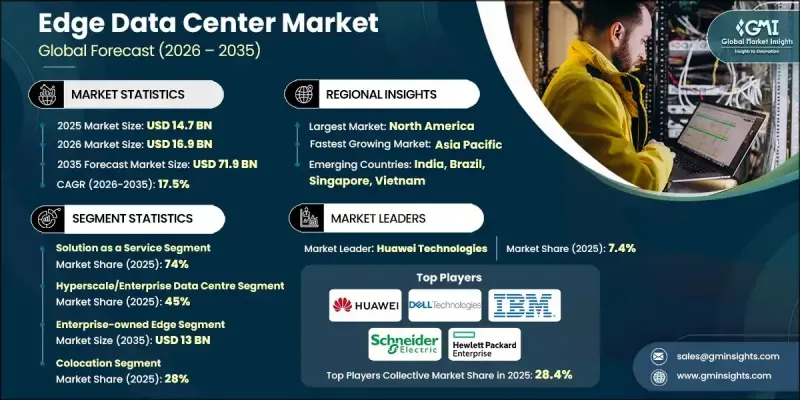
隨著互聯生態系統對即時運算的需求持續成長,低延遲數位基礎設施的需求也日益成長,市場擴張正是這一趨勢的體現。為了支援即時資料處理、更快的回應速度和不間斷的服務交付,企業越來越需要將運算資源部署在更靠近終端使用者和資料產生點的位置。下一代連接和分散式運算框架的快速部署正在重塑基礎設施策略,並推動分散式架構的發展,從而減少對集中式雲端設施的依賴。隨著資料量的激增,本地處理使企業能夠更有效率地管理工作負載,同時減少網路擁塞並提高業務連續性。人工智慧的普及進一步強化了對地理分散式運算的需求,因為在更靠近資料來源的位置進行推理可以提高速度、準確性和可靠性。此外,關於資料居住和管治的合規性要求企業和公共機構必須在規定的地理範圍內儲存和處理訊息,這進一步提升了邊緣資料中心在現代數位生態系統中的戰略重要性。
| 市場覆蓋範圍 | |
|---|---|
| 開始年份 | 2025 |
| 預測年份 | 2026-2035 |
| 起始值 | 147億美元 |
| 預測金額 | 719億美元 |
| 複合年成長率 | 17.5% |
預計到 2025 年,軟體即服務 (SaaS) 細分市場將佔 74% 的市場佔有率,到 2035 年將達到 503 億美元。這一主導地位是由對整合平台的需求所驅動的,這些平台能夠實現跨分散式基礎設施的無縫協作,同時確保一致的效能、可擴展性和營運彈性。
預計到 2025 年,超大規模和企業資料中心領域將佔 45% 的市場佔有率,到 2035 年將達到 321 億美元。大型營運商繼續在人口中心和資料中心附近部署規模小規模、分散式的設施,以提高延遲效能、工作負載彈性和運算效率。
預計到 2035 年,中國邊緣資料中心市場規模將達到 97 億美元。政策支持、不斷擴大的數位基礎設施和國家技術舉措正在刺激對在地化資料處理的投資。
目錄
第1章調查方法
第2章執行摘要
第3章業界考察
- 生態系分析
- 供應商情況
- 利潤率分析
- 成本結構
- 每個階段的附加價值
- 影響價值鏈的因素
- 中斷
- 產業影響因素
- 促進要素
- 超低延遲要求
- 5G和MEC擴展
- 邊緣人工智慧推理
- 物聯網和感測器的普及
- 數據主權合規性
- 產業潛在風險與挑戰
- 高額的基礎設施安裝成本
- 安全和管理複雜性
- 市場機遇
- 邊緣人工智慧與自動化發展
- 擴大智慧城市基礎設施
- 多租戶邊緣託管
- 超大規模資料中心業者和通訊業者之間的邊緣協作
- 成長潛力分析
- 監管環境
- 北美洲
- 美國- 加州消費者隱私法案
- 加拿大 - 個人資訊保護和電子文件法
- 歐洲
- 英國- 資料保護法
- 德國 - 聯邦資料保護法
- 法國——數位共和國法案
- 義大利 - 個人資料保護法
- 西班牙—資料保護與數位權利組織法
- 亞太地區
- 中國 - 個人資訊保護法
- 日本—個人資訊保護法
- 印度 - 數位個人資料保護法
- 拉丁美洲
- 巴西 - 通用資料保護法
- 墨西哥 - 個人資料保護聯邦法(私人實體持有的個人資料)
- 阿根廷 - 個人資料保護法
- 中東和非洲
- 阿拉伯聯合大公國個人資料保護法
- 南非 - 個人資訊保護法
- 沙烏地阿拉伯 - 個人資料保護法
- 北美洲
- 波特五力分析
- PESTEL 分析
- 技術與創新展望
- 當前技術趨勢
- 新興技術
- 成本細分分析
- 開發成本結構
- 研發成本分析
- 行銷和銷售成本
- 專利分析
- 永續性和環境方面
- 永續實踐
- 減少廢棄物策略
- 生產中的能源效率
- 環保舉措
- 邊緣部署模型和拓樸框架
- 本地部署、近邊緣和遠邊緣架構
- 網路邊緣、運算邊緣和資料邊緣
- 都市區和農村部署考慮因素
- 邊緣和超大規模動態
- 邊緣操作、遠端系統管理和可靠性風險
- 互連和網路依賴性分析
- 未來邊緣架構演進
- AI原生邊緣基礎設施
- 邊緣、雲端和網路功能的融合
- 主權和受監管優勢的長期影響
第4章 競爭情勢
- 介紹
- 公司市佔率分析
- 北美洲
- 歐洲
- 亞太地區
- 拉丁美洲
- 中東和非洲
- 主要市場公司的競爭分析
- 競爭定位矩陣
- 戰略展望矩陣
- 重大進展
- 併購
- 夥伴關係與合作
- 新產品發布
- 企業擴張計畫和資金籌措
第5章 按組件分類的市場估算與預測,2022-2035年
- 解決方案
- 服務
第6章 市場估算與預測:依資料中心規模分類,2022-2035年
- 微型資料中心
- 超大規模/企業級資料中心
- 其他
7. 按所有權類型分類的市場估算與預測,2022-2035 年
- 通訊業者邊緣
- 超大規模雲邊緣
- 公司所有邊緣
- CDN提供者邊緣
8. 按機架數量分類的市場估算與預測,2022-2035 年
- 小規模(1至10個貨架)
- 中等規模(10 至 100 個貨架)
- 大型(100個貨架或更多)
第9章 按應用領域分類的市場估算與預測,2022-2035年
- BFSI
- 搭配
- 能源
- 政府
- 衛生保健
- 製造業
- 資訊科技/通訊
- 其他
第10章 2022-2035年各地區市場估計與預測
- 北美洲
- 美國
- 加拿大
- 歐洲
- 德國
- 英國
- 法國
- 義大利
- 西班牙
- 俄羅斯
- 北歐國家
- 葡萄牙
- 克羅埃西亞
- 比荷盧經濟聯盟
- 亞太地區
- 中國
- 印度
- 日本
- 澳洲
- 韓國
- 新加坡
- 泰國
- 印尼
- 越南
- 拉丁美洲
- 巴西
- 墨西哥
- 阿根廷
- 哥倫比亞
- 中東和非洲
- 南非
- 沙烏地阿拉伯
- 阿拉伯聯合大公國
- 土耳其
第11章 公司簡介
- 世界玩家
- Dell Technologies
- IBM
- Huawei Technologies
- Hewlett Packard Enterprise Company
- Eaton
- Vertiv
- Fujitsu
- Schneider Electric
- Cisco Systems
- Oracle
- 區域玩家
- Rittal
- Flexential
- EdgeConnex
- NTT
- Equinix
- a. Digital Realty
- CyrusOne
- QTS Realty Trust
- CoreSite Realty
- Interxion
- Emerging/Disruptor Players
- 365 Operating Company
- Vapor IO
- EdgePresence
- Vantage Data Centers
- EdgeMicro
- Compass Data Centers
- Aligned Energy
- Cologix
- DataBank
The Global Edge Data Center Market was valued at USD 14.7 billion in 2025 and is estimated to grow at a CAGR of 17.5% to reach USD 71.9 billion by 2035.
Market expansion reflects the accelerating demand for low-latency digital infrastructure as real-time computing requirements continue to rise across connected ecosystems. Organizations increasingly require computing resources to be deployed closer to end users and data generation points to support instantaneous data processing, faster response times, and uninterrupted service delivery. The rapid rollout of next-generation connectivity and distributed computing frameworks is reshaping infrastructure strategies, encouraging decentralized architectures that reduce reliance on centralized cloud facilities. As data volumes surge, localized processing enables enterprises to manage workloads more efficiently while reducing network congestion and improving operational continuity. Artificial intelligence adoption is further reinforcing the need for geographically distributed computing, as near-source inference enhances speed, accuracy, and reliability. Additionally, compliance requirements related to data residency and governance are pushing enterprises and public institutions to store and process information within defined geographic boundaries, reinforcing the strategic importance of edge data centers in modern digital ecosystems.
| Market Scope | |
|---|---|
| Start Year | 2025 |
| Forecast Year | 2026-2035 |
| Start Value | $14.7 Billion |
| Forecast Value | $71.9 Billion |
| CAGR | 17.5% |
The solution-as-a-service segment accounted for 74% share in 2025 and is forecast to reach USD 50.3 billion by 2035. This dominance is driven by demand for integrated platforms that enable seamless coordination across distributed infrastructure while ensuring consistent performance, scalability, and operational resilience.
The hyperscale and enterprise data center segment held a 45% share in 2025 and is expected to reach USD 32.1 billion by 2035. Large operators continue to deploy smaller, distributed facilities closer to population and data hubs to improve latency performance, workload resilience, and computing efficiency.
China Edge Data Center Market is projected to reach USD 9.7 billion by 2035. Policy support, digital infrastructure expansion, and national technology initiatives are accelerating localized data processing investments.
Key companies active in the Global Edge Data Center Market include Schneider Electric, Dell Technologies, Vertiv, Huawei Technologies, Hewlett Packard Enterprise Company, Eaton, IBM, Fujitsu, EdgeConnex, Rittal, Flexential, Vapor, and EdgePresence. Companies operating in the Global Edge Data Center Market are strengthening their market position through strategic infrastructure expansion, modular deployment models, and technology integration. Providers are investing in scalable and standardized solutions to accelerate deployment timelines and reduce operational complexity. Partnerships with telecom operators, cloud platforms, and enterprise clients support ecosystem integration and long-term contracts. Firms are also prioritizing energy efficiency, automation, and remote management capabilities to improve reliability and cost performance.
Table of Contents
Chapter 1 Methodology
- 1.1 Market scope and definition
- 1.2 Research design
- 1.2.1 Research approach
- 1.2.2 Data collection methods
- 1.3 Data mining sources
- 1.3.1 Global
- 1.3.2 Regional/Country
- 1.4 Base estimates and calculations
- 1.4.1 Base year calculation
- 1.4.2 Key trends for market estimation
- 1.5 Primary research and validation
- 1.5.1 Primary sources
- 1.6 Forecast
- 1.7 Research assumptions and limitations
Chapter 2 Executive Summary
- 2.1 Industry 360° synopsis, 2022 - 2035
- 2.2 Key market trends
- 2.2.1 Regional
- 2.2.2 Component
- 2.2.3 Data center size
- 2.2.4 Ownership
- 2.2.5 Rack count
- 2.2.6 Application
- 2.3 TAM Analysis, 2026-2035
- 2.4 CXO perspectives: Strategic imperatives
- 2.4.1 Executive decision points
- 2.4.2 Critical success factors
- 2.5 Future outlook & strategic recommendations
Chapter 3 Industry Insights
- 3.1 Industry ecosystem analysis
- 3.1.1 Supplier landscape
- 3.1.2 Profit margin analysis
- 3.1.3 Cost structure
- 3.1.4 Value addition at each stage
- 3.1.5 Factor affecting the value chain
- 3.1.6 Disruptions
- 3.2 Industry impact forces
- 3.2.1.1 Growth drivers
- 3.2.1.2 Ultra-low latency requirements
- 3.2.1.3 5G and MEC expansion
- 3.2.1.4 AI inference at edge
- 3.2.1.5 IoT and sensor proliferation
- 3.2.1.6 Data sovereignty compliance
- 3.2.2 Industry pitfalls and challenges
- 3.2.2.1 High infrastructure deployment costs
- 3.2.2.2 Security and management complexity
- 3.2.3 Market opportunities
- 3.2.3.1 Edge AI and automation growth
- 3.2.3.2 Smart city infrastructure expansion
- 3.2.3.3 Multi-tenant edge colocation
- 3.2.3.4 Hyperscaler-telco edge partnerships
- 3.3 Growth potential analysis
- 3.4 Regulatory landscape
- 3.4.1 North America
- 3.4.1.1 U.S. - California Consumer Privacy Act
- 3.4.1.2 Canada - Personal Information Protection and Electronic Documents Act
- 3.4.2 Europe
- 3.4.2.1 UK - Data Protection Act
- 3.4.2.2 Germany - Federal Data Protection Act
- 3.4.2.3 France - Digital Republic Act
- 3.4.2.4 Italy - Personal Data Protection Code
- 3.4.2.5 Spain - Organic Law on Data Protection and Digital Rights
- 3.4.3 Asia Pacific
- 3.4.3.1 China - Personal Information Protection Law
- 3.4.3.2 Japan - Act on the Protection of Personal Information
- 3.4.3.3 India - Digital Personal Data Protection Act
- 3.4.4 Latin America
- 3.4.4.1 Brazil - General Data Protection Law
- 3.4.4.2 Mexico - Federal Law on Protection of Personal Data Held by Private Parties
- 3.4.4.3 Argentina - Personal Data Protection Law
- 3.4.5 Middle East & Africa
- 3.4.5.1 UAE - Personal Data Protection Law
- 3.4.5.2 South Africa - Protection of Personal Information Act
- 3.4.5.3 Saudi Arabia - Personal Data Protection Law
- 3.4.1 North America
- 3.5 Porter's analysis
- 3.6 PESTEL analysis
- 3.7 Technology and innovation landscape
- 3.7.1 Current technological trends
- 3.7.2 Emerging technologies
- 3.8 Cost breakdown analysis
- 3.8.1 Development cost structure
- 3.8.2 R&D cost analysis
- 3.8.3 Marketing & sales costs
- 3.9 Patent analysis
- 3.10 Sustainability and environmental aspects
- 3.10.1 Sustainable practices
- 3.10.2 Waste reduction strategies
- 3.10.3 Energy efficiency in production
- 3.10.4 Eco-friendly Initiatives
- 3.11 Edge deployment models & topology framework
- 3.11.1 On-premise, near-edge & far-edge architectures
- 3.11.2 Network edge vs compute edge vs data edge
- 3.11.3 Urban vs rural deployment considerations
- 3.12 Edge vs hyperscale dynamics
- 3.13 Edge operations, remote management & reliability risks
- 3.14 Interconnection & network dependency analysis
- 3.15 Future edge architecture evolution
- 3.15.1 AI-native edge infrastructure
- 3.15.2 Convergence of edge, cloud and network functions
- 3.15.3 Long-term implications of sovereign and regulated edge
Chapter 4 Competitive Landscape, 2025
- 4.1 Introduction
- 4.2 Company market share analysis
- 4.2.1 North America
- 4.2.2 Europe
- 4.2.3 Asia Pacific
- 4.2.4 LATAM
- 4.2.5 MEA
- 4.3 Competitive analysis of major market players
- 4.4 Competitive positioning matrix
- 4.5 Strategic outlook matrix
- 4.6 Key developments
- 4.6.1 Mergers & acquisitions
- 4.6.2 Partnerships & collaborations
- 4.6.3 New Product Launches
- 4.6.4 Expansion Plans and funding
Chapter 5 Market Estimates & Forecast, By Component, 2022 - 2035 ($Bn)
- 5.1 Key trends
- 5.2 Solution
- 5.3 Service
Chapter 6 Market Estimates & Forecast, By Data Center Size, 2022 - 2035 ($Bn)
- 6.1 Key trends
- 6.2 Micro Data Center
- 6.3 Hyperscale/Enterprise Data Center
- 6.4 Others
Chapter 7 Market Estimates & Forecast, By Ownership, 2022 - 2035 ($Bn)
- 7.1 Key trends
- 7.2 Telecom operator edge
- 7.3 Hyperscale cloud edge
- 7.4 Enterprise-owned edge
- 7.5 CDN provider edge
Chapter 8 Market Estimates & Forecast, By Rack Count, 2022-2035 (USD Mn)
- 8.1 Key trends
- 8.2 Small (1-10 racks)
- 8.3 Medium (10-100 racks)
- 8.4 Large (>100 racks)
Chapter 9 Market Estimates & Forecast, By Application, 2022 - 2035 (USD Mn)
- 9.1 Key trends
- 9.2 BFSI
- 9.3 Colocation
- 9.4 Energy
- 9.5 Government
- 9.6 Healthcare
- 9.7 Manufacturing
- 9.8 IT & Telecom
- 9.9 Others
Chapter 10 Market Estimates & Forecast, By Region, 2022 - 2035 (USD Mn)
- 10.1 Key trends
- 10.2 North America
- 10.2.1 US
- 10.2.2 Canada
- 10.3 Europe
- 10.3.1 Germany
- 10.3.2 UK
- 10.3.3 France
- 10.3.4 Italy
- 10.3.5 Spain
- 10.3.6 Russia
- 10.3.7 Nordics
- 10.3.8 Portugal
- 10.3.9 Croatia
- 10.3.10 Benelux
- 10.4 Asia Pacific
- 10.4.1 China
- 10.4.2 India
- 10.4.3 Japan
- 10.4.4 Australia
- 10.4.5 South Korea
- 10.4.6 Singapore
- 10.4.7 Thailand
- 10.4.8 Indonesia
- 10.4.9 Vietnam
- 10.5 Latin America
- 10.5.1 Brazil
- 10.5.2 Mexico
- 10.5.3 Argentina
- 10.5.4 Colombia
- 10.6 MEA
- 10.6.1 South Africa
- 10.6.2 Saudi Arabia
- 10.6.3 UAE
- 10.6.4 Turkey
Chapter 11 Company Profiles
- 11.1 Global Players
- 11.1.1 Dell Technologies
- 11.1.2 IBM
- 11.1.3 Huawei Technologies
- 11.1.4 Hewlett Packard Enterprise Company
- 11.1.5 Eaton
- 11.1.6 Vertiv
- 11.1.7 Fujitsu
- 11.1.8 Schneider Electric
- 11.1.9 Cisco Systems
- 11.1.10 Oracle
- 11.2 Regional Players
- 11.2.1 Rittal
- 11.2.2 Flexential
- 11.2.3 EdgeConnex
- 11.2.4 NTT
- 11.2.5 Equinix
- 11.2.6 a. Digital Realty
- 11.2.7 CyrusOne
- 11.2.8 QTS Realty Trust
- 11.2.9 CoreSite Realty
- 11.2.10 Interxion
- 11.3 Emerging / Disruptor Players
- 11.3.1. 365 Operating Company
- 11.3.2 Vapor IO
- 11.3.3 EdgePresence
- 11.3.4 Vantage Data Centers
- 11.3.5 EdgeMicro
- 11.3.6 Compass Data Centers
- 11.3.7 Aligned Energy
- 11.3.8 Cologix
- 11.3.9 DataBank

 邊緣資料中心市場規模、佔有率、成長及全球產業分析:按類型、應用和地區分類的洞察,2026-2034 年預測
 邊緣資料中心市場:按組件、部署類型、最終用戶和設施規模分類-2026-2032年全球市場預測全球邊緣資料中心市場規模、佔有率、趨勢和成長分析報告(2026-2034)
 邊緣資料中心市場分析與預測(至2035年):類型、產品類型、服務、技術、元件、應用、部署模式、最終使用者、設備、解決方案
 2026年全球電信邊緣數據平台市場報告2026年全球託管邊緣資料中心市場報告2026年全球邊緣資料中心市場報告
 電信邊緣分析市場,全球預測至 2032 年:按組件、部署模式、組織類型、用例、技術、最終用戶和地區分類
 邊緣資料中心市場 - 全球產業規模、佔有率、趨勢、機會和預測,按組件、設施規模、最終用途、地區和競爭格局分類,2021-2031 年預測
 日本邊緣資料中心市場報告:按組件、設施規模、產業和地區分類,2026-2034年