


 |
市場調查報告書
商品編碼
1913456
醫療廢棄物管理市場機會、成長要素、產業趨勢分析及預測(2026年至2035年)Medical Waste Management Market Opportunity, Growth Drivers, Industry Trend Analysis, and Forecast 2026 - 2035 |
||||||

全球醫療廢棄物管理市場預計到 2025 年將達到 167 億美元,到 2035 年將達到 343 億美元,年複合成長率為 7.5%。
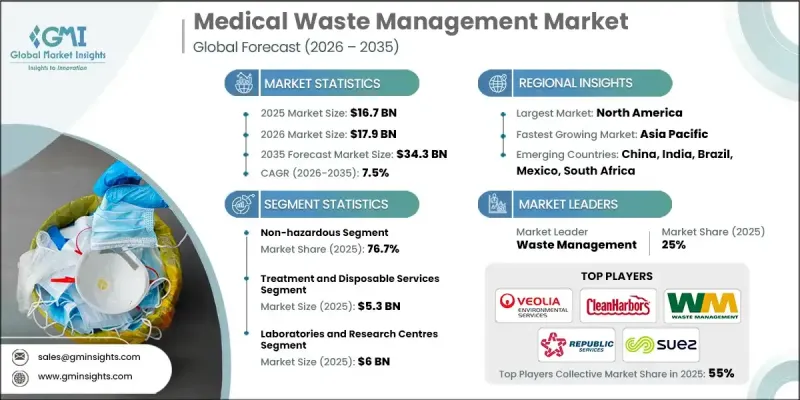
全球醫療基礎設施(包括醫院、診所、實驗室和研究中心)的快速擴張推動了這一成長,導致醫療廢棄物產生量顯著增加。人們對不當處置醫療廢棄物所帶來的健康和環境風險(包括感染疾病和抗藥性微生物的傳播)的認知不斷提高,進一步推動了對高效廢棄物管理解決方案的需求。隨著監管機構日益嚴格地實施廢棄物處置政策,醫療機構面臨著採用擴充性、安全且對環境負責的處置方法的壓力。全面的員工培訓和教育計畫對於確保醫療廢棄物的正確收集、分類和處置至關重要,這為廢棄物管理服務提供者拓展業務和提高合規性創造了重要機會。
| 市場覆蓋範圍 | |
|---|---|
| 開始年份 | 2025 |
| 預測年份 | 2026-2035 |
| 起始值 | 167億美元 |
| 預測金額 | 343億美元 |
| 複合年成長率 | 7.5% |
到2025年,非危險廢棄物佔比將達到76.7%。醫療設施的擴張,尤其是在都市區和發展中地區,正在推動非感染性廢棄物的產生。有效管理這類廢棄物有助於最佳化資源配置和最大限度地降低處置成本,從而降低營運成本。
2025 年,處理和處置服務部門創造了 53 億美元的收入。這些服務專注於安全收集、處理和再利用醫療廢棄物,包括塑膠、金屬和其他無害材料,旨在最大限度地減少對環境的影響,並將廢棄物轉化為可重複使用的資源和能源。
預計2025年北美醫療廢棄物管理市場規模將達到67億美元,到2035年將達到136億美元,複合年成長率(CAGR)為7.4%。該地區擁有完善的醫療基礎設施,醫療廢棄物量不斷成長,且廢棄物處理法規嚴格,這些都是推動市場成長的主要因素。醫院、診斷中心和製藥企業是該地區先進處理和處置服務的主要驅動力。
目錄
第1章調查方法和範圍
第2章執行摘要
第3章業界考察
- 生態系分析
- 產業影響因素
- 促進要素
- 全球醫療廢棄物的產生量正在增加。
- 有效率且對環境負責的廢棄物管理正變得越來越重要
- 政府加大力度管理醫療廢棄物
- 醫療產業的快速發展,尤其是在開發中國家
- 產業潛在風險與挑戰
- 缺乏對醫療廢棄物相關健康危害的認知
- 缺乏正確處置醫療廢棄物的培訓
- 市場機遇
- 採用先進的廢棄物處理技術
- 促進要素
- 成長潛力分析
- 監管環境
- 北美洲
- 歐洲
- 亞太地區
- 技術格局
- 未來市場趨勢
- 波特五力分析
- PESTEL 分析
第4章 競爭情勢
- 介紹
- 公司市佔率分析
- 世界
- 北美洲
- 歐洲
- 企業矩陣分析
- 主要市場公司的競爭分析
- 競爭定位矩陣
- 重大進展
- 併購
- 夥伴關係與合作
- 新產品發布
- 擴張計劃
第5章 依廢棄物類型分類的市場估算與預測,2021-2034年
- 危險廢棄物
- 一般廢棄物
第6章 依服務分類的市場估計與預測,2021-2034年
- 收集、運輸和倉儲服務
- 處理和處置服務
- 焚化
- 高壓釜處理
- 微波處理
- 其他處理和處置服務
- 回收服務
- 其他服務
7. 按廢棄物來源分類的市場估算與預測,2021-2034 年
- 醫院
- 實驗室和研究中心
- 護理機構
- 其他廢棄物來源
第8章 2021-2034年各地區市場估算與預測
- 北美洲
- 美國
- 加拿大
- 歐洲
- 德國
- 英國
- 法國
- 西班牙
- 義大利
- 荷蘭
- 亞太地區
- 中國
- 日本
- 印度
- 澳洲
- 韓國
- 拉丁美洲
- 巴西
- 墨西哥
- 阿根廷
- 中東和非洲
- 南非
- 沙烏地阿拉伯
- 阿拉伯聯合大公國
第9章:公司簡介
- Bertin Technologies
- BioMedical Waste Solutions
- Clean Harbors
- Daniels Sharpsmart
- Environmental Solutions Group
- Gamma Waste Systems
- GRP &Associates
- MedPro Disposal
- Republic Services
- Suez Recycling and Recovery
- Triumvirate Environmental
- US Ecology
- Veolia Environmental Services
- Waste Management
The Global Medical Waste Management Market was valued at USD 16.7 billion in 2025 and is estimated to grow at a CAGR of 7.5% to reach USD 34.3 billion by 2035.
The growth is driven by the rapid expansion of healthcare infrastructure worldwide, including hospitals, clinics, laboratories, and research centers, which has led to a substantial increase in medical waste generation. Rising awareness of health and environmental risks associated with improper disposal, such as the spread of infectious diseases and antimicrobial-resistant microorganisms, is further fueling demand for efficient waste management solutions. Regulatory authorities are increasingly implementing strict waste handling policies, prompting healthcare providers to adopt scalable, safe, and environmentally responsible practices. Comprehensive staff training and education programs are becoming essential in ensuring proper collection, segregation, and disposal of medical waste, creating significant opportunities for waste management service providers to expand their operations and improve compliance.
| Market Scope | |
|---|---|
| Start Year | 2025 |
| Forecast Year | 2026-2035 |
| Start Value | $16.7 Billion |
| Forecast Value | $34.3 Billion |
| CAGR | 7.5% |
In 2025, the non-hazardous segment held 76.7% share. The expansion of healthcare facilities, particularly in urban and developing areas, is driving the production of non-infectious waste. Effective management of this waste helps reduce operational costs by optimizing resource allocation and minimizing disposal expenses.
The treatment and disposal services segment generated USD 5.3 billion in 2025. These services focus on the safe collection, processing, and repurposing of medical waste, including plastics, metals, and other non-hazardous materials, aiming to minimize environmental impact and convert suitable waste into reusable resources or energy.
North America Medical Waste Management Market accounted for USD 6.7 billion in 2025 and is expected to reach USD 13.6 billion by 2035, growing at a CAGR of 7.4%. The region leads the market due to its extensive healthcare infrastructure, rising medical waste volumes, and strict regulations for waste disposal. Hospitals, diagnostic centers, and pharmaceutical facilities are significant drivers for advanced treatment and disposal services in the region.
Key players in the Global Medical Waste Management Market include Veolia Environmental Services, Clean Harbors, Waste Management, Republic Services, Bertin Technologies, BioMedical Waste Solutions, Daniels Sharpsmart, Environmental Solutions Group, Gamma Waste Systems, GRP & Associates, MedPro Disposal, Suez Recycling and Recovery, Triumvirate Environmental, and US Ecology. Companies in the Global Medical Waste Management Market are strengthening their market presence by expanding service networks, investing in state-of-the-art treatment technologies, and offering scalable solutions for diverse healthcare settings. Strategic partnerships with hospitals, laboratories, and research centers help secure long-term contracts and enhance brand recognition. Businesses are also focusing on sustainability by implementing recycling and energy recovery initiatives, which improve environmental credentials.
Table of Contents
Chapter 1 Methodology and Scope
- 1.1 Market scope and definitions
- 1.2 Research design
- 1.2.1 Research approach
- 1.2.2 Data collection methods
- 1.3 Base estimates and calculations
- 1.3.1 Base year calculation
- 1.3.2 Key trends for market estimation
- 1.4 Forecast model
- 1.5 Primary research and validation
- 1.5.1 Primary sources
- 1.5.2 Data mining sources
Chapter 2 Executive Summary
- 2.1 Industry 360° synopsis
- 2.2 Key market trends
- 2.2.1 Regional trends
- 2.2.2 Type of waste trends
- 2.2.3 Service trends
- 2.2.4 Waste generator trends
- 2.3 CXO perspectives: Strategic imperatives
- 2.3.1 Key decision points for industry executives
- 2.3.2 Critical success factors for market players
- 2.4 Future outlook and strategic recommendations
Chapter 3 Industry Insights
- 3.1 Industry ecosystem analysis
- 3.2 Industry impact forces
- 3.2.1 Growth drivers
- 3.2.1.1 Increasing volume of medical waste generated globally
- 3.2.1.2 Increasing importance for effective and eco-friendly waste management
- 3.2.1.3 Growing government initiatives for medical waste disposal
- 3.2.1.4 Surging healthcare industry especially in developing economies
- 3.2.2 Industry pitfalls and challenges
- 3.2.2.1 Lack of awareness regarding health hazards associated with medical waste
- 3.2.2.2 Lack of training for proper disposal of medical waste
- 3.2.3 Market opportunity
- 3.2.3.1 Adoption of advanced waste treatment technologies
- 3.2.1 Growth drivers
- 3.3 Growth potential analysis
- 3.4 Regulatory landscape
- 3.4.1 North America
- 3.4.2 Europe
- 3.4.3 Asia Pacific
- 3.5 Technological landscape
- 3.6 Future market trends
- 3.7 Porter's analysis
- 3.8 PESTEL analysis
Chapter 4 Competitive Landscape, 2024
- 4.1 Introduction
- 4.2 Company market share analysis
- 4.2.1 Global
- 4.2.2 North America
- 4.2.3 Europe
- 4.3 Company matrix analysis
- 4.4 Competitive analysis of major market players
- 4.5 Competitive positioning matrix
- 4.6 Key developments
- 4.6.1 Merger and acquisition
- 4.6.2 Partnership and collaboration
- 4.6.3 New product launches
- 4.6.4 Expansion plans
Chapter 5 Market Estimates and Forecast, By Type of Waste, 2021 - 2034 ($ Mn)
- 5.1 Key trends
- 5.2 Hazardous
- 5.3 Non-hazardous
Chapter 6 Market Estimates and Forecast, By Service, 2021 - 2034 ($ Mn)
- 6.1 Key trends
- 6.2 Collection, transportation and storage services
- 6.3 Treatment and disposable services
- 6.3.1 Incineration
- 6.3.2 Autoclaving
- 6.3.3 Microwaving
- 6.3.4 Other treatment and disposable services
- 6.4 Recycling services
- 6.5 Other services
Chapter 7 Market Estimates and Forecast, By Waste Generator, 2021 - 2034 ($ Mn)
- 7.1 Key trends
- 7.2 Hospitals
- 7.3 Laboratories and research centers
- 7.4 Nursing homes
- 7.5 Other waste generators
Chapter 8 Market Estimates and Forecast, By Region, 2021 - 2034 ($ Mn)
- 8.1 Key trends
- 8.2 North America
- 8.2.1 U.S.
- 8.2.2 Canada
- 8.3 Europe
- 8.3.1 Germany
- 8.3.2 UK
- 8.3.3 France
- 8.3.4 Spain
- 8.3.5 Italy
- 8.3.6 Netherlands
- 8.4 Asia Pacific
- 8.4.1 China
- 8.4.2 Japan
- 8.4.3 India
- 8.4.4 Australia
- 8.4.5 South Korea
- 8.5 Latin America
- 8.5.1 Brazil
- 8.5.2 Mexico
- 8.5.3 Argentina
- 8.6 Middle East and Africa
- 8.6.1 South Africa
- 8.6.2 Saudi Arabia
- 8.6.3 UAE
Chapter 9 Company Profiles
- 9.1 Bertin Technologies
- 9.2 BioMedical Waste Solutions
- 9.3 Clean Harbors
- 9.4 Daniels Sharpsmart
- 9.5 Environmental Solutions Group
- 9.6 Gamma Waste Systems
- 9.7 GRP & Associates
- 9.8 MedPro Disposal
- 9.9 Republic Services
- 9.10 Suez Recycling and Recovery
- 9.11 Triumvirate Environmental
- 9.12 US Ecology
- 9.13 Veolia Environmental Services
- 9.14 Waste Management

 醫療廢棄物管理市場:依廢棄物類型、處理方法、服務類型和最終用戶分類-2026-2032年全球市場預測
 2026年全球醫療廢棄物管理市場報告醫療廢棄物收集箱市場:依產品類型、廢棄物類型、材料、最終用戶和分銷管道分類-全球預測,2026-2032年
 全球醫療廢棄物管理市場規模、佔有率、趨勢和成長分析報告(2026-2034年)全球醫藥廢棄物管理市場規模、佔有率、趨勢和成長分析報告(2026-2034年)
 日本醫療廢棄物管理市場規模、佔有率、趨勢和預測:按處理設施、處理方法和地區分類,2026-2034年全球醫用固化劑市場按類型、應用、最終用戶和分銷管道分類,2026-2032年預測全球醫藥廢棄物容器市場(按廢棄物類型、材料、容器類型、容器容量和最終用戶分類)預測(2026-2032年)醫療危險廢棄物處理服務市場(按廢棄物類型、處理技術、服務模式、容器類型和最終用戶分類)-全球預測,2026-2032年
 醫療廢棄物管理市場規模、佔有率和成長分析(按服務、廢棄物類型、處理設施、廢棄物來源和地區分類)-2026-2033年產業預測