


 |
市場調查報告書
商品編碼
1913447
二丁基羥基甲苯市場機會、成長要素、產業趨勢分析及2026年至2035年預測Butylated Hydroxytoluene (BHT) Market Opportunity, Growth Drivers, Industry Trend Analysis, and Forecast 2026 - 2035 |
||||||

全球二丁基羥基甲苯(BHT) 市場預計到 2025 年將達到 3.2 億美元,到 2035 年將達到 4.856 億美元,年複合成長率為 4.3%。
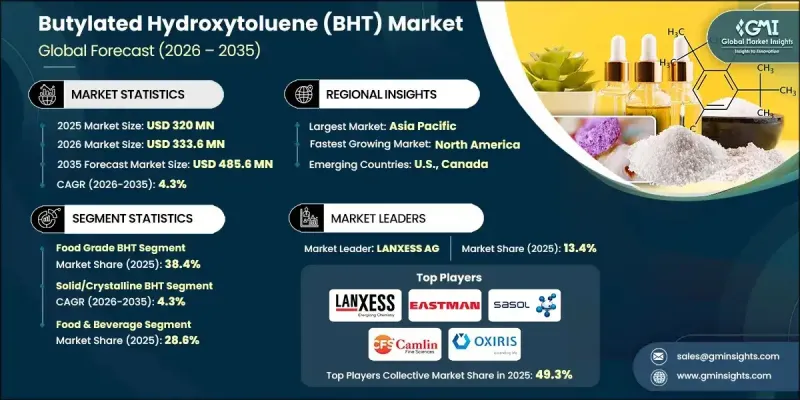
二丁基羥基甲苯)作為一種高效能抗氧化劑在多個工業領域的廣泛應用,推動了市場的發展。 BHT在延緩油脂氧化方面發揮關鍵作用,直接有助於提高產品穩定性並延長保存期限。其清除自由基的能力可防止產品劣化和腐敗,使其成為食品保鮮、個人保健產品和藥品的重要成分。包裝和保存期限產品需求的不斷成長,進一步提升了BHT在工業生產中的重要性。 BHT因其成本效益高、抗氧化性能強且對產品特性影響小而持續受到青睞。開發中國家食品加工和化妝品生產的擴張也進一步推動了市場成長。然而,某些地區不斷變化的法規結構和健康相關問題正在影響市場動態,要求製造商專注於合規性、品質保證和產品純度,以維持需求並確保市場的長期穩定。
| 市場覆蓋範圍 | |
|---|---|
| 開始年份 | 2025 |
| 預測年份 | 2026-2035 |
| 起始值 | 3.2億美元 |
| 預測金額 | 4.856億美元 |
| 複合年成長率 | 4.3% |
預計到2025年,食品級BHT的市佔率將達到38.4%,並在2035年之前以4.4%的複合年成長率成長。該細分市場受益於加工食品、穀物、飲料和動物營養產品中對抗氧化劑解決方案的強勁需求。維持產品新鮮度和完整性的需求持續推動消費,而法律規範和不斷變化的消費者偏好正在影響配方策略。
2025年,固體或結晶質BHT市佔率達到73.4%,預計2026年至2035年將以4.3%的複合年成長率成長。這種形態的產品因其穩定性好、易於操作、可精確計量以及與多種配方相容性強而被廣泛採用。其性能穩定和儲存優勢持續推動其在食品、醫藥和化妝品等應用領域的需求。
預計到2025年,北美二丁基羥基甲苯(BHT)市佔率將達到29.9%。食品、製藥和化妝品製造商的穩定需求,以及嚴格的品質和安全標準,正在支撐該地區的成長。對高純度配方的重視和對合規性的承諾,正在影響採購決策並維持市場成長動能。
目錄
第1章調查方法和範圍
第2章執行摘要
第3章業界考察
- 生態系分析
- 供應商情況
- 利潤率
- 每個階段的附加價值
- 影響價值鏈的因素
- 中斷
- 產業影響因素
- 促進要素
- 產業潛在風險與挑戰
- 市場機遇
- 成長潛力分析
- 監管環境
- 北美洲
- 歐洲
- 亞太地區
- 拉丁美洲
- 中東和非洲
- 波特五力分析
- PESTEL 分析
- 價格趨勢
- 按地區
- 依產品類型
- 未來市場趨勢
- 科技與創新趨勢
- 當前技術趨勢
- 新興技術
- 專利狀態
- 貿易統計(HS編碼)(註:僅提供主要國家的貿易統計)
- 主要進口國
- 主要出口國
- 永續性和環境方面
- 永續努力
- 減少廢棄物策略
- 生產中的能源效率
- 環保舉措
- 考慮到碳足跡
第4章 競爭情勢
- 介紹
- 公司市佔率分析
- 按地區
- 北美洲
- 歐洲
- 亞太地區
- 拉丁美洲
- 中東和非洲
- 按地區
- 企業矩陣分析
- 主要市場公司的競爭分析
- 競爭定位矩陣
- 重大進展
- 併購
- 夥伴關係與合作
- 新產品發布
- 業務拓展計劃
第5章 2022-2035年各等級市場估算與預測
- 食品級BHT
- 醫藥級
- 工業技術級BHT
第6章 按類型分類的市場估算與預測,2022-2035年
- 固體/結晶質BHT
- 液態BHT
第7章 按應用領域分類的市場估算與預測,2022-2035年
- 食品/飲料
- 化妝品和個人護理
- 藥物製劑
- 聚合物/塑膠穩定劑
- 潤滑油/石油產品
- 飼料添加劑
- 包裝材料和食品接觸物質
第8章 2022-2035年各地區市場估算與預測
- 北美洲
- 美國
- 加拿大
- 歐洲
- 德國
- 英國
- 法國
- 西班牙
- 義大利
- 其他歐洲地區
- 亞太地區
- 中國
- 印度
- 日本
- 澳洲
- 韓國
- 亞太其他地區
- 拉丁美洲
- 巴西
- 墨西哥
- 阿根廷
- 其他拉丁美洲地區
- 中東和非洲
- 沙烏地阿拉伯
- 南非
- 阿拉伯聯合大公國
- 其他中東和非洲地區
第9章:公司簡介
- AB Enterprises
- Akrochem Corporation
- Anmol Chemicals
- Camlin Fine Sciences Ltd.
- Eastman Chemical Company
- Kemin Industries
- KH Chemicals BV
- Lanxess AG
- Oxiris Chemicals SA
- Ratnagiri Chemicals Pvt Ltd
- Sasol Limited
- SI Group
The Global Butylated Hydroxytoluene (BHT) Market was valued at USD 320 million in 2025 and is estimated to grow at a CAGR of 4.3% to reach USD 485.6 million by 2035.
Market development is supported by the widespread use of butylated hydroxytoluene as an effective antioxidant across multiple industries. BHT plays a critical role in slowing oxidation in fats and oils, which directly supports longer product stability and extended shelf life. Its ability to neutralize free radicals helps prevent degradation and quality loss, making it an essential ingredient in food preservation, personal care formulations, and pharmaceutical products. Rising demand for packaged and long-shelf-life products is reinforcing its importance in industrial processing. BHT continues to be favored due to its cost efficiency, strong antioxidant performance, and minimal impact on product characteristics. Expanding food processing and cosmetics production in developing economies is further supporting market growth. However, evolving regulatory frameworks and health-related concerns in certain regions are shaping market dynamics, encouraging manufacturers to focus on compliance, quality assurance, and product purity to maintain demand and ensure long-term market stability.
| Market Scope | |
|---|---|
| Start Year | 2025 |
| Forecast Year | 2026-2035 |
| Start Value | $320 Million |
| Forecast Value | $485.6 Million |
| CAGR | 4.3% |
The food grade BHT accounted for 38.4% share in 2025 and is expected to grow at a CAGR of 4.4% through 2035. This segment benefits from strong demand for antioxidant solutions in processed foods, cereals, beverages, and animal nutrition products. The need to maintain freshness and product integrity continues to support consumption, although regulatory oversight and shifting consumer preferences are influencing formulation strategies.
The solid or crystalline BHT segment held 73.4% share in 2025 and is forecast to grow at a CAGR of 4.3% from 2026 to 2035. This form is widely adopted due to its stability, ease of handling, precise dosing capability, and compatibility with various formulations. Its consistent performance and storage advantages continue to drive demand across food, pharmaceutical, and cosmetic applications.
North America Butylated Hydroxytoluene (BHT) Market held 29.9% share in 2025. Regional growth is supported by stable demand from food, pharmaceutical, and cosmetic manufacturers, along with strict quality and safety standards. Emphasis on high-purity formulations and regulatory compliance continues to shape purchasing decisions and sustain market momentum.
Key companies operating in the Global Butylated Hydroxytoluene (BHT) Market include Lanxess AG, Eastman Chemical Company, SI Group, Sasol Limited, Kemin Industries, Camlin Fine Sciences Ltd., Akrochem Corporation, KH Chemicals BV, Oxiris Chemicals S.A., Ratnagiri Chemicals Pvt Ltd, AB Enterprises, and Anmol Chemicals. Companies active in the Global Butylated Hydroxytoluene (BHT) Market are strengthening their competitive position through a combination of quality enhancement, regulatory alignment, and portfolio optimization. Manufacturers are focusing on producing high-purity grades to meet increasingly strict safety standards across food, cosmetic, and pharmaceutical applications. Strategic investments in process efficiency and quality control systems are helping improve consistency and reliability. Firms are also expanding their presence in emerging markets where food processing and personal care industries are growing steadily. Long-term supply agreements with end users, competitive pricing strategies, and improved distribution networks are supporting market penetration.
Table of Contents
Chapter 1 Methodology & Scope
- 1.1 Market scope and definition
- 1.2 Research design
- 1.2.1 Research approach
- 1.2.2 Data collection methods
- 1.3 Data mining sources
- 1.3.1 Global
- 1.3.2 Regional/Country
- 1.4 Base estimates and calculations
- 1.4.1 Base year calculation
- 1.4.2 Key trends for market estimation
- 1.5 Primary research and validation
- 1.5.1 Primary sources
- 1.6 Forecast model
- 1.7 Research assumptions and limitations
Chapter 2 Executive Summary
- 2.1 Industry 3600 synopsis
- 2.2 Key market trends
- 2.2.1 Regional
- 2.2.2 Grade
- 2.2.3 Form
- 2.2.4 Application
- 2.3 TAM Analysis, 2026-2035
- 2.4 CXO perspectives: Strategic imperatives
- 2.4.1 Executive decision points
- 2.4.2 Critical success factors
- 2.5 Future Outlook and Strategic Recommendations
Chapter 3 Industry Insights
- 3.1 Industry ecosystem analysis
- 3.1.1 Supplier landscape
- 3.1.2 Profit margin
- 3.1.3 Value addition at each stage
- 3.1.4 Factor affecting the value chain
- 3.1.5 Disruptions
- 3.2 Industry impact forces
- 3.2.1 Growth drivers
- 3.2.2 Industry pitfalls and challenges
- 3.2.3 Market opportunities
- 3.3 Growth potential analysis
- 3.4 Regulatory landscape
- 3.4.1 North America
- 3.4.2 Europe
- 3.4.3 Asia Pacific
- 3.4.4 Latin America
- 3.4.5 Middle East & Africa
- 3.5 Porter's analysis
- 3.6 PESTEL analysis
- 3.7 Price trends
- 3.7.1 By region
- 3.7.2 By Product type
- 3.8 Future market trends
- 3.9 Technology and Innovation landscape
- 3.9.1 Current technological trends
- 3.9.2 Emerging technologies
- 3.10 Patent Landscape
- 3.11 Trade statistics (HS code) ( Note: the trade statistics will be provided for key countries only)
- 3.11.1 Major importing countries
- 3.11.2 Major exporting countries
- 3.12 Sustainability and environmental aspects
- 3.12.1 Sustainable practices
- 3.12.2 Waste reduction strategies
- 3.12.3 Energy efficiency in production
- 3.12.4 Eco-friendly initiatives
- 3.13 Carbon footprint consideration
Chapter 4 Competitive Landscape, 2025
- 4.1 Introduction
- 4.2 Company market share analysis
- 4.2.1 By region
- 4.2.1.1 North America
- 4.2.1.2 Europe
- 4.2.1.3 Asia Pacific
- 4.2.1.4 LATAM
- 4.2.1.5 MEA
- 4.2.1 By region
- 4.3 Company matrix analysis
- 4.4 Competitive analysis of major market players
- 4.5 Competitive positioning matrix
- 4.6 Key developments
- 4.6.1 Mergers & acquisitions
- 4.6.2 Partnerships & collaborations
- 4.6.3 New Product Launches
- 4.6.4 Expansion Plans
Chapter 5 Market Estimates and Forecast, By Grade, 2022-2035 (USD Million) (Kilo Tons)
- 5.1 Key trends
- 5.2 Food grade BHT
- 5.3 Pharmaceutical grade
- 5.4 Technical/industrial grade BHT
Chapter 6 Market Estimates and Forecast, By Form, 2022-2035 (USD Million) (Kilo Tons)
- 6.1 Key trends
- 6.2 Solid/crystalline BHT
- 6.3 Liquid BHT
Chapter 7 Market Estimates and Forecast, By Application, 2022-2035 (USD Million) (Kilo Tons)
- 7.1 Key trends
- 7.2 Food & beverage
- 7.3 Cosmetics & personal care
- 7.4 Pharmaceutical formulations
- 7.5 Polymer & plastic stabilization
- 7.6 Lubricants & petroleum products
- 7.7 Animal feed additives
- 7.8 Packaging materials & food contact substances
Chapter 8 Market Estimates and Forecast, By Region, 2022-2035 (USD Million) (Kilo Tons)
- 8.1 Key trends
- 8.2 North America
- 8.2.1 U.S.
- 8.2.2 Canada
- 8.3 Europe
- 8.3.1 Germany
- 8.3.2 UK
- 8.3.3 France
- 8.3.4 Spain
- 8.3.5 Italy
- 8.3.6 Rest of Europe
- 8.4 Asia Pacific
- 8.4.1 China
- 8.4.2 India
- 8.4.3 Japan
- 8.4.4 Australia
- 8.4.5 South Korea
- 8.4.6 Rest of Asia Pacific
- 8.5 Latin America
- 8.5.1 Brazil
- 8.5.2 Mexico
- 8.5.3 Argentina
- 8.5.4 Rest of Latin America
- 8.6 Middle East and Africa
- 8.6.1 Saudi Arabia
- 8.6.2 South Africa
- 8.6.3 UAE
- 8.6.4 Rest of Middle East and Africa
Chapter 9 Company Profiles
- 9.1 AB Enterprises
- 9.2 Akrochem Corporation
- 9.3 Anmol Chemicals
- 9.4 Camlin Fine Sciences Ltd.
- 9.5 Eastman Chemical Company
- 9.6 Kemin Industries
- 9.7 KH Chemicals BV
- 9.8 Lanxess AG
- 9.9 Oxiris Chemicals S.A.
- 9.10 Ratnagiri Chemicals Pvt Ltd
- 9.11 Sasol Limited
- 9.12 SI Group


