


 |
市場調查報告書
商品編碼
1913446
法尼烯市場機會、成長要素、產業趨勢分析及預測(2026年至2035年)Farnesene Market Opportunity, Growth Drivers, Industry Trend Analysis, and Forecast 2026 - 2035 |
||||||

全球法尼烯市場預計到 2025 年將達到 1.803 億美元,到 2035 年將達到 11 億美元,年複合成長率為 19.9%。
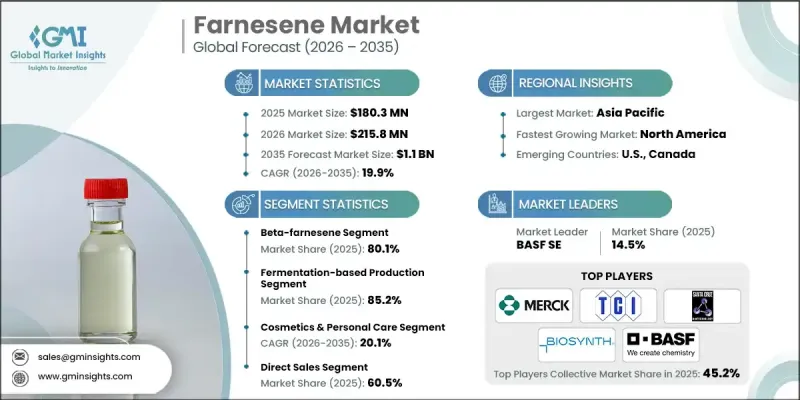
由於法尼烯在眾多產業的廣泛應用,其市場正經歷快速成長。法尼烯是一種天然存在的倍半萜烴,主要來自可再生原料,與全球轉型為環境友善和永續材料的趨勢高度契合。工業價值鏈中對天然原料日益成長的需求推動了法尼烯的廣泛應用。法尼烯天然的芳香特性使其成為香料、食品添加物和藥物製劑的重要成分。其抗氧化和抗菌特性進一步促進了其在個人保健產品和化妝品配方中的應用,增強了產品的穩定性和功能性。消費者對可再生和可生物分解原料的偏好不斷成長,也持續推動市場成長。作為永續材料和生物基替代品(包括清潔劑)的建構模組,法尼烯在工業配方中的需求也不斷擴大。其在治療化合物合成中的藥物應用不斷拓展,進一步提升了其在全球市場的商業性潛力。
| 市場覆蓋範圍 | |
|---|---|
| 開始年份 | 2025 |
| 預測年份 | 2026-2035 |
| 起始值 | 1.803億美元 |
| 預測金額 | 11億美元 |
| 複合年成長率 | 19.9% |
2025年,BETA-法尼烯市佔率達到80.1%,預計到2035年將以20%的複合年成長率成長。其強勁的市場地位得益於其天然來源、可生物分解性以及與永續病蟲害防治實踐的兼容性,使其在農業領域的應用日益廣泛。此外,工業界對生物基替代品的需求不斷成長,以減少對合成化學品的依賴,同時,持續的研究也拓展其在香精香料和能源相關領域的應用。
預計到 2025 年,以發酵為基礎的生產方式將佔據 85.2% 的市場佔有率,並在 2026 年至 2035 年期間以 19.9% 的複合年成長率成長。這種生產方式之所以受到青睞,是因為它能夠高效利用可再生原料生產適用於高階應用的高純度法尼烯,並且與生物技術主導的生產流程相契合,有助於減少對石化燃料的依賴,並滿足多個終端用戶行業對天然級原料的需求。
預計到2025年,北美法尼烯市佔率將達到27.2%。在監管壓力和消費者對環保產品需求的推動下,個人護理和工業應用領域對永續原料的日益普及,正推動該地區的市場擴張。先進的研發能力和生物基化學品製造領域的創新也進一步促進了市場發展。
目錄
第1章調查方法和範圍
第2章執行摘要
第3章業界考察
- 生態系分析
- 供應商情況
- 利潤率
- 每個階段的附加價值
- 影響價值鏈的因素
- 中斷
- 產業影響因素
- 促進要素
- 產業潛在風險與挑戰
- 市場機遇
- 成長潛力分析
- 監管環境
- 北美洲
- 歐洲
- 亞太地區
- 拉丁美洲
- 中東和非洲
- 波特五力分析
- PESTEL 分析
- 價格趨勢
- 按地區
- 依產品類型
- 未來市場趨勢
- 科技與創新趨勢
- 當前技術趨勢
- 新興技術
- 專利狀態
- 貿易統計(HS編碼)(註:僅提供主要國家的貿易統計)
- 主要進口國
- 主要出口國
- 永續性和環境方面
- 永續努力
- 減少廢棄物策略
- 生產中的能源效率
- 環保舉措
- 考慮到碳足跡
第4章 競爭情勢
- 介紹
- 公司市佔率分析
- 按地區
- 北美洲
- 歐洲
- 亞太地區
- 拉丁美洲
- 中東和非洲
- 按地區
- 企業矩陣分析
- 主要市場公司的競爭分析
- 競爭定位矩陣
- 重大進展
- 併購
- 夥伴關係與合作
- 新產品發布
- 業務拓展計劃
第5章 依產品類型分類的市場估算與預測,2022-2035年
- α-法尼烯
- BETA-法尼烯
第6章 依生產方式分類的市場估算與預測,2022-2035年
- 基於發酵的生產
- 天然萃取物
- 化學合成
第7章 按應用領域分類的市場估算與預測,2022-2035年
- 化妝品和個人護理
- 護膚應用
- 護髮應用
- 彩妝品
- 燃料應用
- 航空燃料
- 柴油和船用燃料
- 潤滑油/功能性流體
- 香水和空氣清新劑
- 天然香氛
- 青檸口味和柑橘類應用
- 調味劑應用
- 溶劑和工業清潔劑
- 其他
第8章 按分銷管道分類的市場估算與預測,2022-2035年
- 直銷
- 批發商和批發公司
- 線上平台
第9章 2022-2035年各地區市場估算與預測
- 北美洲
- 美國
- 加拿大
- 歐洲
- 德國
- 英國
- 法國
- 西班牙
- 義大利
- 其他歐洲地區
- 亞太地區
- 中國
- 印度
- 日本
- 澳洲
- 韓國
- 亞太其他地區
- 拉丁美洲
- 巴西
- 墨西哥
- 阿根廷
- 其他拉丁美洲地區
- 中東和非洲
- 沙烏地阿拉伯
- 南非
- 阿拉伯聯合大公國
- 其他中東和非洲地區
第10章:公司簡介
- Alfa Chemistry
- BASF SE
- Biosynth
- BOC Sciences
- Clearsynth
- Glentham Life Sciences
- LGC Limited
- Merck(Sigma-Aldrich)
- Paraiso Bioenergia
- Santa Cruz Biotechnology
- TCI(Tokyo Chemical Industry)
The Global Farnesene Market was valued at USD 180.3 million in 2025 and is estimated to grow at a CAGR of 19.9% to reach USD 1.1 billion by 2035.
The market is experiencing rapid expansion due to rising adoption across a wide range of industries. Farnesene is a naturally occurring sesquiterpene hydrocarbon derived primarily from renewable feedstocks, which aligns strongly with the global shift toward environmentally responsible and sustainable materials. Its growing acceptance is supported by increasing demand for naturally sourced ingredients across industrial value chains. Farnesene plays an essential role as a raw material in fragrance, flavor, and pharmaceutical formulations due to its naturally appealing aromatic profile. Its antioxidant and antimicrobial properties further support its use in personal care and cosmetic formulations by enhancing product stability and functional performance. Rising consumer preference for renewable and biodegradable ingredients continues to support market growth. Farnesene is also gaining momentum as a building block for bio-based alternatives used in industrial formulations, including sustainable materials and cleaning solutions. Expanding pharmaceutical applications for synthesizing therapeutic compounds are further broadening their commercial potential across global markets.
| Market Scope | |
|---|---|
| Start Year | 2025 |
| Forecast Year | 2026-2035 |
| Start Value | $180.3 Million |
| Forecast Value | $1.1 Billion |
| CAGR | 19.9% |
The beta-farnesene segment accounted for 80.1% share in 2025 and is expected to grow at a CAGR of 20% through 2035. Its strong market position is supported by increasing use in agricultural applications due to its natural origin, biodegradability, and compatibility with sustainable pest management practices. Demand is rising as industries seek bio-based alternatives that reduce reliance on synthetic chemical inputs, while ongoing research continues to expand its use in flavor, fragrance, and energy-related applications.
The fermentation-based production segment held an 85.2% share in 2025 and is projected to grow at a CAGR of 19.9% from 2026 to 2035. This production route is favored for its efficiency and alignment with biotechnology-driven manufacturing, utilizing renewable feedstocks to produce high-purity farnesene suitable for premium applications. The process supports reduced fossil fuel dependence and meets demand for natural-grade ingredients across multiple end-use industries.
North America Farnesene Market held a 27.2% share in 2025. Regional expansion is driven by increasing adoption of sustainable ingredients across personal care and industrial applications, supported by regulatory pressure and consumer demand for environmentally responsible products. Advanced research capabilities and innovation across bio-based chemical manufacturing further contribute to market development.
Key players operating in the Global Farnesene Market include BASF SE, Merck (Sigma-Aldrich), TCI (Tokyo Chemical Industry), Alfa Chemistry, Paraiso Bioenergia, Biosynth, Santa Cruz Biotechnology, LGC Limited, Glentham Life Sciences, Clearsynth, BOC Sciences, and Sigma-aligned specialty chemical suppliers. Companies operating in the Global Farnesene Market are strengthening their market positions by investing in bio-based production technologies and expanding fermentation capacities to ensure scalability and cost efficiency. Strategic collaborations with biotechnology firms and research institutions are helping accelerate product development and application diversification. Many players are prioritizing sustainability-focused branding and regulatory compliance to align with evolving consumer expectations. Geographic expansion into high-growth regions, along with portfolio diversification across industrial, personal care, and pharmaceutical applications, remains a key focus.
Table of Contents
Chapter 1 Methodology & Scope
- 1.1 Market scope and definition
- 1.2 Research design
- 1.2.1 Research approach
- 1.2.2 Data collection methods
- 1.3 Data mining sources
- 1.3.1 Global
- 1.3.2 Regional/Country
- 1.4 Base estimates and calculations
- 1.4.1 Base year calculation
- 1.4.2 Key trends for market estimation
- 1.5 Primary research and validation
- 1.5.1 Primary sources
- 1.6 Forecast model
- 1.7 Research assumptions and limitations
Chapter 2 Executive Summary
- 2.1 Industry 360° synopsis
- 2.2 Key market trends
- 2.2.1 Regional
- 2.2.2 Product type
- 2.2.3 Production method
- 2.2.4 Application
- 2.2.5 Distribution channel
- 2.3 TAM Analysis, 2026-2035
- 2.4 CXO perspectives: Strategic imperatives
- 2.4.1 Executive decision points
- 2.4.2 Critical success factors
- 2.5 Future Outlook and Strategic Recommendations
Chapter 3 Industry Insights
- 3.1 Industry ecosystem analysis
- 3.1.1 Supplier landscape
- 3.1.2 Profit margin
- 3.1.3 Value addition at each stage
- 3.1.4 Factor affecting the value chain
- 3.1.5 Disruptions
- 3.2 Industry impact forces
- 3.2.1 Growth drivers
- 3.2.2 Industry pitfalls and challenges
- 3.2.3 Market opportunities
- 3.3 Growth potential analysis
- 3.4 Regulatory landscape
- 3.4.1 North America
- 3.4.2 Europe
- 3.4.3 Asia Pacific
- 3.4.4 Latin America
- 3.4.5 Middle East & Africa
- 3.5 Porter's analysis
- 3.6 PESTEL analysis
- 3.7 Price trends
- 3.7.1 By region
- 3.7.2 By product type
- 3.8 Future market trends
- 3.9 Technology and Innovation landscape
- 3.9.1 Current technological trends
- 3.9.2 Emerging technologies
- 3.10 Patent Landscape
- 3.11 Trade statistics (HS code)( Note: the trade statistics will be provided for key countries only)
- 3.11.1 Major importing countries
- 3.11.2 Major exporting countries
- 3.12 Sustainability and environmental aspects
- 3.12.1 Sustainable practices
- 3.12.2 Waste reduction strategies
- 3.12.3 Energy efficiency in production
- 3.12.4 Eco-friendly initiatives
- 3.13 Carbon footprint consideration
Chapter 4 Competitive Landscape, 2025
- 4.1 Introduction
- 4.2 Company market share analysis
- 4.2.1 By region
- 4.2.1.1 North America
- 4.2.1.2 Europe
- 4.2.1.3 Asia Pacific
- 4.2.1.4 LATAM
- 4.2.1.5 MEA
- 4.2.1 By region
- 4.3 Company matrix analysis
- 4.4 Competitive analysis of major market players
- 4.5 Competitive positioning matrix
- 4.6 Key developments
- 4.6.1 Mergers & acquisitions
- 4.6.2 Partnerships & collaborations
- 4.6.3 New Product Launches
- 4.6.4 Expansion Plans
Chapter 5 Market Estimates and Forecast, By Product Type, 2022-2035 (USD Million) (Kilo Tons)
- 5.1 Key trends
- 5.2 Alpha-farnesene
- 5.3 Beta-farnesene
Chapter 6 Market Estimates and Forecast, By Production Method, 2022-2035 (USD Million) (Kilo Tons)
- 6.1 Key trends
- 6.2 Fermentation-based production
- 6.3 Natural extraction
- 6.4 Chemical synthesis
Chapter 7 Market Estimates and Forecast, By Application, 2022-2035 (USD Million) (Kilo Tons)
- 7.1 Key trends
- 7.2 Cosmetics & personal care
- 7.2.1 Skincare applications
- 7.2.2 Haircare applications
- 7.2.3 Color cosmetics
- 7.3 Fuel applications
- 7.3.1 Aviation fuel
- 7.3.2 Diesel & marine fuel
- 7.4 Lubricants & functional fluids
- 7.5 Flavors & fragrances
- 7.5.1 Natural flavoring agent
- 7.5.2 Lime flavor & citrus applications
- 7.5.3 Fragrance additive applications
- 7.6 Solvents & industrial cleaners
- 7.7 Others
Chapter 8 Market Estimates and Forecast, By Distribution Channel, 2022-2035 (USD Million) (Kilo Tons)
- 8.1 Key trends
- 8.2 Direct sales
- 8.3 Distributors & wholesalers
- 8.4 Online platforms
Chapter 9 Market Estimates and Forecast, By Region, 2022-2035 (USD Million) (Kilo Tons)
- 9.1 Key trends
- 9.2 North America
- 9.2.1 U.S.
- 9.2.2 Canada
- 9.3 Europe
- 9.3.1 Germany
- 9.3.2 UK
- 9.3.3 France
- 9.3.4 Spain
- 9.3.5 Italy
- 9.3.6 Rest of Europe
- 9.4 Asia Pacific
- 9.4.1 China
- 9.4.2 India
- 9.4.3 Japan
- 9.4.4 Australia
- 9.4.5 South Korea
- 9.4.6 Rest of Asia Pacific
- 9.5 Latin America
- 9.5.1 Brazil
- 9.5.2 Mexico
- 9.5.3 Argentina
- 9.5.4 Rest of Latin America
- 9.6 Middle East and Africa
- 9.6.1 Saudi Arabia
- 9.6.2 South Africa
- 9.6.3 UAE
- 9.6.4 Rest of Middle East and Africa
Chapter 10 Company Profiles
- 10.1 Alfa Chemistry
- 10.2 BASF SE
- 10.3 Biosynth
- 10.4 BOC Sciences
- 10.5 Clearsynth
- 10.6 Glentham Life Sciences
- 10.7 LGC Limited
- 10.8 Merck (Sigma-Aldrich)
- 10.9 Paraiso Bioenergia
- 10.10 Santa Cruz Biotechnology
- 10.11 TCI (Tokyo Chemical Industry)


