


 |
市場調查報告書
商品編碼
1913422
輕型車輛拖車市場機會、成長要素、產業趨勢分析及2026年至2035年預測Light Car Trailer Market Opportunity, Growth Drivers, Industry Trend Analysis, and Forecast 2026 - 2035 |
||||||

預計到 2025 年,全球輕型車輛拖車市場價值將達到 15.8 億美元,到 2035 年將達到 21.6 億美元,年複合成長率為 3.2%。
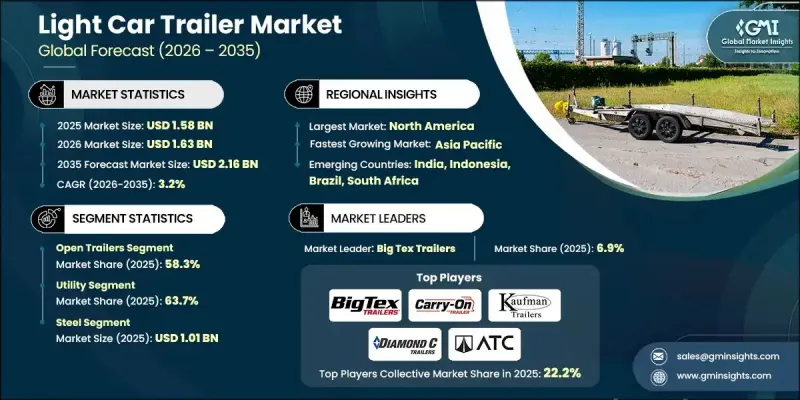
市場擴張與全球都市區和半都市區物流營運和短途配送網路的穩定成長密切相關。小規模企業和自由職業模式的日益普及推動了對經濟靈活運輸解決方案的需求,進而促進了輕型車輛拖車的廣泛應用。最初,封閉式輕型車輛拖車僅在一些以生活方式為導向的特定應用場景中獲得認可,這些場景的關鍵需求是耐用性、安全儲存和耐候性。隨後,由於其性能穩定、易於使用和安全性提升,這些拖車的應用範圍逐漸擴展到其他領域。這種轉變逐漸推動了它們在日常交通和商業應用中的普及。區域分析顯示,北美憑藉其發達的交通基礎設施、較高的消費者接受度和成熟的出行模式,成為關鍵市場。該地區對能夠滿足個人和商用運輸需求的靈活牽引解決方案的偏好,也進一步推動了市場需求。
| 市場覆蓋範圍 | |
|---|---|
| 開始年份 | 2025 |
| 預測年份 | 2026-2035 |
| 起始值 | 15.8億美元 |
| 預測金額 | 21.6億美元 |
| 複合年成長率 | 3.2% |
截至2025年,敞篷拖車市佔率將達到58.3%。據稱,敞篷輕型車輛拖車因其在專業和工業領域的應用日益廣泛而備受重視。其設計便於裝卸超大或不規則貨物,適用於需要便利裝卸能力的場所。
預計到2025年,多用途拖車將佔據63.7%的市場佔有率,到2035年市場規模將達到14億美元。多用途輕型車輛拖車的特點是能夠適應各種日常運輸需求。其實實用設計使其能夠重複用於商業和個人運輸。豐富的配置選項提高了裝載效率和整體便利性,使其市場滲透率高於專用拖車。
預計2025年,美國輕型車輛拖吊車市場規模將達5.182億美元。由於休閒和商業活動領域長期以來的強勁需求,美國有望繼續保持主導地位。國內物流行業的持續強勁成長以及線上零售分銷的快速發展,推動了對適應性強的本地運輸解決方案的需求。因此,越來越多的個體經營者以及郊區和區域的中小型企業正在將輕型車輛拖車納入其日常營運中。
目錄
第1章調查方法
第2章執行摘要
第3章業界考察
- 生態系分析
- 供應商情況
- 利潤率
- 成本結構
- 每個階段的附加價值
- 影響價值鏈的因素
- 中斷
- 產業影響因素
- 促進要素
- 休閒車和旅行拖車的需求不斷成長
- 戶外探險旅遊的成長
- 增加可支配收入和改善生活方式
- 拓展電子商務與最後一公里配送解決方案
- 產業潛在風險與挑戰
- 高昂的初始投資和購買成本
- 新興市場道路基礎設施短缺
- 市場機遇
- 新興市場的擴張
- 永續輕型拖車材料的成長
- 旅遊和戶外休閒的擴展
- 可客製化和模組化拖車正變得越來越受歡迎
- 促進要素
- 成長潛力分析
- 監管環境
- 北美洲
- 美國交通部拖吊法規
- 州/省拖車登記和公路法規
- 美國國家公路交通安全管理局拖車合規標籤(美國)
- 歐洲
- 歐盟整車類型認證(WVTA)
- 聯合國歐洲經濟委員會(UNECE)條例(WP.29)
- 歐盟駕駛執照類別
- 亞太地區
- 澳洲設計規則(ADR)
- 中國GB標準
- 印度汽車法規
- 拉丁美洲
- 墨西哥 NOM-035-SCT-2 拖車安全標準
- 聯合國歐洲經濟委員會(UNECE)/聯合國全球技術法規(GTRs)
- 道路交通安全標準
- 中東和非洲
- 沙烏地阿拉伯拖車技術法規(SASO)
- 海灣合作理事會車輛標準
- 阿拉伯聯合大公國道路和交通管理局(RTA)拖車法規
- 北美洲
- 波特五力分析
- PESTEL 分析
- 科技與創新趨勢
- 當前技術趨勢
- 新興技術
- 價格趨勢
- 按地區
- 依產品
- 生產統計
- 生產基地
- 消費基礎
- 出口和進口
- 成本細分分析
- 永續性和環境影響
- 環境影響評估
- 社會影響力和社區服務
- 公司管治與企業社會責任
- 永續金融與投資趨勢
- 製造和設計趨勢
- 從鋼材轉向鋁材和複合材料
- 模組化和可自訂拖車設計的演變
- 提高空氣動力性能和燃油效率的考量因素
- 輕量化創新
- 經銷和售後服務生態系統
- 經銷商網路結構及覆蓋範圍分析
- 線上銷售管道滲透與數位轉型
- 售後零件和配件市場
- 維護和服務基礎設施可用性
- 案例研究
- 未來前景與機遇
第4章 競爭情勢
- 介紹
- 公司市佔率分析
- 北美洲
- 歐洲
- 亞太地區
- 拉丁美洲
- 中東和非洲
- 主要市場公司的競爭分析
- 競爭定位矩陣
- 戰略展望矩陣
- 重大進展
- 併購
- 夥伴關係與合作
- 新產品發布
- 企業擴張計畫和資金籌措
第5章 依設計分類的市場估算與預測,2022-2035年
- 打開拖車
- 平板拖車
- 傾斜式拖車
- 傾卸拖車
- 封閉式拖車
- 廂式拖車
- 特製封閉式拖車
第6章 按車軸分類的市場估算與預測,2022-2035年
- 單軸
- 多軸車輛
- 雙人(串聯式)
- 三重軸
第7章 按材料分類的市場估算與預測,2022-2035年
- 鋼材
- 鋁
- 複合材料/玻璃纖維
- 其他
8. 依有效載荷分類的市場估算與預測,2022-2035 年
- 最高可達750公斤
- 751 kg~2,000 kg
- 2,001 kg~3,500 kg
第9章 按應用領域分類的市場估算與預測,2022-2035年
- 公用事業
- 貿易/建築
- 農業
- 物流/小型配送
- 其他
- 休閒用途
第10章 依最終用途分類的市場估計與預測,2022-2035年
- 船隊所有
- 個人/私人
- 租賃/出租
第11章 依銷售管道分類的市場估計與預測,2022-2035年
- 直銷
- 間接銷售
第12章 2022-2035年各地區市場估算與預測
- 北美洲
- 美國
- 加拿大
- 歐洲
- 德國
- 英國
- 法國
- 義大利
- 西班牙
- 俄羅斯
- 北歐國家
- 比荷盧經濟聯盟
- 亞太地區
- 中國
- 印度
- 日本
- 韓國
- ANZ
- 新加坡
- 馬來西亞
- 印尼
- 越南
- 泰國
- 拉丁美洲
- 巴西
- 墨西哥
- 阿根廷
- 哥倫比亞
- 中東和非洲
- 南非
- 沙烏地阿拉伯
- 阿拉伯聯合大公國
第13章:公司簡介
- 世界公司
- Big Tex Trailers
- PJ Trailers
- Aluma
- ATC Trailers
- Ifor Williams Trailers
- Featherlite Trailers
- Sundowner Trailers
- Diamond C Trailers
- Haulmark Industries
- Felling Trailers
- Kaufman Trailers
- Pace American
- Wells Cargo
- Load Trail
- Woodford Trailers
- 本地公司
- Brian James Trailers
- Debon Trailers
- SylvanSport
- Pongratz Trailer
- Carry-On Trailer
- 新興企業
- Vezeko
- UNSINN Fahrzeugtechnik
- Temared
- Nugent Engineering
- Erde SAS
The Global Light Car Trailer Market was valued at USD 1.58 billion in 2025 and is estimated to grow at a CAGR of 3.2% to reach USD 2.16 billion by 2035.
Market expansion is linked to the steady growth of logistics operations and short-distance delivery networks across global urban and semi-urban areas. Rising participation in small-scale enterprises and independent work models has increased demand for affordable and flexible transport solutions, supporting wider adoption of light car trailers. Initially, enclosed light car trailers gained recognition within limited lifestyle-oriented use cases, where durability, secure storage, and weather resistance were key requirements. Over time, consistent performance, ease of use, and improved safety features helped broaden awareness of these trailers beyond niche usage. This shift gradually encouraged their adoption for daily transport needs and professional applications. Regional analysis identifies North America as the leading market, supported by developed transport infrastructure, strong consumer acceptance, and established mobility patterns. Market demand in the region is further supported by preferences for flexible towing solutions that align with both personal and work-related transportation needs.
| Market Scope | |
|---|---|
| Start Year | 2025 |
| Forecast Year | 2026-2035 |
| Start Value | $1.58 Billion |
| Forecast Value | $2.16 Billion |
| CAGR | 3.2% |
The open trailers segment held an 58.3% share in 2025. Open-structure light car trailers are described as gaining prominence due to increased deployment in professional and industrial operations. Their design supports easier handling of oversized or irregular cargo, making them suitable for sectors that require straightforward loading and unloading capabilities.
The utility segment accounted for 63.7% share in 2025 and is forecast to reach USD 1.4 billion by 2035. Utility light car trailers are characterized by their adaptability across a wide range of routine hauling requirements. Their practical design supports repeated use across professional tasks and personal transport needs. Availability in multiple configurations improves efficiency during loading processes and enhances overall usability, contributing to their higher market penetration compared to purpose-specific trailer categories.
U.S. Light Car Trailer Market reached USD 518.2 million in 2025. The country is described as maintaining its leadership position due to long-standing demand across both leisure-oriented and commercial activities. Continued strength in the domestic logistics sector and rapid growth in online retail distribution have increased the need for adaptable local transport solutions. As a result, independent operators and smaller enterprises across suburban and rural regions are increasingly incorporating light car trailers into their daily operations.
Key companies active in the Global Light Car Trailer Market include Big Tex Trailers, Diamond C Trailer, Aluma Trailers, Carry-On Trailer, Featherlite Trailers, ATC Trailers, Kaufman Trailers, Pace American, Sylvansport, and Futura Trailers. Manufacturers operating in the Light Car Trailer Market are described as focusing on product durability, design optimization, and customization to strengthen their competitive position. Many companies are investing in lightweight materials and improved towing compatibility to enhance performance and efficiency. Expanding dealer networks and regional distribution channels remains a key priority to improve customer reach. Strategic pricing and flexible product portfolios are being used to address both personal and professional buyer segments.
Table of Contents
Chapter 1 Methodology
- 1.1 Research approach
- 1.2 Quality commitments
- 1.2.1 GMI AI policy & data integrity commitment
- 1.3 Research trail & confidence scoring
- 1.3.1 Research trail components
- 1.3.2 Scoring components
- 1.4 Data collection
- 1.4.1 Partial list of primary sources
- 1.5 Data mining sources
- 1.5.1 Paid sources
- 1.6 Base estimates and calculations
- 1.6.1 Base year calculation
- 1.7 Forecast model
- 1.8 Research transparency addendum
Chapter 2 Executive Summary
- 2.1 Industry 360° synopsis
- 2.2 Key market trends
- 2.2.1 Regional
- 2.2.2 Design
- 2.2.3 Axle
- 2.2.4 Material
- 2.2.5 Payload
- 2.2.6 Application
- 2.2.7 End Use
- 2.2.8 Sales Channel
- 2.3 TAM analysis, 2026-2035
- 2.4 CXO perspectives: Strategic imperatives
- 2.4.1 Executive decision points
- 2.4.2 Critical success factors
- 2.5 Future outlook and recommendations
Chapter 3 Industry Insights
- 3.1 Industry ecosystem analysis
- 3.1.1 Supplier landscape
- 3.1.2 Profit margin
- 3.1.3 Cost structure
- 3.1.4 Value addition at each stage
- 3.1.5 Factor affecting the value chain
- 3.1.6 Disruptions
- 3.2 Industry impact forces
- 3.2.1 Growth drivers
- 3.2.1.1 Rising demand for recreational vehicles and travel trailers
- 3.2.1.2 Growth in outdoor and adventure tourism
- 3.2.1.3 Increasing disposable income and lifestyle upgrades
- 3.2.1.4 Expansion of E-commerce and last-mile delivery solutions
- 3.2.2 Industry pitfalls and challenges
- 3.2.2.1 High initial investment and purchase cost
- 3.2.2.2 Limited road infrastructure in emerging markets
- 3.2.3 Market opportunities
- 3.2.3.1 Expansion in emerging markets
- 3.2.3.2 Growth of sustainable and lightweight trailer materials
- 3.2.3.3 Expansion in tourism and outdoor recreational segments
- 3.2.3.4 Rising Popularity of Customizable and Modular Trailers
- 3.2.1 Growth drivers
- 3.3 Growth potential analysis
- 3.4 Regulatory landscape
- 3.4.1 North America
- 3.4.1.1 DOT Trailer Regulations (U.S.)
- 3.4.1.2 State/Provincial Trailer Registration & Road Laws
- 3.4.1.3 NHTSA Trailer Compliance Labels (U.S.)
- 3.4.2 Europe
- 3.4.2.1 EU Whole Vehicle Type Approval (WVTA)
- 3.4.2.2 UNECE Regulations (WP.29)
- 3.4.2.3 EU Driver License Categories
- 3.4.3 Asia Pacific
- 3.4.3.1 Australian Design Rules (ADRs)
- 3.4.3.2 China GB standards
- 3.4.3.3 India Motor Vehicle Regulations
- 3.4.4 Latin America
- 3.4.4.1 Mexico NOM-035-SCT-2 Trailer Safety Specification
- 3.4.4.2 UNECE/UN Global Technical Regulations (GTRs)
- 3.4.4.3 Road Traffic Safety Codes
- 3.4.5 Middle East & Africa
- 3.4.5.1 Saudi Trailer Technical Regulation (SASO)
- 3.4.5.2 GCC Vehicle Standards
- 3.4.5.3 UAE Road & Transport Authority (RTA) Trailer Rules
- 3.4.1 North America
- 3.5 Porter's analysis
- 3.6 PESTEL analysis
- 3.7 Technology and innovation landscape
- 3.7.1 Current technological trends
- 3.7.2 Emerging technologies
- 3.8 Price trends
- 3.8.1 By region
- 3.8.2 By product
- 3.9 Production statistics
- 3.9.1 Production hubs
- 3.9.2 Consumption hubs
- 3.9.3 Export and import
- 3.10 Cost breakdown analysis
- 3.11 Sustainability and environmental impact
- 3.11.1 Environmental impact assessment
- 3.11.2 Social impact & community benefits
- 3.11.3 Governance & corporate responsibility
- 3.11.4 Sustainable finance & investment trends
- 3.12 Manufacturing and design trends
- 3.12.1 Shift from steel to aluminum and composite materials
- 3.12.2 Modular and customizable trailer design evolution
- 3.12.3 Aerodynamic improvements and fuel efficiency considerations
- 3.12.4 Lightweight engineering innovations
- 3.13 Distribution and after-sales ecosystem
- 3.13.1 Dealer network structure and coverage analysis
- 3.13.2 Online sales channel penetration and digital transformation
- 3.13.3 Aftermarket parts and accessories market
- 3.13.4 Maintenance and service infrastructure availability
- 3.14 Case studies
- 3.15 Future outlook & opportunities
Chapter 4 Competitive Landscape, 2025
- 4.1 Introduction
- 4.2 Company market share analysis
- 4.2.1 North America
- 4.2.2 Europe
- 4.2.3 Asia Pacific
- 4.2.4 LATAM
- 4.2.5 MEA
- 4.3 Competitive analysis of major market players
- 4.4 Competitive positioning matrix
- 4.5 Strategic outlook matrix
- 4.6 Key developments
- 4.6.1 Mergers & acquisitions
- 4.6.2 Partnerships & collaborations
- 4.6.3 New product launches
- 4.6.4 Expansion plans and funding
Chapter 5 Market Estimates & Forecast, By Design, 2022 - 2035 ($Bn, Units)
- 5.1 Key trends
- 5.2 Open trailers
- 5.2.1 Flatbed trailers
- 5.2.2 Ramped trailers
- 5.2.3 Dump-trailers
- 5.3 Enclosed trailers
- 5.3.1 Box Trailers
- 5.3.2 Specialty enclosed trailers
Chapter 6 Market Estimates & Forecast, By Axle, 2022 - 2035 ($Bn, Units)
- 6.1 Key trends
- 6.2 Single Axle
- 6.3 Multi-Axle
- 6.3.1 Tandem (Double)
- 6.3.2 Triple (Tri-Axle)
Chapter 7 Market Estimates & Forecast, By Material, 2022 - 2035 ($Bn, Units)
- 7.1 Key trends
- 7.2 Steel
- 7.3 Aluminum
- 7.4 Composite/Fiberglass
- 7.5 Others
Chapter 8 Market Estimates & Forecast, By Payload, 2022 - 2035 ($Bn, Units)
- 8.1 Key trends
- 8.2 Up to 750 kg
- 8.3 751 kg - 2,000 kg
- 8.4 2,001 kg - 3,500 kg
Chapter 9 Market Estimates & Forecast, By Application, 2022 - 2035 ($Bn, Units)
- 9.1 Key trends
- 9.2 Utility
- 9.2.1 Trade & Construction
- 9.2.2 Agriculture
- 9.2.3 Logistics/Parcel
- 9.2.4 Others
- 9.3 Recreational
Chapter 10 Market Estimates & Forecast, By End Use, 2022 - 2035 ($Bn, Units)
- 10.1 Key trends
- 10.2 Fleet-Owned
- 10.3 Private/Individual
- 10.4 Leased/Rental
Chapter 11 Market Estimates & Forecast, By Sales Channel, 2022 - 2035 ($Bn, Units)
- 11.1 Key trends
- 11.2 Direct
- 11.3 Indirect
Chapter 12 Market Estimates & Forecast, By Region, 2022 - 2035 ($Bn, Units)
- 12.1 Key trends
- 12.2 North America
- 12.2.1 US
- 12.2.2 Canada
- 12.3 Europe
- 12.3.1 Germany
- 12.3.2 UK
- 12.3.3 France
- 12.3.4 Italy
- 12.3.5 Spain
- 12.3.6 Russia
- 12.3.7 Nordics
- 12.3.8 Benelux
- 12.4 Asia Pacific
- 12.4.1 China
- 12.4.2 India
- 12.4.3 Japan
- 12.4.4 South Korea
- 12.4.5 ANZ
- 12.4.6 Singapore
- 12.4.7 Malaysia
- 12.4.8 Indonesia
- 12.4.9 Vietnam
- 12.4.10 Thailand
- 12.5 Latin America
- 12.5.1 Brazil
- 12.5.2 Mexico
- 12.5.3 Argentina
- 12.5.4 Colombia
- 12.6 MEA
- 12.6.1 South Africa
- 12.6.2 Saudi Arabia
- 12.6.3 UAE
Chapter 13 Company Profiles
- 13.1 Global companies
- 13.1.1 Big Tex Trailers
- 13.1.2 PJ Trailers
- 13.1.3 Aluma
- 13.1.4 ATC Trailers
- 13.1.5 Ifor Williams Trailers
- 13.1.6 Featherlite Trailers
- 13.1.7 Sundowner Trailers
- 13.1.8 Diamond C Trailers
- 13.1.9 Haulmark Industries
- 13.1.10 Felling Trailers
- 13.1.11 Kaufman Trailers
- 13.1.12 Pace American
- 13.1.13 Wells Cargo
- 13.1.14 Load Trail
- 13.1.15 Woodford Trailers
- 13.2 Regional companies
- 13.2.1 Brian James Trailers
- 13.2.2 Debon Trailers
- 13.2.3 SylvanSport
- 13.2.4 Pongratz Trailer
- 13.2.5 Carry-On Trailer
- 13.3 Emerging companies
- 13.3.1 Vezeko
- 13.3.2 UNSINN Fahrzeugtechnik
- 13.3.3 Temared
- 13.3.4 Nugent Engineering
- 13.3.5 Erde SAS


