


 |
市場調查報告書
商品編碼
1913416
乙烯-乙烯醇共聚物市場機會、成長要素、產業趨勢分析及2026年至2035年預測Ethylene-Vinyl Alcohol Copolymer (EVOH) Market Opportunity, Growth Drivers, Industry Trend Analysis, and Forecast 2026 - 2035 |
||||||

2025年全球乙烯-乙烯醇共聚物市值為9.554億美元,預計2035年將達到18億美元,年複合成長率為6.5%。
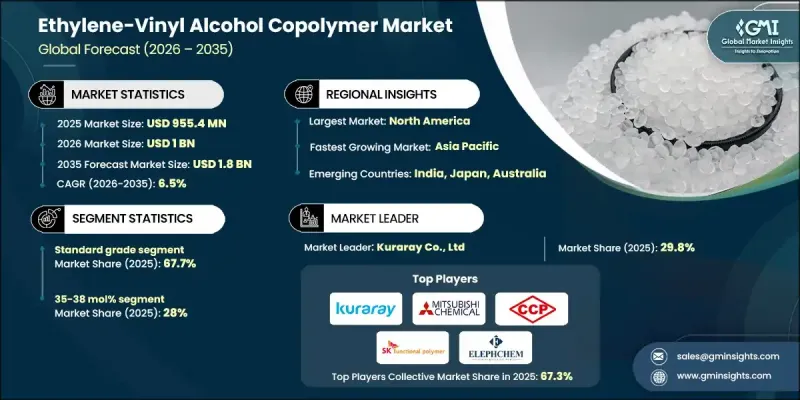
市場成長得益於多個終端應用產業對先進阻隔材料日益成長的需求。乙烯-乙烯醇共聚物(EVOH)因其優異的氣體滲透性、氣味遷移和水分滲透性能而廣受認可,使其成為對性能要求極高的應用領域的首選解決方案。人們對產品安全、保存期限和法規遵循的日益關注,正在加速高阻隔材料的應用,尤其是在包裝價值鏈中。製造商優先考慮能夠延長產品完整性並支援減少廢棄物的舉措。同時,環境法規遵循要求正在推動有助於排放排放和提高技術應用中密封效率的材料的廣泛應用。汽車製造商也在擴大EVOH基部件的應用,以滿足不斷變化的蒸氣控制和永續性標準。在對材料效率和聚合物加工技術創新的日益重視的推動下,市場需求仍然強勁。隨著各行業尋求兼具耐用性、可靠性和法規遵從性的材料,EVOH在全球市場中佔據有利地位,可望保持長期穩定的成長。
| 市場覆蓋範圍 | |
|---|---|
| 開始年份 | 2025 |
| 預測年份 | 2026-2035 |
| 起始值 | 9.554億美元 |
| 預測金額 | 18億美元 |
| 複合年成長率 | 6.5% |
預計到2025年,標準級EVOH將佔據67.7%的市場佔有率,並在2035年之前以6.2%的複合年成長率成長。由於其在多個行業領域的廣泛適用性以及卓越的性價比,該等級產品將繼續佔據主導地位。特種級EVOH因其更高的阻隔強度、耐化學腐蝕性或熱穩定性等特性,在應用領域日益受到青睞。
2025 年,35-38 莫耳% 類別佔了 28% 的市佔率。此成分範圍因其在加工性和阻隔效果方面的最佳平衡而受到認可,從而支持在包裝、汽車和醫療應用中的穩定性能。
預計2026年至2035年,北美乙烯-乙烯醇共聚物市場將以5.8%的複合年成長率成長。推動市場需求成長的因素包括:對永續材料解決方案的日益重視、回收技術的進步以及對循環經濟舉措投資的不斷增加。監管政策的調整和政府支持的永續性項目也持續推動先進乙烯-乙烯醇共聚物(EVOH)配方的應用。
目錄
第1章調查方法和範圍
第2章執行摘要
第3章業界考察
- 生態系分析
- 供應商情況
- 利潤率
- 每個階段的附加價值
- 影響價值鏈的因素
- 中斷
- 產業影響因素
- 促進要素
- 食品包裝對長期保存期限的需求日益成長
- 車輛燃油滲透的嚴格規定
- 藥品包裝需求成長
- 產業潛在風險與挑戰
- 低乙烯EVOH對濕度高度敏感
- 高階定價與通用阻隔材料對比
- 市場機遇
- 生物基特級初榨橄欖油市場趨勢
- 醫療設備領域的新興應用
- 促進要素
- 成長潛力分析
- 監管環境
- 北美洲
- 歐洲
- 亞太地區
- 拉丁美洲
- 中東和非洲
- 波特五力分析
- PESTEL 分析
- 價格趨勢
- 按地區
- 按年級
- 未來市場趨勢
- 科技與創新趨勢
- 當前技術趨勢
- 新興技術
- 專利狀態
- 貿易統計資料(HS編碼)(註:貿易統計僅適用於主要國家)
- 主要進口國
- 主要出口國
- 永續性和環境方面
- 永續努力
- 減少廢棄物策略
- 生產中的能源效率
- 環保舉措
- 考慮到碳足跡
第4章 競爭情勢
- 介紹
- 公司市佔率分析
- 按地區
- 北美洲
- 歐洲
- 亞太地區
- 拉丁美洲
- 中東和非洲
- 按地區
- 企業矩陣分析
- 主要市場公司的競爭分析
- 競爭定位矩陣
- 重大進展
- 併購
- 夥伴關係與合作
- 新產品發布
- 業務拓展計劃
第5章 各等級市場估算與預測,2022-2035年
- 標準級
- 特級
第6章 依乙烯含量分類的市場估算與預測,2022-2035年
- 小於29莫耳%
- 29-35莫耳百分比
- 35-38莫耳百分比
- 38-44莫耳百分比
- >44莫耳百分比
第7章 按應用領域分類的市場估算與預測,2022-2035年
- 食品/飲料
- 生肉/禽肉包裝
- 乳製品
- 加工食品和蒸餾食品
- 零嘴零食和糖果甜點
- 調味品、醬汁、沙拉醬
- 烘焙產品
- 其他
- 製藥
- 泡殼包裝
- 輸液袋和輸液劑
- 藥品包裝袋和藥包
- 其他
- 車
- 農業
- 青貯膜
- 溫室薄膜
- 多卷膠片
- 其他
- 化妝品和個人護理
- 護膚品包裝
- 護髮產品包裝
- 香水包裝
- 其他
- 建造
- 其他
第8章 2022-2035年各地區市場估算與預測
- 北美洲
- 美國
- 加拿大
- 歐洲
- 德國
- 英國
- 法國
- 西班牙
- 義大利
- 其他歐洲地區
- 亞太地區
- 中國
- 印度
- 日本
- 澳洲
- 韓國
- 亞太其他地區
- 拉丁美洲
- 巴西
- 墨西哥
- 阿根廷
- 其他拉丁美洲地區
- 中東和非洲
- 沙烏地阿拉伯
- 南非
- 阿拉伯聯合大公國
- 其他中東和非洲地區
第9章:公司簡介
- Bouling Chemical Co., Limited
- Chang Chun Petrochemical Co., Ltd
- Dow Chemical Company
- Elephchem
- Exxon Mobil Chemical
- Kuraray Co., Ltd
- Mitsubishi Chemical Corporation
- Mitsui Chemicals, Inc.
- Mondi Group
- SK Functional Polymer
The Global Ethylene-Vinyl Alcohol Copolymer Market was valued at USD 955.4 million in 2025 and is estimated to grow at a CAGR of 6.5% to reach USD 1.8 billion by 2035.
Market growth is supported by rising demand for advanced barrier materials across multiple end-use industries. Ethylene-vinyl alcohol copolymer is widely recognized for its strong resistance to gas transmission, odor migration, and moisture penetration, making it a preferred solution for performance-driven applications. Increasing focus on product safety, preservation, and regulatory compliance has accelerated adoption of high-barrier materials, particularly within packaging value chains. Manufacturers are prioritizing solutions that extend product integrity while supporting waste reduction initiatives. In parallel, environmental compliance requirements are encouraging wider use of materials that help limit emissions and improve containment efficiency in technical applications. Automotive manufacturers are also increasing adoption of EVOH-based components to meet evolving vapor control and sustainability standards. Growing emphasis on material efficiency, combined with innovation in polymer processing, continues to strengthen demand. As industries seek durable, reliable, and regulation-ready materials, EVOH remains well positioned for steady long-term growth across global markets.
| Market Scope | |
|---|---|
| Start Year | 2025 |
| Forecast Year | 2026-2035 |
| Start Value | $955.4 Million |
| Forecast Value | $1.8 Billion |
| CAGR | 6.5% |
The standard grade EVOH accounted for 67.7% share in 2025 and is expected to grow at a CAGR of 6.2% through 2035. This grade continues to dominate due to its adaptability across multiple industries and its balance between cost efficiency and functional performance. Specialty grades are gaining traction in applications that require enhanced barrier strength, chemical resistance, or thermal stability.
The 35-38 mol% category held 28% share in 2025. This composition range is favored for its optimal balance between processability and barrier effectiveness, supporting consistent performance across packaging, automotive, and healthcare-related uses.
North America Ethylene-Vinyl Alcohol Copolymer Market is forecast to grow at a CAGR of 5.8% between 2026 and 2035. Demand is being driven by increased emphasis on sustainable material solutions, advancements in recycling technologies, and growing investment in circular economy initiatives. Regulatory alignment and government-supported sustainability programs continue to encourage adoption of advanced EVOH formulations.
Key companies operating in the Ethylene-Vinyl Alcohol Copolymer Market include Kuraray Co., Ltd, Mitsubishi Chemical Corporation, Dow Chemical Company, Mitsui Chemicals, Inc., Exxon Mobil Chemical, Mondi Group, Chang Chun Petrochemical Co., Ltd, SK Functional Polymer, Bouling Chemical Co., Limited, and Elephchem. Companies in the Ethylene-Vinyl Alcohol Copolymer (EVOH) Market are strengthening their competitive position through innovation, capacity expansion, and strategic collaboration. Manufacturers are investing in research to enhance barrier performance, recyclability, and material compatibility with sustainable packaging systems. Product portfolio diversification allows suppliers to address a wider range of application requirements. Strategic partnerships with packaging and automotive manufacturers support long-term supply agreements and early adoption of new grades.
Table of Contents
Chapter 1 Methodology & Scope
- 1.1 Market scope and definition
- 1.2 Research design
- 1.2.1 Research approach
- 1.2.2 Data collection methods
- 1.3 Data mining sources
- 1.3.1 Global
- 1.3.2 Regional/Country
- 1.4 Base estimates and calculations
- 1.4.1 Base year calculation
- 1.4.2 Key trends for market estimation
- 1.5 Primary research and validation
- 1.5.1 Primary sources
- 1.6 Forecast model
- 1.7 Research assumptions and limitations
Chapter 2 Executive Summary
- 2.1 Industry 360° synopsis
- 2.2 Key market trends
- 2.2.1 Regional
- 2.2.2 Grade
- 2.2.3 Ethylene content
- 2.2.4 Application
- 2.3 TAM Analysis, 2026-2035
- 2.4 CXO perspectives: Strategic imperatives
- 2.4.1 Executive decision points
- 2.4.2 Critical success factors
- 2.5 Future Outlook and Strategic Recommendations
Chapter 3 Industry Insights
- 3.1 Industry ecosystem analysis
- 3.1.1 Supplier landscape
- 3.1.2 Profit margin
- 3.1.3 Value addition at each stage
- 3.1.4 Factor affecting the value chain
- 3.1.5 Disruptions
- 3.2 Industry impact forces
- 3.2.1 Growth drivers
- 3.2.1.1 Rising demand for extended shelf life in food packaging
- 3.2.1.2 Stringent automotive fuel permeation regulations
- 3.2.1.3 Growth in pharmaceutical packaging demand
- 3.2.2 Industry pitfalls and challenges
- 3.2.2.1 High moisture sensitivity of low ethylene EVOH
- 3.2.2.2 Premium pricing vs commodity barrier materials
- 3.2.3 Market opportunities
- 3.2.3.1 Bio-based EVOH market development
- 3.2.3.2 Emerging applications in medical devices
- 3.2.1 Growth drivers
- 3.3 Growth potential analysis
- 3.4 Regulatory landscape
- 3.4.1 North America
- 3.4.2 Europe
- 3.4.3 Asia Pacific
- 3.4.4 Latin America
- 3.4.5 Middle East & Africa
- 3.5 Porter's analysis
- 3.6 PESTEL analysis
- 3.7 Price trends
- 3.7.1 By region
- 3.7.2 By grade
- 3.8 Future market trends
- 3.9 Technology and innovation landscape
- 3.9.1 Current technological trends
- 3.9.2 Emerging technologies
- 3.10 Patent Landscape
- 3.11 Trade statistics (HS code)(Note: the trade statistics will be provided for key countries only)
- 3.11.1 Major importing countries
- 3.11.2 Major exporting countries
- 3.12 Sustainability and environmental aspects
- 3.12.1 Sustainable practices
- 3.12.2 Waste reduction strategies
- 3.12.3 Energy efficiency in production
- 3.12.4 Eco-friendly initiatives
- 3.13 Carbon footprint consideration
Chapter 4 Competitive Landscape, 2025
- 4.1 Introduction
- 4.2 Company market share analysis
- 4.2.1 By region
- 4.2.1.1 North America
- 4.2.1.2 Europe
- 4.2.1.3 Asia Pacific
- 4.2.1.4 LATAM
- 4.2.1.5 MEA
- 4.2.1 By region
- 4.3 Company matrix analysis
- 4.4 Competitive analysis of major market players
- 4.5 Competitive positioning matrix
- 4.6 Key developments
- 4.6.1 Mergers & acquisitions
- 4.6.2 Partnerships & collaborations
- 4.6.3 New Product Launches
- 4.6.4 Expansion Plans
Chapter 5 Market Estimates and Forecast, By Grade, 2022-2035 (USD Billion) (Kilo Tons)
- 5.1 Key trends
- 5.2 Standard grade
- 5.3 Specialty grade
Chapter 6 Market Estimates and Forecast, By Ethylene Content, 2022-2035 (USD Billion) (Kilo Tons)
- 6.1 Key trends
- 6.2 <29 mol%
- 6.3 29-35 mol%
- 6.4 35-38 mol%
- 6.5 38-44 mol%
- 6.6 >44 mol%
Chapter 7 Market Estimates and Forecast, By Application, 2022-2035 (USD Billion) (Kilo Tons)
- 7.1 Key trends
- 7.2 Food & beverages
- 7.2.1 Fresh meat & poultry packaging
- 7.2.2 Dairy products
- 7.2.3 Processed foods & ready-to-eat meals
- 7.2.4 Snacks & confectionery
- 7.2.5 Condiments, sauces & dressings
- 7.2.6 Bakery products
- 7.2.7 Others
- 7.3 Pharmaceuticals
- 7.3.1 Blister packs
- 7.3.2 IV bags & infusion solutions
- 7.3.3 Drug pouches & sachets
- 7.3.4 Others
- 7.4 Automotive
- 7.5 Agriculture
- 7.5.1 Silage films
- 7.5.2 Greenhouse films
- 7.5.3 Mulch films
- 7.5.4 Others
- 7.6 Cosmetics & personal care
- 7.6.1 Skincare product packaging
- 7.6.2 Haircare product packaging
- 7.6.3 Fragrance & perfume packaging
- 7.6.4 Others
- 7.7 Construction
- 7.8 Others
Chapter 8 Market Estimates and Forecast, By Region, 2022-2035 (USD Billion) (Kilo Tons)
- 8.1 Key trends
- 8.2 North America
- 8.2.1 U.S.
- 8.2.2 Canada
- 8.3 Europe
- 8.3.1 Germany
- 8.3.2 UK
- 8.3.3 France
- 8.3.4 Spain
- 8.3.5 Italy
- 8.3.6 Rest of Europe
- 8.4 Asia Pacific
- 8.4.1 China
- 8.4.2 India
- 8.4.3 Japan
- 8.4.4 Australia
- 8.4.5 South Korea
- 8.4.6 Rest of Asia Pacific
- 8.5 Latin America
- 8.5.1 Brazil
- 8.5.2 Mexico
- 8.5.3 Argentina
- 8.5.4 Rest of Latin America
- 8.6 Middle East and Africa
- 8.6.1 Saudi Arabia
- 8.6.2 South Africa
- 8.6.3 UAE
- 8.6.4 Rest of Middle East and Africa
Chapter 9 Company Profiles
- 9.1 Bouling Chemical Co., Limited
- 9.2 Chang Chun Petrochemical Co., Ltd
- 9.3 Dow Chemical Company
- 9.4 Elephchem
- 9.5 Exxon Mobil Chemical
- 9.6 Kuraray Co., Ltd
- 9.7 Mitsubishi Chemical Corporation
- 9.8 Mitsui Chemicals, Inc.
- 9.9 Mondi Group
- 9.10 SK Functional Polymer

 乙烯-丙烯酸共聚物市場:依形態、等級、技術、應用和銷售管道分類-2026-2032年全球市場預測乙烯共聚物市場:依產品類型、製造技術、形態和終端用戶產業分類-全球預測,2026-2032年
 乙烯共聚物市場分析及預測(至2035年):依類型、產品、應用、技術、最終用戶、材料類型、製程、功能、安裝類型分類
 2026年全球乙烯共聚物市場報告EVOH收縮膜市場按應用、終端用途產業、薄膜結構、成分和收縮方向分類-2026-2032年全球預測
 乙烯 - 乙烯醇(EVOH)全球市場、產能、需求、平均價格及產業展望(至2034年)
 全球乙烯 - 乙烯醇共聚物(EVOH)樹脂市場
 全球乙烯丙烯酸共聚物市場:市場佔有率和排名、總收入和需求預測(2025-2031)
 乙烯丙烯酸共聚物市場,全球 2025-2029
 乙烯共聚物全球市場規模、佔有率和趨勢分析報告:按應用、最終用途、類型和地區分類的展望和預測(2024-2031)