


 |
市場調查報告書
商品編碼
1913415
木質顆粒市場機會、成長要素、產業趨勢分析及2026年至2035年預測Wood Pellets Market Opportunity, Growth Drivers, Industry Trend Analysis, and Forecast 2026 - 2035 |
||||||

全球木質顆粒市場預計到 2025 年價值 110 億美元,到 2035 年達到 168 億美元,年複合成長率為 4.3%。
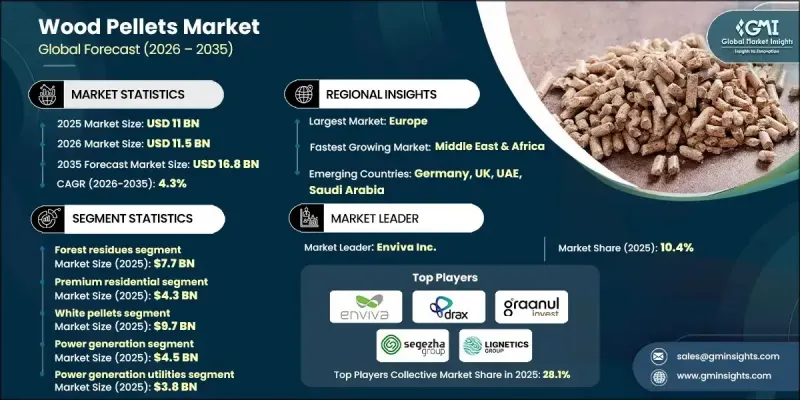
市場發展與生質能能源解決方案在發電和大規模供熱領域的日益普及密切相關。公共產業和工業營運商正在加速向木質顆粒轉型,以取代傳統的石化燃料,從而減少排放並達到環保合規目標。高能耗產業也因需要性能穩定、排放低且標準化的燃料而採用顆粒燃料系統。促進可再生能源利用的政策框架和監管要求繼續發揮強勁的成長動力。政府獎勵、可再生能源強制性規定和永續性目標支持生質能能源的日益普及,提高了木質顆粒的成本競爭力,並強化了其在全球能源轉型中的作用。
| 市場覆蓋範圍 | |
|---|---|
| 開始年份 | 2025 |
| 預測年份 | 2026-2035 |
| 起始值 | 110億美元 |
| 預測金額 | 168億美元 |
| 複合年成長率 | 4.3% |
以森林殘餘物為原料的顆粒燃料市場將佔原料組合的大部分,預計2025年市場規模將達到77億美元。該市場受益於穩定的供應和適合大規模顆粒燃料生產的特性。材料性能和能量輸出的穩定性有助於實現高效率加工和成本效益高的生產。已開發地區成熟的林業供應鏈進一步鞏固了該市場,確保了可追溯且永續性的原料來源,符合產業和公共產業的採購標準。
預計2025年,高階住宅顆粒燃料市場規模將達43億美元。此等級產品嚴格符合家用暖氣要求及品質標準,具有高效率燃燒、極低殘留及系統性能穩定等特性。已開發經濟體對節能型住宅暖氣解決方案的持續投資以及清潔能源政策的支持將維持市場需求。
預計到2025年,北美木質顆粒市場將佔據16.4%的市場。該地區受益於強大的生產能力和大規模的出口活動(主要由美國推動)。豐富的森林資源、完善的顆粒生產基礎設施和先進的物流能力使該地區能夠有效率地供應國際市場。
目錄
第1章調查方法和範圍
第2章執行摘要
第3章業界考察
- 生態系分析
- 供應商情況
- 利潤率
- 每個階段的附加價值
- 影響價值鏈的因素
- 中斷
- 產業影響因素
- 促進要素
- 食品和飲料行業的需求不斷成長
- 政府法規鼓勵使用環保材料
- 零售和快速消費品(FMCG)行業的應用日益廣泛
- 產業潛在風險與挑戰
- 原物料價格波動
- 與森林砍伐相關的環境問題
- 市場機遇
- 對可再生能源和碳中和解決方案的需求日益成長
- 擴大工業用途及與煤炭混燒
- 促進要素
- 成長潛力分析
- 監管環境
- 北美洲
- 歐洲
- 亞太地區
- 拉丁美洲
- 中東和非洲
- 波特五力分析
- PESTEL 分析
- 價格趨勢
- 按地區
- 原料
- 未來市場趨勢
- 科技與創新趨勢
- 當前技術趨勢
- 新興技術
- 專利狀態
- 貿易統計(HS編碼)(註:僅提供主要國家的貿易統計)
- 主要進口國
- 主要出口國
- 永續性和環境方面
- 永續努力
- 減少廢棄物策略
- 生產中的能源效率
- 環保舉措
- 碳足跡考量
第4章 競爭情勢
- 介紹
- 公司市佔率分析
- 按地區
- 北美洲
- 歐洲
- 亞太地區
- 拉丁美洲
- 中東和非洲
- 按地區
- 企業矩陣分析
- 主要市場公司的競爭分析
- 競爭定位矩陣
- 重大進展
- 併購
- 夥伴關係與合作
- 新產品發布
- 擴張計劃
第5章 依原料分類的市場估算與預測,2022-2035年
- 森林殘餘物
- 針葉樹
- 硬木
- 原木和紙漿材
- 農業殘餘物
- 再生木材
第6章 各等級市場估算與預測,2022-2035年
- 高級版 (A1)
- 標準(A2)
- 工業級(B)
- 其他
7. 2022-2035年按顆粒類型分類的市場估算與預測
- 白色顆粒
- 黑色顆粒
第8章 按應用領域分類的市場估算與預測,2022-2035年
- 加熱
- 發電
- 熱電聯產(CHP)
- 其他
9. 依最終用途分類的市場估計與預測,2022-2035 年
- 對於住宅/家庭
- 商業設施
- 發電公司
- 工業製造
- 區域供熱供應商
- 農業/畜牧業
- 餐飲服務業及住宿設施
第10章 2022-2035年各地區市場估計與預測
- 北美洲
- 美國
- 加拿大
- 歐洲
- 德國
- 英國
- 法國
- 西班牙
- 義大利
- 其他歐洲地區
- 亞太地區
- 中國
- 印度
- 日本
- 澳洲
- 韓國
- 亞太其他地區
- 拉丁美洲
- 巴西
- 墨西哥
- 其他拉丁美洲地區
- 中東和非洲
- 沙烏地阿拉伯
- 南非
- 阿拉伯聯合大公國
- 其他中東和非洲地區
第11章:公司簡介
- Enviva Inc
- Drax Group PLC
- Graanul Invest
- Lignetics Group
- Segezha Group
- Fram Fuels
- Viridis Energy Inc.
- Rentech Inc.
- Wood &Energy
- Buhler
- Energex
- Highland Pellets LLC
- Pfeifer Group
The Global Wood Pellets Market was valued at USD 11 billion in 2025 and is estimated to grow at a CAGR of 4.3% to reach USD 16.8 billion by 2035.
Market development is closely tied to the rising adoption of biomass-based energy solutions across power generation and large-scale heating applications. Utilities and industrial operators are increasingly turning to wood pellets as a substitute for conventional fossil fuels to reduce emissions and meet environmental compliance targets. High energy-consuming industries are also incorporating pellet-based systems due to their need for standardized fuel with consistent performance and lower emission output. Policy frameworks and regulatory mandates promoting renewable energy usage continue to act as strong growth enablers. Government incentives, renewable energy obligations, and sustainability targets are supporting wider biomass adoption, improving the cost competitiveness of wood pellets and reinforcing their role within the global energy transition.
| Market Scope | |
|---|---|
| Start Year | 2025 |
| Forecast Year | 2026-2035 |
| Start Value | $11 Billion |
| Forecast Value | $16.8 Billion |
| CAGR | 4.3% |
The forest residue-based pellets segment accounted for USD 7.7 billion in 2025, representing a major share of the feedstock mix. This segment benefits from reliable availability and suitability for large-scale pellet manufacturing. The consistency in material characteristics and energy output supports efficient processing and cost-effective production. Established forestry supply chains across developed regions further strengthen this segment by ensuring traceable and sustainable sourcing that meets industrial and utility procurement standards.
The premium residential pellets segment held USD 4.3 billion in 2025. This grade aligns closely with household heating requirements and quality regulations, offering efficient combustion, minimal residue, and stable system performance. Ongoing investment in energy-efficient residential heating solutions and supportive clean energy policies across developed economies continue to sustain demand.
North America Wood Pellets Market accounted for 16.4% share in 2025. The region benefits from strong production capacity and significant export activity, largely supported by the United States. Abundant forest resources, established pellet manufacturing infrastructure, and advanced logistics capabilities enable the region to serve international markets efficiently.
Key companies operating in the Global Wood Pellets Market include Drax Group PLC, Enviva Inc., Lignetics Group, Graanul Invest, Segezha Group, Highland Pellets LLC, Fram Fuels, Rentech Inc., Viridis Energy Inc., Energex, Buhler, Wood & Energy, and Pfeifer Group. Companies active in the Global Wood Pellets Market are reinforcing their market position through capacity expansion, supply chain integration, and long-term offtake agreements. Leading producers are investing in efficient processing technologies to improve yield consistency and reduce operational costs. Strategic partnerships with utilities and industrial buyers are helping secure stable demand and revenue visibility. Firms are also expanding export infrastructure and logistics capabilities to strengthen access to international markets.
Table of Contents
Chapter 1 Methodology & Scope
- 1.1 Market scope and definition
- 1.2 Research design
- 1.2.1 Research approach
- 1.2.2 Data collection methods
- 1.3 Data mining sources
- 1.3.1 Global
- 1.3.2 Regional/Country
- 1.4 Base estimates and calculations
- 1.4.1 Base year calculation
- 1.4.2 Key trends for market estimation
- 1.5 Primary research and validation
- 1.5.1 Primary sources
- 1.6 Forecast model
- 1.7 Research assumptions and limitations
Chapter 2 Executive Summary
- 2.1 Industry 360° synopsis
- 2.2 Key market trends
- 2.2.1 Regional
- 2.2.2 Feedstock
- 2.2.3 Pellet type
- 2.2.4 Grade
- 2.2.5 Application
- 2.2.6 End Use
- 2.3 TAM Analysis, 2026-2035
- 2.4 CXO perspectives: Strategic imperatives
- 2.4.1 Executive decision points
- 2.4.2 Critical success factors
- 2.5 Future Outlook and Strategic Recommendations
Chapter 3 Industry Insights
- 3.1 Industry ecosystem analysis
- 3.1.1 Supplier Landscape
- 3.1.2 Profit Margin
- 3.1.3 Value addition at each stage
- 3.1.4 Factor affecting the value chain
- 3.1.5 Disruptions
- 3.2 Industry impact forces
- 3.2.1 Growth drivers
- 3.2.1.1 Increasing demand from food and beverage industry
- 3.2.1.2 Government regulations promoting eco-friendly materials
- 3.2.1.3 Increasing adoption in the retail and FMCG sectors
- 3.2.2 Industry pitfalls and challenges
- 3.2.2.1 Volatility in raw material prices
- 3.2.2.2 Environmental concerns related to deforestation
- 3.2.3 Market opportunities
- 3.2.3.1 Rising demand for renewable energy and carbon-neutral solutions
- 3.2.3.2 Expansion in industrial applications and co-firing with coal
- 3.2.1 Growth drivers
- 3.3 Growth potential analysis
- 3.4 Regulatory landscape
- 3.4.1 North America
- 3.4.2 Europe
- 3.4.3 Asia Pacific
- 3.4.4 Latin America
- 3.4.5 Middle East & Africa
- 3.5 Porter's analysis
- 3.6 PESTEL analysis
- 3.7 Price trends
- 3.7.1 By region
- 3.7.2 Feedstock
- 3.8 Future market trends
- 3.9 Technology and Innovation Landscape
- 3.9.1 Current technological trends
- 3.9.2 Emerging technologies
- 3.10 Patent Landscape
- 3.11 Trade statistics (HS code) (Note: the trade statistics will be provided for key countries only)
- 3.11.1 Major importing countries
- 3.11.2 Major exporting countries
- 3.12 Sustainability and environmental aspects
- 3.12.1 Sustainable practices
- 3.12.2 Waste reduction strategies
- 3.12.3 Energy efficiency in production
- 3.12.4 Eco-friendly initiatives
- 3.13 Carbon footprint considerations
Chapter 4 Competitive Landscape, 2025
- 4.1 Introduction
- 4.2 Company market share analysis
- 4.2.1 By region
- 4.2.1.1 North America
- 4.2.1.2 Europe
- 4.2.1.3 Asia Pacific
- 4.2.1.4 LATAM
- 4.2.1.5 MEA
- 4.2.1 By region
- 4.3 Company matrix analysis
- 4.4 Competitive analysis of major market players
- 4.5 Competitive positioning matrix
- 4.6 Key developments
- 4.6.1 Mergers & acquisitions
- 4.6.2 Partnerships & collaborations
- 4.6.3 New product launches
- 4.6.4 Expansion plans
Chapter 5 Market Estimates and Forecast, By Feedstock, 2022 - 2035 (USD billion) (Kilo Tons)
- 5.1 Key trends
- 5.2 Forest residues
- 5.2.1 Softwood
- 5.2.2 Hardwood
- 5.2.3 Roundwood & pulpwood
- 5.3 Agricultural residues
- 5.4 Recycled wood
Chapter 6 Market Estimates and Forecast, By Grade, 2022 - 2035 (USD billion) (Kilo Tons)
- 6.1 Key trends
- 6.2 Premium (A1)
- 6.3 Standard (A2)
- 6.4 Industrial grade (B)
- 6.5 Others
Chapter 7 Market Estimates and Forecast, By Pellet Types, 2022 - 2035 (USD billion) (Kilo Tons)
- 7.1 Key trends
- 7.2 White pellets
- 7.3 Black pellets
Chapter 8 Market Estimates and Forecast, By Application, 2022 - 2035 (USD billion) (Kilo Tons)
- 8.1 Key trends
- 8.2 Heating
- 8.3 Power generation
- 8.4 Combined Heat & Power (CHP)
- 8.5 Others
Chapter 9 Market Estimates and Forecast, By End Use, 2022 - 2035 (USD billion) (Kilo Tons)
- 9.1 Key trends
- 9.2 Residential / Household
- 9.3 Commercial establishments
- 9.4 Power generation utilities
- 9.5 Industrial manufacturing
- 9.6 District heating operators
- 9.7 Agriculture & Livestock
- 9.8 Food Service & Hospitality
Chapter 10 Market Estimates and Forecast, By Region, 2022 - 2035 (USD billion) (Kilo Tons)
- 10.1 Key trends
- 10.2 North America
- 10.2.1 U.S.
- 10.2.2 Canada
- 10.3 Europe
- 10.3.1 Germany
- 10.3.2 UK
- 10.3.3 France
- 10.3.4 Spain
- 10.3.5 Italy
- 10.3.6 Rest of Europe
- 10.4 Asia Pacific
- 10.4.1 China
- 10.4.2 India
- 10.4.3 Japan
- 10.4.4 Australia
- 10.4.5 South Korea
- 10.4.6 Rest of Asia Pacific
- 10.5 Latin America
- 10.5.1 Brazil
- 10.5.2 Mexico
- 10.5.3 Rest of Latin America
- 10.6 Middle East and Africa
- 10.6.1 Saudi Arabia
- 10.6.2 South Africa
- 10.6.3 UAE
- 10.6.4 Rest of Middle East and Africa
Chapter 11 Company Profiles
- 11.1 Enviva Inc
- 11.2 Drax Group PLC
- 11.3 Graanul Invest
- 11.4 Lignetics Group
- 11.5 Segezha Group
- 11.6 Fram Fuels
- 11.7 Viridis Energy Inc.
- 11.8 Rentech Inc.
- 11.9 Wood & Energy
- 11.10 Buhler
- 11.11 Energex
- 11.12 Highland Pellets LLC
- 11.13 Pfeifer Group

 木質顆粒市場:依原料、等級、應用及通路分類-2026-2032年全球市場預測
 木質顆粒市場規模、佔有率、成長及全球產業分析:按類型、應用和地區分類的洞察,2026-2034 年預測
 2026-2030年全球木質顆粒市場全球木質顆粒市場規模、佔有率、趨勢和成長分析報告(2026-2034)
 2026-2034年木質顆粒市場規模、佔有率、趨勢及預測(依原料種類、應用及地區分類)
 2026年全球木質顆粒市場報告
 木質顆粒燃料市場-全球產業規模、佔有率、趨勢、機會和預測:按原料、暖氣用途、應用、地區和競爭格局分類,2021-2031年日本木屑顆粒市場報告(按原料類型(森林木材和廢棄物、農業殘餘物及其他)、應用(發電廠、住宅供暖、商業供暖、熱電聯產及其他)和地區分類,2026-2034年)
 木質顆粒市場規模、佔有率和成長分析(按原料、應用、最終用途和地區分類)-2026-2033年產業預測
 工業木質顆粒市場規模、佔有率及成長分析(依原料、應用、最終用途及地區分類)-2026-2033年產業預測