


 |
市場調查報告書
商品編碼
1913370
剪式升降機市場:市場機會、成長促進因素、產業趨勢分析及預測(2026-2035)Scissor Lift Market Opportunity, Growth Drivers, Industry Trend Analysis, and Forecast 2026 - 2035 |
||||||

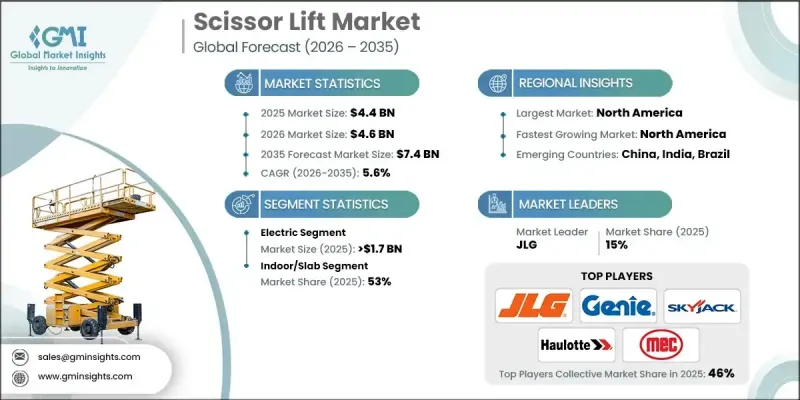
全球剪式升降機市場預計到 2025 年將達到 44 億美元,到 2035 年將達到 74 億美元,年複合成長率為 5.6%。
剪叉式升降機市場成長的驅動力主要來自建築、製造和維護等行業對剪式升降機的日益普及,在這些行業中,安全性和效率至關重要。企業越來越依賴剪式升降機的多功能性、易用性和在狹小空間內靈活操控的能力,從而為室內外作業提供有效的解決方案。市場關注正從純粹的功能性需求轉向能夠提升操作人員舒適度、安全性和環保性能的特性。對永續解決方案以及符合噪音和空氣品質法規的需求不斷成長,促使製造商進行創新,從而推出了設計更緊湊、配備更先進操作控制系統的電動和混合模式。此外,租賃服務也越來越受歡迎,為企業提供了經濟高效的選擇,無需長期持有設備。
| 市場覆蓋範圍 | |
|---|---|
| 開始年份 | 2025 |
| 預測期 | 2026-2035 |
| 初始市場規模 | 44億美元 |
| 市場規模預測 | 74億美元 |
| 複合年成長率 | 5.6% |
受日益嚴格的非道路排放氣體法規和人們對室內空氣品質日益成長的關注所推動,預計到2025年,電動剪式升降機市場規模將達到17億美元。這些因素預計將推動全電動剪式升降機的普及,而柴油和內燃機車型將保持小規模的穩定市場佔有率,價值成長有限。
到 2025 年,室內/平板安裝設備將佔 53% 的市場佔有率,這反映出其在倉庫、工廠、配銷中心等受控環境中的廣泛應用。對緊湊靈活、即使在不平坦的表面上也能提供穩定性和安全駕駛的平台的需求,使得室內應用成為領先的細分市場。
預計2025年,美國剪式升降機市場規模將達到13.4億美元,佔82%的市佔率。成熟的建築業、持續進行的基礎設施計劃以及先進設備的廣泛應用是推動市場需求的主要因素。大型租賃公司和國內製造商的大力支持也進一步促進了市場成長。
目錄
第1章:分析方法和範圍
第2章執行摘要
第3章業界考察
- 生態系分析
- 供應商情況
- 利潤率
- 每個階段的附加價值
- 影響價值鏈的因素
- 產業影響因素
- 促進要素
- 安全工作平台的需求日益成長
- 建築和基礎設施計劃成長
- 轉向電動和環保車型
- 產業潛在風險與挑戰
- 較高的初始投資和維護成本
- 惡劣環境下的運作限制
- 市場機遇
- 擴大租賃服務
- 智慧技術整合
- 促進要素
- 成長潛力分析
- 關鍵市場趨勢與顛覆性因素
- 未來市場趨勢
- 風險及緩解分析
- 科技與創新趨勢
- 當前技術趨勢
- 新興技術
- 價格趨勢
- 按地區
- 透過動力來源
- 監管環境
- 北美洲
- 歐洲
- 亞太地區
- 中東和非洲
- 拉丁美洲
- 波特五力分析
- PESTEL 分析
第4章 競爭情勢
- 介紹
- 公司市佔率分析
- 按地區
- 企業矩陣分析
- 主要企業的競爭分析
- 競爭定位矩陣
- 主要趨勢
- 企業合併(M&A)
- 夥伴關係與合作
- 新產品發布
- 擴張計劃
第5章 依動力來源的市場估算與預測(2022-2035 年)
- 電動剪式升降機
- 柴油/內燃機升降機
- 混合式剪式升降機
- 油壓剪式升降機
- 氣動剪剪式升降機
第6章 依運作環境分類的市場估計與預測(2022-2035 年)
- 室內/平板式剪式升降機
- 越野剪式升降機
- 多地形剪式升降機
第7章 按規模分類的市場估計和預測(2022-2035 年)
- 小型/微型剪式升降機
- 標準剪式升降機
- 大型剪式升降機
- 大型/高載重電梯
第8章 按平台高度分類的市場估算與預測(2022-2035 年)
- 低層作業車輛
- 中級工作車輛
- 高空作業平台
- 超高海拔作業車輛
第9章 依產能分類的市場估計與預測(2022-2035 年)
- 小型汽車
- 標準規格車輛
- 大型汽車
- 超大型汽車
第10章 依最終用途產業分類的市場估計與預測(2022-2035 年)
- 建築和基礎設施
- 倉儲/物流
- 製造業和工業
- 設施管理/房地產管理
- 零售和商業
- 航太航太
第11章 依分銷管道分類的市場估計與預測(2022-2035 年)
- 直銷
- 間接銷售
第12章 各地區市場估算與預測(2022-2035 年)
- 北美洲
- 美國
- 加拿大
- 歐洲
- 德國
- 英國
- 法國
- 義大利
- 西班牙
- 土耳其
- 亞太地區
- 中國
- 日本
- 印度
- 澳洲
- 韓國
- 拉丁美洲
- 巴西
- 墨西哥
- 阿根廷
- 中東和非洲
- 南非
- 沙烏地阿拉伯
- 阿拉伯聯合大公國
第13章:公司簡介
- JLG Industries, Inc.(Oshkosh Corporation)
- Terex Corporation(Genie Brand)
- Linamar Corporation(Skyjack Brand)
- Haulotte Group
- MEC Aerial Work Platforms
- Aichi Corporation(Toyota Industries)
- Manitou Group
- Zhejiang Dingli Machinery Co., Ltd.
- Hy-Brid Lifts
- AXCS Equipment
- Zoomlion Heavy Industry(Zoomlion Access)
- XCMG(Xuzhou Construction Machinery Group)
- Sinoboom Intelligent Equipment Co., Ltd.
- Almac SpA
- Hangcha(Hangzhou Hangcha Aerial Platform Equipment)
The Global Scissor Lift Market was valued at USD 4.4 billion in 2025 and is estimated to grow at a CAGR of 5.6% to reach USD 7.4 billion by 2035.
Growth in the market is driven by the expanding adoption of scissor lifts across industries such as construction, manufacturing, and maintenance, where safety and efficiency are top priorities. Companies are increasingly relying on scissor lifts for their versatility, ease of use, and ability to operate in confined spaces, offering effective solutions for both indoor and outdoor tasks. The market has shifted focus from purely functional requirements to features that enhance operator comfort, safety, and environmental performance. Rising demand for sustainable solutions and compliance with regulations regarding noise and air quality have pushed manufacturers to innovate, producing electric and hybrid models with more compact designs and advanced operator control systems. Additionally, rental services are gaining popularity, providing cost-effective options for businesses without long-term ownership commitments.
| Market Scope | |
|---|---|
| Start Year | 2025 |
| Forecast Year | 2026-2035 |
| Start Value | $4.4 Billion |
| Forecast Value | $7.4 Billion |
| CAGR | 5.6% |
The electric scissor lift segment reached USD 1.7 billion in 2025, driven by increasing regulations on off-road emissions and growing concerns about indoor air quality. These factors are encouraging the adoption of fully electric scissor lifts, while diesel and internal combustion models are expected to maintain a smaller, stable presence with limited value growth.
The indoor/slab segment held a 53% share in 2025, reflecting its extensive use in controlled environments such as warehouses, factories, and distribution centers. The need for compact, agile platforms that offer stability and safe navigation across uneven surfaces makes indoor applications the dominant segment.
U.S. Scissor Lift Market held 82% share, generating USD 1.34 billion in 2025. High demand is supported by a mature construction sector, ongoing infrastructure projects, and the availability of advanced equipment. Strong support from major rental companies and domestic manufacturers has further reinforced market growth.
Key players operating in the Global Scissor Lift Market include JLG Industries, Inc. (Oshkosh Corporation), Terex Corporation (Genie Brand), Linamar Corporation (Skyjack Brand), Haulotte Group, MEC Aerial Work Platforms, Aichi Corporation (Toyota Industries), Manitou Group, Zhejiang Dingli Machinery Co., Ltd., Hy-Brid Lifts, AXCS Equipment, Zoomlion Heavy Industry (Zoomlion Access), XCMG (Xuzhou Construction Machinery Group), Sinoboom Intelligent Equipment Co., Ltd., Almac S.p.A., and Hangcha (Hangzhou Hangcha Aerial Platform Equipment). To strengthen their foothold, companies in the Scissor Lift Market are focusing on innovation and sustainability, developing electric and hybrid models with advanced control systems and compact designs to meet regulatory and environmental demands. Strategic partnerships with construction and industrial service providers expand distribution networks and increase rental opportunities. Companies are also investing in R&D to enhance safety features, improve operator comfort, and optimize platform versatility.
Table of Contents
Chapter 1 Methodology and Scope
- 1.1 Market scope and definition
- 1.2 Research design
- 1.2.1 Research approach
- 1.2.2 Data collection methods
- 1.3 Data mining sources
- 1.3.1 Global
- 1.3.2 Regional/Country
- 1.4 Base estimates and calculations
- 1.4.1 Base year calculation
- 1.4.2 Key trends for market estimation
- 1.5 Primary research and validation
- 1.5.1 Primary sources
- 1.6 Forecast model
- 1.7 Research assumptions and limitations
Chapter 2 Executive Summary
- 2.1 Industry 3600 synopsis
- 2.2 Key market trends
- 2.2.1 By regional
- 2.2.2 By power source
- 2.2.3 By operating environment
- 2.2.4 By size
- 2.2.5 By platform height
- 2.2.6 By capacity/load rating
- 2.2.7 By end use industry
- 2.2.8 By distribution channel
- 2.3 CXO perspectives: Strategic imperatives
- 2.3.1 Key decision points for industry executives
- 2.3.2 Critical success factors for market players
- 2.4 Future outlook and strategic recommendations
Chapter 3 Industry Insights
- 3.1 Industry ecosystem analysis
- 3.1.1 Supplier landscape
- 3.1.2 Profit margin
- 3.1.3 Value addition at each stage
- 3.1.4 Factor affecting the value chain
- 3.2 Industry impact forces
- 3.2.1 Growth drivers
- 3.2.1.1 Rising demand for safe working platforms
- 3.2.1.2 Growth in construction and infrastructure projects
- 3.2.1.3 Shift toward electric and eco-friendly models
- 3.2.2 Industry pitfalls & challenges
- 3.2.2.1 High initial investment and maintenance costs
- 3.2.2.2 Operational limitations in extreme conditions
- 3.2.3 Opportunities
- 3.2.3.1 Expansion of rental services
- 3.2.3.2 Integration of smart technologies
- 3.2.1 Growth drivers
- 3.3 Growth potential analysis
- 3.4 Major market trends and disruptions
- 3.5 Future market trends
- 3.6 Risk and mitigation Analysis
- 3.7 Technology and innovation landscape
- 3.7.1 Current technological trends
- 3.7.2 Emerging technologies
- 3.8 Price trends
- 3.8.1 By region
- 3.8.2 By power source
- 3.9 Regulatory landscape
- 3.9.1 North America
- 3.9.2 Europe
- 3.9.3 Asia-Pacific
- 3.9.4 Middle East and Africa
- 3.9.5 Latin America
- 3.10 Porter's analysis
- 3.11 PESTEL analysis
Chapter 4 Competitive Landscape, 2025
- 4.1 Introduction
- 4.2 Company market share analysis
- 4.2.1 By region
- 4.2.1.1 North America
- 4.2.1.2 Europe
- 4.2.1.3 Asia Pacific
- 4.2.1.4 Latin America
- 4.2.1.5 Middle East and Africa
- 4.2.1 By region
- 4.3 Company matrix analysis
- 4.4 Competitive analysis of major market players
- 4.5 Competitive positioning matrix
- 4.6 Key developments
- 4.6.1 Mergers & acquisitions
- 4.6.2 Partnerships & collaborations
- 4.6.3 New product launches
- 4.6.4 Expansion plans
Chapter 5 Market Estimates & Forecast, By Power Source, 2022-2035 (USD Billion) (Thousand Units)
- 5.1 Key trends
- 5.2 Electric scissor lifts
- 5.3 Diesel/internal combustion engine lifts
- 5.4 Hybrid scissor lifts
- 5.5 Hydraulic scissor lifts
- 5.6 Pneumatic scissor lifts
Chapter 6 Market Estimates & Forecast, By Operating Environment, 2022-2035 (USD Billion) (Thousand Units)
- 6.1 Key trends
- 6.2 Indoor/slab scissor lifts
- 6.3 Rough terrain scissor lifts
- 6.4 Multi-terrain scissor lifts
Chapter 7 Market Estimates & Forecast, By Size, 2022-2035 (USD Billion) (Thousand Units)
- 7.1 Key trends
- 7.2 Compact/micro scissor lifts
- 7.3 Standard scissor lifts
- 7.4 Large scissor lifts
- 7.5 Heavy-duty/high-capacity lifts
Chapter 8 Market Estimates & Forecast, By Platform Height, 2022-2035 (USD Billion) (Thousand Units)
- 8.1 Key trends
- 8.2 Low-level access
- 8.3 Mid-level access
- 8.4 High-level access
- 8.5 Ultra-high access
Chapter 9 Market Estimates & Forecast, By Capacity, 2022-2035 (USD Billion) (Thousand Units)
- 9.1 Key trends
- 9.2 Light-duty
- 9.3 Standard-duty
- 9.4 Heavy-duty
- 9.5 Extra heavy-duty
Chapter 10 Market Estimates & Forecast, By End Use Industry, 2022-2035 (USD Billion) (Thousand Units)
- 10.1 Key trends
- 10.2 Construction & infrastructure
- 10.3 Warehousing & logistics
- 10.4 Manufacturing & industrial
- 10.5 Facilities maintenance & property management
- 10.6 Retail & commercial
- 10.7 Aerospace & aviation
Chapter 11 Market Estimates & Forecast, By Distribution Channel, 2022-2035 (USD Billion) (Thousand Units)
- 11.1 Key trends
- 11.2 Direct sales
- 11.3 Indirect sales
Chapter 12 Market Estimates and Forecast, By Region, 2022 - 2035 (USD Billion) (Thousand Units)
- 12.1 Key trends
- 12.2 North America
- 12.2.1 U.S.
- 12.2.2 Canada
- 12.3 Europe
- 12.3.1 Germany
- 12.3.2 UK
- 12.3.3 France
- 12.3.4 Italy
- 12.3.5 Spain
- 12.3.6 Turkey
- 12.4 Asia Pacific
- 12.4.1 China
- 12.4.2 Japan
- 12.4.3 India
- 12.4.4 Australia
- 12.4.5 South Korea
- 12.5 Latin America
- 12.5.1 Brazil
- 12.5.2 Mexico
- 12.5.3 Argentina
- 12.6 Middle East and Africa
- 12.6.1 South Africa
- 12.6.2 Saudi Arabia
- 12.6.3 UAE
Chapter 13 Company Profiles
- 13.1 JLG Industries, Inc. (Oshkosh Corporation)
- 13.2 Terex Corporation (Genie Brand)
- 13.3 Linamar Corporation (Skyjack Brand)
- 13.4 Haulotte Group
- 13.5 MEC Aerial Work Platforms
- 13.6 Aichi Corporation (Toyota Industries)
- 13.7 Manitou Group
- 13.8 Zhejiang Dingli Machinery Co., Ltd.
- 13.9 Hy-Brid Lifts
- 13.10 AXCS Equipment
- 13.11 Zoomlion Heavy Industry (Zoomlion Access)
- 13.12 XCMG (Xuzhou Construction Machinery Group)
- 13.13 Sinoboom Intelligent Equipment Co., Ltd.
- 13.14 Almac S.p.A.
- 13.15 Hangcha (Hangzhou Hangcha Aerial Platform Equipment)

 平板剪式升降機市場:依動力來源、類型、工作高度、應用、最終用戶、銷售管道,全球預測(2026-2032年)
 全球剪式升降機市場規模、佔有率、趨勢和成長分析報告(2026-2034)
 2026年全球剪式升降機市場報告
 剪叉式升降機市場 - 全球產業規模、佔有率、趨勢、機會和預測,按類型、平台高度、應用、地區和競爭格局分類,2021-2031年預測
 剪式升降機市場規模、佔有率、成長分析、按類型、舉升高度、最終用戶、按地區 - 產業預測,2025-2032
 剪式升降機市場規模、佔有率、趨勢分析報告:按引擎類型、舉升高度、最終應用、按地區、細分市場預測,2025-2030 年