


 |
市場調查報告書
商品編碼
1913355
電弧焊接設備市場機會、成長要素、產業趨勢分析及2026年至2035年預測Arc Welding Equipment Market Opportunity, Growth Drivers, Industry Trend Analysis, and Forecast 2026 - 2035 |
||||||

全球電弧焊接設備市場預計到 2025 年將達到 48 億美元,到 2035 年將達到 92 億美元,年複合成長率為 6.9%。
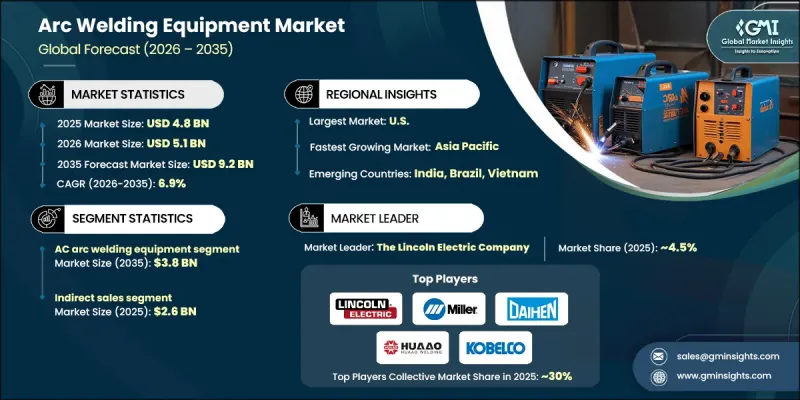
規範職場安全和設備設計的法規結構對依賴電弧焊接作業的各行業的需求有顯著影響。對電壓閾值、電氣絕緣、接地通訊協定和氣流標準的嚴格要求推動了合規焊接系統和安全解決方案的普及。人們對焊接相關健康風險的日益關注,強化了對適當通風、排氣控制和呼吸防護的必要性。職業安全法規強制要求使用耐熱、防火和耐電的防護設備,並規定了可視性和臉部防護的性能標準。這些規定共同影響設備設計、設施維修和採購決策。隨著製造商和最終用戶將合規性、作業安全和工人保護放在首位,對先進電弧焊接設備的需求持續成長。市場成長反映了對更安全、合規技術的持續投資,這些技術在提高生產力的同時,也降低了長期的職業風險。
| 市場覆蓋範圍 | |
|---|---|
| 開始年份 | 2025 |
| 預測年份 | 2026-2035 |
| 起始值 | 48億美元 |
| 預測金額 | 92億美元 |
| 複合年成長率 | 6.9% |
到2025年,交流電電弧焊接設備將佔據40.3%的市場佔有率,預計到2035年將以7%的複合年成長率成長。此細分市場受益於成本競爭力以及在各種電氣條件下都能穩定運作的特性。開路電壓等級的監管限制直接影響產品設計,促使製造商開發符合既定安全標準的設備,以滿足手動和自動應用的需求。
到2025年,間接銷售管道將創造26億美元的銷售額,佔總銷售額的55%。此通路支援標準化產品、替換零件和耗材的廣泛分銷,同時將業務拓展至製造商尚未直接服務的地區和客戶群。間接通路具有擴充性、柔軟性和成本效益,尤其是在次市場和小規模的營運環境中。
預計到2025年,北美電弧焊接設備市場將佔據38.2%的市場佔有率,並在2035年之前以7.1%的複合年成長率成長。強大的製造能力、嚴格的安全標準執行以及持續的設備升級鞏固了該地區的市場主導地位。監管要求規定了詳細的技術規範,這些規範直接影響採購行為和設備更換週期。
目錄
第1章調查方法和範圍
第2章執行摘要
第3章業界考察
- 生態系分析
- 供應商情況
- 利潤率
- 每個階段的附加價值
- 影響價值鏈的因素
- 產業影響因素
- 促進要素
- 嚴格的安全規章
- 永續鋼鐵生產和基礎設施發展
- 對健康風險意識的提高促進了更安全技術的進步。
- 產業潛在風險與挑戰
- 高昂的資本和整合成本
- 工程師短缺和合規負擔
- 機會
- 擴大可再生能源和綠色基礎設施計劃
- 開發人工智慧驅動和物聯網賦能的焊接解決方案
- 促進要素
- 成長潛力分析
- 未來市場趨勢
- 價格趨勢分析
- 區域和焊接技術
- 科技與創新趨勢
- 目前技術
- 新興技術
- 法律規範
- 按地區
- 波特五力分析
- PESTEL 分析
第4章 競爭情勢
- 介紹
- 公司市佔率分析
- 按地區
- 企業矩陣分析
- 主要市場公司的競爭分析
- 競爭定位矩陣
- 產品系列基準測試
- 重大進展
- 併購
- 夥伴關係與合作
- 新產品發布
- 擴張計劃
第5章 焊接技術市場估算與預測(2022-2035)
- 手工電電弧焊接(SMAW)
- 氣體保護金屬極電弧焊接(GMAW/MIG)
- 藥芯焊絲電弧焊接(FCAW)
- 鎢電弧焊接(GTAW)
- 潛弧焊接(SAW)
- 其他(等離子電弧焊接(PAW)等)
第6章 依能源類型分類的市場估計與預測,2022-2035年
- 交流電電弧焊接設備
- 直流電電弧焊接設備
- 其他
7. 2022-2035年按最終用途產業分類的市場估算與預測
- 汽車/運輸設備
- 重工業/製造業
- 建築和基礎設施
- 造船和海洋工業
- 航太與國防
- 能源與電力
- 石油和天然氣
- 其他
第8章 按分銷管道分類的市場估算與預測,2022-2035年
- 直銷
- 間接銷售
第9章 2022-2035年各地區市場估算與預測
- 北美洲
- 美國
- 加拿大
- 歐洲
- 德國
- 英國
- 法國
- 義大利
- 西班牙
- 亞太地區
- 中國
- 印度
- 日本
- 韓國
- 澳洲
- 拉丁美洲
- 巴西
- 墨西哥
- 阿根廷
- 中東和非洲
- 阿拉伯聯合大公國
- 沙烏地阿拉伯
- 南非
第10章:公司簡介
- Ador Welding
- Amada Miyachi America
- Arcon Welding Equipment
- CLOOS Welding Equipment
- Daihen
- Denyo
- ESAB
- Fronius International
- Illinois Tool Works(ITW Welding)
- Jinan Huaao Electric Welding Machine
- Kobe Steel(Kobelco)
- Miller Electric Mfg.(part of ITW Welding)
- OTC Daihen
- Panasonic Welding Systems
- The Lincoln Electric Company
The Global Arc Welding Equipment Market was valued at USD 4.8 billion in 2025 and is estimated to grow at a CAGR of 6.9% to reach USD 9.2 billion by 2035.
Regulatory frameworks governing workplace safety and equipment design strongly shape demand across industries that rely on arc welding operations. Strict requirements related to voltage thresholds, electrical insulation, grounding protocols, and airflow standards have increased the adoption of compliant welding systems and supporting safety solutions. Growing recognition of welding-related health risks has further intensified the need for proper ventilation, exhaust management, and respiratory protection. Occupational safety regulations mandate protective equipment with resistance to heat, fire, and electrical exposure, while also specifying performance standards for visibility and facial protection. These rules collectively influence equipment engineering, facility upgrades, and purchasing decisions. As manufacturers and end users prioritize compliance, operational safety, and workforce protection, demand for advanced arc welding equipment continues to rise. The market's growth reflects sustained investment in safer, regulation-aligned technologies that support productivity while reducing long-term occupational risk.
| Market Scope | |
|---|---|
| Start Year | 2025 |
| Forecast Year | 2026-2035 |
| Start Value | $4.8 Billion |
| Forecast Value | $9.2 Billion |
| CAGR | 6.9% |
In 2025, the AC arc welding equipment accounted for a 40.3% share and is expected to grow at a CAGR of 7% through 2035. This segment benefits from cost competitiveness and operational characteristics that support stable performance under varying electrical conditions. Regulatory limits on open-circuit voltage levels directly influence product design, prompting manufacturers to align equipment development with established safety thresholds for both manual and automatic applications.
The indirect sales channel generated USD 2.6 billion in 2025, representing a 55% share. This route supports the broad distribution of standardized products, replacement components, and consumables while extending reach into regions and customer groups not served directly by manufacturers. Indirect channels offer scalability, flexibility, and cost efficiency, particularly in secondary markets and smaller operational settings.
North America Arc Welding Equipment Market held a 38.2% share in 2025 and is forecast to grow at a CAGR of 7.1% through 2035. Strong manufacturing capacity, strict enforcement of safety standards, and consistent equipment upgrades support regional dominance. Regulatory mandates establish detailed technical requirements that directly influence purchasing behavior and equipment replacement cycles.
Key companies active in the Global Arc Welding Equipment Market include The Lincoln Electric Company, ESAB, Fronius International, Panasonic Welding Systems, Illinois Tool Works, Miller Electric Mfg., OTC Daihen, Daihen, Denyo, Ador Welding, CLOOS Welding Equipment, Amada Miyachi America, Kobe Steel, Jinan Huaao Electric Welding Machine, and Arcon Welding Equipment. Companies in the Global Arc Welding Equipment Market strengthen their competitive position through continuous product innovation, regulatory compliance, and expansion of distribution networks. Manufacturers invest in safety-focused engineering, energy efficiency, and digital monitoring capabilities to meet evolving industry standards. Strategic partnerships with distributors enhance market reach, while localized manufacturing improves supply reliability. After-sales service, training support, and consumables integration help build long-term customer relationships.
Table of Contents
Chapter 1 Methodology & Scope
- 1.1 Market scope and definition
- 1.2 Research design
- 1.2.1 Research approach
- 1.2.2 Data collection methods
- 1.3 Data mining sources
- 1.3.1 Global
- 1.3.2 Regional/Country
- 1.4 Base estimates and calculations
- 1.4.1 Base year calculation
- 1.4.2 Key trends for market estimation
- 1.5 Primary research and validation
- 1.5.1 Primary sources
- 1.6 Forecast model
- 1.7 Research assumptions and limitations
Chapter 2 Executive Summary
- 2.1 Industry 3600 synopsis
- 2.2 Key market trends
- 2.2.1 Regional trends
- 2.2.2 Welding technology trends
- 2.2.3 Power source trends
- 2.2.4 End use industry trends
- 2.2.5 Distribution channel trends
- 2.3 CXO perspective: Strategic imperatives
- 2.3.1 Key decision points for industry executives
- 2.3.2 Critical success factors for market players
- 2.4 Future outlook and strategic recommendations
- 2.5 Strategic recommendations
- 2.5.1 Supply chain diversification strategy
- 2.5.2 Product portfolio enhancement
- 2.5.3 Partnership and alliance opportunities
- 2.5.4 Cost management and pricing strategy
- 2.6 Decision framework
- 2.6.1 Investment priority matrix
- 2.6.2 ROI analysis
Chapter 3 Industry Insights
- 3.1 Industry ecosystem analysis
- 3.1.1 Supplier Landscape
- 3.1.2 Profit Margin
- 3.1.3 Value addition at each stage
- 3.1.4 Factor affecting the value chain
- 3.2 Industry impact forces
- 3.2.1 Growth drivers
- 3.2.1.1 Stringent safety regulations
- 3.2.1.2 Sustained steel production and infrastructure build-out
- 3.2.1.3 Health risk awareness encouraging safer technologies
- 3.2.2 Industry pitfalls & challenges
- 3.2.2.1 High capital and integration costs
- 3.2.2.2 Technical skills shortage and compliance burden
- 3.2.3 Opportunities
- 3.2.3.1 Expansion of renewable energy and green infrastructure projects
- 3.2.3.2 Development of AI-driven and IoT enabled welding solutions
- 3.2.1 Growth drivers
- 3.3 Growth potential analysis
- 3.4 Future market trends
- 3.5 Price trend analysis
- 3.5.1 Region and welding technology
- 3.6 Technology and innovation landscape
- 3.6.1 Current technology
- 3.6.2 Emerging technologies
- 3.7 Regulatory framework
- 3.7.1 By region
- 3.7.1.1 North America
- 3.7.1.2 Europe
- 3.7.1.3 Asia Pacific
- 3.7.1.4 Latin America
- 3.7.1.5 Middle East and Africa
- 3.7.1 By region
- 3.8 Porter's five forces analysis
- 3.9 PESTEL analysis
Chapter 4 Competitive Landscape, 2025
- 4.1 Introduction
- 4.2 Company market share analysis
- 4.2.1 By Region
- 4.2.1.1 North America
- 4.2.1.2 Europe
- 4.2.1.3 Asia Pacific
- 4.2.1.4 Latin America
- 4.2.1.5 Middle East and Africa
- 4.2.1 By Region
- 4.3 Company matrix analysis
- 4.4 Competitive analysis of major market players
- 4.5 Competitive positioning matrix
- 4.6 Product portfolio benchmarking
- 4.7 Key developments
- 4.7.1 Mergers & acquisitions
- 4.7.2 Partnerships & collaborations
- 4.7.3 New Product Launches
- 4.7.4 Expansion Plans
Chapter 5 Market Estimates & Forecast, By Welding Technology 2022 - 2035 (USD Billion) (Thousand Units)
- 5.1 Key trends
- 5.2 Shielded metal arc welding (SMAW)
- 5.3 Gas metal arc welding (GMAW/MIG)
- 5.4 Flux-cored arc welding (FCAW)
- 5.5 Gas tungsten arc welding (GTAW)
- 5.6 Submerged arc welding (SAW)
- 5.7 Others (plasma arc welding (PAW), etc.)
Chapter 6 Market Estimates & Forecast, By Power Source, 2022 - 2035 (USD Billion) (Thousand Units)
- 6.1 Key trends
- 6.2 AC arc welding equipment
- 6.3 DC arc welding equipment
- 6.4 Others
Chapter 7 Market Estimates & Forecast, By End Use Industry, 2022 - 2035 (USD Billion) (Thousand Units)
- 7.1 Key trends
- 7.2 Automotive & transportation
- 7.3 Heavy industry & fabrication
- 7.4 Construction & infrastructure
- 7.5 Shipbuilding & marine
- 7.6 Aerospace & defense
- 7.7 Energy and power
- 7.8 Oil and gas
- 7.9 Others
Chapter 8 Market Estimates & Forecast, By Distribution Channel, 2022 - 2035, (USD Billion) (Thousand Units)
- 8.1 Key trends
- 8.2 Direct sales
- 8.3 Indirect sales
Chapter 9 Market Estimates & Forecast, By Region, 2022 - 2035, (USD Billion) (Thousand Units)
- 9.1 Key trends
- 9.2 North America
- 9.2.1 U.S.
- 9.2.2 Canada
- 9.3 Europe
- 9.3.1 Germany
- 9.3.2 U.K.
- 9.3.3 France
- 9.3.4 Italy
- 9.3.5 Spain
- 9.4 Asia Pacific
- 9.4.1 China
- 9.4.2 India
- 9.4.3 Japan
- 9.4.4 South Korea
- 9.4.5 Australia
- 9.5 Latin America
- 9.5.1 Brazil
- 9.5.2 Mexico
- 9.5.3 Argentina
- 9.6 MEA
- 9.6.1 UAE
- 9.6.2 Saudi Arabia
- 9.6.3 South Africa
Chapter 10 Company Profiles (Business Overview, Financial Data, Product Landscape, Strategic Outlook, SWOT Analysis)
- 10.1 Ador Welding
- 10.2 Amada Miyachi America
- 10.3 Arcon Welding Equipment
- 10.4 CLOOS Welding Equipment
- 10.5 Daihen
- 10.6 Denyo
- 10.7 ESAB
- 10.8 Fronius International
- 10.9 Illinois Tool Works (ITW Welding)
- 10.10 Jinan Huaao Electric Welding Machine
- 10.11 Kobe Steel (Kobelco)
- 10.12 Miller Electric Mfg. (part of ITW Welding)
- 10.13 OTC Daihen
- 10.14 Panasonic Welding Systems
- 10.15 The Lincoln Electric Company

 逆變式焊接機市場分析及預測(至2035年):類型、產品、技術、組件、應用、過程、最終用戶、功能、安裝方式
 電弧焊接市場規模、佔有率和趨勢分析報告:按產品類型、最終用途、地區和細分市場預測(2026-2033 年)
 電弧焊接設備市場:2026-2032年全球市場預測(依製程、設備類型、焊接材料、電流類型、產品類型、終端用戶產業及分銷管道分類)
 逆變焊接設備的全球市場美國電弧焊接設備市場規模、佔有率和趨勢分析報告:按類型、產品、最終用途和細分市場預測,2025-2033 年電弧焊接設備市場規模、佔有率和趨勢分析報告:按類型、產品、最終用途、地區和細分市場預測,2025 年至 2033 年全球電弧焊接逆變器市場
 2025-2029年全球電弧焊接機器人市場
 電弧焊接逆變器市場報告:趨勢、預測和競爭分析(至 2031 年)
 全球弧焊逆變器市場規模(按類型、應用、地區、範圍和預測)